

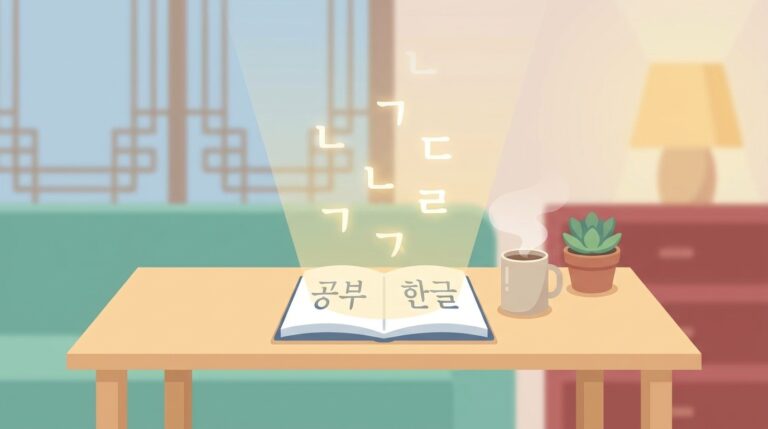
Write Book Reviews Like a Native K-Blogger: Elevate Your Korean to C1
Phase 1: Empathy (스토리 몰입형 오프닝)
안녕하세요! Daily Hangul (매일한글) Editor here, your ultimate companion in mastering Korean cultural nuances! 🌸
Have you ever scrolled through Korean blogging platforms like Naver Blog or Brunch and felt a wave of inspiration? You see beautifully styled photos of a warm latte next to a critically acclaimed novel, accompanied by deep, emotionally resonant reviews. You think, “I want to share my thoughts on this amazing book in Korean too!”
But as you open a blank post, you hit a wall. Translating your thoughts directly from English makes your review sound like a dry, clinical school report. You want to express how a novel “lingers in your heart” or how the author’s words “deeply resonated with you,” but the textbook phrases feel incredibly stiff.
Don’t worry! This is a very common pain point for advanced C1 learners. Writing about literature in Korean requires a shift from analytical English logic to emotional and evocative Korean phrasing. Today, we are going to bridge that gap. By the end of this guide, you will be able to write book reviews that blend seamlessly into the Korean “Book-stagram” (#북스타그램) community! Let’s dive in! 📖✨
Phase 2: Key Expressions (핵심 표현 3선 심층 분석)
To write like a native blogger, you need to master words that evoke deep sentiment (Gam-seong). Here are three must-have C1-level expressions for your book reviews.
1. 여운이 남다 (yeo-un-i nam-da)
- Pronunciation: Yuh-oon-ee nahm-dah (Think of “yeo-un” as a gentle echo that remains after a bell is rung)
- Meaning: To leave a lasting impression; a lingering feeling/aftertaste.
- K-Culture Moment: Often used in book blogs and film reviews to describe that bittersweet, thoughtful state you are left in after finishing a masterpiece (like the novel Almond or Pachinko).
- Editor’s Insight: While English speakers say a book “haunts” them or “stays with them,” Koreans focus on the Yeo-un (여운 / lingering resonance)—the emotional vibrations that stay in your heart long after the book is closed.
- Situation Spectrum: Casual ✅ | Semi-formal ✅ | Formal ✅
- 🤔 Think About It: How does your native language describe the feeling of not being able to stop thinking about a book? Is it physical (like “haunting”) or more abstract like the Korean “echo” (Yeo-un)?
2. 가슴에 와닿다 (ga-seum-e wa-dat-da)
- Pronunciation: Gah-seum-eh wah-daht-dah (Liaison makes “와닿다” sound like wah-daht-tah)
- Meaning: To touch one’s heart; to deeply resonate.
- K-Culture Moment: Used when highlighting a specific quote or passage that felt incredibly relatable or comforting, a staple phrase in the popular K-healing essay genre (e.g., I Want to Die but I Want to Eat Tteokbokki).
- Editor’s Insight: Literally meaning “to come and touch the chest/heart,” this is much warmer and more natural than simply saying “인상 깊었다” (it was impressive).
- Situation Spectrum: Casual ✅ | Semi-formal ✅ | Formal ⚠️ (Use ‘마음에 와닿다’ for highly formal essays)
- 🤔 Think About It: In Korean, emotional resonance physically “touches the chest.” How does this physical metaphor compare to “resonating” in your language?
3. 활자 너머의 (hwal-ja neo-meo-ui)
- Pronunciation: Hwal-jah nuh-muh-ui (The ‘ui’ sound is pronounced like eh when used as a possessive particle here)
- Meaning: Beyond the printed letters/words.
- K-Culture Moment: This is a highly sophisticated, literary expression used by Korean book influencers to describe reading between the lines or connecting deeply with the author’s unspoken emotions.
- Editor’s Insight: Hwal-ja (활자) means “movable type” or “printed letters.” Using this phrase shows a deep appreciation for the art of writing itself.
- Situation Spectrum: Casual ⚠️ (Too poetic for text messages) | Semi-formal ✅ | Formal ✅
- 🤔 Think About It: Why do you think Korean readers prefer poetic expressions like “beyond the printed type” over the more direct “reading between the lines”?
Phase 3: Textbook vs. Real Korean (교과서 한국어 vs 진짜 한국어)
Let’s upgrade your textbook sentences into organic, blog-ready Korean!
Situation 1: Saying “The book was interesting and I recommend it.”
- 📖 교과서 한국어: 이 책은 재미있어서 추천합니다.
(I recommend this book because it is interesting.) - 🗣️ 진짜 한국어: 가독성이 좋아서 단숨에 읽어 내려갔고, 많은 분들께 인생 책으로 권해드리고 싶어요.
(It was such an easy read that I devoured it in one sitting, and I highly recommend it as a ‘life book’ to many.) - 💡 왜 다를까? Advanced reviewers use Ga-dok-seong (가독성 / readability) and In-saeng chaek (인생 책 / life-altering book) to show real passion rather than using the generic word jae-mi-it-da (fun/interesting).
Situation 2: Saying “I cried because it was sad.”
- 📖 교과서 한국어: 내용이 슬퍼서 울었습니다.
(I cried because the content was sad.) - 🗣️ 진짜 한국어: 잔잔한 울림 끝에 결국 눈시울이 붉어졌습니다.
(After a gentle, quiet resonance, my eyes eventually welled up with tears.) - 💡 왜 다를까? Korean book bloggers love understated, evocative expressions. Instead of outright saying “I cried” (울었다), they use poetic visuals like “my eye rims turned red” (눈시울이 붉어지다).
Phase 4: K-Culture Deep Dive & Non-verbal Manners
4-1. The Aesthetics of “Book-stagram” (#북스타그램)
When posting a book review on Korean social media, visuals and emotional courtesy are key.
* Non-verbal etiquette: When taking photos of book pages, it is polite to cover major spoilers with a pretty bookmark, a dried flower, or a coffee cup. Blurring out text or only showing a small snippet is considered polite to the author and future readers.
* The Tone: Write as if you are whispering in a cozy indie bookstore. Humility and emotional sensitivity are highly valued in the Korean reading community.
4-2. The “Healing Essay” Phenomenon (힐링 에세이)
If you visit any bookstore in Seoul (like Kyobo Book Centre in Gwanghwamun), you’ll see massive displays of “Healing Essays” (힐링 에세이). These are short, beautifully illustrated reflective essays focusing on self-love, burnout, and mental health. Writing reviews for these books requires using words of empathy (gong-gam), solace (wi-ro), and healing (hil-ring).
Phase 5: Interactive Roleplay Scenario
Meet Ji-won (지원), a passionate Korean book blogger who runs a popular literary blog. You are chatting with her in a cozy cafe in Sangsu-dong about a book you both recently finished.
💬 Dialogue (8 Turns)
- 지원: “지수 씨, 저번에 제가 빌려드린 소설책 다 읽으셨어요? 어떠셨는지 너무 궁금해요!”
(Ji-soo, did you finish reading the novel I lent you last time? I’m so curious about what you thought!) - 지수 (You): “
🎭 (책을 소중히 어루만지며)네, 어제 밤새워서 다 읽었어요! 마지막 장을 덮는데 정말 여운이 길게 남더라고요.”
(Yes, I stayed up all night and finished it! As I closed the final page, it really left a long, lingering resonance.) - 지원: “그쵸! 저도 그 책 마지막 결말 부분이 계속 머릿속 맴돌아서 며칠 동안 다른 책을 못 읽었어요.”
(Right! The ending kept spinning in my head too, so I couldn’t read any other books for days.) - 지수 (You): “
🎭 (고개를 끄덕이며)맞아요. 특히 주인공이 어머니께 편지를 쓰는 장면은 정말 가슴에 깊이 와닿았어요.”
(Exactly. Especially the scene where the main character writes a letter to his mother—it really touched my heart deeply.) - 지원: “그 대사, 정말 명작이죠. 작가님이 감정을 참 덤덤하면서도 섬세하게 잘 표현하시는 것 같아요.”
(That dialogue is truly a masterpiece. I think the author expresses emotions so calmly yet delicately.) - 지수 (You): “
🎭 (눈을 반짝이며)맞아요. 활자 너머의 진심이 그대로 느껴지는 기분이었어요.”
(Yes. It felt as though the sincerity beyond the printed letters was felt completely.) - 지원: “우와, ‘활자 너머의 진심’이라니! 지수 씨 완전 프로 서평가 같은데요? 블로그에 이대로 쓰시면 조회수 폭발할 것 같아요!”
(Wow, ‘sincerity beyond the printed letters’! Ji-soo, you sound like a professional book reviewer! If you write this on your blog, your views will explode!) - 지수 (You): “
🎭 (수줍게 웃으며)에이, 지원 씨 덕분에 좋은 책을 만나서 감상평이 술술 나오는 거예요!”
(Aw, it’s all because I found such a great book thanks to you, Ji-won, that the review is flowing so smoothly!)
🔀 Interactive Choice Point
How would you reply to Ji-won’s suggestion to post your review on your blog?
- Option A: “에이, 제 한국어 실력으로는 블로그 글 쓰기에는 아직 멀었어요.”
- Option B: “안 그래도 오늘 저녁에 블로그에 포스팅해 보려고요! 제목은 뭐가 좋을까요?”
- Option C: “네, 꼭 파워블로거가 되어서 사람들에게 제 실력을 자랑하고 싶어요.”
💡 Feedback on Your Choice:
- Option A (Risk): Humility is good, but being too self-deprecating might kill the exciting momentum of the conversation.
- Option B (Best): Perfect! It shows enthusiasm, takes her compliment gracefully, and invites her to continue the friendly collaboration by asking for title advice.
- Option C (Bad): Too direct and self-centered. It clashes with the warm, community-focused, and humble vibes of the Korean literary scene.
Phase 6: 10-Second Emotion Shadowing Drill
Read these sentences aloud with the correct pauses (/) and emotional tone!
[🥺 감동받아 울컥한 듯한 어조로]
마지막 페이지를 / 덮는 순간, / 말로 표현할 수 없는 / 여운이 남았습니다.
(The moment I closed the last page, / an indescribable / lingering resonance remained.)-
[💖 진심 가득하고 따뜻한 어조로]
작가의 따뜻한 문장들이 / 지친 제 마음에 / 가만히 와닿았어요.
(The author’s warm sentences / gently touched / my exhausted heart.)
Phase 7: K-Culture Mini-Dictionary
- 인생 책 (In-saeng Chaek): “Life Book.” The ultimate book that changed your outlook on life.
- 덕통사고 (Deok-tong-sa-go): “Fan-accident.” Suddenly and unexpectedly becoming an intense fan of something (or an author/book genre).
- 가독성 (Ga-dok-seong): “Readability.” Used to describe how smoothly and easily a book can be read.
- 소장 가치 (So-jang Ga-chi): “Collectible Value.” A book so beautiful or meaningful that you must buy the physical copy to keep forever on your shelf.
Phase 8: Traveler’s Survival Kit
If you love books, you must visit Korea’s independent bookstores (Dong-ne Chaek-bang).
Survival Expressions TOP 3
- “요즘 가장 잘 나가는 소설 추천해 주실 수 있나요?”
(Yo-jeum ga-jang jal na-ga-neun so-seol chu-cheon-hae ju-sil su in-na-yo?)
👉 “Could you recommend the most popular novel these days?” - “이 책 선물할 건데, 포장 가능할까요?”
(I chaek seon-mul-hal geon-de, po-jang ga-neung-hal-kka-yo?)
👉 “I’m going to gift this book, is wrapping available?” - “혹시 이 책 재고가 남아 있나요?”
(Hok-si i chaek jae-go-ga na-ma in-na-yo?)
👉 “By any chance, is this book in stock?”
📌 Editor’s Travel Note:
Skip the giant corporate stores for a day and search for “독립서점” (Independent Bookstore) on Naver Map (네이버 지도 App). These small, curated shops in neighborhoods like Mangwon-dong or Yeonhui-dong offer cozy vibes, unique indie books, and often serve amazing coffee!
Phase 9: ” 한 발 더 깊이” (Deep Thought Essay)
In Korea, writing a book review is often seen as an act of “mind-cleansing” (Ma-eum Jeong-ri). Unlike Western literary criticism, which historically values objective analysis, heavy theory, and sharp critique, Korean blog reviews often lean heavily toward personal emotional resonance (Gong-gam). A book is not just an object of study; it is a companion that walks with you through a specific season of your life. That is why the best Korean book reviews read like quiet, intimate diary entries.
💬 Your Turn: What is your ultimate “인생 책” (Life Book)? How would you describe its “여운” (lingering feeling) in the comments below? Let’s practice in Korean!
Phase 10: FAQ & Common Mistakes
Q: What is the difference between 독후감 (Dok-hu-gam) and 서평 (Seo-pyeong)?
A: 독후감 (Reading Diary) is a personal reflection on how you felt after reading, mostly focus on your subjective emotions. 서평 (Book Review) is slightly more objective, containing an analytical summary, evaluation, and recommendation for others. On blogs, people usually write a mix of both!
Q: Can I use 반말 (informal language) in my book blog?
A: Many bloggers write in a reflective, diary-like informal style called il-gi-che (e.g., ~했다, ~였다). However, if you want to build a warm community and talk to your readers, using semi-formal 해요체 (e.g., ~했어요, ~좋더라고요) is highly recommended!
Q: How do I translate “I highly recommend this book” naturally?
A: Avoid direct translations like “이 책을 높게 추천합니다” (awkward). Instead, use “강력히 추천합니다” (strongly recommend) or “꼭 읽어보시길 권해드려요” (I advise/hope you read it).
🚨 Common Mistakes Alert!
- Wrong: 이 소설은 진짜 재미있었어요. 꼭 보세요.
- Correct Action: This is grammatically correct but too basic for C1. Upgrade it to: “흥미진진한 전개 덕분에 몰입감이 뛰어난 소설입니다. 일독을 권합니다.” (Thanks to the exciting plot, this novel is highly immersive. I recommend reading it.)
Phase 11: Action Mission
- 🥉 Bronze: Find a book quote you love, translate it into Korean, and write one sentence about why it touched you using “가슴에 와닿았다”.
- 🥈 Silver: Take a picture of your current book, post it on Instagram with the hashtag #북스타그램 and write: “여운이 길게 남는 책.”
- 🥇 Gold: Write a mini 3-sentence book review in the comments below using at least two expressions learned today! We will give you direct feedback!
Phase 12: Interactive Quiz Challenge
Let’s test your C1 book review skills!
1. Match the Phrase to its Nuance
Which phrase is best suited to describe a book’s message that you felt deeply on a personal level?
* A) 활자가 넘치다
* B) 가슴에 와닿다
* C) 여운이 없다
🔎 Check Answer
Answer: B) 가슴에 와닿다
Explanation: “가슴에 와닿다” means to touch one’s heart deeply. A is nonsense, and C means “there is no lingering feeling.”
2. True or False?
In Korean book blogging culture, posting a giant picture revealing the main twist ending of a novel without warning is totally acceptable.
* True
* False
🔎 Check Answer
Answer: False
Explanation: Spoiling the ending is a major etiquette violation in the #북스타그램 community. Always warn readers of spoilers or cover them!







