

How to Pay Your Korean Apartment Bills Without Panicking (A2 Guide)
Phase 1: Empathy (Welcome Home!)
안녕하세요! (An-nyeong-ha-se-yo!) Welcome back to Daily Hangul, your cozy corner for mastering real-life Korean. I’m your chief editor and local cultural navigator!
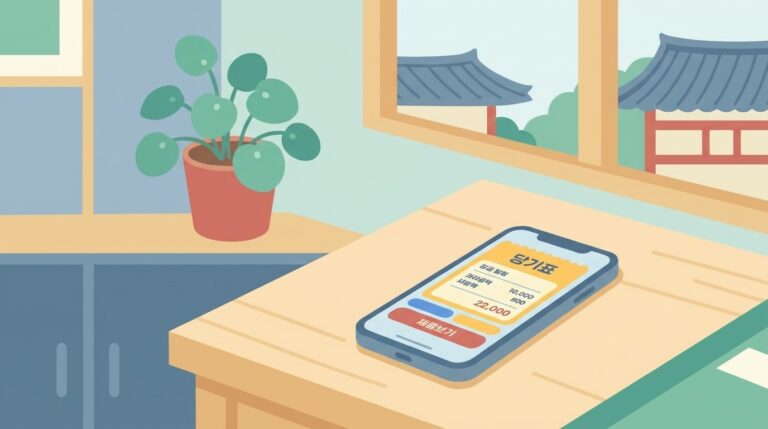
Imagine this: You’ve just moved into your dream studio apartment (officetel) in Seoul. You’re enjoying your morning iced americano, when suddenly, a small paper slip with numbers slides under your door or arrives via text. It’s the 관리비 (Gwan-ri-bi) — the monthly building maintenance fee.
You stare at terms like ‘공동전기’ (shared electricity) and ‘장기수선충당금’ (long-term repair fund) and feel a wave of anxiety. How do you pay it? Who do you talk to? Don’t worry! This guide is created based on real-life stories from expat learners just like you. By the end of this post, you’ll be paying your bills in Korean with absolute confidence!
Phase 2: Three Core Expressions Deep Dive
1. 관리비가 얼마나 나왔어요? (Gwan-ri-bi-ga ol-ma-na na-wat-eo-yo?)
- Pronunciation: Gwan-ri-bi-ga ol-ma-na na-wat-eo-yo? (Sounds like: Gwan-ree-bee-gah ol-mah-nah nah-waht-uh-yo?)
- Meaning: How much did the maintenance fee come out to?
- K-Culture Moment: You will hear this constantly in family-themed K-Dramas where parents complain about the winter heating bills while turning off lights around the house.
- Editor’s Insight: The verb ‘나오다’ (to come out) is used in Korean whenever a bill or a result is officially issued. Instead of asking “How much is it?” (얼마예요?), asking “How much did it come out to?” sounds much more natural and local.
- Situation Spectrum: Casual: ⚠️ | Semi-formal: ✅ | Formal: ✅
- 🤔 Think About It: In your home country, do you use the phrase “came out” for utility bills, or do you have a completely different expression?
2. 이번 달 관리비 납부해 주세요. (I-beon dal gwan-ri-bi nap-bu-hae ju-se-yo.)
- Pronunciation: I-beon dal gwan-ri-bi nap-bu-hae ju-se-yo. (Sounds like: Ee-buhn dahl gwan-ree-bee nahp-boo-hae joo-seh-yo)
- Meaning: Please pay this month’s maintenance fee.
- K-Culture Moment: This is the polite notification you will receive from your landlord (임대인) or the building office via text message every month.
- Editor’s Insight: ‘납부하다’ (nap-bu-ha-da) is the official/formal verb for paying taxes, public utilities, or fees, whereas ‘내다’ (nae-da) is the casual, everyday verb for paying money.
- Situation Spectrum: Casual: 🚫 | Semi-formal: ✅ | Formal: ✅
- 🤔 Think About It: Why do you think languages use more formal terms (like ‘납부’ vs ‘내다’) for official duties? How does it change the mood?
3. 계좌이체로 보낼게요. (Gye-jwa-i-che-ro bo-nael-ge-yo.)
- Pronunciation: Gye-jwa-i-che-ro bo-nael-ge-yo. (Sounds like: Gyeh-jwah-ee-cheh-roh boh-nael-geh-yo)
- Meaning: I will send it via bank transfer.
- K-Culture Moment: In Korea’s highly digitized cash-free society, almost all administrative fees and rents are paid through instantaneous mobile banking transfers rather than cash or checks.
- Editor’s Insight: ‘-로/으로’ is a particle meaning “by means of”. ‘계좌이체’ (bank transfer) + ‘-로’ (by) means “via bank transfer”.
- Situation Spectrum: Casual: ✅ | Semi-formal: ✅ | Formal: ⚠️
- 🤔 Think About It: How popular is instant mobile banking in your country compared to Korea’s ultra-fast one-tap transfer culture?
Phase 3: Textbook Korean vs. Real Korean
Situation 1: Asking how to pay the bill
- 📖 Textbook Korean: 관리비를 지불하고 싶습니다. 어떻게 합니까? (I want to pay the maintenance fee. How do I do it?)
- 🗣️ Real Korean: 관리비 어디로 보내면 돼요? (Where should I send the maintenance fee?)
- 💡 Why the difference? Textbook phrases can sound like a formal legal document. Real Koreans use the conversational ‘보내면 돼요?’ (Is it okay if I send it to…?) to ask for the account number directly and casually.
Situation 2: Informing someone that you completed the transfer
- 📖 Textbook Korean: 송금을 완료하였습니다. (I have completed the remittance.)
- 🗣️ Real Korean: 방금 계좌로 보냈어요! (I just sent it to the account!)
- 💡 Why the difference? ‘송금’ (remittance) and ‘완료’ (completion) sound like automated bank teller messages. Real humans simply say ‘보냈어요’ (sent it) with ‘방금’ (just now) to show instant action.
Phase 4: K-Culture Deep Dive & Non-verbal Manners
4-1. Nunchi & Gestures: Meeting the Guard (경비아저씨)
When you have a question about your utility bill, you will often visit the ground-floor guard office (경비실 – Gyeong-bi-sil).
1. The Polite Bow: Always start with a gentle 15-degree bow and say “안녕하세요!” (Hello!).
2. Two-Handed Rule: When showing your paper bill (고지서) to the guard, always hold it with both hands as a sign of respect.
4-2. The “Officetel” Culture Code
In Korea, many young professionals live in an 오피스텔 (Officetel)—a hybrid of an office and a residential studio. In these buildings, the administrative office (관리사무소 – Gwan-ri-sa-mu-so) handles everything from trash rules to fixing broken lights. If your bill looks unusually high, you don’t call the landlord; you walk straight to the 관리사무소!
Phase 5: Real-Life Roleplay Scenario
The Setting
You are standing in the lobby of your officetel. You ran into Minjun (민준), the friendly building representative who helps foreign residents settle in.
- Minjun (민준): 안녕하세요! 혹시 이번 달 관리비 고지서 받으셨어요?
(An-nyeong-ha-se-yo! Hok-si i-beon dal gwan-ri-bi go-ji-seo bat-eu-syeot-eo-yo?)
🎭 [Smiling warmly, pointing to the mailboxes]
(Hello! By any chance, did you receive this month’s maintenance bill?) -
You (학습자): 아, 네! 받았어요. 그런데 어떻게 내는지 잘 몰라요.
(Ah, ne! Bat-at-eo-yo. Geon-de eo-tteoh-ge nae-neun-ji jal mol-ra-yo.)
🎭 [Scratching your head, looking slightly embarrassed]
(Ah, yes! I received it. But I don’t really know how to pay it.) -
Minjun (민준): 아, 걱정 마세요! 보통은 은행 계좌이체로 납부해요. 고지서 아래에 가상계좌 번호가 있어요.
(Ah, geok-jeong ma-se-yo! Bo-tong-eun eun-haeng gye-jwa-i-che-ro nap-bu-hae-yo. Go-ji-seo a-rae-e ga-sang-gye-jwa beon-ho-ga is-seo-yo.)
🎭 [Tapping on your paper bill to point out the bank details]
(Ah, don’t worry! Usually, we pay via bank transfer. There is a virtual account number at the bottom of the bill.) -
You (학습자): 가상계좌요? 그게 뭐예요?
(Ga-sang-gye-jwa-yo? Geu-ge mwo-ye-yo?)
🎭 [Tilting your head in curiosity]
(Virtual account? What is that?) -
Minjun (민준): 본인만 쓸 수 있는 일회용 전용 계좌예요. 거기로 송금하면 바로 확인돼요.
(Bon-in-man sseul su in-neun il-hoe-yong jeon-yong gye-jwa-ye-yo. Geo-ri-ro song-geum-ha-myeon ba-ro hwa-gin-dae-yo.)
🎭 [Nodding reassuringly]
(It is a personal, one-time-use account made just for you. If you transfer money there, it is confirmed instantly.) -
You (학습자): 아, 편리하네요! 그럼 지금 계좌이체로 보낼게요.
(Ah, pyeon-ri-ha-ne-yo! Geu-reom ji-geum gye-jwa-i-che-ro bo-nael-ge-yo.)
🎭 [Pulling out your phone with a bright smile]
(Oh, that’s convenient! Then I will send it via bank transfer right now.) -
Minjun (민준): 네, 맞아요. 보내고 나서 확인 문자 오면 끝이에요!
(Ne, maj-a-yo. Bo-nae-go na-seo hwa-gin mun-ja o-myeon kkeut-i-e-yo!)
🎭 [Giving a reassuring thumbs-up]
(Yes, exactly. Once you send it and get a confirmation text, you are all done!) -
You (학습자): 정말 감사합니다, 민준 씨! 많이 배웠어요.
(Jeong-mal gam-sa-hap-ni-da, Min-jun ssi! Man-i bae-wot-eo-yo.)
🎭 [Giving a polite 30-degree bow]
(Thank you so much, Minjun! I learned a lot.)
🔀 Choose Your Path! (Interactive Decision Point)
Minjun asks you: “Have you set up automated payments yet? It’s much easier!” How do you reply?
- Option A: “아니요, 아직 안 했어요. 신청하고 싶어요!” (No, I haven’t yet. I want to apply!)
- Feedback (BEST): Perfect! This shows high enthusiasm and asks for a life-saving tip. Minjun will likely show you how to link your bank account for automatic monthly payments.
- Option B: “괜찮아요. 매달 직접 할게요.” (It’s okay. I’ll do it manually every month.)
- Feedback (RISK): Not bad, but you might forget one month and get hit with a late fee (연체료 – yeon-chae-ryo)!
- Option C: “바빠서 그냥 안 낼래요.” (I’m busy, so I just won’t pay.)
- Feedback (BAD): Yikes! If you don’t pay your 관리비, your water or electricity might get turned off. Definitely avoid this!
Phase 6: 10-Second Emotional Shadowing Drill
Repeat these phrases out loud while copying the emotional flow!
- 이번 달 / 관리비가 / 너무 많이 나왔어요!
- [🥺 Tearful and shocked]
- Ee-beon dal / gwan-ree-bee-gah / nuh-moo mah-nee nah-waht-uh-yo!
- (This month’s maintenance fee came out to be way too high!)
- 방금 / 계좌이체로 / 보냈어요!
- [😊 Proud and relieved]
- Bahng-geum / gyeh-jwah-ee-cheh-roh / boh-naes-suh-yo!
- (I just sent it via bank transfer!)
Phase 7: K-Culture Mini Dictionary
- 관리비 (Gwan-ri-bi) | Noun | Monthly building service & utility fees.
- 고지서 (Go-ji-seo) | Noun | The official paper statement or bill showing individual charges.
- 계좌이체 (Gye-jwa-i-che) | Noun | Bank-to-bank electronic fund transfer.
- 연체료 (Yeon-che-ryo) | Noun | The late payment penalty fee added if you pay past the due date.
Phase 8: Survivor’s Living Kit
Survival Expressions TOP 3
- 자동이체 해주세요. (Ja-dong-i-che hae-ju-se-yo.)
- Pro Tip: “Please set up automatic transfers.” Say this at your Korean bank so you never forget to pay on time!
- 영수증 주세요. (Yeong-su-jeung ju-se-yo.)
- Pro Tip: “Please give me a receipt.” Good for keeping records for your landlord.
- 관리비 포함이에요? (Gwan-ri-bi po-ham-i-e-yo?)
- Pro Tip: “Is the maintenance fee included (in the rent)?” Essential phrase when apartment hunting!
Editor’s Travel & Living Note
When managing bills in Korea, you must download the 아파트아이 (Apartment i) mobile application if you live in a large apartment complex. It allows you to view detailed monthly tracking graphs of your water and heat usage. To make quick payments, we highly recommend setting up an account with Toss or KakaoPay so you can transfer money to your virtual account with a simple fingerprint scan!
Note: Virtual accounts (가상계좌) issued on bills are temporary and unique to you; do not share them with others!
Phase 9: One Step Deeper (Reflection)
In Korea, the ‘관리비’ (maintenance fee) system is highly detailed because most Koreans live in high-density communal housing like apartments or officetels. Sharing the cost of common electricity, building cleaning, elevator maintenance, and security guards reflects the Korean value of shared community responsibility. Everyone chips in to keep the shared space sparkling clean and safe.
💬 Your Turn: How are building maintenance fees handled in your country? Do you pay them to a landlord, or do you manage them individually? Let me know in the comments below!
Phase 10: FAQ & Common Mistakes
Q: What is a ‘가상계좌’ (Virtual Account) and is it safe?
A: Yes, it is extremely safe! It is a temporary, secure account number generated solely for your specific transaction. When you send money to that account, the system instantly knows it’s from you, eliminating the need to send proof of payment to the office.
Q: Can I pay my Korean bills with a foreign credit card?
A: Generally, no. Most building management systems only accept domestic Korean bank transfers (계좌이체) or payments via Korean mobile apps. Having a local bank account is highly recommended.
Q: What happens if I miss the due date (납부기한)?
A: A small late fee (연체료), usually around 1-3% of your bill, will be added to your next month’s statement. Don’t worry, they won’t cut your power immediately for being a few days late!
🚨 Common Mistakes Board
- Mistaking ‘월세’ (monthly rent) for ‘관리비’ (maintenance fee): They are completely separate payments! Always check if your rent price includes the gwanribi.
- Sending money to the wrong bank name: Korean virtual accounts are tied to specific domestic banks (e.g., Shinhan, Kookmin). Make sure you select the correct bank logo in your banking app.
- Ignoring the ‘납부기한’ (Due Date): Some buildings charge penalties immediately on the day after the deadline.
Phase 11: Action Mission
- 🥉 Bronze Mission: Say “관리비 고지서” (Gwan-ri-bi go-ji-seo) three times fast to practice your pronunciation!
- 🥈 Silver Mission: Share this blog post with a friend who is planning to live or study in Korea.
- 🥇 Gold Mission: Walk to your local convenience store or guard office and practice reading the Korean letters on your mailboxes!
-
🎮 K-Culture Mission: Next time you watch a realistic slice-of-life K-Drama (like Reply 1988 or Because This Is My First Life), listen carefully to see if you can hear characters complaining about their bills using the word ‘관리비’ or ‘고지서’!
Phase 12: Interactive Quiz Challenge
Let’s test your new skills!
Q1. What does ‘계좌이체’ mean?
- Monthly rent
- Bank transfer
- Utility receipt
Click to reveal the Answer!
Correct Answer: 2. Bank transfer
Excellent! 계좌이체 (Gye-jwa-i-che) is the most common way to pay bills in Korea.
Q2. Complete the sentence: “이번 달 _________가 너무 많이 나왔어요!” (This month’s maintenance fee came out way too high!)
- 월세 (Wol-se)
- 고지서 (Go-ji-seo)
- 관리비 (Gwan-ri-bi)
Click to reveal the Answer!
Correct Answer: 3. 관리비 (Gwan-ri-bi)
Bingo! 관리비 specifically refers to the monthly building maintenance and utilities fee.
Q3. True or False: You should use both hands when handing a document to a Korean building administrator or guard.
- True
- False
Click to reveal the Answer!
Correct Answer: True
Using two hands is a sign of basic local etiquette and respect in Korea!
“,






