

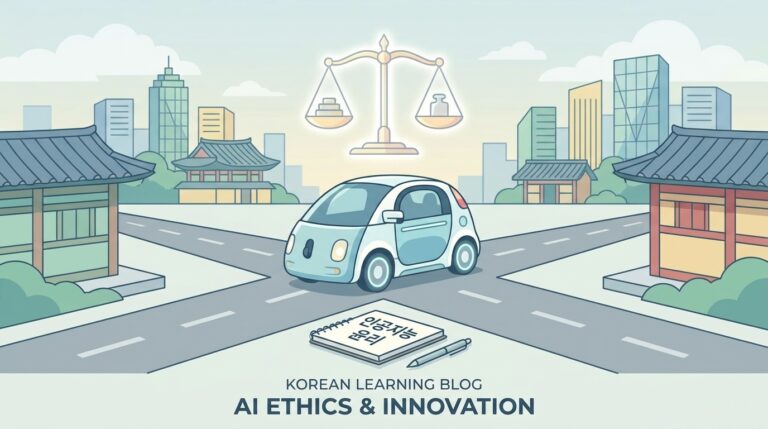
Do Robots Value Human Life? Mastering Korean Tech Ethics Debates Like a Native
Phase 1: Empathy (스토리 몰입형 오프닝)
안녕하세요! Welcome back to another premium edition of Daily Hangul (매일한글). It’s your favorite Korean bestie and Chief Editor here to guide you through the dazzling, fast-paced world of Korean language and culture!
Imagine you’re sitting in a sleek café in Gangnam, sipping an iced Americano (아아) with your Korean tech-industry colleagues. Suddenly, the conversation shifts from the latest K-Drama to a hot global debate: autonomous vehicles and the Trolley Problem. Your colleague looks at you and asks: ‘자율주행차가 사고 직전에 보행자와 운전자 중 누구를 구해야 할까요?’ (If an autonomous car is about to crash, should it save the pedestrian or the driver?)
Suddenly, you freeze. You know the ethics, but you lack the sophisticated, C1-level Korean vocabulary to express your deep philosophical thoughts. You don’t want to sound like a textbook; you want to debate with nuance, emotion, and intellectual grit.
Don’t worry! This guide is built based on real feedback from advanced learners who struggled to transition from ‘simple daily chat’ to ‘high-level intellectual discussions.’ By the end of this post, you’ll be debating AI ethics like a native Korean tech analyst!
Phase 2: 핵심 표현 3선 심층 분석 (Core Expressions)
To debate C1-level topics, you need vocabulary that carries weight. Let’s master three essential terms.
1. 가치 판단 (Gachi Pandan)
- Pronunciation: gachi-pandan (Sounds like ‘gah-chee pahn-dahn’. Rhymes with ‘catchy’ but with a soft ‘g’.)
- Meaning: Value Judgment
- K-Culture Moment: You will hear this in Korean investigative journalism shows like SBS 그것이 알고 싶다 (I Want to Know That) or tech debates on JTBC 비정상회담 (Abnormal Summit) when discussing whether algorithms can make moral decisions.
- Editor’s Insight: ‘가치’ means value, and ‘판단’ means judgment. In Korean culture, making a ‘가치 판단’ is seen as a uniquely human capability, deeply tied to emotional intelligence and social harmony.
- Situation Spectrum: Casual 🚫 | Semi-formal ⚠️ | Formal ✅ (Best used in professional debates, essays, or deep late-night talks)
- 🤔 Think About It: Does your native language separate ‘logical decision’ from ‘value judgment’ the way Korean does with ‘논리적 결정’ and ‘가치 판단’?
2. 불가피한 선택 (Bulgapihan Seontaek)
- Pronunciation: bool-gah-pee-hahn seon-taek (Sounds like ‘bool-gah-pee-hahn sun-teck’.)
- Meaning: An inevitable choice / No-win scenario
- K-Culture Moment: Think of sci-fi K-Dramas like SF8 or the movie Jung_E, where characters are forced to make tragic, irreversible decisions under extreme technical circumstances.
- Editor’s Insight: ‘불가피’ literally means ‘impossible to avoid.’ Using this phrase elevates your Korean instantly, signaling that you understand the complex, tragic nature of ethical dilemmas where no outcome is perfect.
- Situation Spectrum: Casual ⚠️ | Semi-formal ✅ | Formal ✅
- 🤔 Think About It: How do you justify a ‘불가피한 선택’ in your culture? Is it based on utilitarianism or individual rights?
3. 알고리즘의 편향성 (Algorijeum-ui Pyeonhyangseong)
- Pronunciation: al-go-ri-jeum-ui pyeon-hyang-seong (Sounds like ‘al-go-rhee-jum-pyaon-hyahng-sung’.)
- Meaning: Algorithmic Bias
- K-Culture Moment: Frequently used in Korean tech portals like Naver News or during panels discussing how AI models trained on Western data might not fit the collectivist norms of Korean society.
- Editor’s Insight: ‘편향성’ comes from ‘편향’ (bias/leaning). In Korea, fairness (공정성) is a massive societal priority, especially among Gen Z and Millennials. Discussing algorithm bias shows you understand modern Korean social concerns.
- Situation Spectrum: Casual 🚫 | Semi-formal ✅ | Formal ✅
- 🤔 Think About It: Do you think AI bias is more of a technical bug, or a reflection of human prejudice?
Phase 3: 교과서 한국어 vs 진짜 한국어 (Textbook vs. Real Korean)
Let’s swap out stiff, robotic textbook phrases for natural, flowing Korean that native speakers actually use in discussions.
Scenario 1: Objecting to an ethical setup
- 📖 Textbook Korean: “이것은 도덕적으로 옳지 않습니다.” (This is morally incorrect.)
- 🗣️ 진짜 한국어: “이건 아무리 봐도 좀 선 넘은 거 아닌가요?” (No matter how you look at it, isn’t this crossing the line?)
- 💡 왜 다를까? Koreans love the idiom ‘선 넘다’ (to cross the line). It sounds incredibly natural, punchy, and is widely used even in serious intellectual discussions to call out unfairness.
Scenario 2: Feeling uncomfortable about AI making life-or-death decisions
- 📖 Textbook Korean: “자율주행차의 알고리즘에 대해 우려가 큽니다.” (I have high concerns about the autonomous car algorithm.)
- 🗣️ 진짜 한국어: “아무리 AI라지만 사람 목숨을 두고 저울질하는 건 좀 찝찝해요.” (No matter how smart AI is, weighing human lives like that feels a bit iffy/uncomfortable.)
- 💡 왜 다를까? ‘저울질하다’ (to weigh/measure options on scales) and ‘찝찝하다’ (to feel uneasy/uncomfortable) are raw, conversational expressions that show your emotional intelligence alongside your vocabulary.
Phase 4: K-Culture 딥다이브 & 비언어적 매너 (Deep Dive & Manners)
4-1. Nunchi & Gestures: How to Debate Without Causing Offense
In Korea, debating ethics is not about ‘winning’ the argument; it’s about exploring the truth together while maintaining harmony (Hwa, 화).
* The Tilt: When you disagree, do not point your finger. Instead, tilt your head slightly (about 15 degrees) and say, “그것도 일리가 있네요, 하지만…” (That makes sense too, but…).
* The Softener: Always use passive or soft sentence endings like “~지 않을까 싶습니다” (I wonder if it might be…) instead of aggressive declarative statements like “~는 틀렸습니다” (You are wrong).
4-2. Culture Code: The Autonomous Car in K-Drama
Remember the hit drama Start-Up (스타트업)? The characters fought passionately over ‘Tarzan’ (타잔), their self-driving car software. In Korea, technology is rarely discussed in a vacuum; it is always connected to family protection, filial piety, and communal responsibility. A Korean debating AV ethics will almost always prioritize saving the elderly or children over purely logical ‘numerical asset values.’
Phase 5: 실전 롤플레이 시나리오 (Real-Life Roleplay)
Characters:
* 지민 (Jimin): An AI ethics researcher at a cutting-edge Korean mobility startup.
* 민우 (Minwoo): A tech-savvy friend who loves autonomous gadgets.
Setting: A modern office lounge in Pangyo Techno Valley (the Silicon Valley of Korea).
- 지민: 민우 씨, 만약 자율주행차가 불가피한 사고 상황에 직면하면 어떻게 해야 할까요? 운전자를 지켜야 할까요, 아니면 보행자를 보호해야 할까요?
- 민우: 🎭 (진지하게 머리를 긁적이며) 아, 그 트롤리 딜레마 말씀이시죠? 정말 어려운 가치 판단의 문제네요.
- 지민: 맞아요. 인공지능이 인간의 생명을 두고 저울질하는 시스템을 설계하는 게 맞는지 회의감이 들 때가 많아요.
- 민우: 🎭 (눈을 크게 뜨며) 하지만 아예 규정이 없으면 개발자들이 알고리즘을 짤 수가 없잖아요. 결국 법적인 기준이 필요하지 않을까요?
- 지민: 🎭 (한숨을 쉬며) 그렇죠. 하지만 만약 알고리즘의 편향성 때문에 특정 집단이 더 위험해진다면 그 책임은 누가 지나요?
- 민우: 🎭 (팔짱을 끼고 고개를 끄덕이며) 그것도 선을 넘는 일이죠. 결국 제조사나 정부가 책임 소재를 명확히 해야 할 것 같아요.
- 지민: 맞아요. 결국 기술이 발전해도 사람 중심의 가치가 빠지면 찝찝한 기분이 지워지지 않는 것 같아요.
- 민우: 🎭 (미소를 지으며) 그래서 지민 씨 같은 연구원의 역할이 중요한 거 아니겠어요? 응원합니다!
🔀 인터랙티브 분기점 (Interactive Branch)
Now, it’s your turn to respond to Jimin! Choose your path:
- Option A: “기계가 사람을 어떻게 평가해요? 그건 말이 안 돼요!” (How can machines judge humans? That makes no sense!)
- Feedback (Bad): Too direct and dismissive. It shuts down the intellectual flow of a C1 debate.
- Option B: “결국 생명 존중이 최우선이 되어야 하니까, 알고리즘도 그렇게 설계되어야 해요.” (Ultimately, respect for life must be the top priority, so algorithms should be designed that way.)
- Feedback (Best): Beautiful! It uses elegant C1-level vocabulary (‘생명 존중’, ‘설계되어야 해요’) and directly addresses the core ethics.
- Option C: “그건 대기업이 알아서 해결할 문제 아닌가요?” (Isn’t that a problem for conglomerates to solve on their own?)
- Feedback (Risk): A bit cynical and evades the philosophical depth of the conversation.
Phase 6: 10초 감정 섀도잉 드릴 (10-Second Shadowing Drill)
Practice reading these with authentic emotional delivery! / means pause briefly.
[🤔 진지하고 학구적으로]
“아무리 / 최첨단 기술이라지만, / 인간의 가치 판단을 / 완전히 대체할 수는 / 없습니다.”
(No matter how cutting-edge the technology is, it can never fully replace human value judgment.)-
[🥺 찝찝하고 걱정스럽게]
“기계가 / 사람의 목숨을 두고 / 저울질한다는 것 자체가 / 제 기준에서는 / 좀 선을 넘은 것 같아요.”
(The very idea of a machine weighing human lives feels like crossing the line in my book.)
Phase 7: K-Culture 미니 사전 (Core Vocabulary Dictionary)
- 트롤리 딜레마 (Trolley Dilemma): The classic philosophical thought experiment used globally and in Korea to discuss autonomous vehicle ethics.
- 생명 존중 (Saeng-myeong jon-jung): Respect for life. A fundamental ethical pillar in Korean societal debates.
- 책임 소재 (Chaek-im so-jae): Locus of responsibility / Where the blame lies. Vital for legal and technical discussions in corporate Korea.
- 과실 비율 (Gwa-sil bi-yul): Fault ratio / Negligence percentage. Essential vocabulary if you ever get into a car accident or discuss insurance in Korea.
Phase 8: 여행자를 위한 생존 키트 (The Tech-Traveler’s Survival Kit)
Survival Expressions for Future Mobility in Korea:
- “여기 자율주행 셔틀 타는 곳이 어디예요?” (Where is the autonomous shuttle boarding area?)
- “갑자기 급정거할 수 있으니 손잡이를 꽉 잡으세요.” (Hold onto the handrail tightly as it might brake suddenly.)
- “이 차, 자율주행 모드 작동 중인가요?” (Is this car running on autonomous mode?)
🚗 Editor’s Travel Note:
Did you know Korea is piloting advanced autonomous taxis and buses? You can actually experience them in regions like Sangam-dong, Seoul, and Sejong City! To book these future rides and navigate Korean transit flawlessly, make sure to read the Seoul autonomous driving bus guides or use the 카카오 T 앱 다운로드 to explore self-driving taxi options in designated zones. Note: Services and operational hours are subject to change depending on local regulations and weather conditions.
Phase 9: “한 발 더 깊이” (Humanities Essay)
Korea is historically a collectivist society heavily influenced by Confucianism (유교 사상), where the safety and harmony of the community often outweigh individual convenience. When discussing autonomous car ethics, Western debates often focus on individual rights (e.g., protecting the owner who bought the car). In contrast, Korean societal discourse tends to lean heavily toward protecting the vulnerable—such as children in school zones (어린이 보호구역) or the elderly. This deep ‘Jeong’ (정 – affectionate community bond) is woven directly into how Koreans view AI algorithms.
💬 Your Turn: Do you think an AI car should prioritize its driver, or the community? Let us know your thoughts in Korean in the comments below!
Phase 10: FAQ & 오해 방지 (FAQ & Common Mistakes)
Q: Is ‘도덕’ (morality) the same as ‘윤리’ (ethics)?
A: They are very similar, but ‘도덕’ refers to personal, social norms of right and wrong, while ‘윤리’ is more academic and professional. For tech/AI, always use ‘윤리적 문제’ (ethical issues).
Q: Can I use ‘선 넘다’ in a business presentation about AI?
A: It is slightly casual. In a formal board meeting, use ‘도를 넘어섰다’ (has crossed the limit) or ‘윤리적 범위를 벗어났다’ (out of ethical boundaries) instead.
Q: How do I say ‘Trolley Problem’ like a native speaker?
A: Simply transliterate it as ‘트롤리 딜레마’. Every tech and philosophy major in Korea knows this term instantly.
🚨 Common Mistakes Alert!
- Mistake 1: Saying “기계가 사람을 죽여요” (The machine kills humans) in a debate.
- Correct Action: Use “기계가 인명 피해를 야기합니다” (The machine causes human casualties) to sound like a C1 professional.
- Mistake 2: Using informal ‘너’ when debating hard topics.
- Correct Action: Always refer to your debate partner as ‘~씨’ or ‘~연구원님’ to maintain respect.
- Mistake 3: Confusing ‘가치’ (value) with ‘같이’ (together) in writing. They sound identical! Keep your spelling sharp.
Phase 11: 액션 미션 (Daily Missions)
- 🥉 Bronze Mission: Write a 1-sentence opinion about self-driving cars in the comments using ‘가치 판단’.
- 🥈 Silver Mission: Record yourself reading the Phase 6 Shadowing Drill and share it on Instagram tagging
@DailyHangul! - 🥇 Gold Mission: Next time you chat with a Korean friend, ask them: “자율주행차 윤리 문제에 대해 어떻게 생각해요?” and use at least two vocabulary words from today!
- 🎮 K-Culture Mission: Watch Episode 5 of the K-Drama Start-Up and spot the scenes where they discuss self-driving car algorithms!
Phase 12: 인터랙티브 퀴즈 챌린지 (Quiz)
1. Situational Vocabulary Quiz
Which word fits best in this sentence?
“AI가 사람의 목숨을 두고 무조건 수치로만 _________ 것은 문제가 있다.”
* A) 가치 판단하는
* B) 저울질하는
* C) 피하는
👉 Click to see the Answer & Explanation
Correct Answer: B) 저울질하는
Explanation: ‘저울질하다’ (weighing/measuring options) perfectly describes the act of mathematically calculating the value of human lives.
2. True or False Culture Quiz
“In Korea, it is considered perfectly polite to point directly at your opponent’s face when passionately making an ethical point during a debate.” (T/F)
👉 Click to see the Answer & Explanation
Correct Answer: False!
Explanation: Pointing is considered aggressive and impolite in Korea. Instead, use open-palm gestures and tilt your head slightly to show you are contemplating, not attacking.






