

Welcome to the Korean Post Office! Your Ultimate Stress-Free Guide
안녕하세요! (Annyeonghaseyo!) I’m your Daily Hangul editor, your personal guide to living and traveling in Korea like a local. 💖
Imagine this: You’ve spent the last week collecting the coolest Korean snacks, cute K-Pop photocard albums, and trendy skincare items to send to your best friend back home. You finally walk into a busy Korean Post Office (우체국 – Ucheguk). People are bustling, machines are beeping, and you see stacks of empty boxes. You want to ask for one, but your mind goes blank.
“How do I say ‘Give me a box’ without sounding rude?”
Don’t worry! Sending packages in a foreign country can feel intimidating, but today, we are going to master the exact, real-life phrases you need. Our actual students have used these exact tips to send tons of K-beauty goodies home without a single drop of sweat. Let’s dive in!
Phase 2: 3 Key Expressions Deep Dive
1. 박스 주세요 (Bakseu juseyo)
- Pronunciation: Bahk-seu joo-seh-yo (Rhymes with the English word “box” + “say-yo”)
- Meaning: Please give me a box.
- K-Culture Moment: In many cozy K-Dramas, you’ll see mothers packaging a “Taekbae” (택배 – parcel) filled with homemade Kimchi and side dishes for their children living in the city. When they walk up to the counter, this is the exact phrase they use.
- Editor’s Insight: “주세요” (juseyo) is the ultimate magic word in Korean. It literally means “please give me.” Combined with the loanword “박스” (bakseu), this phrase is instantly understood by any clerk!
- Situation Spectrum: Casual 🚫 | Semi-formal ✅ | Formal ✅
- 🤔 Think About It: Notice how Korean easily adopts the English word “box” as “박스”. Why do you think loanwords are so common in modern Korean daily life compared to your native language?
2. 제일 작은 박스 주세요 (Jeil jageun bakseu juseyo)
- Pronunciation: Jeh-eel jah-geun bahk-seu joo-seh-yo
- Meaning: Please give me the smallest box.
- K-Culture Moment: Think of K-Pop fans mailing tiny, precious photocard trades to their online friends. They don’t need a giant box—just the smallest, cutest one!
- Editor’s Insight: “제일” (jeil) means “the most” or “best,” and “작은” (jageun) means “small.” Together, they mean “the smallest.” Korean post office boxes are numbered from Size 1 (제일 작은 것) to Size 5 (제일 큰 것).
- Situation Spectrum: Casual 🚫 | Semi-formal ✅ | Formal ✅
- 🤔 Think About It: In your country, do post offices have standard numbered boxes, or do you have to bring your own? How does structured sizing make life easier?
3. 테이프는 어디에 있어요? (Teipeuneun eodie isseoyo?)
- Pronunciation: Teh-ee-peu-neun eo-dee-eh ees-seo-yo?
- Meaning: Where is the tape?
- K-Culture Moment: When moving out of a tiny university dorm (원룸) in a classic youth drama, the main character is always seen frantically searching for packing tape to secure their life’s belongings.
- Editor’s Insight: Just like “박스”, “테이프” (teipeu) is another easy loanword from English. If you can’t find the packing tape on the self-wrapping table, simply ask this to get guided immediately.
- Situation Spectrum: Casual 🚫 | Semi-formal ✅ | Formal ✅
- 🤔 Think About It: Why is asking questions politely with “어디에 있어요?” (Where is…?) so vital for budget travelers? How does it save you time?
Phase 3: Textbook Korean vs. Real Korean
Let’s look at the difference between what stiff textbooks teach you and what real Koreans actually say at the post office counter!
Scenario 1: Buying a Box
- 📖 Textbook Korean: 상자를 구매하고 싶습니다. (Sangjareul gumaehago sipseumnida. – “I would like to purchase a shipping container.”)
- 🗣️ Real Korean: 박스 주세요. (Bakseu juseyo. – “Box, please!”)
- 💡 Why the difference? The textbook version is grammatically correct but sounds incredibly robotic and overly formal, like you’re signing a business contract instead of just grabing a cardboard box!
Scenario 2: Asking for Tools
- 📖 Textbook Korean: 포장용 접착테이프는 어느 곳에 비치되어 있습니까? (Pojangyong jeobchakteipeuneun eoneu gose bichideo-eo isseumnika? – “In which location is the adhesive packing tape situated?”)
- 🗣️ Real Korean: 테이프 어디 있어요? (Teipeu eodi isseoyo? – “Where is the tape?”)
- 💡 Why the difference? Native Koreans value speed and simplicity in public service areas. Dropping particles like “-는” and using the short “어디 있어요?” keeps communication fast and friendly.
Phase 4: K-Culture Deep Dive & Non-verbal Manners
4-1. Nunchi & Gestures at the Post Office
- The Two-Handed Hand-off: When the postal clerk hands you the box, always receive it with both hands. This is a crucial sign of respect in Korea.
- Polite Pointing: If you are asking where the tape or scissors are, do not point with your index finger. Instead, gesture towards the general direction with an open palm facing slightly upward.
- The Nod: Always give a small, polite nod of the head when saying thank you (감사합니다 – Gamsahamnida).
4-2. The Packaging Zone (포장대 – Pojangdae)
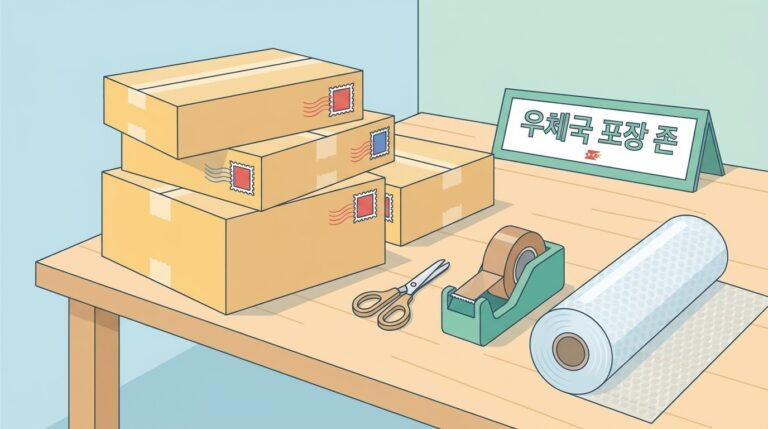
In Korean post offices, there is a magical place called the 포장대 (Pojangdae). It is a dedicated table in the middle of the lobby where you can find free-to-use scissors, heavy-duty tape, glue, markers, and even bubble wrap (affectionately called “bbyobbyoyi” – 뽁뽁이 in Korean)! You don’t need to buy these tools. You just pick your box, go to this zone, pack your items for free, and then take it to the counter to pay and ship!
Phase 5: Real-Life Roleplay Scenario
Let’s practice! You are at the Seoul Central Post Office. Meet Minji, a helpful and friendly post office clerk.
- Character: Minji (우체국 직원 – Post Office Staff)
- Setting: A bustling post office with stacks of boxes in the corner.
Minji: 어서 오세요! 무엇을 도와드릴까요?
(Eoseo oseyo! Mueoseul dowadeurilkkayo?)
“Welcome! How can I help you?”
You: 🎭 (Smiling politely) 안녕하세요. 박스 주세요.
(Annyeonghaseyo. Bakseu juseyo.)
“Hello. Please give me a box.”
Minji: 네, 어떤 크기가 필요하세요?
(Ne, eotteon keugiga piryohaseyo?)
“Sure, what size do you need?”
You: 🎭 (Gesturing a small square with your hands) 음… 제일 작은 박스 주세요.
(Eum… jeil jageun bakseu juseyo.)
“Um… Please give me the smallest box.”
Minji: 아, 1호 박스요? 여기 있습니다.
(Ah, il-ho bakseuyo? Yeogi isseumnida.)
“Ah, the Size 1 box? Here it is.”
You: 🎭 (Receiving the box with both hands and bowing slightly) 감사합니다. 테이프는 어디에 있어요?
(Gamsahamnida. Teipeuneun eodie isseoyo?)
“Thank you. Where is the tape?”
Minji: 🎭 (Pointing with an open hand to the middle table) 저기 포장대에 다 준비되어 있어요!
(Jeogi pojangdaee da junbideo-eo isseoyo!)
“It’s all prepared over there at the packaging table!”
You: 아, 그렇군요! 감사합니다.
(Ah, georeokgunyo! Gamsahamnida.)
“Ah, I see! Thank you.”
🔀 Interactive Choice: What will you say next?
How do you ask for a pen to write the address?
- A: “펜 주세요!” (Pen juseyo!)
- B: “볼펜 내놔.” (Bolpen naenwa.)
- C: “필기구를 빌려주실 수 있으십니까?” (Pilgigureul billyeojusil su isseusimnika?)
Feedback:
- Correct Answer is A (Best): Polite, short, and perfectly natural!
- If you chose B (Bad): Yikes! “내놔” means “Hand it over” in highly informal slang. The clerk might think you are a drama villain!
- If you chose C (Risk): Too textbook and grammatically complex. The clerk will look confused by your extreme formality.
Phase 6: 10-Second Emotion Shadowing Drill
To sound like a natural Korean speaker, practice cutting the words at the slash (/) and matching the emotion!
- 박스 / 주세요!
- [😊 Polite & Friendly] Bahk-seu / joo-seh-yo!
- 제일 / 작은 박스 / 어디에 / 있어요?
- [🤔 Curious & Soft] Jeh-eel / jah-geun bahk-seu / eo-dee-eh / ees-seo-yo?
Phase 7: K-Culture Mini Dictionary
- 우체국 (Ucheguk) | Post Office
- Usage: Locate this on maps to ship letters or heavy boxes of souvenirs.
- 포장대 (Pojangdae) | Packaging Station
- Usage: The holy grail area containing free tape, scissors, and bubble wrap.
- 택배 (Taekbae) | Courier/Delivery Service
- Usage: Korea’s hyper-fast delivery culture that powers online shopping.
- 호 (Ho) | Number/Size unit
- Usage: Used to specify box sizes (e.g., 1호, 2호, 3호).
Phase 8: Traveler’s Survival Kit
Emergency Phrases TOP 3
- 해외 배송 돼요? (Hae-oe baesong dwaeyo?)
- Meaning: Is international shipping available?
- Pro Tip: Ask this immediately if you’re mailing items back to your home country.
- 우표 필요해요. (Upyo piryohaeyo.)
- Meaning: I need stamps.
- Pro Tip: Use this if you are sending postcards to friends!
- 카드로 할게요. (Kadeuro halkkeyo.)
- Meaning: I’ll pay by card.
- Pro Tip: Korea is highly cashless; you can pay for even a 500-won box with your credit card.
🗺️ Editor’s Travel Note
To find the closest post office, download the Naver Map App. Simply type in 우체국 (Ucheguk) in the search bar to find the nearest location with real-time walking routes. Keep in mind that post offices are usually open from 09:00 to 18:00 (Monday to Friday), but financial services close at 16:30! Note: Operating hours may vary slightly depending on the branch.
Phase 9: “One Step Deeper”
In Korea, there’s a unique cultural concept called 정 (Jeong)—a warm feeling of attachment, sharing, and community. The fact that Korean post offices offer free, high-quality packing tape, scissors, bubble wrap, and markers at the Pojangdae is a subtle reflection of Jeong. It is built on a high level of social trust, where people share public goods with care and respect. When using these tools, making sure to place them back neatly for the next person is a beautiful way to participate in this communal culture.
💬 Your Turn!
Does your local post office provide free tape and wrapping tools, or do you have to buy everything? Tell us in the comments below!
Phase 10: FAQ & Common Mistakes
Q: Do I need to pay for the box first before packing my items?
A: No! You can simply ask for the box at the counter (or grab one from the display), pack your items at the wrapping station, and then bring the packed box back to the counter to weigh it and pay for both the box and the shipping fee at the same time.
Q: Can I use my own box from a convenience store?
A: Yes, you can! As long as it is sturdy and sealed properly with tape, you do not have to purchase official post office boxes.
Q: How do I write the address for international shipping?
A: You can write the destination address in English (or the destination language), but make sure to write the country name clearly in bold capital letters!
🚨 Common Mistakes Alert!
- Mistake 1: Grabbing tape and scissors and walking back to your seat to pack.
- Correct Action: Keep the tools at the shared packing table so others can use them too!
- Mistake 2: Forgetting to write the postal code (우편번호 – upyeonbeonho).
- Correct Action: Double-check the 5-digit postal code of both sender and receiver before lining up.
Phase 11: Action Mission
- 🥉 Bronze Mission: Stand in front of your mirror and say “박스 주세요!” three times with a bright, friendly smile.
- 🥈 Silver Mission: Write down “제일 작은 박스 주세요” on a sticky note and stick it to your desk as a daily vocabulary booster!
- 🥇 Gold Mission: Next time you visit Korea, go to a local post office, grab a box, pack a postcard, and pay entirely in Korean!
- 🎮 K-Culture Mission: Watch your favorite slice-of-life K-Drama and keep an eye out for any delivery trucks or post offices. Drop the drama name in our comments if you find one!
Phase 12: Interactive Quiz
Test your new skills!
1. Which word means “the smallest” in Korean?
🔍 Check Answer
제일 작은 (Jeil jageun)! “제일” means most, and “작은” means small.
2. True or False: You have to pay extra to use the scissors and tape at the wrapping station.
🔍 Check Answer
False! The packaging zone (포장대) tools are completely free for customer convenience!
3. Translate: “Where is the tape?”
🔍 Check Answer
테이프 어디에 있어요? (Teipeu eodie isseoyo?)
“,







