

Phase 1: Empathy (Your Korean Best Friend is Here!)
안녕하세요! (Annyeonghaseyo!) Hello there, future Korean speaker! I’m your lead editor from Daily Hangul (매일한글), your trusty cultural companion.
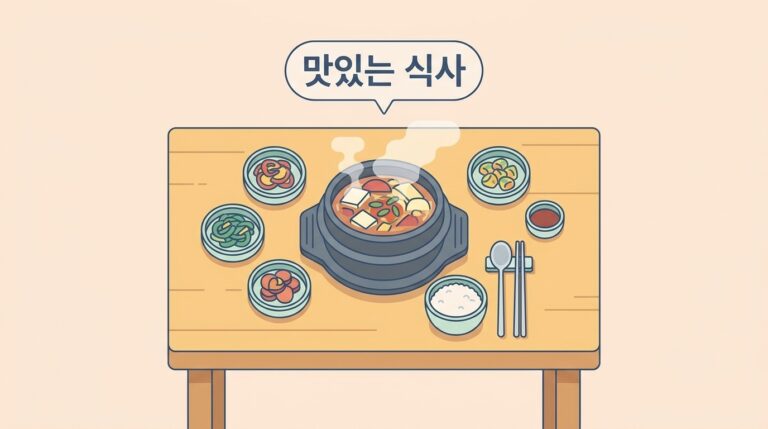
Imagine this scenario: You’ve finally landed an invitation to a warm, cozy Korean household. The table is absolutely overflowing with colorful side dishes, sizzling meat, and steaming stew. You sit down with your Korean host. The delicious aroma fills the air. You want to show your excitement and politely wish them a wonderful meal.
You open your mouth… and freeze. How do I say ‘Bon Appétit’ in Korean naturally? Will I sound too stiff like a textbook, or accidentally sound rude?
Don’t worry! This is one of the most common worries our actual students face when they first eat with Koreans. Today, we’re going to break down the most warm, friendly, and practical ways to wish someone a great meal. By the end of this guide, you will be dining with ultimate confidence! Let’s dig in!
Phase 2: Deep Dive into 3 Core Expressions
1. 맛있게 드세요 (Mas-it-ge deuseyo)
- Pronunciation: Ma-sheet-ge deu-seh-yo
- Meaning: “Please eat deliciously” (Enjoy your meal)
- K-Culture Moment: You will hear this phrase constantly in K-Dramas whenever a loving mother serves a giant table of food to her family, or when a friendly restaurant owner brings out your steaming bowl of soup.
- Editor’s Insight: This is the absolute gold standard! It is polite, incredibly natural, and safe to use with almost anyone—coworkers, hosts, or acquaintances.
- Situation Spectrum: Casual: ⚠️ | Semi-formal: ✅ | Formal: ✅
- 🤔 Think About It: In English, we focus on the meal itself being good (“Have a good meal”). But in Korean, we wish for the person to experience eating “deliciously” (맛있게). Isn’t that beautifully active?
2. 맛있게 먹어 (Mas-it-ge meog-eo)
- Pronunciation: Ma-sheet-ge muh-guh
- Meaning: “Eat deliciously” (Enjoy the food – casual)
- K-Culture Moment: Two close friends sharing a quick cup of street-food tteokbokki after school, lightly tapping their chopsticks together.
- Editor’s Insight: This is the banmal (casual/informal) version of the phrase above. Only use this with close friends of the same age, or younger people. Using this with an elder or boss is a big social slip!
- Situation Spectrum: Casual: ✅ | Semi-formal: 🚫 | Formal: 🚫
- 🤔 Think About It: How does your native language change when you speak to your best friend versus your friend’s parents?
3. 많이 드세요 (Mani deuseyo)
- Pronunciation: Ma-nee deu-seh-yo
- Meaning: “Please eat a lot!”
- K-Culture Moment: A host at a K-BBQ restaurant continuously piling juicy grilled meat onto your plate, smiling from ear to ear.
- Editor’s Insight: In Korean culture, feeding someone abundantly is the ultimate sign of love and care. This phrase is a beautiful way to show hospitality. As a guest, you might hear this a lot, but you can also say it if you are treating others to food!
- Situation Spectrum: Casual: ⚠️ | Semi-formal: ✅ | Formal: ✅
- 🤔 Think About It: Why do you think offering “a lot” of food is such a deep part of Korean hospitality?
Phase 3: Textbook Korean vs. Real Korean
Let’s compare what dry textbooks teach you versus what real Korean friends actually say in everyday life!
Situation 1: Wishing your colleagues a good lunch
- 📖 Textbook Korean: “식사를 맛있게 하십시오.” (Siksareul mas-it-ge hasipsio. – “Please execute your dining deliciously.” Sound like a rigid military officer!)
- 🗣️ Real Korean: “맛있게 드세요!” (Mas-it-ge deuseyo! – “Enjoy your meal!” Warm, light, and perfectly polite.)
- 💡 Why the difference? Modern Korean society values friendly politeness over cold, historical honorifics in casual office settings.
Situation 2: Hosting your close friend at your house
- 📖 Textbook Korean: “음식을 즐겁게 드십시오.” (Eumsigeul jeolgeopge deuseyo. – “Please consume the food with joy.” Nobody speaks like this!)
- 🗣️ Real Korean: “많이 먹어~ 많이 준비했어!” (Mani meog-eo~ mani junbi-haesseo! – “Eat up! I prepared a lot!”)
- 💡 Why the difference? Real friends focus on sharing abundance and showing effort, which makes the bond feel much closer.
Phase 4: K-Culture Deep Dive & Non-verbal Manners
4-1. Nunchi & Chopstick Etiquette
- Wait for the Eldest: Before you reach for that delicious Kimchi, wait! In Korea, the eldest or most senior person at the table must pick up their chopsticks or spoon first.
- The Head Bow: When someone says “맛있게 드세요” to you, it’s polite to nod or bow your head slightly while making soft eye contact and saying “감사합니다” (Thank you).
4-2. The Power of “Jeong” (정)
In Korea, food is not just nutrition—it is Jeong (정), which means deep affection and attachment. When a Korean host constantly tells you to “많이 드세요” (eat a lot), they are pouring their affection into you. Leaving a completely empty plate and looking satisfied is the greatest compliment you can return!
Phase 5: Real-Life Roleplay Scenario
Let’s practice! You are visiting your coworker Minjun’s house. His mother cooked an incredible Korean feast.
Characters:
- Minjun (민준): Your friendly colleague (uses casual language to you, polite to his mom).
- Minjun’s Mom (어머니): The sweet, generous host.
- You (매일한글 학습자): The polite, respectful guest.
8-Turn Dialogue:
- Mom: 🎭 Smiling warmly while carrying a hot clay pot 🎭 자, 음식 식기 전에 어서 앉아요.
(Ja, eumsik sikgi jeone eoseo anjayo. / Come, sit down before the food gets cold.) - You: 🎭 Bowing slightly in awe of the food 🎭 와, 정말 맛있겠어요! 초대해 주셔서 감사합니다.
(Wa, jeongmal mas-it-gesseoyo! Chodaehae jusyeoseo gamsahabnida. / Wow, it looks absolutely delicious! Thank you so much for inviting me.) - Minjun: 🎭 Passing you the rice bowl 🎭 우리 엄마 갈비찜 진짜 맛있어. 맛있게 먹어!
(Uri eomma galbijjim jinja mas-isseo. Mas-it-ge meog-eo! / My mom’s galbijjim is really the best. Enjoy the meal!) - Mom: 🎭 Scooping a huge portion of ribs onto your plate 🎭 입맛에 맞을지 모르겠네. 많이 드세요!
(Immase majeulji moreugenne. Mani deuseyo! / I hope it suits your taste. Please eat a lot!) - You: 🎭 Clasping hands together politely 🎭 네, 잘 먹겠습니다! 어머니도 맛있게 드세요.
(Ne, jal meog-gesseumnida! Eomeoni-do mas-it-ge deuseyo. / Yes, I will eat well! Please enjoy your meal too, Mother.) - Mom: 🎭 Delighted and clapping her hands 아이고, 한국말도 정말 잘하네! 천천히 많이 먹어요.
(Aigo, Hangukmal-do jeongmal jalhane! Cheoncheonhi mani meogeoyo. / Oh my, you speak Korean so well! Eat slowly and eat plenty.) - Minjun: 🎭 Laughing softly 🎭 맞아, 천천히 먹어. 여기 반찬도 더 있어.
(Maja, cheoncheonhi meog-eo. Yeogi banchan-do deo isseo. / Right, eat slowly. There are more side dishes here.) - You: 🎭 Taking a bite and smiling widely 음! 진짜 맛있어요. 최고예요!
(Eum! Jinja mas-isseoyo. Choegoyeyo! / Mmm! This is really delicious. It is the best!)
🔀 Interactive Choice Point!
How would you respond when Minjun’s mom passes you the food?
- Option A: You pick up your chopsticks immediately and start eating before anyone else does.
- Option B: You politely clasp your hands, say “잘 먹겠습니다” (I will eat well), and wait for the mom to start.
- Option C: You look at Minjun’s mom and say “맛있게 먹어” (Enjoy the food – casual).
💡 Feedback:
- Option A (Bad): Oops! Eating before the elders start can look a bit impatient in Korea. Wait just a moment next time!
- Option B (Best!): Perfect! Saying “잘 먹겠습니다” and waiting politely shows incredible manners and cultural respect. You earned 100 points!
- Option C (Risk!): Oh no! Saying “맛있게 먹어” to an elder is too casual and can sound rude. Remember to use the polite “드세요” (deuseyo) form for adults!
Phase 6: 10-Second Emotion Shadowing Drill
Let’s train your mouth muscles! Try speaking these out loud with the correct emotion. / means a short pause.
- [😊 Bright and Grateful]
- “잘 / 먹겠습니다! / 맛있게 / 드세요!”
- Jal / meog-gesseumnida! / Mas-it-ge / deuseyo!
- [🥺 Excited and Hungry]
- “와, / 진짜 / 맛있겠어요!”
- Wa, / jinja / mas-it-gesseoyo!
Phase 7: K-Culture Mini Dictionary
- 잘 먹겠습니다 (Jal meog-gesseumnida): “I will eat well.” Said before starting a meal to show appreciation.
- 잘 먹었습니다 (Jal meogeotseumnida): “I ate well.” Said after finishing a meal to thank the cook.
- 집밥 (Jipbap): “Home-cooked meal.” A beloved word representing comfort, nostalgia, and healthy food.
- 반찬 (Banchan): “Side dishes.” Small, shareable dishes served alongside rice, representing Korean community sharing culture.
Phase 8: Traveler’s Survival Kit
🚨 Survival Expressions TOP 3
- 여기요, 물 좀 주세요! (Yeogiyo, mul jom juseyo!)
- Pro Tip: “Excuse me, please give us some water!”
- 진짜 맛있어요! (Jinja mas-isseoyo!)
- Pro Tip: “It is really delicious!” Say this to the restaurant staff as you leave.
- 계산해 주세요. (Gyesanhae juseyo.)
- Pro Tip: “Please bring the bill / I’d like to pay.”
🗺️ Editor’s Travel Note
When traveling in Korea, don’t miss out on local hidden gems! I highly recommend utilizing the 네이버 지도 앱 다운로드 (Naver Map App Download) to find the best local dining spots near you. For trendy restaurants, try using the CatchTable app to secure reservations beforehand. (Note: Restaurant reservation policies and app updates may change over time).
Phase 9: “One Step Deeper” (Reflection)
In many Western cultures, dining is often individualized—everyone orders their own plate. But in Korea, sharing a table is a communal experience. Bowls of soup are shared, and side dishes are continuously passed around. Wishing someone to “eat deliciously” (맛있게 드세요) is more than just polite table talk; it is a way of saying, “I am happy to share this warm, nurturing moment with you.”
💬 Your Turn!
Have you ever tried dining with Korean friends? What is your favorite Korean dish? Tell us in the comments below!
Phase 10: FAQ & Avoiding Misunderstandings
Q: Can I say “맛있게 드세요” to the restaurant waiter who brings me food?
A: Actually, no! “맛있게 드세요” is said to someone who is about to eat the food. Since the waiter is working and serving you, you should simply say “감사합니다” (Thank you).
Q: What is the difference between “잘 먹겠습니다” and “맛있게 드세요”?
A: “잘 먹겠습니다” is said by the person who is eating to thank the host or cook. “맛있게 드세요” is said to others sharing the meal to wish them a pleasant dining experience.
Q: Is it okay to lift my rice bowl while eating in Korea?
A: Unlike some other Asian countries, in Korea, it is polite to keep your rice bowl on the table while eating with your spoon. Lifting the bowl is generally discouraged!
🚨 Common Mistakes Board
- Mistake 1: Saying “맛있게 먹어” to your host’s parents.
- Correct Action: Always use the polite “맛있게 드세요”.
- Mistake 2: Burping loudly to show appreciation.
- Correct Action: Burping is considered bad manners at Korean tables. Instead, express your praise verbally: “정말 맛있어요!” (It’s really delicious!)
Phase 11: Action Mission!
- Bronze Mission 🥉: Practice saying “잘 먹겠습니다!” in front of the mirror before your next meal.
- Silver Mission 🥈: Share a picture of your favorite food on Instagram or Twitter, and write a caption using the tag #DailyHangul and “맛있게 드세요!”
- Gold Mission 🥇: Next time you eat at a Korean restaurant, look at the staff as you leave and say “잘 먹었습니다!” (I ate well!) with a warm smile.
Phase 12: Interactive Quiz Challenge
1. Which phrase should you use to wish your boss a good meal?
- A) 맛있게 먹어
- B) 맛있게 드세요
2. Fill in the blank:
When starting a meal, you say “잘 ___________!” (I will eat well).
3. True or False:
It is considered polite to start eating before the oldest person at the table picks up their chopsticks.
🔍 Reveal Answers & Explanations!
- Answer: B
- Explanation: Always use the polite honorific “드세요” (deuseyo) for bosses, elders, and hosts!
- Answer: 먹겠습니다 (meog-gesseumnida)
- Explanation: “잘 먹겠습니다” is the standard polite greeting before eating.
- Answer: False
- Explanation: You should always wait for the oldest person at the table to pick up their utensils first to show respect.







