

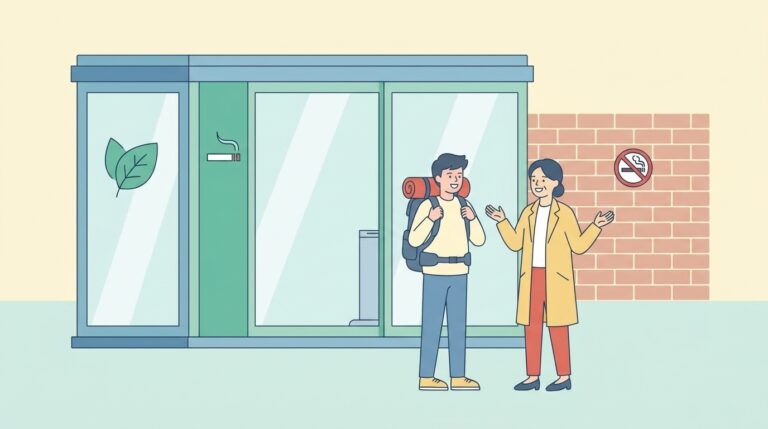
Stay Safe and Respectful: Navigating No-Smoking Zones in Korea
Phase 1: Empathy (Your Friendly Guide to Korean Rules)
안녕하세요! (An-nyeong-ha-se-yo!) Your best friend and chief editor at Daily Hangul is here!
Imagine this: You’ve just finished a sizzling, delicious meal of K-BBQ with your Korean friends. You step outside, feeling satisfied, and instinctively reach into your pocket for a cigarette. You look around, see people rushing by, and wonder, “Can I light up here? Or will I face a heavy fine or a round of disapproving glares?”
If you’ve felt this anxiety, you are definitely not alone! Many of our intermediate (B1) students tell us that understanding Korean rules about indoor and outdoor smoking is one of the trickiest cultural hurdles. Korea has some of the strictest smoke-free policies in the world, and they change rapidly.
Learning these rules isn’t just about avoiding a 100,000 KRW fine; it’s about mastering Nunchi (눈치 – situational wit) and showing respect to the community. Today, we’ll make sure you walk the streets of Seoul with confidence, knowing exactly what to look for and how to ask politely! Let’s dive in!
Phase 2: Deep Dive into 3 Key Expressions
1. 여기 담배 피워도 돼요? (Is it okay to smoke here?)
- Pronunciation: Yeo-gi dam-bae pi-weo-do dwae-yo?
- (Sound Analogy: “Yeo-gi” sounds like “yuh-gi”. “Dwae-yo” is like the “dwe-” in “dwell” combined with “yo” in “yo-yo”.)
- Meaning: “Can I smoke here?” (Direct: “Here tobacco smoke even if okay?”)
- K-Culture Moment: You will often hear a character in a realistic K-drama (like My Mister or Misaeng) asking this to a security guard or an older colleague behind an office building.
- Editor’s Insight: This uses the “-어도 돼요?” (Is it okay to…?) pattern. It is highly polite and cautious, making it the perfect safe question to ask when you are unsure.
- Situation Spectrum: Casual (⚠️ to close friends: 여기 담배 피워도 돼?), Semi-formal (✅), Formal (✅ 여기서 흡연해도 괜찮습니까?)
- 🤔 Think About It: In your country, do people ask for permission before smoking outdoors, or do they just look for an ashtray?
2. 여기 금연 구역이에요. (This is a non-smoking area.)
- Pronunciation: Yeo-gi geum-yeon gu-yeok-i-e-yo.
- (Sound Analogy: “Geum-yeon” sounds like “gum-yun” without the heavy ‘u’ sound; think of the German ‘ö’ or a soft ‘uh’.)
- Meaning: “This is a non-smoking zone.”
- K-Culture Moment: If you try to light up near a subway station entrance or inside a cafe balcony, a staff member or a passing elder might tap your shoulder and point to a sign while saying this phrase.
- Editor’s Insight: The word 금연 (禁煙 – Geum-yeon) literally means “prohibited tobacco.” Its opposite is 흡연 (吸煙 – Heub-yeon), meaning “inhaling tobacco.”
- Situation Spectrum: Casual (⚠️), Semi-formal (✅), Formal (✅ 이곳은 금연구역입니다.)
- 🤔 Think About It: How visible are “No Smoking” signs in your hometown compared to Korea, where they are on almost every street corner and building entrance?
3. 저기 흡연실이 따로 있어요. (There is a separate smoking room over there.)
- Pronunciation: Jeo-gi heub-yeon-sil-i tta-ro is-seo-yo.
- (Sound Analogy: “Tta-ro” uses a double ‘t’ sound; tense up your tongue and release it sharply, like the ‘t’ in “star” rather than “tar”.)
- Meaning: “There is a designated smoking room over there.”
- K-Culture Moment: In Korean PC bangs (gaming cafes), modern bars, or large KTX train stations, you’ll find enclosed glass cabins labeled 흡연실 (Smoking Room).
- Editor’s Insight: 따로 (Tta-ro) means “separately.” Adding this word emphasizes that smoking must only occur in that specific, designated zone.
- Situation Spectrum: Casual (✅), Semi-formal (✅), Formal (✅)
- 🤔 Think About It: Why do you think Korea prefers indoor glass smoking booths over open outdoor smoking areas?
Phase 3: Textbook Korean vs. Real-Life Korean
Scenario 1: Asking where the smoking area is
- 📖 Textbook Korean: “흡연구역이 어디입니까?” (Heub-yeon-gu-yeok-i eo-di-im-ni-ka? – “Where is the smoking zone?”)
- 🗣️ Real-Life Korean: “혹시… 담배 어디서 피워야 돼요?” (Hok-si… dam-bae eo-di-seo pi-weo-ya dwae-yo? – “Excuse me… where should I smoke?”)
- 💡 Why is it different? The textbook version sounds like a military announcement or a formal survey. Real Koreans use 혹시 (by any chance) to soften the question and the “-어야 돼요 (must/should do)” grammar to ask for the proper, lawful location.
Scenario 2: Being told not to smoke
- 📖 Textbook Korean: “여기서 흡연하시면 안 됩니다.” (Yeo-gi-seo heub-yeon-ha-si-myeon an deom-ni-da. – “Smoking is not permitted here.”)
- 🗣️ Real-Life Korean: “아, 죄송한데 여기 금연이라 밖에 나가셔야 돼요.” (Ah, joe-song-han-de yeo-gi geum-yeon-i-ra bak-ke na-ga-syeo-ya dwae-yo. – “Ah, sorry, but this is a no-smoking zone so you have to go outside.”)
- 💡 Why is it different? Koreans prefer avoiding direct, harsh prohibitions. By adding 죄송한데 (I’m sorry, but…) and giving a reason (금연이라… because it’s no-smoking), the request feels polite and cooperative rather than confrontational.
Phase 4: K-Culture Deep Dive & Non-Verbal Manners
4-1. Nunchi (눈치) & Gestures
If you are caught smoking in a restricted area, you might not hear a word. Instead, you’ll receive the “Korean Stare”—a silent, heavy look from passersby.
* The “X” Gesture: If an older person or security guard points at you and crosses their index fingers or forearms in an “X” shape, it means “Stop immediately, that’s not allowed!”
* The Pointing Gesture: Often, people will silently point toward a red and white circle sign with a cigarette crossed out. If they do, bow slightly, say “아, 죄송합니다” (Ah, joe-song-hap-ni-da – “Ah, I’m sorry”), and extinguish your cigarette immediately.
4-2. The Evolution of Smoking in Korea
In 1990s K-dramas, you’d routinely see actors smoking inside offices, restaurants, and even hospital hallways. Today, however, Korea has some of the most comprehensive indoor smoking bans in the world.
* All commercial buildings over a certain size, cafes, restaurants, bars, and PC bangs are 100% smoke-free.
* This dramatic cultural shift means smoking has moved either underground into high-tech ventilation booths or to obscure back alleys. Showing that you respect this shift proves you understand modern Korean societal values.
Phase 5: Real-Life Roleplay Scenario
Meet the Characters:
- Minho (민호): A friendly 20-something Korean office worker taking a coffee break outside a building.
- You: A visitor who wants to know where it is safe to smoke without breaking the rules.
[Setting: A busy alleyway behind a modern office building in Gangnam, Seoul]

You: (Looking around hesitantly, holding an unlit cigarette)
      저기요, 혹시 실례지만... 여기 담배 피워도 돼요?
      (Jeo-gi-yo, hok-si sil-lye-ji-man... yeo-gi dam-bae pi-weo-do dwae-yo?)
      "Excuse me, sorry to bother you... but is it okay to smoke here?"

Minho: (Waving hands gently with a warm, apologetic smile)
       아, 여기는 빌딩 바로 앞이라 금연 구역이에요.
       여기서 피우시면 과태료 나올 수 있어요.
       (Ah, yeo-gi-neun bil-ding ba-ro ap-i-ra geum-yeon gu-yeok-i-e-yo. Yeo-gi-seo pi-u-si-myeon gwa-tae-ryo na-ol su is-seo-yo.)
       "Ah, this is right in front of the building, so it's a non-smoking zone. If you smoke here, you might get fined."

You: (Surprised)
      앗, 진짜요? 몰랐어요. 그럼 어디서 피워야 돼요?
      (At, jin-jja-yo? Mol-las-seo-yo. Geureom eo-di-seo pi-weo-ya dwae-yo?)
      "Oh, really? I didn't know. Then where should I go to smoke?"

Minho: (Pointing toward a small alleyway across the street)
       저기 길 건너서 골목으로 들어가시면 흡연부스가 따로 있어요.
       사람들 많이 서 있는 곳 보이시죠?
       (Jeo-gi gil geon-neo-seo gol-mok-eu-ro deul-eo-ga-si-myeon heub-yeon-bu-seu-ga tta-ro is-seo-yo. Sa-ram-deul man-i seo in-neun got bo-i-si-jyo?)
       "If you cross the street over there and go into the alley, there is a separate smoking booth. See where all those people are standing?"

You: (Nodding appreciatively)
      아, 저기 부스 같은 곳 말씀이시죠? 정말 감사합니다!
      (Ah, jeo-gi bu-seu gat-eun got mal-sseum-i-si-jyo? Jeong-mal gam-sa-hap-ni-da!)
      "Ah, you mean that booth-like place over there? Thank you so much!"

Minho: (Nodding and smiling)
       네, 맞아요. 거기서는 편하게 피우셔도 돼요. 좋은 하루 보내세요!
       (Ne, maj-a-yo. Geo-gi-seo-neun pyeon-ha-ge pi-u-syeo-do dwae-yo. Jo-eun ha-ru bo-nae-se-yo!)
       "Yes, that's right. You can smoke comfortably over there. Have a great day!"
🔀 Interactive Choice: What will you do next?
- Choice A: “Ah, thank you! I’ll go over there right now.” (아, 감사합니다! 바로 저기로 갈게요.)
- Choice B: “Is it okay if I just light it here quickly for one minute?” (여기서 1분만 그냥 피우면 안 돼요?)
- Choice C: “Do you have a lighter?” (혹시 라이터 있으세요?)
Feedback on Your Choice:
- Best (Choice A): Perfect! You respected the law, took Minho’s friendly advice, and prevented a fine. You showed excellent Nunchi!
- Risk (Choice B): Dangerous! Asking to break the rules even for “one minute” puts Minho in an awkward position. Koreans hate causing public inconvenience (Min-pae – 민폐).
- Bad (Choice C): Too abrupt! Asking for a lighter before moving to the correct smoking zone shows you don’t care about the non-smoking rule.
Phase 6: 10-Second Shadowing Drill
Let’s practice speaking with real-life emotions! Mimic the pauses (/) and emotional cues to sound like a native speaker.
- [🥺 Worried & Polite]
저기요… / 혹시 / 여기 담배 피워도 돼요?
(Jeo-gi-yo… / hok-si / yeo-gi dam-bae pi-weo-do dwae-yo?) -
[😮 Surprised & Apologetic]
아, 진짜요? / 몰랐어요! / 죄송합니다.
(Ah, jin-jja-yo? / mol-las-seo-yo! / joe-song-hap-ni-da.) -
[😊 Relieved & Grateful]
아! / 저기 흡연 부스가 / 따로 있군요! / 감사합니다!
(Ah! / jeo-gi heub-yeon bu-seu-ga / tta-ro it-gun-yo! / gam-sa-hap-ni-da!)
Phase 7: K-Culture Mini Dictionary
- 금연 구역 (Geum-yeon gu-yeok) | Non-Smoking Zone
- Areas designated by local governments or building owners where smoking is legally banned.
- 흡연실 / 흡연 부스 (Heub-yeon-sil / Heub-yeon bu-seu) | Smoking Room / Booth
- Enclosed glass structures with ventilation systems built specifically for smokers.
- 꽁초 (Kkong-cho) | Cigarette Butt
- Often combined as 담배꽁초 (dam-bae-kkong-cho). Littering these carries an additional fine!
- 과태료 (Gwa-tae-ryo) | Fine / Penalty Fee
- The administrative fine you receive if caught smoking in a restricted area (usually 100,000 KRW).
Phase 8: Traveler’s Survival Kit
Survival Expressions TOP 3
- “여기 금연이에요?” (Yeo-gi geum-yeon-i-e-yo?)
- Meaning: “Is this a non-smoking area?” (Ask this to a staff member before lighting up on terraces).
- “흡연구역 어디예요?” (Heub-yeon-gu-yeok eo-di-yeo-yo?)
- Meaning: “Where is the smoking area?” (Perfect for hotels or large malls).
- “불 빌릴 수 있을까요?” (Bul bil-ril su is-seul-kka-yo?)
- Meaning: “Could I borrow a light?” (A polite way to ask another smoker for a lighter).
📝 Editor’s Travel Note
When navigating Korean cities, remember that almost all streets near subway station exits (typically within 10 meters) are designated non-smoking zones marked with painted signs on the pavement.
To find nearby facilities or navigate Seoul easily, we highly recommend utilizing the official Naver Map App Download or KakaoMap App Download rather than generic global maps, as they show updated layouts of buildings and subways with high precision.
Phase 9: Go One Step Deeper (Reflections on Korean Collectivism)
In western countries, smoking rules are often viewed through the lens of individual rights and personal space. In Korea, however, rules are deeply tied to collective harmony (공동체 의식). The Korean concept of 민폐 (Min-pae) refers to causing harm or annoyance to others in public. Because smoking introduces second-hand smoke to non-smokers, doing it outside of designated areas is seen as highly inconsiderate to the group. Following these rules isn’t just about avoiding a fine; it’s a way of saying, “I care about your comfort as much as my own.”
💬 Your Turn: How does your country view smoking in public? Is it treated as an individual choice, or is there a strong social pressure like in Korea? Let us know in the comments below!
Phase 10: FAQ & Avoiding Common Mistakes
Q: Are e-cigarettes (vapes) allowed indoors in Korea?
A: No! Under Korean law, electronic cigarettes (both liquid and heat-not-burn types like IQOS) are classified exactly the same as traditional cigarettes. Smoking vapes indoors will result in the same 100,000 KRW fine.
Q: Can I smoke on restaurant terraces or outdoor seating areas?
A: Generally, no. If the terrace is part of the restaurant’s commercial property, it is legally considered an indoor space and is smoke-free. Always ask the staff, “여기서 담배 피워도 돼요?” before lighting up.
Q: Where can I safely throw away my cigarette butts?
A: Throwing butts on the street or down storm drains is illegal and highly frowned upon. Look for public trash cans with metal ash trays on top, or carry a 휴대용 재떨이 (portable pocket ashtray) which you can buy at any convenience store.







