

Delivery Food in Korea: ‘How Much is the Delivery Fee?’ Made Easy!
Phase 1: Welcome to the Ultimate Late-Night Food Adventure! 🍗
안녕하세요! (An-nyeong-ha-se-yo!) Hello! I am your friendly K-culture bestie and Lead Editor from Daily Hangul.
Imagine this: You are cozying up in your Seoul Airbnb after a long day of sightseeing. Your stomach rumbles. You want to try that famous, super crispy Korean fried chicken (치킨 – chi-kin) or a warm bowl of black bean noodles (짜장면 – jja-jang-myeon) that you saw in your favorite K-drama.
You decide to call a local restaurant or talk to the front desk. But then, a wave of panic hits you: “Wait, how do I ask about the delivery fee in Korean? What if it’s too expensive?”
Don’t worry! Today, we are going to learn the absolute easiest, most natural way to ask “How much is the delivery fee?” and other essential survival phrases. This guide is built based on real-life feedback from hundreds of beginner students just like you who successfully ordered their first meals in Korea! Let’s dive in!
Phase 2: Core Expressions Deep Dive 💡
Here are the top 3 magic expressions you need. They are simple, polite, and instantly understood!
1. 배달비 얼마예요? (Bae-dal-bi eol-ma-yeo-yo?)
- Pronunciation: Bae-dal-bi eol-ma-yeo-yo? (Sounds like: “Pay-dahl-bee eol-mah-yuh-yo?”)
- Meaning: “How much is the delivery fee?”
- K-Culture Moment: You will hear this in K-dramas when roommates are deciding who pays for the delivery.
- Editor’s Insight: 배달 (Bae-dal) means “delivery” and 비 (bi) means “fee/expense”. Combined with the beginner-friendly question 얼마예요? (eol-ma-yeo-yo? / How much is it?), you get the perfect natural phrase!
- Situation Spectrum:
- Casual: ⚠️ 배달비 얼마야? (Bae-dal-bi eol-ma-ya?)
- Semi-formal: ✅ 배달비 얼마예요? (Bae-dal-bi eol-ma-yeo-yo?)
- Formal: ✅ 배달비가 어떻게 되나요? (Bae-dal-bi-ga eo-tteo-ke doe-na-yo?)
- 🤔 Think About It: In your home country, is delivery usually free, or do you have a flat fee? How does it compare to Korea?
2. 배달 돼요? (Bae-dal dwae-yo?)
- Pronunciation: Bae-dal dwae-yo? (Sounds like: “Pay-dahl dway-yo?”)
- Meaning: “Do you deliver?” / “Is delivery available?”
- K-Culture Moment: This is the legendary phrase Koreans shout when they want to order food straight to the Han River park grass!
- Editor’s Insight: 돼요? (dwae-yo?) comes from the verb meaning “to be okay/possible”. It is a magical word for A1 learners because you can attach it to almost any noun to ask if something is possible!
- Situation Spectrum:
- Casual: ⚠️ 배달 돼? (Bae-dal dwae?)
- Semi-formal: ✅ 배달 돼요? (Bae-dal dwae-yo?)
- Formal: ✅ 배달 가능합니까? (Bae-dal ga-neung-hap-ni-ka?)
- 🤔 Think About It: What food would you most want to be delivered to you right now?
3. 배달비 있어요? (Bae-dal-bi is-seo-yo?)
- Pronunciation: Bae-dal-bi is-seo-yo? (Sounds like: “Pay-dahl-bee ees-suh-yo?”)
- Meaning: “Is there a delivery fee?”
- K-Culture Moment: Used when you are checking if a restaurant offers free delivery for big orders.
- Editor’s Insight: 있어요? (is-seo-yo?) means “Do you have?” or “Is there?”. If you are on a tight budget, this is the quickest way to check for extra costs.
- Situation Spectrum:
- Casual: ⚠️ 배달비 있어? (Bae-dal-bi is-seo?)
- Semi-formal: ✅ 배달비 있어요? (Bae-dal-bi is-seo-yo?)
- Formal: ✅ 배달 요금이 발생하나요? (Bae-dal yo-geum-i bal-saeng-ha-na-yo?)
- 🤔 Think About It: Do you mind paying extra for fast delivery, or do you prefer to wait longer for free delivery?
Phase 3: Textbook Korean vs. Real-Life Korean 🗣️
Many textbooks teach formal phrases that make you sound like an official government document! Let’s look at the difference:
Situation 1: Asking about the delivery charge
- 📖 Textbook Korean: 배달 요금은 얼마입니까? (Bae-dal yo-geum-eun eol-ma-im-ni-ka?)
- 🗣️ Real Korean: 배달비 얼마예요? (Bae-dal-bi eol-ma-yeo-yo?)
- 💡 Why the difference? While “요금” (charge/fare) is grammatically correct, locals almost exclusively use the shorter “배달비” (delivery fee) in daily life. “얼마입니까” sounds overly stiff—like you are in a military briefing!
Situation 2: Asking if they can deliver to your current spot
- 📖 Textbook Korean: 이곳으로 배송이 가능합니까? (I-gots-eu-ro bae-song-i gae-neung-ham-ni-ka?)
- 🗣️ Real Korean: 여기 배달 돼요? (Yeo-gi bae-dal dwae-yo?)
- 💡 Why the difference? “배송” (bae-song) usually refers to parcel shipping (like Amazon or Coupang). For food, always use “배달” (bae-dal). Also, “여기” (here) is much warmer and more natural than “이곳으로” (to this location).
Phase 4: K-Culture Deep Dive & Non-Verbal Manners 🌟
4-1. The Art of the Delivery Hand-off (Nunchi & Gestures)
When your delivery food arrives, your non-verbal manners speak volumes!
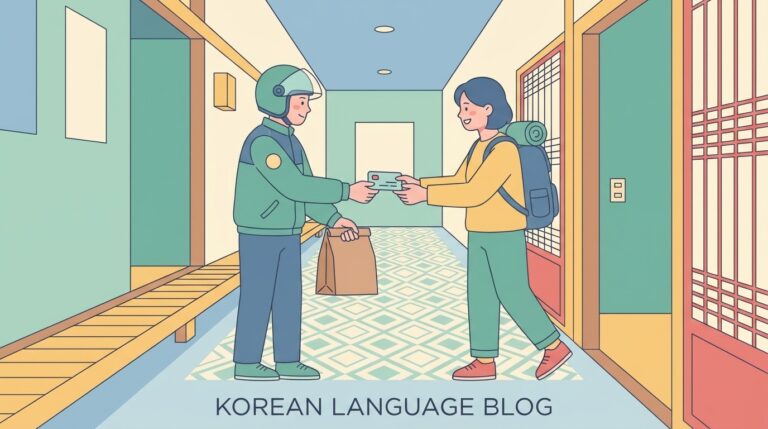
* Two-Hand Rule: When handing over your credit card or receiving the food bag, always use two hands. This is a major sign of respect in Korea!
* The Head Bow: A slight, friendly nod/bow of the head while saying “감사합니다!” (Gam-sa-ham-ni-da! / Thank you!) will make your delivery rider’s day.
4-2. The “Ppalli-Ppalli” (빨리빨리) Delivery Culture
Korea’s delivery system is legendary. It is fast, efficient, and operates almost 24/7. In the past, food was delivered in real ceramic bowls, and you would leave the empty dishes outside your door for the rider to collect later. While most places now use disposable containers, the speed remains lightning-fast!
Phase 5: Real-Life Roleplay Scenario 🎭
Meet Minji, a friendly local delivery rider, and practice your conversation!
- Setting: The entrance of a cozy guesthouse in Seoul. You are waiting for your warm late-night snack.
-
Minji (Rider): 안녕하세요! 배달 왔습니다.
(An-nyeong-ha-se-yo! Bae-dal wat-seum-ni-da.)
“Hello! Delivery is here.” -
You: 아, 감사합니다!
(Ah, gam-sa-ham-ni-da!)
🎭 [Smile warmly and receive the bag with both hands]
“Ah, thank you!” -
Minji (Rider): 결제 도와드릴게요. 카드로 하실 건가요?
(Gyeol-je do-wa-deu-ril-ge-yo. Ka-deu-ro ha-sil geon-ga-yo?)
“I will help you with the payment. Will it be by card?” -
You: 네, 카드 여기요. 저기… 혹시 배달비 얼마예요?
(Ne, ka-deu yeo-gi-yo. Jeo-gi… hok-si bae-dal-bi eol-ma-yeo-yo?)
🎭 [Hand over card with both hands and ask curiously]
“Yes, here is the card. Excuse me… by any chance, how much is the delivery fee?” -
Minji (Rider): 삼천 원입니다! 결제 완료되었습니다.
(Sam-cheon won-im-ni-da! Gyeol-je wan-ryo-doe-at-seum-ni-da.)
“It is 3,000 KRW! Payment is complete.” -
You: 네, 감사합니다. 맛있게 먹을게요!
(Ne, gam-sa-ham-ni-da. Ma-sit-ge meog-eul-ge-yo!)
🎭 [Take your card back with both hands and bow slightly]
“Yes, thank you. I will enjoy the food!”
🔀 Interactive Choice Point!
How would you respond if the rider tells you the fee is cash-only but you don’t have cash?
* A: “죄송해요, 현금 없어요. 카드로 돼요?” (Joe-song-hae-yo, hyeon-geum eop-seo-yo. Ka-deu-ro dwae-yo? / I’m sorry, I don’t have cash. Is card okay?)
* B: “카드 안 돼요? 그냥 취소해 주세요.” (Ka-deu an dwae-yo? Geu-nyang chwi-so-hae ju-se-yo. / Card doesn’t work? Just cancel it.)
* C: “계좌이체 돼요?” (Gye-jwa-i-che dwae-yo? / Can I do a bank transfer?)
Feedback on your choices:
- Best Choice (A): Super polite and perfectly natural! Most delivery riders carry portable card terminals anyway, so asking “카드로 돼요?” is the best solution.
- Bad Choice (B): A bit too blunt and rude for an A1 learner. Canceling at the door hurts the restaurant and rider.
- Risk Choice (C): A great option if you have a Korean bank account, but quite difficult for a foreign traveler without a local app!
Phase 6: 10-Second Emotion Shadowing Drill ⏱️
Let’s practice speaking with real Korean emotion! Focus on the pauses / and the feelings in brackets.
- 배달비 / 얼마예요?
- Pronunciation: Bae-dal-bi / eol-ma-yeo-yo?
- Feeling:
[😊 Polite, soft, and slightly curious]
- 여기 / 배달 / 돼요?
- Pronunciation: Yeo-gi / bae-dal / dwae-yo?
- Feeling:
[🥺 Super hungry and praying they say yes!]
Phase 7: K-Culture Mini Dictionary 📖
- 배달앱 (Bae-dal-aep) | Delivery App
- Usage: Apps like Baemin or Yogiyo used to order food on your phone.
- 배달비 (Bae-dal-bi) | Delivery fee
- Usage: The extra cost added to your bill for delivery services.
- 서비스 (Seo-bi-seu) | Service (Freebie)
- Usage: In Korea, “Service” means a free side dish, drink, or snack given by the owner to show appreciation. If you see a small extra dish with a handwritten note, it’s a “서비스”!
- 카드 (Ka-deu) | Credit/Debit Card
- Usage: The most common payment method for deliveries at the door.
Phase 8: Traveler’s Survival Kit 🎒
Top 3 Survival Phrases for Your Hotel Lobby:
- “문 앞에 두고 가세요.” (Mun ap-e du-go ga-se-yo.)
- Pro Tip: “Please leave it at the door.” (Perfect for contactless delivery!)
- “로비에 맡겨 주세요.” (Ro-bi-e mat-gyeo ju-se-yo.)
- Pro Tip: “Please leave it at the lobby/front desk.”
- “영수증 주세요.” (Yeong-su-jeung ju-se-yo.)
- Pro Tip: “Please give me a receipt.”
🗺️ Editor’s Travel Note
Before ordering, download the official Baedal Minjok App on Google Play or Apple App Store. While most Korean apps require a local phone number, many guesthouse hosts or hotel concierges are happy to help you place the order if you ask politely using your new phrases! (Disclaimer: App policies and delivery fees are subject to change depending on restaurant locations and local weather conditions.)
Phase 9: “One Step Deeper” (Reflective Thought) 💭
In Korea, delivery isn’t just a business; it is tied to the concept of “Jeong” (정 – warm affection and sharing). Delivery riders work extremely hard through rain, snow, and extreme summer heat to bring you hot food. It is common for locals to offer a small canned drink or a hot pack to riders during harsh weather. This small act of kindness shows how connected Korean society is.
💬 Your Turn: How does delivery culture in your country show care for service workers? Let me know in the comments below! I read every single one!
Phase 10: FAQ & Avoiding Common Mistakes ❓
Q: Can I pay with cash for my delivery?
A: Yes! While card payments are more common, you can ask “현금 돼요?” (Hyeon-geum dwae-yo? / Is cash okay?) when the rider arrives. Just make sure to have small bills ready!
Q: What is the average delivery fee in Korea?
A: It usually ranges from 2,000 KRW to 4,000 KRW (about $1.50 to $3.00 USD). However, during late nights or heavy rain, it might go slightly higher.
Q: Can I order food to public parks like the Han River?
A: Yes! Many major parks have designated “Delivery Zones” (배달존 – Bae-dal-jon). You just tell the app or rider which zone number you are standing near.
🚨 Common Mistakes Alert!
- Using “배송” (shipping) instead of “배달” (food delivery).
- Correct Action: Say “배달 돼요?” instead of “배송 돼요?”.
- Not using both hands to pay.
- Correct Action: Keep your hands steady and offer your card with both hands to show local etiquette.
- Panicking and speaking too fast.
- Correct Action: Keep it simple! Just say “배달비 얼마예요?” slowly. Korean people are super friendly and will understand you!
Phase 11: Action Mission! 🏆
- 🥉 Bronze Mission: Write “배달비 얼마예요?” in your phone notepad and read it aloud 3 times today!
- 🥈 Silver Mission: Share this post with a friend who is planning a trip to Korea or loves K-dramas.
- 🥇 Gold Mission: Use “여기 배달 돼요?” next time you are at a local cafe or small eatery in Korea!
🎮 K-Culture Mission: Watch a K-drama today and see if you can spot a scene where characters eat late-night delivery (hint: it’s usually fried chicken or black bean noodles!). Listen closely to see if they say “배달”!
Phase 12: Interactive Quiz Challenge 🧠
Let’s test what you learned!
1. Match the Phrase!
What is the most natural way to ask “How much is the delivery fee?”
* A) 배달비 얼마예요?
* B) 배달비 있습니까?
* C) 배달 요금은 얼마입니까?
🔍 Click to reveal the Answer & Explanation
Answer: A) 배달비 얼마예요?
Explanation: This is the most natural, friendly, and common way to ask. ‘C’ is too robotic, and ‘B’ means “Is there a delivery fee?”.
2. Fill in the Blank!
Complete the phrase: “여기 배달 ____?” (Is delivery available here?)
* A) 비요
* B) 돼요
* C) 있어요
🔍 Click to reveal the Answer & Explanation
Answer: B) 돼요
Explanation: “여기 배달 돼요?” translates to “Is delivery possible/available here?”.
3. True or False?
In Korea, it is polite to use only one hand when giving your card to the delivery rider.
* True / False
🔍 Click to reveal the Answer & Explanation
Answer: False!
Explanation: Always use two hands to hand over your card or receive food to show local respect and politeness!






