

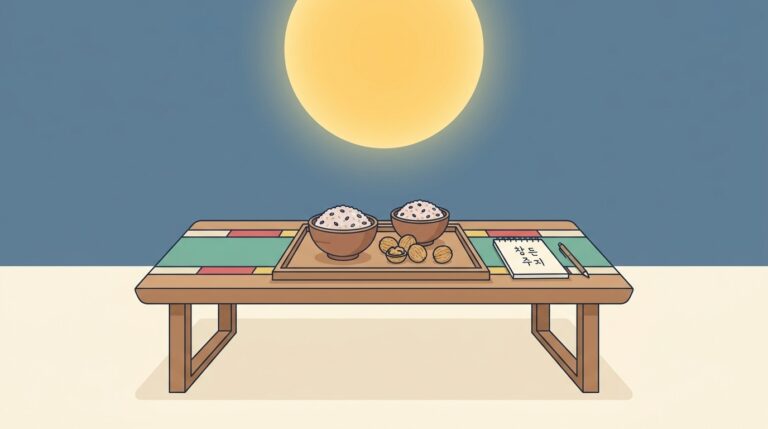
Master Jeongwol Daeboreum: The Art of Cracking Bureom and Savoring Ogokbap Like a Cultural Native
Phase 1: Welcome to the Hearth of Korean Tradition!
안녕하세요! Welcome back to another masterclass by Daily Hangul, your premium cultural navigator. I’m your lead editor, and today we’re stepping out of the standard textbook bubble into the warm, crackling hearth of Korea’s first full moon of the lunar year: 정월 대보름 (Jeongwol Daeboreum).
Imagine this: It is a crisp February evening in Seoul. You walk into a traditional home, expecting a quiet dinner, when suddenly—CRACK! A sharp, echoing sound of walnuts and peanuts being shattered by bare teeth fills the room, followed by hearty laughter and chants of “내 더위 사가라!” (Buy my summer heat!).
If you’re a C2-level learner, you already know the big holidays like Seollal (Lunar New Year) and Chuseok. But to truly understand the spiritual, linguistic, and communal fabric of Korea, you must conquer the nuanced vernacular of Jeongwol Daeboreum. Today, we will explore the deep-seated linguistic talismans of this festival so you can converse not just as an advanced speaker, but as a true cultural insider who understands the collective wishes of a nation.
Phase 2: Key Expressions Deep Dive
1. 부럼을 깨물다 (Bureom-eul kkaemulda)
- Pronunciation: boo-reom-eul kkae-mool-da (Sounds like “boo-rum” with a sharp “kkae” and a resolute “mool-da”)
- Meaning: To crack hard-shelled nuts (bureom) with one’s teeth on the first full moon.
- K-Culture Moment: In standard family K-Dramas, you’ll often see a grandfather handing out walnuts, chestnuts, and ginkgo nuts to family members early in the morning, urging them to bite hard to ward off modern-day stress and skin troubles.
- Editor’s Insight: This is not a passive act of “eating nuts” (견과류 먹기). The verb 깨물다 (to bite down/clench) carries a tactile, protective resolve. By cracking the shell with your teeth, you are physically performing an ancient psychosomatic ward against dental disease and skin boils (부스럼 – buseoreom, which sounds homophonically identical to bureom).
- Situation Spectrum: Casual (✅) | Semi-formal (✅) | Formal (⚠️ – use more polite honorific verbal endings like “부럼을 깨물며 건강을 기원합니다”)
- 🤔 Think About It: Does your native culture have a physical, sensory ritual to safeguard health? How does the crisp sound of a cracking shell reinforce psychological resilience in your own community?
2. 내 더위 사가라 (Nae deowi sagara)
- Pronunciation: nae deo-wi sa-ga-ra (Sounds like “nay duh-we sah-gah-rah”)
- Meaning: “Buy my heat!” / Take away my upcoming summer heat susceptibility!
- K-Culture Moment: A playful morning game where children call out a friend’s name. The moment the friend answers “응?” (Yes?), the caller quickly shouts this phrase to jokingly transfer their summer fatigue to the victim.
- Editor’s Insight: Grammatically, this utilizes the compound verb 사 가다 (to buy and go) combined with the blunt imperative suffix -아라/어라. In Korea’s linguistic history, speech holds physical weight (말이 씨가 된다). This phrase acts as a verbal contract, lightheartedly shifting the upcoming physical burdens of the agricultural cycle to someone else.
- Situation Spectrum: Casual (✅) | Semi-formal (🚫) | Formal (🚫)
- 🤔 Think About It: Notice the linguistic playfulness of transferring vulnerability through speech. How does this compare to superstitions like “knocking on wood” or “jinxing” in your language?
3. 오곡밥으로 액운을 막다 (Ogokbap-euro aegun-eul makda)
- Pronunciation: o-gok-bap-eu-ro aeg-un-eul mak-da (Sounds like “oh-gok-bap-oo-ro egh-oon-ool mahk-dah”)
- Meaning: To ward off misfortune using five-grain rice.
- K-Culture Moment: High-end culinary documentaries highlighting the delicate balance of glutinous rice, millet, sorghum, black beans, and red beans, cooked to perfection to synchronize the five elements.
- Editor’s Insight: At the C2 level, look at the noun 액운 (misfortune/evil spirits) and the verb 막다 (to block/prevent). Traditional Korean gastronomy is inherently functional and spiritual (약식동원 – food and medicine share the same root). Eating five grains is not a mere diet; it is a defensive, communal culinary shield.
- Situation Spectrum: Casual (✅) | Semi-formal (✅) | Formal (✅)
- 🤔 Think About It: How does your culture view the relationship between seasonal food and spiritual alignment? Is food merely sustenance, or is it a barrier against unseen adversity?
Phase 3: Textbook Korean vs. Real Native Korean
Scenario 1: Wishing Someone Well on the Holiday
- 📖 Textbook Korean: 정월 대보름을 축하합니다. (Jeongwol Daeboreum-eul chukha-hamnida.)
- Translation: “Congratulations on the Great Full Moon Festival.”
- 🗣️ Real Native Korean: 올 한 해도 무탈하고 더위 타지 마세요! (Ol han haedo mutal-hago deowi taji maseyo!)
- Translation: “May you remain safe and sound this year, and don’t suffer from the summer heat!”
- 💡 Why the difference? Koreans rarely “congratulate” a lunar cycle. Instead, they exchange highly practical, somatic wishes centered on enduring physical hardships (like extreme heat and agricultural labor) through seasonal transitions.
Scenario 2: Explaining Nut Cracking
- 📖 Textbook Korean: 건강을 위해 견과류를 깨서 먹습니다. (Geongang-eul wihae gyeongwaryu-rula kkaeseo meokseumnida.)
- Translation: “We crack and eat nuts for health purposes.”
- 🗣️ Real Native Korean: 일 년 내내 부스럼 안 나게 부럼 야무지게 깨물어야죠! (Il nyeon naenae buseoreom an nage bureom yamujige kkaemureoyajyo!)
- Translation: “We’ve got to firmly crack these nuts so we don’t get a single skin boil all year long!”
- 💡 Why the difference? The specific use of 부스럼 (boils) establishes the historical context of winter nutrient deficiency. Using the highly idiomatic adverb 야무지게 (firmly, smartly) captures the spirited, intentional vibe of the tradition.
Phase 4: K-Culture Deep Dive & Non-Verbal Etiquette
4-1. Nunchi (눈치) & Gesture: The Silent Rules
When cracking bureom in front of elders, never reach for a mechanical nutcracker unless specifically offered; doing so ruins the symbolic wish of strengthening your own teeth! However, to balance this with modern hygienic 눈치 (Nunchi), cover your mouth slightly with your non-dominant hand while biting down to prevent any stray shell fragments from flying across the table. When offering a cracked nut to an elder, use both hands with a slight bow of the head, saying, “건강을 기원하는 뜻으로 드립니다” (I offer this as a wish for your good health).
4-2. Cultural Code: The Wisdom of Jinchaesik (진채식)
Jeongwol Daeboreum culinary culture is heavily centered on 진채식 (seasoned dried winter greens). Our ancestors preserved summer vegetables by drying them under the autumn sun to eat on this day. At a Korean table, recognizing these dried greens (like radish greens, aster, and eggplant) and complementing their earthy flavors shows an incredibly advanced appreciation of the Korean ecological ethos of recycling nature’s seasonal abundance.
Phase 5: Real-Life Roleplay Scenario
The Setting
You are staying at a traditional Hanok guesthouse in Bukchon, Seoul. The host, Grandmother Min-young (민영 할머니)—a warm-hearted but strict guardian of culinary heritage—is preparing the Daeboreum feast.
Characters:
* 민영 할머니 (Grandmother Min-young): Guesthouse host, proud traditionalist.
* You (C2 Speaker): An advanced learner aiming to blend in naturally.
The Dialogue
- 민영 할머니: (Bringing out a wooden tray piled with walnuts and five-grain rice) “자, 오늘이 정월 대보름인데, 외국에서 온 우리 손님도 부럼 맛 좀 봐야지?”
(Here, today is Jeongwol Daeboreum. Our guest from abroad should also taste some bureom, right?) -
You: 🎭 (Eyeing the walnuts with playful determination) “할머니, 오늘을 위해서 제가 아침부터 어금니를 튼튼하게 준비해 뒀습니다!”
(Grandmother, I’ve kept my molars strong and ready since this morning just for today!) -
민영 할머니: 🎭 (Laughs warmly) “허허, 말 한마디가 아주 야무지네! 자, 이 호두부터 한 번 깨물어 봐라. 이가 튼튼해야 복도 잘 씹어 삼키지.”
(Haha, your words are so clever! Here, try cracking this walnut first. Your teeth must be strong to chew and swallow good fortune.) -
You: 🎭 (Covering your mouth slightly as you bite down with a sharp crack) “합! 거봐요 할머니, 깨졌죠? 올 한 해 제 부스럼은 이걸로 싹 물러갔네요.”
(Hap! See, grandmother, it cracked! With this, all my skin boils for the year are completely gone.) -
민영 할머니: “아이고, 부스럼 얘기까지 하는 걸 보니 영락없는 한국 사람 다 됐네. 오곡밥도 한 그릇 들고 가라.”
(Oh my, hearing you talk about buseoreom makes you look just like a real Korean. Have a bowl of five-grain rice, too.) -
You: 🎭 (Taking the bowl with both hands) “감사히 먹겠습니다. 그런데 할머니, 저 오곡밥 먹기 전에 드릴 말씀이 있는데요… 민영 할머니!”
(Thank you for the meal. But grandmother, before I eat this ogokbap, there is something I must tell you… Grandmother Min-young!) -
민영 할머니: 🎭 (Looking up, curious) “왜 부르냐? 무슨 일 있어?”
(Why are you calling me? Is something wrong?) -
You: 🎭 (Grinning mischievously) “제 더위 사가세요! 올해 제 더위는 이제 다 할머니 겁니다!”
(Buy my summer heat! All of my heat this year belongs to you now!) -
민영 할머니: 🎭 (Swatting your arm playfully) “아이구, 내가 한 발 늦었네! 내 더위를 먼저 팔았어야 했는데! 아주 영악한 녀석이군!”
(Oh my, I was one step too late! I should have sold mine first! What a clever rascal!)
🔀 Interactive Choice Point
Grandmother Min-young now asks you to try the 귀밝이술 (Gwibalgisul – ear-clearing rice wine) served cold. How do you respond?
- Selection A: “술은 몸에 해로우니 사양하겠습니다.” (I will decline as alcohol is bad for the body.)
- Selection B: 🎭 (Receiving the cup with both hands, turning your torso slightly away to drink) “이 귀밝이술 마시고 올해는 할머니의 따뜻한 덕담만 귀에 가득 차길 바랄게요.” (Drinking this ear-clearing wine, I hope my ears are filled only with your warm words of wisdom this year.)
- Selection C: “우와, 이거 낮술이네요! 원샷 하겠습니다!” (Wow, daytime drinking! Let’s bottom’s up!)
💡 Feedback Loop
- Selection A (Bad): While personal choices are respected, flatly declining traditional ceremonial food/drink with a clinical, moralizing reason breaks the warm, communal rhythm of the holiday.
- Selection B (Best): This is the gold standard of C2 pragmatics. You combined the physical respect of turning your torso away to drink with a poetic, culturally rich toast that flatters the host.
- Selection C (Risk): While energetic, treating the sacred morning ritual of Gwibalgisul as a casual daytime drinking game (낮술) might make you seem unrefined to traditional elders.
Phase 6: 10-Second Emotion Shadowing Drill
Practice these sentences with the exact rhythm, pause (/), and emotional intent to sound indistinguishable from a native speaker.
- Drill 1: [😊 Mischievously, with a sparkling tone]
- “내 더위 / 홀랑 사 가라! / 올해 더위는 / 네가 다 책임지는 거다? / 하하!”
- (Nae deowi / hollang sa gara! / Olhae deowinin / nega da chaegimjineun geoda? / Haha!)
- Drill 2: [🥺 Sincerely and reverently, wishing for safety]
- “올 한 해는 / 부스럼 하나 없이 / 무사태평하게 / 보낼 수 있게 해 주세요!”
- (Ol han haenun / buseoreom hana eopsi / musataepyeonghage / bonael su itge hae juseyo!)
Phase 7: K-Culture Mini-Dictionary
- 부스럼 (Buseoreom)
- Meaning: Boils or skin eruptions.
- Real-life Usage: Used symbolically on Daeboreum to represent all physical impurities and stress breakouts that accumulate over winter.
- 귀밝이술 (Gwibalgisul)
- Meaning: Ear-clearing wine.
- Real-life Usage: A cold cheongju (refined rice wine) consumed on Daeboreum morning to bless the drinker with sharp hearing and only good news throughout the year.
- 더위팔기 (Deowipargi)
- Meaning: Heat-selling.
- Real-life Usage: A playful verbal game of passing potential summer exhaustion to friends before the sun rises on Daeboreum.
- 무사태평 (Musa-taepyeong)
- Meaning: Peace, safety, and tranquility (無事泰平).
- Real-life Usage: A sophisticated four-character idiom (사자성어) used in formal greetings to wish for a year completely devoid of accidents or chaos.
Phase 8: The Traveler’s Survival Kit
Survival Expressions TOP 3
- “이거 이번 대보름에 직접 만드신 오곡밥인가요?”
- Pronunciation: I-geo ibeon daeboreume jikjeop mandusin ogokbamingayo?
- Pro Tip: Use this at traditional restaurants to immediately signal your high-level awareness of seasonal custom cuisines.
- “더위 사세요!”
- Pronunciation: Deowi saseyo!
- Pro Tip: Use this playfully with close Korean colleagues or friends on the morning of Daeboreum to show your witty sense of humor.
- “부럼 깨물어서 그런지 올해 치과 갈 일은 없겠어요.”
- Pronunciation: Bureom kkaemureoseo geureonji olhae chigwa gal ireun eopgesseoyo.
- Pro Tip: A clever joke to use after cracking nuts, blending the traditional myth with modern life (dentist visits).
🗺️ Editor’s Travel Note
If you are visiting Korea during late winter or early spring, head straight to the National Folk Museum of Korea or check out cultural events organized by local communities in Bukchon Hanok Village. They offer interactive programs where you can taste freshly steamed ogokbap and receive your own bag of bureom nuts. Note: Event schedules and program availability vary annually based on the lunar calendar, so double-check before planning your journey.
Phase 9: “A Step Deeper” – The Collectivist Philosophy of Food Sharing
In Western societies, health is often treated as a highly individualized pursuit—you take your vitamins, go to your gym, and monitor your personal biometrics. In traditional Korean culture, however, health is a collective responsibility. On Jeongwol Daeboreum, there was an agrarian custom called 백가반 (Baekgaban), where families would gather and share five-grain rice with neighbors of different surnames. It was believed that eating rice cooked by neighbors from at least three different households would bring supreme luck. This simple act reveals the warm essence of 정 (Jeong): the belief that individual well-being is intrinsically bound to the harmony of the entire village.
💬 Your Turn: How does your home country celebrate seasonal changes? Do you share specific, symbolic dishes with your neighbors to build community bonds? Share your cultural stories in the comments below!
Phase 10: FAQ & Common Mistakes
FAQ
Q: Is it rude to sell heat (더위팔기) to someone older than me?
A: Yes, absolute etiquette caution is required here! 더위팔기 is strictly a peer-to-peer game. Calling an elder’s name and trying to sell them your heat is considered disrespectful. Only do this with close friends, classmates, or younger relatives.
Q: What if I have weak teeth or dental work? Do I have to use my teeth for bureom?
A: While the ritual traditionally emphasizes biting with teeth to test oral health, do not damage your dental work! You can make a soft biting gesture to maintain the symbolic spirit, then use a napkin or your hand to break the nut shell safely.
Q: Can vegetarians eat Ogokbap and Jinchaesik?
A: Absolutely! Ogokbap and the accompanying seasoned dried greens (진채식) are completely plant-based and incredibly healthy, making them perfect vegetarian-friendly representations of Korean temple and traditional cuisine.
🚨 Common Mistakes Warning
| Incorrect Action | Why It’s Wrong | Correct Action |
|---|---|---|
| Calling the holiday “보름날” in formal contexts | It is too casual and generic (means “any full moon day”). | Use the precise term 정월 대보름 to specify the first lunar full moon. |
| Saying “부럼을 깨다” to refer to the bodily act | While grammatically okay, it sounds like breaking nuts with a hammer. | Use the idiomatic and traditional verb 부럼을 깨물다 (to bite/clench). |
| Wishing people “새해 복 많이 받으세요” on Daeboreum | Seollal has passed; this greeting is redundant now. | Say “무사태평하고 건강한 한 해 보내세요” instead. |
Phase 11: Action Mission
- 🥉 Bronze Mission: Find a bag of mixed walnuts and peanuts at your local market, crack them, and say out loud: “올해 부스럼은 이걸로 끝!” (This is the end of skin troubles for this year!)
- 🥈 Silver Mission: Record yourself doing our 10-Second Shadowing Drill on Instagram or TikTok, tag @Daily_Hangul, and show off your perfect pitch-accent.
- 🥇 Gold Mission: Call a close Korean friend on the morning of Jeongwol Daeboreum, trick them into answering their phone, and instantly yell, “내 더위 사가라!”
- 🎮 K-Culture Mission: Watch a traditional cooking segment on YouTube, identify at least three different dried greens (진채식) used alongside ogokbap, and drop their names in the comments below!
Phase 12: Interactive Quiz Challenge
Test your cultural fluency with this quick check-in!
1. Situational Judgment
You are visiting a Korean family on the morning of Jeongwol Daeboreum. The host offers you a cold glass of Gwibalgisul (귀밝이술). What is the most culturally appropriate advanced response?
* A) “아침부터 술을 마시면 하루 종일 취해 있어서 안 됩니다.”
* B) “귀를 밝혀주는 술이라니, 아주 멋진 전통이네요! 올 한 해 좋은 소식만 들을 수 있게 한 모금 마시겠습니다.”
* C) “감사합니다! 원샷하겠습니다!”
Reveal Correct Answer & Explanation
Correct Answer: B
Explanation: Explaining the cultural significance of the drink back to the host in a respectful, appreciative manner while accepting the symbolic cup shows deep linguistic mastery and social grace (Nunchi).
2. Fill in the Blanks
Complete the sentence with the correct vocabulary matching the Daeboreum tradition:
* “정월 대보름에는 피부에 ( )이 안 생기도록 딱딱한 견과류인 ( )을 깨뭅니다.”
Reveal Correct Answer & Explanation
Correct Answer: 부스럼 (Buseoreom) / 부럼 (Bureom)
Explanation: Homophonic wordplay is key here! You bite down on 부럼 (nuts) to ward off 부스럼 (skin boils). Excellent job matching these two!
3. True or False?
True or False: The game of “selling heat” (더위팔기) can be done at any time during the day on Jeongwol Daeboreum.
Reveal Correct Answer & Explanation
Correct Answer: False
Explanation: The traditional rule of Deowipargi states that you must sell your heat before the sun rises on the morning of Daeboreum. Once the sun is up, the transaction is no longer spiritually valid!
“, 200:







