

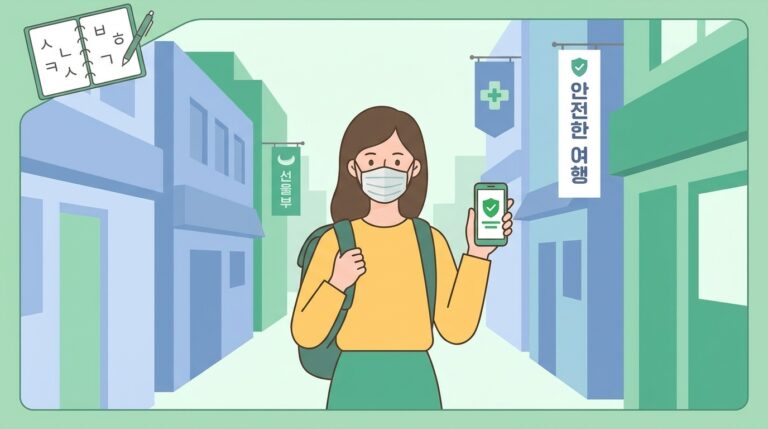
Stay Safe and Calm: The Ultimate C1 Guide to Navigating Pandemic and Safety Terms in Korea
Phase 1: Empathy (Our Shared Journey to Safety)
안녕하세요! It’s your Chief Editor and cultural companion from Daily Hangul.
Imagine this: You’re watching the thrilling K-drama Happiness (해피니스), where an apartment complex is sealed off due to a mysterious infectious disease. You see the characters frantically communicating with health officials, navigating quarantine protocols, and discussing tracking routes. Or perhaps you recall the intense real-life days of pandemic management in Korea, where loud 재난문자 (disaster alerts) buzzed on everyone’s phones simultaneously.
As a high-intermediate to advanced (C1) learner, you aren’t just looking for simple phrases like “I am sick” (아파요). You want to understand the sophisticated social systems, precise administrative terms, and the nuanced community-first mindset that defines Korea’s approach to public safety. When a crisis hits, knowing the right words isn’t just about language proficiency—it is about safety, autonomy, and peace of mind. Let’s dive deep into the essential vocabulary and cultural codes that will help you navigate any public health scenario in Korea like a seasoned local.
Phase 2: Deep Dive into 3 Key Expressions
At the C1 level, you need vocabulary that allows you to read news reports, understand government briefings, and engage in high-level discussions.
1. 선제적으로 대응하다 (Seonjejeog-euro dae-eunghada)
- Pronunciation: [Seon-je-jeok-eu-ro dae-eung-ha-da] (Think of seon-je like “sun-jae” from Lovely Runner, combined with “dae-eung” meaning to respond or counter).
- Meaning: To respond preemptively / To take proactive measures.
- K-Culture Moment: You will hear this phrase constantly in government briefings on SBS or KBS News. For example, when a city government decides to test all residents in a specific block before a cluster outbreak spreads.
- Editor’s Insight: The word 선제적 (preemptive) is a combination of 선 (first/ahead) and 제 (to control/制). In Korean administrative culture, acting before a problem escalates is highly valued as a sign of competent leadership and civic responsibility.
- Situation Spectrum: Casual (⚠️ – too formal for casual chat, use ‘미리 대처하다’ instead) | Semi-formal (✅) | Formal (✅)
- 🤔 Think About It: How does your home country’s administrative language compare? Is there a similar emphasis on “preemption” (선제) over “reaction” (대응) in public safety?
2. 방역 수칙을 준수하다 (Bang-yeog suchig-eul junsuhada)
- Pronunciation: [Bang-yeok su-chik-eul jun-su-ha-da] (Bang-yeok sounds like “bahng-yuck”; jun-su sounds like the male name “Jun-su”).
- Meaning: To adhere to quarantine/epidemiological guidelines.
- K-Culture Moment: Seen on banners in subway stations, cafes, and universities during public health emergencies.
- Editor’s Insight: While “준수하다” means to comply or adhere to, 방역 (quarantine/epidemic prevention) is a heavy word. In Western contexts, “quarantine” often implies strict isolation, but in Korea, 방역 refers to the collective, systematic defense against disease (mask-wearing, hand sanitizing, social distancing).
- Situation Spectrum: Casual (🚫) | Semi-formal (✅) | Formal (✅)
- 🤔 Think About It: The word “수칙” (rules/guidelines) implies a shared social contract. Why do you think Koreans feel a strong moral obligation to follow these collective rules?
3. 동선이 겹치다 (Dongseon-i gyeopchida)
- Pronunciation: [Dong-seon-i gyeop-chi-da] (Dong-seon means “line of movement/route”; gyeop-chi-da means “to overlap”).
- Meaning: Routes/travel paths overlapped (with a confirmed case).
- K-Culture Moment: A text message alert pops up: “확진자와 동선이 겹치신 분은 검사를 받으시기 바랍니다” (Those whose paths overlapped with the confirmed case, please get tested).
- Editor’s Insight: Dongseon (동선 / 動線) literally translates to “moving line.” During epidemiological investigations, tracing one’s dongseon is a standard procedure. If someone says “너랑 나랑 동선이 겹쳤네!” in a casual context, it just means “Our paths crossed today!”
- Situation Spectrum: Casual (✅) | Semi-formal (✅) | Formal (✅)
- 🤔 Think About It: In some cultures, tracking individual paths raises high privacy concerns. In Korea, public safety transparency often takes temporary precedence. How do you balance this dynamically in your own mind?
Phase 3: Textbook Korean vs. Real Korean
Let’s look at how official instructions translate into real-life spoken Korean.
Scenario A: Reminding someone to wear/adjust their mask
- 📖 Textbook Korean: 마스크를 올바르게 착용해 주십시오. (Please wear your mask correctly.)
- 🗣️ Real Korean: 마스크 코 위까지 꼭 올려 쓰셔야 해요. (You really have to pull your mask up over your nose.)
- 💡 Why the difference? Administrative Korean uses “착용하다” (to wear/don), but real people use the active verb “올려 쓰다” (to pull up and wear). Koreans will politely but firmly remind you of this, especially in tight spaces like elevators.
Scenario B: Describing how you avoided getting sick
- 📖 Textbook Korean: 저는 백신 접종을 완료하여 감염되지 않았습니다. (I completed my vaccination and was not infected.)
- 🗣️ Real Korean: 다행히 백신 패스 덕분에 위기를 모면했어요. (Thankfully, I dodged a bullet thanks to the vaccine pass.)
- 💡 Why the difference? C1 speakers should use colorful idiomatic expressions like “위기를 모면하다” (to escape a crisis / dodge a bullet) to sound natural instead of sounding like an official document.
Phase 4: K-Culture Deep Dive & Non-verbal Manners
4-1. Nunchi (눈치) & Quarantine Gestures
During a pandemic in Korea, your 눈치 (social wits/intuitive sense) must operate at 100%.
* The “X” Hand Sign: If you try to enter a facility without scanning your QR code or showing your digital certificate, a staff member might make an “X” sign with their forearms. This is not rude; it is a universal, non-verbal “halt” sign in Korea to prevent entry without checking.
* The Polite Bow-Cough: If you must cough or sneeze, turn your head completely away from others, cough into your inner sleeve, and give a quick, apologetic slight bow (목례) to reassure those around you that you are taking care.
4-2. The
Frequently Asked Questions (FAQ)
Q: What does "선제적으로 대응하다 (Seonjejeog-euro dae-eunghada)" mean in Korean and how do you pronounce it?
A: In Korean, "선제적으로 대응하다 (Seonjejeog-euro dae-eunghada)" is pronounced [Seon-je-jeok-eu-ro dae-eung-ha-da] and means: To respond preemptively / To take proactive measures.
Q: What does "방역 수칙을 준수하다 (Bang-yeog suchig-eul junsuhada)" mean in Korean and how do you pronounce it?
A: In Korean, "방역 수칙을 준수하다 (Bang-yeog suchig-eul junsuhada)" is pronounced [Bang-yeok su-chik-eul jun-su-ha-da] and means: To adhere to quarantine/epidemiological guidelines.
Q: What does "동선이 겹치다 (Dongseon-i gyeopchida)" mean in Korean and how do you pronounce it?
A: In Korean, "동선이 겹치다 (Dongseon-i gyeopchida)" is pronounced [Dong-seon-i gyeop-chi-da] and means: Routes/travel paths overlapped (with a confirmed case).







