

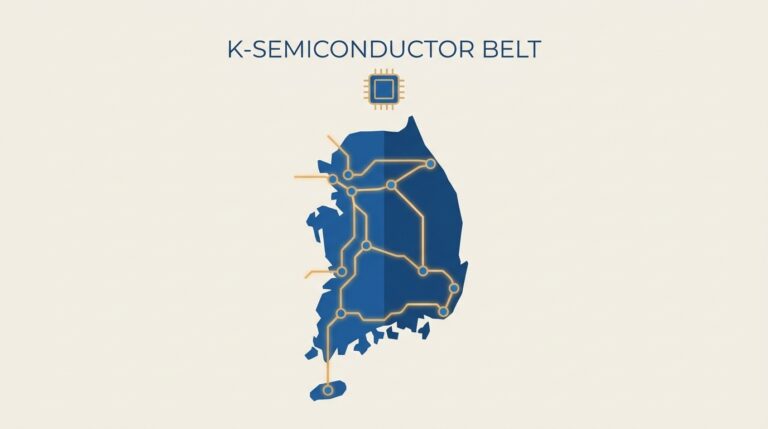
Master Korea’s Tech Powerhouse: Decoding the K-Semiconductor Belt Strategy (K-반도체 벨트)
Phase 1: Empathy & Storytelling
안녕하세요! It’s your friendly Korean tutor and local culture navigator from Daily Hangul.
Imagine this: You are sitting in a sleek, glass-walled conference room in Yeouido, Seoul’s financial hub, or perhaps watching a high-stakes economy segment on JTBC News. The anchors are gesturing toward a map of the Korean peninsula, glowing with blue and orange zones connecting towns like Yongin, Giheung, and Pyeongtaek. Suddenly, phrases like “초격차 기술” (super-gap technology) and “생태계 조성” (ecosystem creation) start flying around.
You can understand basic business Korean, but the sheer weight of these strategic terms makes your head spin. How do Korean tech executives speak so confidently about global supply chains?
Don’t worry! Today, we are upgrading your vocabulary to the C1 (Advanced) level by deep-diving into the K-Semiconductor Belt Strategy (K-반도체 벨트 전략). Mastering these terms will not only help you ace advanced business meetings but also unlock deep analytical conversations with Korean colleagues over dinner. Let’s decode the language of the world’s silicon powerhouse together!
Phase 2: Key Expressions Analysis
1. 초격차 기술 (Cho-gyeok-cha Gi-sul)
- Pronunciation: Cho-gyuck-cha gi-sul (Think of the “cho” in chocolate, “gyuck” sounding like a sharp “yuck” with a ‘g’, and “cha” as in the dance “cha-cha”).
- Meaning: Super-Gap Technology (An insurmountable technological lead over competitors).
- K-Culture Moment: This term is the holy grail of Korean conglomerates like Samsung Electronics and SK Hynix. In business news and tech K-dramas, whenever a CEO announces a brand-new 2-nanometer chip process, they call it the realization of 초격차 기술.
- Editor’s Insight: Standard advanced tech is just “첨단 기술” (advanced technology). But 초격차 implies a competitive philosophy deeply rooted in the Korean mindset: not just leading the race, but running so fast that competitors lose sight of you entirely.
- Situation Spectrum: Casual (🚫) / Semi-formal (⚠️) / Formal (✅)
- 🤔 Think About It: Does your native culture emphasize “gradual co-existence” in business, or is there a direct equivalent to Korea’s relentless pursuit of an “insurmountable gap” (초격차)?
2. 생태계 조성 (Saeng-tae-gye Jo-seong)
- Pronunciation: Sang-tae-gyeh jo-sung (“Saeng” as in “sang-ria” but with a flat ‘ae’, “tae” as in taekwondo, and “gye” like “ye-s” with a ‘g’).
- Meaning: Ecosystem Fostering / Creation.
- K-Culture Moment: In government briefings regarding the K-Semiconductor Belt, policymakers always stress that a semiconductor industry cannot thrive with giant foundries alone. It requires 생태계 조성—nurturing smaller fabless and packaging companies around the giants.
- Editor’s Insight: While “생태계” biologically means an ecosystem, in Korean business, it highlights organic interdependence. If you suggest a project in Korea, don’t just talk about “building a network” (네트워크 구축); use “생태계 조성” to sound highly professional and strategic.
- Situation Spectrum: Casual (⚠️ – used when joking about a chaotic group chat) / Semi-formal (✅) / Formal (✅)
- 🤔 Think About It: How does viewing an industry as a living, breathing “ecosystem” change your approach to business partnerships in Korea?
3. 내재화하다 (Nae-jae-hwa-hada)
- Pronunciation: Nay-jae-hwa-ha-da (“Nae” as in “nay”, “jae” as in the musical “ja-zz” with an ‘ae’ sound, and “hwa” as in the start of “what”).
- Meaning: To Internalize / Domestically Localize (especially technology or supply chains).
- K-Culture Moment: Following the global supply chain crises of recent years, you will hear Korean tech analysts passionately debate the need to 내재화하다 critical raw materials (소재) and equipment (장비) to avoid external shocks.
- Editor’s Insight: This is a high-level Hanja-based verb (內在化). Using this instead of “국산화하다” (to domesticate production) shows a deep, systemic understanding of corporate and national security strategy.
- Situation Spectrum: Casual (🚫) / Semi-formal (⚠️) / Formal (✅)
Phase 3: Textbook Korean vs. Real-World Korean
Situation 1: Discussing a business bottleneck
- 📖 Textbook Korean: “공급망에 문제가 생겼습니다.”
(There is a problem in the supply chain.) - 🗣️ Real-World Korean: “글로벌 공급망 이슈가 우리의 발목을 잡고 있습니다.”
(Global supply chain issues are holding us back/grabbing our ankles.) - 💡 Why the difference?: C1 speakers use vivid, native-level idioms. “발목을 잡다” (to grab one’s ankle) is a highly common idiom used even in serious economic panels to describe a critical bottleneck that stalls progress.
Situation 2: Gaining a dominant market share
- 📖 Textbook Korean: “우리 회사는 시장 점유율을 많이 올렸습니다.”
(Our company increased our market share a lot.) - 🗣️ Real-World Korean: “우리가 시장을 선점하며 완전히 승기를 잡았습니다.”
(We preoccupied the market and completely seized the momentum of victory.) - 💡 Why the difference?: “승기를 잡다” (to seize the momentum of victory) originates from military strategy and is heavily favored by Korean corporate leaders to express definitive, aggressive market leadership.
Phase 4: K-Culture Deep-Dive & Non-Verbal Etiquette
4-1. Nunchi (눈치) & Non-Verbal Manners in Tech Meetings
When presenting or discussing the K-Semiconductor Belt map in front of Korean executives, your physical manners must match your advanced vocabulary:
* The Open-Palm Gesture: Never point at a slide or map with a single index finger. It can feel overly aggressive or casual. Instead, extend your hand with your palm facing slightly upward and fingers together to guide your audience’s eyes.
* The “Agreeable Nod” Angle: When a senior director explains the alignment between the Giheung and Pyeongtaek campuses, do not nod frantically. Maintain steady eye contact, tilt your head slightly forward (about 10 degrees), and offer a slow, deliberate nod of intellectual agreement.
4-2. Cultural Code: The National Pride of
Frequently Asked Questions (FAQ)
Q: What does "초격차 기술 (Cho-gyeok-cha Gi-sul)" mean in Korean and how do you pronounce it?
A: In Korean, "초격차 기술 (Cho-gyeok-cha Gi-sul)" is pronounced [Cho-gyuck-cha gi-sul (Think of the "cho" in chocolate, "gyuck" sounding like a sharp "yuck" with a 'g', and "cha" as in the dance "cha-cha"] and means: Super-Gap Technology (An insurmountable technological lead over competitors).
Q: What does "생태계 조성 (Saeng-tae-gye Jo-seong)" mean in Korean and how do you pronounce it?
A: In Korean, "생태계 조성 (Saeng-tae-gye Jo-seong)" is pronounced [Sang-tae-gyeh jo-sung ("Saeng" as in "sang-ria" but with a flat 'ae', "tae" as in taekwondo, and "gye" like "ye-s" with a 'g'] and means: Ecosystem Fostering / Creation.
Q: What does "내재화하다 (Nae-jae-hwa-hada)" mean in Korean and how do you pronounce it?
A: In Korean, "내재화하다 (Nae-jae-hwa-hada)" is pronounced [Nay-jae-hwa-ha-da ("Nae" as in "nay", "jae" as in the musical "ja-zz" with an 'ae' sound, and "hwa" as in the start of "what"] and means: To Internalize / Domestically Localize (especially technology or supply chains).







