

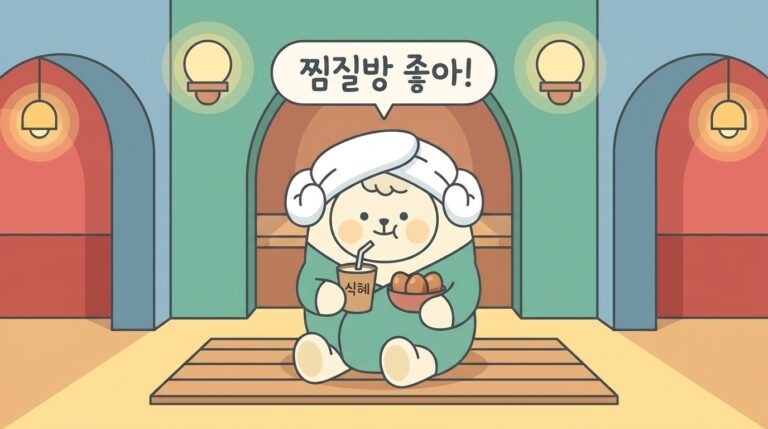
Phase 1: Empathy (스토리 몰입형 오프닝)
안녕하세요! 매일한글 에디터입니다. 😊
Have you ever walked into a Korean Jjimjilbang (찜질방—hot spring spa) feeling a bit like an outsider? You see groups of friends laughing, wearing adorable towel ‘sheep heads’ (yang-meori), and cracking roasted eggs on each other’s foreheads. You want to join the fun, but standard textbook phrases like “이것은 온천입니다” (This is a hot spring) make you sound more like an audio guide than a local buddy.
Today, we’re diving into the warm, steaming, and incredibly cozy heart of Korean bathhouse culture. Our goal? Moving you from a hesitant observer to a seasoned regular who knows exactly how to order, behave, and converse with local flair. This guide is built on real-world situations and feedback from advanced learners who wanted to blend in seamlessly. Ready to soak in? Let’s go!
Phase 2: 핵심 표현 3선 심층 분석 (Deep Dive: 3 Essential Expressions)
1. 몸을 지지다 (Mom-eul jijida)
- Pronunciation: [Mom-eul ji-ji-da] (Think of ‘ji-ji’ sounding like the ‘ge’ in ‘gentle’, but shorter and crisper)
- Meaning: Lit. “to sear/griddle one’s body.” Idiomatically: To soak in a hot bath or lie in a heavily heated clay room to melt away deep fatigue.
- K-Culture Moment: You will hear tired characters in K-Dramas say this with a long, satisfying sigh as they sink into a 42°C tub or a hot clay kiln.
- Editor’s Insight: This isn’t just ‘taking a bath’ (mok-yok). It’s a therapeutic, deep-bone warming experience. It conveys a deep sense of relief and physical recovery.
- Situation Spectrum: Casual (✅) | Semi-formal (⚠️) | Formal (🚫)
- 🤔 Think About It: In Western cultures, high heat is often associated with discomfort. Why do you think Koreans use a food-cooking verb like “지지다” (to pan-fry/sear) to describe ultimate relaxation?
2. 살얼음 동동 뜨다 (Sal-eoreum dong-dong tteuda)
- Pronunciation: [Sal-eo-reum dong-dong tteu-da] (The ‘dong-dong’ mimics the light, buoyant floating sound of ice chips)
- Meaning: Lit. “Thin ice floats buoyantly.” Used to describe an incredibly icy, refreshing drink or broth, particularly Sikhye (식혜—sweet rice punch).
- K-Culture Moment: Usually shouted happily at the snack bar counter after sweating out 2 liters of water in the Bulgama (불가마—hot oak kiln).
- Editor’s Insight: Standard Korean would just say “얼음 넣어주세요” (Please add ice). But using “살얼음 동동” shows you appreciate the delicate texture of shaved thin ice that melts on your tongue.
- Situation Spectrum: Casual (✅) | Semi-formal (✅) | Formal (⚠️)
- 🤔 Think About It: How does your culture linguistically handle the texture of ice in food and drinks? Is it just ‘crushed’ or does it have an aesthetic description?
3. 이열치열 (I-yeol-chi-yeol)
- Pronunciation: [I-yeol-chi-yeol]
- Meaning: “Fighting heat with heat.” (Han-ja: 以熱治熱)
- K-Culture Moment: A classic phrase muttered when entering a scorching 80°C hot salt room in the middle of a humid Korean summer.
- Editor’s Insight: This represents a core Korean health philosophy. Sweating out toxins in high heat during summer actually helps cool down the core body temperature and balance energy.
- Situation Spectrum: Casual (✅) | Semi-formal (✅) | Formal (✅)
- 🤔 Think About It: Do you practice ‘fighting fire with fire’ in your culture, or do you strictly seek cold AC and ice cream when it’s hot?
Phase 3: 교과서 한국어 vs 진짜 한국어 (Textbook vs. Real-Life Korean)
Situation 1: Ordering Roasted Eggs and Rice Punch at the Snack Bar
- 📖 교과서 한국어 (Textbook): “구운 계란 세 개와 식혜 한 잔을 주십시오.” (Please give me three baked eggs and one cup of Sikhye.)
- 🗣️ 진짜 한국어 (Real Life): “사장님, 여기 맥반석 계란 삼인분… 아니, 세 개랑요, 식혜는 살얼음 동동 띄워서 큰 걸로 하나만 주세요!” (Boss, over here, three Maekbanseok eggs… wait, just three pieces, and for the Sikhye, please make it a large one with thin ice floating!)
- 💡 왜 다를까? (Why the difference?): Real-world ordering is dynamic. Saying “맥반석 계란” (elvan-stone roasted eggs) shows local food knowledge, and asking for “살얼음 동동” specifies your texture preference naturally.
Situation 2: Stepping into the Hot Clay Room
- 📖 교과서 한국어 (Textbook): “이 방은 온도가 너무 높아서 아주 뜨겁습니다.” (This room is very hot because the temperature is high.)
- 🗣️ 진짜 한국어 (Real Life): “와, 여기 온도 장난 아니다! 땀 제대로 뺄 수 있겠는데?” (Whoa, the temperature here is no joke! We can really work up a good sweat here.)
- 💡 왜 다를까? (Why the difference?): Using slang like “장난 아니다” (no joke/crazy) and the idiomatic expression “땀을 빼다” (to sweat out/detoxify) immediately makes you sound like a comfortable local.
Phase 4: K-Culture 딥다이브 & 비언어적 매너 (Deep Dive & Manners)
4-1. 눈치 (Nunchi) & Non-verbal Gestures
- The Egg Crack Consent: In K-Dramas, characters dramatically smash the roasted egg on their friend’s forehead. Manner Check: Never do this to someone you aren’t extremely close with! If you do it with a close friend, make sure to do a light tap, not a full force smash. It’s done with a playful grin.
- Wrist/Ankle Key Tap: You pay for everything inside using your electronic locker key. When paying at the snack bar, tap your key on the reader with a slight polite nod to the staff.
4-2. Culture Code Analysis: The Sheep Head (양머리)
Why do we wear the towel like a sheep? It started in the early 2000s in Jjimjilbangs as a fun way to keep hair dry from sweat and protect the head from high heat. After a K-Drama featured characters wearing them, it became a national sensation. It symbolizes leaving your worries, social status, and stress at the door, stepping into a playful, equal state of relaxation.
Phase 5: 실전 롤플레이 시나리오 (Real-life Roleplay Scenario)
Background: You (Alex) and your Korean colleague (Ji-hyun) are visiting the famous ‘Star Spa’ in Seoul after a grueling week of work.
Characters:
* Alex (C1 Learner): Ready to melt away stress like a local.
* Ji-hyun (Native Friend): A veteran bathhouse lover.
- Ji-hyun: 아, 이번 주 프로젝트 때문에 진짜 온몸이 찌뿌둥하네요. 알렉스 씨는 어때요? (Ah, my whole body is so stiff because of this week’s project. How about you, Alex?)
- Alex (C1): 🎭 (기지개를 켜며) 저도요! 어깨에 돌덩이가 얹혀 있는 것 같아요. 오늘 몸 제대로 지지려고 작정하고 왔어요. (Same here! Feels like I have rocks on my shoulders. I came here today determined to properly sear my body.)
- Ji-hyun: 오, ‘지지다’라는 표현도 아시네요! 그럼 먼저 저 80도 황토방부터 들어갈까요? (Oh, you know the word ‘jijida’! Shall we go into that 80-degree clay room first?)
- Alex (C1): 🎭 (비장한 표정을 지으며) 당연하죠! 이열치열이라고 하잖아요. 바로 가시죠! (Of course! They say fight heat with heat. Let’s go right in!)
- Ji-hyun: (방에서 15분 뒤 나오며) 아우, 개운하다! 이제 슬슬 배고프지 않아요? 찜질방의 꽃은 먹는 거죠! (Ah, so refreshing! Aren’t you getting hungry now? The highlight of Jjimjilbang is eating!)
- Alex (C1): 🎭 (양머리를 매만지며) 맞아요. 제 양머리 잘 어울려요? 우리 매점 가서 구운 계란이랑 식혜 먹어요! (Right. Does my sheep head look good? Let’s go to the snack bar and eat roasted eggs and Sikhye!)
- Ji-hyun: 대박, 진짜 한국인 다 되셨네요! 주문은 알렉스 씨가 해볼래요? (Awesome, you’ve really become Korean! Do you want to try ordering, Alex?)
- Alex (C1): 🎭 (자신만만하게 웃으며) 저만 믿으세요! 사장님, 여기 맥반석 계란 세 개랑, 식혜는 꼭 살얼음 동동 띄워서 하나 주세요! (Trust me! Boss, over here, three Maekbanseok eggs, and for the Sikhye, please give us one with thin ice floating!)
🔀 Interactive Choice Point
Now, Ji-hyun challenges you: “알렉스 씨, 구운 계란은 어떻게 깨먹어야 제맛일까요?”
* Choice A: Smash it forcefully onto Ji-hyun’s forehead without warning.
* Choice B: Ask playfully, “머리에 깨도 돼요? 단, 살살!” while tapping your own head first to show how.
* Choice C: Look for a hard table and crack it quietly by yourself.
💡 Feedback:
- Best Choice (B): Keeps the fun K-Drama vibe alive but respects personal boundaries and consents first! High social intelligence (Nunchi).
- Bad Choice (A): High Risk of physical pain and awkward vibes unless you are absolute best friends of 10 years!
- Risk Choice (C): Safe but a bit boring. You missed a perfect bonding moment with your friend.
Phase 6: 10초 감정 섀도잉 드릴 (10-Second Emotion Shadowing Drill)
Let’s practice natural pacing, pause points (/), and emotional delivery.
- [😊 Excited & Confident]
사장님, / 여기 맥반석 계란이랑요, / 식혜는 꼭 / 살얼음 동동 / 띄워주세요!
(Sajangnim, / yeogi maekbanseok gyeran-irangyo, / sikhye-neun kkok / sal-eoreum dong-dong / ttiwo-juseyo!) -
[😫 Relieved & Meltdown of Fatigue]
아~ / 진짜 몸 제대로 / 지진다… / 피로가 / 싹 가시네. / 최고다!
(Ah~ / jinjja mom jedaero / jijinda… / piroga / ssak gasine. / Choegoda!)
Phase 7: K-Culture 미니 사전 (Mini Jjimjilbang Dictionary)
- 맥반석 계란 (Maek-ban-seok Gye-ran) | Elvan-stone roasted eggs. They have a distinct brown color and a smoky, chewy texture compared to boiled eggs.
- 세신사 (Se-sin-sa) | Professional scrubbers. You can pay them for a full-body exfoliation experience (Ttae-miri). It will leave your skin feeling as soft as a newborn baby.
- 불가마 (Bul-ga-ma) | High-temperature kiln dome heated with pine wood. The ultimate test of endurance for bathhouse lovers.
- 식혜 (Sik-hye) | Traditional sweet rice beverage. It hydrates and provides natural sugar to revive your body after sweating.
Phase 8: 여행자를 위한 생존 키트 (Traveler’s Survival Kit)
Survival Phrases TOP 3
- 수건 한 장 더 주실 수 있나요? (Su-geon han jang deo ju-sil su in-na-yo?) | Can I get one more towel, please?
- 락커 키 좀 확인해 주세요. (Rak-keo ki jom hwa-gin-hae ju-se-yo.) | Please check my locker key.
- 남탕/여탕 어디로 가요? (Nam-tang/Yeo-tang eo-di-ro ga-yo?) | Where is the men’s bath / women’s bath?
🗺️ Editor’s Travel Note
- Before going, make sure to download the Naver Map App to find highly-rated traditional spas near your area (search for ‘찜질방’).
- Note on payments: Some neighborhood spas still require physical cash for small snacks, though premium ones link everything to your key card. Always keep 10,000 KRW cash handy just in case.
Phase 9: “한 발 더 깊이” (Deep Think: A Touch of Korean Humanity)
In Korea, going to a bathhouse naked together is called “목욕탕 동기” (bathhouse classmates/peers). Stripping away your designer clothes, makeup, and social titles allows people to connect on a raw, human level. This physical closeness fosters a unique form of community bonding known as 정 (Jeong). It is a space of collective vulnerability where everyone shares the same water and the same heat.
💬 Your Turn: Would you feel comfortable going to a public bath naked with your close friends or colleagues? Let us know in the comments below!
Phase 10: FAQ & 오해 방지 (FAQ & Common Mistakes)
Q: Do I have to be completely naked in the baths?
A: Yes, in the gender-segregated bathing areas (Mok-yok-tang), you must be completely naked. Wearing swimsuits is actually considered unhygienic there. However, in the shared unisex Jjimjilbang areas (where the saunas, snack bars, and sleeping areas are), everyone wears the provided T-shirt and shorts.
Q: Can I wear my outdoor shoes inside the Jjimjilbang?
A: Absolutely not. You must take off your shoes at the entrance locker, put them in a shoe locker, and walk completely barefoot (or in socks) throughout the entire facility.
Q: What is the best order of activities inside the spa?
A: The locals’ golden route: Shower first -> Soak in hot baths -> Dry off & change into the uniform -> Hit the dry saunas/clay kilns -> Cool down with iced Sikhye and eggs -> Take a final quick shower before leaving!
🚨 Common Mistakes Board
- Mistake: Jumping into the hot bath without showering first.
- 👉 Correct Action: Always do a quick soap-and-water body wash at the showers before entering any communal bath.
- Mistake: Wearing the Jjimjilbang clothes inside the hot bath water.
- 👉 Correct Action: Jjimjilbang clothes are only for dry areas. Bathing tubs are naked-only zones.
- Mistake: Splashing or swimming in the hot tubs.
- 👉 Correct Action: These are meant for quiet soaking. Keep splashing to a minimum to respect others’ peace.
Phase 11: 액션 미션 & 참여 유도 (Action Missions)
- 🥉 Bronze Mission: Fold your own ‘Sheep Head’ towel at home! Search a quick tutorial online and try it on.
- 🥈 Silver Mission: Share a picture of your sheep head or your favorite spa snack on SNS and tag us with
#DailyHangul. - 🥇 Gold Mission: Walk into a Korean Jjimjilbang, order your Sikhye with the exact phrase: “식혜 살얼음 동동 띄워주세요!”
🎮 K-Culture Mission: Watch an episode of a drama like Crash Landing on You or Legend of the Blue Sea and spot the iconic Jjimjilbang scene. Note how they interact!
Phase 12: 인터랙티브 퀴즈 챌린지 (Interactive Quiz Challenge)
🔍 Quiz 1: What does ‘몸을 지지다’ mean?
Answer: It means to soak in a warm tub or lie in a hot sauna room to thoroughly warm up your body and relieve fatigue. It is a colloquial, deeply satisfying way to talk about heat relaxation!
🔍 Quiz 2: Fill in the blank: “식혜 한 잔 주세요. 꼭 살얼음 ______ 띄워주세요!”
Answer: 동동 (dong-dong). This mimic word beautifully describes thin ice floating lightly on top of your sweet rice punch!
🔍 Quiz 3: True or False? You must wear swimsuits in the gender-segregated hot tubs.
Answer: False. Swimsuits are forbidden in communal hot tubs for hygiene reasons. Complete nudity is the golden rule there!







