

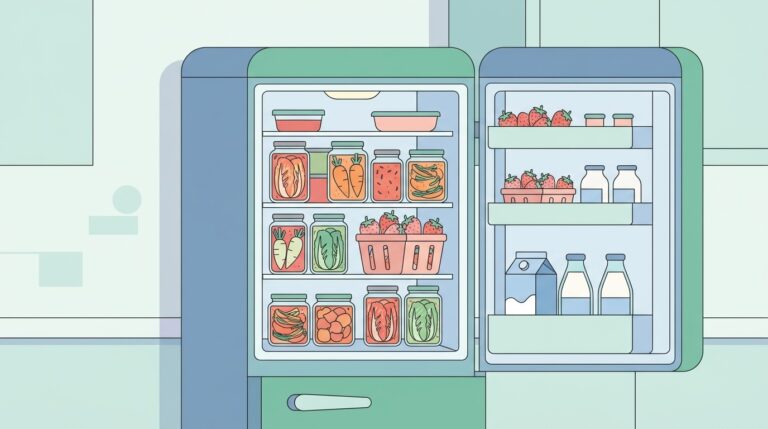
Stay Cool! How to Master Using a Korean Fridge (냉장고에 넣다)
Phase 1: Welcome to the Cold Zone!
안녕하세요! (Annyeonghaseyo!) Hello there, my dear language explorer! I’m your Korean bestie and Chief Editor at Daily Hangul.
Picture this: You just came home from a late-night run to a Korean convenience store. You bought sweet Korean strawberries (딸기 – ttalgi), delicious banana milk, and some freshly made kimbap. Your Korean roommate smiles and points toward the kitchen, saying something rapid-fire ending in “~yo.” You stand there holding your grocery bag, completely lost in translation. Do you leave it on the counter? Do you freeze it?
Managing food and using kitchen appliances is one of the biggest daily hurdles for expats in Korea. Today, we are mastering the absolute essentials of using a Korean refrigerator, focusing on the core phrase: 냉장고에 넣다 (to put in the fridge). By the end of this guide, you’ll sound like a seasoned local living in Seoul!
Phase 2: The Big Three Fridge Phrases
Let’s break down the three most vital phrases you need to survive in a Korean kitchen. Since we are focusing on the A1 (Beginner) level, these are short, sweet, and incredibly useful!
1. 냉장고에 넣어요 (Naeng-jang-go-e neo-heo-yo)
- Pronunciation: Nang-jang-go-eh nuh-uh-yo (Think of “nang” like a bell ringing, “jang” like a jar, and “nuh-uh-yo” like gently pushing something in!)
- Meaning: “Put it in the refrigerator.”
- K-Culture Moment: You will hear this in almost every family K-Drama! A loving mother packs side dishes (반찬 – banchan) in plastic containers and orders her child to put them away immediately.
- Editor’s Insight: The word 냉장고 (naeng-jang-go) combines ‘cold’ (냉), ‘store’ (장), and ‘machine’ (고). 넣어요 comes from 넣다 (to put inside).
- Situation Spectrum: Casual: ✅ | Semi-formal: ✅ | Formal: ⚠️
- 🤔 Think About It: In your home country, what is the one food item you never put in the fridge that Koreans almost always keep refrigerated?
2. 시원하게 마셔요 (Si-won-ha-ge ma-syeo-yo)
- Pronunciation: She-won-ha-gheh mah-shyuh-yo
- Meaning: “Drink it cold.”
- K-Culture Moment: Handing a cold can of sweet Sikhye (rice punch) or a bottle of Soju to a friend after a long hot day.
- Editor’s Insight: Koreans love ice-cold drinks! Even in the freezing winter, “Ah-Ah” (Iced Americano) is a national favorite. Asking someone to drink something cold is a gesture of care.
- Situation Spectrum: Casual: ✅ | Semi-formal: ✅ | Formal: ⚠️
- 🤔 Think About It: Why do you think cold drinks are so popular in Korean social culture?
3. 상해요 (Sang-hae-yo)
- Pronunciation: Sahng-heh-yo
- Meaning: “It will go bad” or “It’s spoiled.”
- K-Culture Moment: Warning a family member not to eat the food left on the dining table overnight during the humid summer.
- Editor’s Insight: This is a crucial safety word. If you hear “상해요!”, stop eating or immediately put the item in the fridge!
- Situation Spectrum: Casual: ✅ | Semi-formal: ✅ | Formal: 🚫
- 🤔 Think About It: How does food storage change between your dry summers and Korea’s humid summers?
Phase 3: Textbook Korean vs. Real-Life Korean
Sometimes, learning from a standard dictionary makes you sound like a robot! Let’s look at how textbooks teach food storage versus what native speakers actually say.
Situation A: Storing leftovers
- 📖 Textbook Korean: 식품을 냉장고에 보관하십시오. (Sikpumeul naengjanggoe bogwanhasipsio.)
- “Please preserve the foodstuff in the refrigeration unit.” (Super robotic and stiff!)
- 🗣️ Real-Life Korean: 냉장고에 넣어 두세요. (Naeng-jang-go-e neo-eo du-se-yo.)
- “Just put it in the fridge.”
- 💡 Why the difference? Koreans prefer practical, action-oriented verbs like “put inside” (넣다) over formal Sino-Korean nouns like “preservation” (보관).
Situation B: Putting ice cream in the freezer
- 📖 Textbook Korean: 동결실에 넣으십시오. (Donggyeolsire neoeusipsio.)
- “Please place it in the freezing compartment.”
- 🗣️ Real-Life Korean: 냉동실에 넣어요. (Naeng-dong-sil-e neo-heo-yo.)
- “Put it in the freezer.”
- 💡 Why the difference? Nobody uses the word ‘Donggyeolsil’ in daily life! Everyone calls the freezer 냉동실 (naeng-dong-sil).
Phase 4: K-Culture & Fridge Manners
4-1. The “Kimchi Fridge” Phenomenon (김치냉장고)
If you enter a Korean home, you might see two refrigerators. No, they aren’t just greedy! The second one is a specialized Kimchi Refrigerator (김치냉장고 – Kimchi Naengjanggo). Kimchi requires precise, cool, and stable temperatures to ferment perfectly without souring too fast. Touching someone else’s specialized kimchi fridge without permission is a big household no-no!
4-2. Respectful Kitchen Manners
When putting away food that someone else bought or prepared for you:
* Always use two hands if you are handing a container of food to an elder to put in the fridge.
* Make sure the plastic container (often called a ‘Lock & Lock’) is sealed shut with a firm click sound. Leaving a container loose is considered careless!
Phase 5: Roleplay Scenario – Cleaning Up After Dinner
Setting: A cozy kitchen in Seoul. Your friendly Korean roommate, Min-su, is washing dishes while you help clean up the side dishes.
- Min-su: 아, 배부르다! 오늘 잘 먹었네요. (Ah, bae-bu-reu-da! Oh-neul jal meog-eot-ne-yo.)
- “Ah, I’m so full! We ate well today.”
- You: 🎭 (Nodding happily) 네, 정말 맛있었어요! (Ne, jeong-mal ma-sit-eot-eo-yo!)
- “Yes, it was really delicious!”
- Min-su: 저기, 김치랑 반찬 좀 정리해 줄래요? (Jeo-gi, kimchi-rang ban-chan jom jeong-ri-hae jul-lae-yo?)
- “Hey, could you clean up the kimchi and side dishes?”
- You: 🎭 (Holding the kimchi container) 이거 어떻게 해요? (I-geo eo-tteoh-ge hae-yo?)
- “What should I do with this?”
- Min-su: 그거 냉장고에 넣어 주세요. (Geu-geo naeng-jang-go-e neo-heo ju-se-yo.)
- “Please put that in the fridge.”
- You: 🎭 (Pointing to the bread) 이 빵도 냉장고에 넣어요? (I ppang-do naeng-jang-go-e neo-heo-yo?)
- “Do I put this bread in the fridge too?”
- Min-su: 아니요, 빵은 실온에 두세요. 냉장고에 넣으면 딱딱해져요! (An-i-yo, ppang-eun sil-on-e du-se-yo. Naeng-jang-go-e neo-heu-myeon ttak-ttak-hae-jyeo-yo!)
- “No, keep the bread at room temperature. If you put it in the fridge, it gets hard!”
- You: 아, 알겠습니다! 그렇게 할게요. (Ah, al-get-seub-ni-da! Geu-reoh-ge hal-ge-yo.)
- “Ah, I see! I will do that.”
🔀 Interactive Choice Time!
What do you do with the remaining hot soup soup bowl?
* A. Put it hot directly into the fridge.
* B. Wait for it to cool down, then ask “냉장고에 넣을까요?” (Shall I put it in the fridge?).
* C. Leave it on the counter overnight without saying anything.
Feedback:
* Choice A (Risk): Putting boiling soup in the fridge makes the fridge work overtime and can warm up other food! Try to let it cool a bit first.
* Choice B (Best!): Perfect! Waiting for it to cool and asking with “넣을까요?” (neo-heul-kka-yo?) shows great manners and local kitchen smarts.
* Choice C (Bad): Uh-oh! During humid months, the soup will spoil (상해요) by morning.
Phase 6: 10-Second Shadowing Drill
Let’s practice speaking naturally! The / represents a short pause to breathe.
- [😊 Friendly & Asking]
- 이거 / 냉장고에 / 넣을까요?
- (I-geo / naeng-jang-go-e / neo-heul-kka-yo?)
- “Shall I put / this / in the fridge?”
- [⚠️ Urgent & Warning]
- ** 빨리 / 냉장고에 / 넣으세요! / 상해요!**
- (Ppal-li / naeng-jang-go-e / neo-heu-se-yo! / Sang-hae-yo!)
- “Quickly / put it in the fridge! / It will spoil!”
Phase 7: K-Culture Mini Dictionary
- 냉장고 (Naeng-jang-go) | Refrigerator: The ultimate appliance for preserving delicious foods.
- 냉동실 (Naeng-dong-sil) | Freezer: Literally “cold freezing room.” Perfect for your ice cream.
- 반찬통 (Ban-chan-tong) | Side dish container: Plastic or glass airtight containers loved by Korean mothers.
- 실온 (Sil-on) | Room temperature: For foods like bananas and bread.
Phase 8: Traveler’s Survival Kit
Survival Expressions
- 시원한 물 주세요 (Si-won-han mul ju-se-yo) – “Please give me cold water.”
- 이거 상했어요? (I-geo sang-haet-eo-yo?) – “Is this spoiled?”
- 냉장고가 안 시원해요 (Naeng-jang-go-ga an si-won-hae-yo) – “The fridge is not cold.”
Editor’s Travel Note
If you are traveling in Korea and staying in an Airbnb or accommodation, finding groceries is key. Use the Naver Map App for iOS to search for nearby small supermarkets (called ‘식자재마트’ or ‘이마트 에브리데이’) to stock up your fridge with fresh snacks and drinks at local prices!
Phase 9: A Deeper Look at “Jeong” (정) through the Fridge
In many Western cultures, a refrigerator is a private personal space. But in Korea, sharing fridge space is a sign of intimacy and community, known as 정 (Jeong – affection/bonding). Sharing side dishes, labeling shared milk carton caps with cute marker doodles, and putting treats in the freezer for your flatmates to enjoy is the ultimate way to build friendship!
💬 Your Turn: Have you ever shared a fridge with roommates? What is one rule you think is essential?
Phase 10: FAQ & Common Mistakes
Q: Can I use “놓다” (noh-da) instead of “넣다” (neo-da)?
A: Be careful! 넣다 means “to put INSIDE” (like inside a fridge or box). 놓다 means “to place ON” a surface (like putting a cup on the table). So, always say “냉장고에 넣어요“!
Q: How do I ask a host where to store something?
A: You can simply point to the food item and ask, “이거 어디에 넣어요?” (I-geo eo-di-e neo-heo-yo? – Where do I put this?).
Q: What is the word for a small hotel fridge?
A: It’s still called 미니 냉장고 (mini naeng-jang-go) or simply 냉장고!
🚨 Common Mistakes Alert!
- Saying “냉장고에 놓으세요” (Place it on top of the fridge) instead of “넣으세요” (Put it inside).
- Forgetting the particle 에 (e) which means “into/to”. Always say 냉장고에!
- Keeping your kimchi in a standard paper bag. It will smell up the whole fridge! Use airtight containers.
Phase 11: Action Mission!
- 🥉 Bronze: Say “냉장고에 넣어요” aloud 3 times in front of your own open fridge today.
- 🥈 Silver: Take a picture of your favorite Korean drink inside your fridge and share it with the tag #DailyHangul.
- 🥇 Gold: Spot a refrigerator in the next K-drama you watch and see if you can hear the characters using any form of “넣다” (to put in)!
Phase 12: Interactive Quiz Challenge!
Can you get a perfect score?
1. Which word means ‘freezer’?
* A) 냉장고 (Naeng-jang-go)
* B) 냉동실 (Naeng-dong-sil)
2. Fill in the blank: “이거 상하기 전에 냉장고에 ______.” (Put this in the fridge before it spoils.)
* A) 넣으세요 (neo-heu-se-yo)
* B) 놓으세요 (noh-heu-se-yo)
3. True or False: Every Korean home has exactly one refrigerator.
* A) True
* B) False
👉 Click to Reveal the Answers & Explanations!
- Answer: B. 냉동실 (Naeng-dong-sil) is freezer, whereas 냉장고 is refrigerator!
- Answer: A. 넣으세요 means “put inside.” 놓으세요 means “place on top of.”
- Answer: B. Many homes have a second specialized “Kimchi Refrigerator”!
See you in the next lesson! 맛있는 음식 많이 드세요 (Eat lots of delicious food)!







