

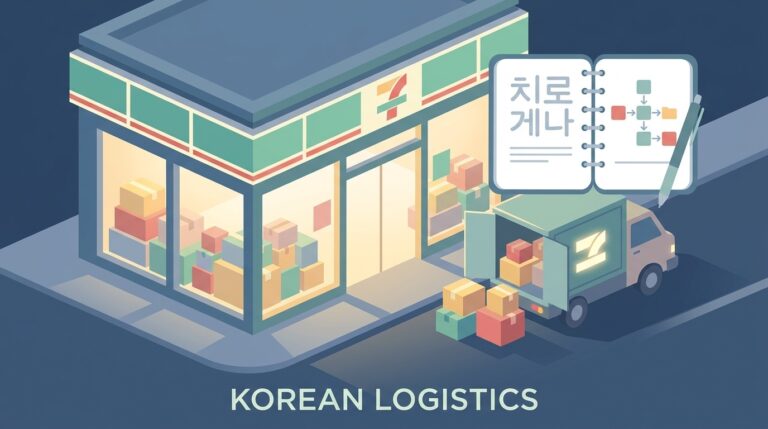
Master C2 Korean: Analyzing the Logistical Genius of Korea’s Convenience Store Half-Price Delivery
Phase 1: Empathy (스토리 몰입형 오프닝)
안녕하세요! Your premium cultural guide and editor at 매일한글 (Daily Hangul) is back!
Imagine this: You’re living in Seoul, and you need to send a textbook to a friend across town. You check the standard courier rates, and they are starting to feel a bit hefty. Then, a Korean colleague says, “그냥 반값택배로 보내세요! (Just send it via half-price delivery!)” You head to the nearest GS25 or CU, tap on the screen, and marvel at how a package can travel across the country for less than the price of a cheap cup of coffee ($1.50 USD).
But as a C2-level learner, you aren’t just looking for cheap rates—you want to understand how this works. How does a convenience store chain piggyback on its existing distribution networks to create a logistical masterpiece? Today, we will analyze the incredible logistics behind 반값택배 (Bangap Taekbae). This guide is built based on real-world cases discussed with global supply chain analysts who struggled to express these high-level logistical paradigms in natural, native-level Korean. Let’s dive deep into the ultimate fusion of daily convenience and corporate efficiency.
Phase 2: Key Expressions Analysis (핵심 표현 3선 심층 분석)
1. 물류망을 공유하다 (Mullyumang-eul gong-yu-hada)
- Pronunciation: Mool-ryu-mang-eul gong-yoo-hada (Think of “mool” like ‘pool’, “ryu” like the street fighter character, and “gong-yoo” like the famous actor Gong Yoo!)
- Meaning: Literally “to share a logistics network.” In business Korean, this refers to co-opting or leveraging an existing supply chain infrastructure for dual purposes.
- K-Culture Moment: You will hear this term frequently in Korean startup documentaries or business talk shows like 삼프로TV (3ProTV) when discussing how retail giants outperform traditional couriers.
- Editor’s Insight: Standard delivery services rely on custom hubs and spokes. 물류망을 공유하다 highlight how convenience stores do not hire extra drivers; they simply utilize the daily supply trucks delivering rice balls (삼각김밥) and bento boxes (도시락) to transport customer packages on their return trips.
- Situation Spectrum: Casual: ⚠️ | Semi-formal: ✅ | Formal: ✅
- 🤔 Think About It: How does your home country leverage daily infrastructure to reduce carbon footprints? Is there a parallel to Korea’s ultra-integrated convenience store network?
2. 역발상 (Yeok-bal-sang)
- Pronunciation: Yeok-bal-sang (Sounds like “Yuck-bal-sang” but with a soft ‘Y’ sound. ‘Yeok’ means reverse/inverse, and ‘balsang’ means idea/concept.)
- Meaning: Reverse thinking / Paradigm shift / Contrary thinking.
- K-Culture Moment: In K-Dramas featuring corporate strategy (like Reborn Rich or Start-Up), a character proposing a seemingly crazy but brilliant plan that flips the market on its head will always say: “이것은 역발상입니다.”
- Editor’s Insight: Traditional logistics focus on speed (faster delivery = higher price). 역발상 flips this: “What if we make it slower, but utilize empty spaces in existing trucks to make it dirt cheap?”
- Situation Spectrum: Casual: ✅ | Semi-formal: ✅ | Formal: ✅
- 🤔 Think About It: Why does Korean society value 역발상 so highly in its fast-paced tech and service industries?
3. 틈새시장 (Teum-sae-si-jang)
- Pronunciation: Teum-sae-shi-jang (“Teum” sounds like the ‘tem’ in ‘temper’ with a flat Korean ‘eu’ vowel; “sae” as in ‘say’; “shijang” as in ‘market’.)
- Meaning: Niche market.
- K-Culture Moment: Often used in entrepreneurial podcasts when explaining how C2C (consumer-to-consumer) secondhand transactions on platforms like 당근마켓 (Karrot) created a massive demand for ultra-cheap, hub-to-hub delivery.
- Editor’s Insight: Standard courier services focus on door-to-door delivery. 틈새시장 targets the gap: people who are willing to walk 3 minutes to their local convenience store if it means saving 50% on shipping fees.
- Situation Spectrum: Casual: ✅ | Semi-formal: ✅ | Formal: ✅
- 🤔 Think About It: Is a “store-to-store” delivery service viable in your country, or do geographical scales make door-to-door the only feasible option?
Phase 3: Textbook Korean vs. Real Native Korean (교과서 한국어 vs 진짜 한국어)
Scenario 1: Explaining how the delivery cost is so cheap
- 📖 Textbook Korean: “물류 비용을 절감하기 위해 공동 배송 시스템을 채택하고 있습니다.”
(To reduce logistical costs, they are adopting a joint delivery system.) - 🗣️ 진짜 한국어: “어차피 매일 도는 물류 차량 유통망을 그대로 태우니까 배송비가 반값으로 떨어지는 거죠.”
(Since they just hitch a ride on the existing distribution network of trucks that make daily rounds anyway, the shipping cost drops to half.) - 💡 Why the difference? The textbook phrase sounds like an academic paper. A true native uses expressions like “~에 태우다” (literally “to let something ride on”), which metaphorically means loading cargo or routing data onto an active, pre-existing system.
Scenario 2: Highlighting store utilization
- 📖 Textbook Korean: “편의점 점포 간의 네트워크를 활용합니다.”
(They utilize the network between convenience store branches.) - 🗣️ 진짜 한국어: “골목마다 촘촘히 박혀 있는 점포 인프라를 백분 활용하는 셈이에요.”
(They are essentially making full use of the store infrastructure tightly packed into every single alleyway.) - 💡 Why the difference? “촘촘히 박혀 있다” (tightly packed/densely embedded) beautifully and colloquially describes the sheer density of Korean convenience stores. “백분 활용하다” (to utilize 100%, to make the most of) is a highly polished C2-level idiom.
Phase 4: K-Culture Deep Dive & Non-verbal Manners
4-1. Nunchi (눈치) & Gestures at the Convenience Store
When utilizing 반값택배, you will interact with both a self-service kiosk (포스트박스) and the store clerk. Here are two vital non-verbal cues:
1. The “Ready-to-Scan” Prep: When you walk up to the counter to pick up or drop off a package, have your QR barcode (received via KakaoTalk) pulled up on your phone screen before you reach the register. Showing the clerk your screen with a polite nod indicates you respect their time, especially during peak rush hours (lunchtime or late night).
2. The Kiosk Courtesy: If someone is struggling with the kiosk screen, stand at least 1.5 meters back. Do not hover. If they look at you with an apologetic expression, a gentle head tilt and saying “천천히 하세요” (Take your time) is the ultimate demonstration of Korean 정 (Jeong).
4-2. The Evolution of Palli-Palli (빨리빨리): Ultra-Rationality
Traditionally, Korean culture is famous for 빨리빨리 (hurry, hurry). However, 반값택배 represents an evolution: 가성비 (cost-effectiveness) and 시공간의 효율화 (spatiotemporal optimization). Koreans are willing to wait 2 to 3 days longer for half-price delivery because it fits the pragmatic mindset of the modern C2C market. It’s no longer just about speed; it’s about absolute efficiency of resources.
Phase 5: Real-Life Roleplay Scenario (실전 롤플레이 시나리오)
Setting: A modern logistics seminar coffee break in Yeouido, Seoul.
Characters:
* 지민 (Jimin): Head of Strategy at a major Korean convenience store franchise.
* David: A visiting global logistics researcher eager to understand the Korean model.
지민: 데이비드 씨, 오늘 한국의 편의점 물류망 세미나는 유익하셨나요?
      (David, did you find today's seminar on Korean convenience store logistics networks useful?)

David: 🎭 (눈을 반짝이며) 네, 정말 흥미로웠습니다. 특히 반값택배의 회차 물류 시스템은 신선한 충격이었어요.
      (Yes, it was truly fascinating. Especially the reverse logistics system of the half-price delivery was a fresh shock.)

지민: 맞아요. 기존 택배망과 달리 점포에 물건을 납품하고 돌아오는 빈 트럭의 여유 공간을 활용한 게 핵심이죠.
      (Exactly. Unlike standard delivery networks, the key is utilizing the empty space in returning trucks after they deliver goods to stores.)

David: 🎭 (턱을 괴고 고개를 끄덕이며) 아, 그렇기 때문에 추가적인 탄소 배출이나 인건비 없이 효율성을 극대화할 수 있었군요.
      (Ah, that's why you could maximize efficiency without additional carbon emissions or labor costs.)

지민: 정확해요! 유통과 물류를 결합한 역발상이 통했던 셈이죠. 당근마켓 같은 중고거래 플랫폼의 급성장도 한몫했고요.
      (Precisely! It means the reverse thinking that combined retail and logistics worked. The rapid growth of secondhand market platforms like Karrot also played a part.)

David: 한국의 촘촘한 점포 인프라가 없었다면 이런 비즈니스 모델은 실현 불가능했을 것 같습니다.
      (Without Korea's dense store infrastructure, this business model would have been impossible to realize.)

지민: 네, 사실상 집 앞 5분 거리의 편의점들이 각각 하나의 초미니 물류 거점 역할을 해주고 있는 거니까요.
      (Yes, effectively, convenience stores within a 5-minute walk from home are each acting as an ultra-micro logistics hub.)

David: 🎭 (미소를 지으며) 정말 배울 점이 많습니다. 저도 이번 귀국 때 제 짐 일부는 반값택배로 미리 공항 근처 편의점에 보낼까 봐요!
      (There is so much to learn. I might even send some of my luggage to a convenience store near the airport using half-price delivery before flying out!)
🔀 Interactive Choice Points (인터랙티브 분기점)
To test your understanding of this advanced logistical discourse, how would you respond to Jimin’s comment about convenience stores acting as “ultra-micro hubs”?
- Option A: “하지만 배송이 너무 느려서 소비자들이 불만을 가지지 않나요?”
- Option B: “소비자가 직접 물건을 찾으러 가야 하는 번거로움을 가격 경쟁력으로 상쇄시킨 영리한 전략이네요.”
- Option C: “그렇다면 편의점 점주들의 업무 피로도가 가중될 텐데요, 본사 차원의 보상책은 마련되어 있나요?”
💡 Feedback Table:
| Option | Rating | Detailed Analysis |
|---|---|---|
| Option A | ⚠️ Risk | While valid, challenging the speed misses the point of the market segment (which prioritizes cost over speed). It sounds a bit too aggressive for a casual seminar break conversation. |
| Option B | 🌟 Best | Showcases C2-level strategic thinking. Using words like 상쇄시키다 (to offset) and 영리한 전략 (clever strategy) showcases high linguistic and business intelligence. |
| Option C | ✅ Good | A highly insightful, ethical, and realistic question. It addresses the labor aspect of franchise logistics and would instantly impress a Korean executive. |
Phase 6: 10-Second Emotional Shadowing Drill (10초 감정 섀도잉 드릴)
Master the exact flow, pause points (/), and natural cadences of high-level business Korean. Follow the emotional cues!
- [🔥 Enthusiastic & Analytical]
- “어차피 / 매일 도는 / 물류 차량 유통망을 / 그대로 태우니까 / 배송비가 반값으로 / 떨어지는 거죠.”
- Eo-cha-pi / mae-il do-neun / mul-lyu cha-ryang yu-tong-mang-eul / geu-dae-ro tae-u-ni-kka / bae-song-bi-ga ban-gaps-eu-ro / tteo-reo-ji-neun geo-jyo.
- [💡 Lightbulb Moment / Realizing a Paradigm Shift]
- “골목마다 / 촘촘히 박혀 있는 / 점포 인프라를 / 백분 활용한 / 역발상의 결과물이에요.”
- Gol-mok-ma-da / chom-chom-hi bak-hyeo in-neun / jeom-po in-peu-ra-reul / baek-bun hwal-yong-han / yeok-bal-sang-ui gyeol-gwa-mul-i-e-yo.
Phase 7: K-Culture Mini-Dictionary (K-Culture 미니 사전)
- 물류거점 (Mullyu-geojeom) | Logistics Hub
- In Korean business, this refers to strategic transit centers. In daily conversation, it’s used metaphorically to describe a central spot where friends meet or stash items (e.g., “우리 집이 완전 친구들 술자리 물류거점이야” – My house is basically the logistics hub for my friends’ drinking parties).
- 회차율 (Hwecha-yul) | Return/Turnover Rate of vehicles
- This measures how efficiently vehicles are utilized on their return journeys. High 회차율 means minimal empty mileage, a key metric in green logistics.
- 백오피스 (Back Office) | Operations Support
- Refers to the administration and IT systems running behind the scenes. In Korea, having a “solid backoffice” (백오피스가 짱짱하다) is high praise for any tech service.
- 라스트마일 (Last Mile) | The final leg of delivery
- The delivery phase from the final hub to the customer’s doorstep. 반값택배 uniquely transfers the burden of the “last mile” from the courier company to the consumer.
Phase 8: Survivor Kit for Travelers (여행자를 위한 생존 키트)
Survival Expressions TOP 3
- “반값택배 수령하러 왔는데요, QR코드 보여드릴게요.”
- Ban-gap-taek-bae su-ryeong-ha-reo wan-neun-de-yo, QR code bo-yeo-deu-ril-ge-yo.
- “I’m here to pick up a half-price parcel; let me show you the QR code.”
- “택배 기기 어디에 있어요?”
- Taek-bae gi-gi eo-di-e is-seo-yo?
- “Where is the parcel kiosk?” (Crucial, as some stores tuck them in the back corners!)
- “받는 분 점포명을 잘 몰라서 주소로 검색해 주시겠어요?”
- Ban-neun bun jeom-po-myeong-eul jal mol-ra-seo ju-so-ro geom-saek-hae ju-shi-ges-seo-yo?
- “I don’t know the recipient’s exact store branch name, could you search by address?” (Used when registering a shipment on the kiosk screen).
🗺️ Editor’s Travel Note
Before attempting this, make sure you download the official apps. For GS25, use the 우리동네GS (My Neighborhood GS App) and for CU, download the 포켓CU (Pocket CU App). You can pre-register your parcel details in the app to avoid standing at the kiosk typing addresses on a resistive touch screen!
Disclaimer: Service rules and pricing are subject to changes by retail networks. Ensure you have a local Korean phone number to receive the pick-up QR codes.
Phase 9: “One Step Deeper” (한 발 더 깊이)
Korea’s 반값택배 is more than just a business model; it is a cultural artifact of 공동체적 신뢰 (community trust) and 공간의 재정의 (redefining space). In many countries, leaving parcels at a convenience store counter or having strangers walk in and out of local shops to pick up packages would raise security concerns. In Korea, however, the absolute density of CCTV cameras and the mutual trust in public spaces allow convenience stores to act as safe neighborhood safehouses. It shows how physical safety and high digital integration can merge to create unprecedented systemic efficiency.
💬 Your Turn: Do you think this community-hub delivery style would work in your hometown? What challenges would it face? Leave your thoughts in the comments below in Korean! Let’s discuss!
Phase 10: FAQ & Mistake Prevention (FAQ & 오해 방지)
Q: Can I send heavy furniture or high-value jewelry via half-price delivery?
A: Absolutely not. There are strict weight limits (usually under 5kg) and volume limits (sum of three sides under 80cm). High-value items (over 500,000 KRW) are also rejected due to insurance limitations. It is designed purely for small parcels, books, and clothes.
Q: Does it deliver to my house if I pay extra?
A: No. 반값택배 operates strictly store-to-store (GS25 to GS25, or CU to CU). You must physically visit the destination store selected by the sender to pick it up.
Q: What happens if I don’t pick up my package on time?
A: You must pick up your parcel within 3 to 4 days of receiving the arrival QR code. If you fail to do so, the package is returned to the original sender, and you will have to pay the return shipping fees!
🚨 The “Common Mistakes” Warning Board
- Mistake 1: Trying to send a GS25 package to a CU store.
- Why: Their logistics systems are completely separate competitor networks!
- Correct Action: Ensure both you and the receiver agree on the same brand (GS25 to GS25 via GS Postbox, or CU to CU via CU Post).
- Mistake 2: Typing the recipient’s home address as the destination.
- Why: The driver will not deliver it, and the system might reject the order or get lost in transit.
- Correct Action: Always input the exact convenience store branch name (e.g., GS25 Yeouido Park Branch).
- Mistake 3: Deleting the KakaoTalk notification message.
- Why: You cannot retrieve your parcel without the unique barcode in that notification.
- Correct Action: Keep the chat message safe, or take a screenshot of the QR code as soon as it arrives.
Phase 11: Action Mission & Engagement
🏆 The 3-Step Challenge
- Bronze (Self-Study): Open Google Maps or Naver Maps, find three convenience stores near your favorite Korean spot, and identify their exact Korean branch names.
- Silver (Share): Take a screenshot of your localized map and share it on Instagram or X (Twitter) tagging #DailyHangul explaining (in Korean) which branch you would choose for your first 반값택배 delivery!
- Gold (Real-world): Next time you are in Korea, send a postcard or small souvenir to your hotel or a friend’s neighborhood using the kiosk. Experience the logistics firsthand!
🎮 K-Culture Mission
Watch a slice-of-life K-Drama (like My Liberation Notes or Welcome to Samdal-ri). Spot the convenience store scenes. Notice how many packages are stacked neatly next to the counter or near the kiosk. That is the physical reality of Korea’s decentralized logistics network!
Phase 12: Interactive Quiz Challenge (인터랙티브 퀴즈 챌린지)
1. Situational Judgment
If you want to explain to a colleague why GS25 and CU can charge so little for their shipping service, which C2 phrase is most accurate?
* A) “인건비를 아끼려고 직원을 다 해고했기 때문이에요.”
* B) “기존 유통망 트럭의 빈 여유 공간을 태우는 역발상 덕분이에요.”
* C) “정부에서 교통 보조금을 전폭적으로 지원해 주거든요.”
🔍 Reveal Answer & Explanation
Correct Answer: B
Explanation: Utilizing the empty space of returning trucks is the definition of reverse logistics (역발상) and is the core reason for the 50% discount. Option A is factually incorrect and socially negative; Option C is false.
2. Fill in the Blanks
“한국은 골목마다 점포 인프라가 ________ 박혀 있어서 초미니 물류 거점으로 제격입니다.”
(Hint: Think of the C2 adverb that means tightly, densely packed.)
🔍 Reveal Answer & Explanation
Correct Answer: 촘촘히 (chom-chom-hi)
Explanation: This beautiful adverb describes a mesh, net, or distribution network that is incredibly dense and leave no gaps.
3. True or False
“반값택배 can be picked up at any time of the year, including weekends and public holidays, because convenience stores are open 24/7.”
🔍 Reveal Answer & Explanation
Correct Answer: TRUE
Explanation: This is the ultimate peak of Korean convenience. While standard post offices close on weekends and red days, convenience store logistical fleets move 365 days a year!






