

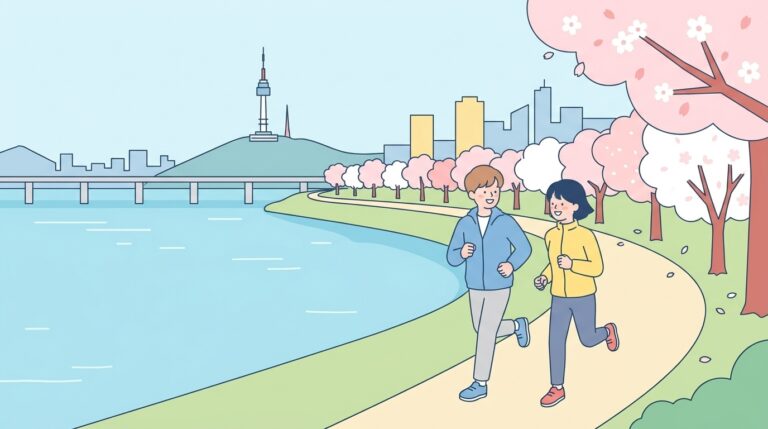
Phase 1: Hello, my workout bestie! (공감)
안녕하세요! (An-nyeong-ha-se-yo!) Your friendly neighborhood Korean editor from Daily Hangul is here! 🌟
Have you ever watched a K-drama where the lead character goes for a refreshing night jog along the beautiful Han River, or did you see your favorite K-pop idols showing off their jaw-dropping dance practice workouts? You immediately think: “Wow, I want to work out like them and talk about my daily routine in Korean!”
But then, reality hits. You go to the gym, or you try to write in your journal, and you freeze. You know the word for “exercise” is 운동 (un-dong), but how do you actually turn it into a natural sentence? Do you say “I am exercising” or “I do exercise”? Why does the textbook sound so stiff and robotic?
Don’t worry! Today, we are going to unlock the secrets of talking about your daily workout routine just like a real Seoul local. This guide is built based on real-life feedback from hundreds of beginner students who used to struggle with daily routine expressions. By the end of this post, you’ll be confidently telling your Korean friends exactly how you stay fit!
Phase 2: The Core Three Workout Phrases (핵심 표현 3선)
Let’s look at the three most important expressions you need. These are the absolute gold standard for A1 level speakers!
1. 운동해요 (un-dong-hae-yo)
- Pronunciation: oon-dong-hae-yo (Sounds like “oon” as in “moon” + “dong” as in “gong” + “hae” as in “hen” + “yo” as in “yo-yo”)
- Meaning: “I exercise” or “I am working out.”
- K-Culture Moment: This is the universal phrase you hear in vlog intros. If a K-beauty YouTuber is showing their morning routine, they will stretch and say: “저 아침에 운동해요” (I exercise in the morning).
- Editor’s Insight: In Korean, we combine the noun 운동 (exercise) with the magic verb 해요 (do/make) to create “to exercise”. It covers everything from lifting weights to yoga!
- Situation Spectrum:
- Casual (To friends): 운동해 (un-dong-hae) ✅
- Semi-formal (Polite/Standard): 운동해요 (un-dong-hae-yo) ✅
- Formal (Business/Interviews): 운동합니다 (un-dong-ham-ni-da) ⚠️ (A bit too stiff for a friendly chat!)
- 🤔 Think About It: Why does Korean use “noun + do (하다)” so often instead of having one single verb? It makes learning verbs so much easier once you know the nouns!
2. 헬스장 가요 (hel-seu-jang ga-yo)
- Pronunciation: hel-seu-jang gah-yo (Sounds like “hel” as in “help” + “seu” as in “super” + “jang” as in “gong” with a ‘j’ + “gah-yo”)
- Meaning: “I go to the gym.”
- K-Culture Moment: In K-dramas, when characters get stressed, they head to a flashy fitness center with neon lights to blow off steam. That place is called the 헬스장!
- Editor’s Insight: 헬스 (hel-seu) comes from the English word “Health”, and 장 (jang) means “place”. So a “Health-place” is the gym! This is classic Konglish (Korean-style English). Do not say “체육관 (che-yuk-gwan)” unless you mean a school gymnasium!
- Situation Spectrum:
- Casual: 헬스장 가 (hel-seu-jang gah) ✅
- Semi-formal: 헬스장 가요 (hel-seu-jang gah-yo) ✅
- Formal: 헬스장에 갑니다 (hel-seu-jang-e gam-ni-da) ⚠️
- 🤔 Think About It: How cool is it that Koreans created their own word “Health-jang” for the gym? It highlights how fitness in Korea is focused on overall “health and wellness” rather than just “heavy lifting.”
3. 산책해요 (san-chaek-hae-yo)
- Pronunciation: sahn-chaek-hae-yo (Sounds like “sahn” as in “sauna” + “chaek” as in “check” + “hae-yo”)
- Meaning: “I take a walk.”
- K-Culture Moment: Every romance K-drama has a scene where the main couple walks through a park filled with cherry blossoms. They aren’t running; they are doing 산책 (san-chaek)!
- Editor’s Insight: If you don’t like sweaty, intense workouts, this is your go-to word. Koreans love taking a light walk after lunch to digest their food and get some sun.
- Situation Spectrum:
- Casual: 산책해 (san-chaek-hae) ✅
- Semi-formal: 산책해요 (san-chaek-hae-yo) ✅
- Formal: 산책합니다 (san-chaek-ham-ni-da) ⚠️
- 🤔 Think About It: In your culture, is “taking a walk” considered a form of daily exercise, or is it just a leisure activity? In Korea, “산책” is a highly respected daily routine!
Phase 3: Textbook Korean vs. Real Korean (교과서 vs. 진짜 한국어)
Let’s compare the stiff textbook phrases with how cool, trendy young Koreans actually talk!
Situation 1: Telling someone you work out everyday
- 📖 Textbook Korean: “저는 매일 체육관에서 운동을 합니다.” (Jeo-neun mae-il che-yuk-gwan-e-seo un-dong-eul ham-ni-da.) – “I perform physical exercises at the gym every day.”
- 🗣️ Real Korean: “나 매일 헬스장 가요.” (Na mae-il hel-seu-jang ga-yo.) – “I go to the gym every day.”
- 💡 Why the difference? Dropping the subject “저/I” and the object marker “을” makes you sound 100 times more natural. Plus, using “헬스장” instead of “체육관” is how real modern people speak.
Situation 2: Suggesting a jog
- 📖 Textbook Korean: “우리 조깅을 하러 갈까요?” (U-ri jo-ging-eul ha-reo gal-kka-yo?) – “Shall we go run for cardiovascular health?”
- 🗣️ Real Korean: “우리 같이 뛸래요?” (U-ri gat-i ttwil-rae-yo?) – “Want to run together?” or “우리 러닝 가요!” (U-ri reo-ning ga-yo!) – “Let’s go running!”
- 💡 Why the difference? “뛰다 (ttwi-da)” means to run/jump, and modern young Koreans prefer the word “러닝 (running)” over the older loanword “조깅 (jogging)”.
Phase 4: K-Culture Deepdive & Non-Verbal Manners (눈치 & 제스처)
4-1. Gym Etiquette & Non-Verbal Manners
- The Indoor Shoes Rule (실내 운동화): This is massive in Korea! You cannot wear the sneakers you wore outside on the gym floor. You must bring a separate, clean pair of “indoor-only” sneakers in your bag and change into them in the locker room. Wearing dirty outdoor shoes inside the gym is a major social crime!
- The Fighting Fist (화이팅): When your friend says they are going to work out, don’t just say “Good job.” Clench your fist slightly and do a small downward pump while saying “화이팅! (Hwa-i-ting! – Fighting!)” or “오운완! (O-wun-wan!)” to show support.
4-2. The “O-Wun-Wan” Instagram Culture
If you search Instagram for the hashtag #오운완, you will find millions of posts! It stands for 오늘 운동 완료 (O-neul Un-dong Wan-ryo), which means “Today’s Workout Complete.” Koreans love taking a mirror selfie at the gym, showing off their fitness outfit, and tagging it #오운완. It’s the ultimate symbol of daily discipline and trendy lifestyle!
Phase 5: Real-Life Roleplay (실전 롤플레이 시나리오)
Imagine you are at a trendy gym in Hongdae, Seoul. You meet your Korean gym-buddy, Minjun (민준), who is super energetic and always encourages you!
- Setting: The cardio zone next to the treadmills. Upbeat K-pop is blasting in the background.
- Minjun: 🎭 [Smiling warmly, holding a sports drink] “어! 안녕하세요! 오늘 또 왔네요?”
- (Oh! An-nyeong-ha-se-yo! O-neul tto wat-ne-yo? / Oh! Hello! You came again today?)
- You: 🎭 [Smiling back, wiping sweat] “네! 저 매일 운동해요!”
- (Ne! Jeo mae-il un-dong-hae-yo! / Yes! I exercise every day!)
- Minjun: 🎭 [Impressed, giving a thumbs up] “와, 진짜 대단해요! 보통 뭐 해요?”
- (Wa, jin-jja dae-dan-hae-yo! Bo-tong mwo hae-yo? / Wow, you are amazing! What do you usually do?)
- You: 🎭 [Pointing to the treadmill] “러닝 뛰어오고, 가끔 산책해요.”
- (Reo-ning ttwil-eo-go, ga-kkeum san-chaek-hae-yo. / I run, and sometimes I take a walk.)
- Minjun: 🎭 [Nodding and pointing to the weight room] “좋네요! 혹시 오늘 헬스 같이 할래요?”
- (Joh-ne-yo! Hok-si o-neul hel-seu gat-i hal-rae-yo? / Sounds good! By any chance, do you want to lift weights together today?)
- You: 🎭 [Enthusiastically fist-pumping] “네, 좋아요! 같이 해요!”
- (Ne, joh-a-yo! Gat-i hae-yo! / Yes, great! Let’s do it together!)
- Minjun: 🎭 [Laughing energetically] “좋아요! 오늘 같이 힘내요, 화이팅!”
- (Joh-a-yo! O-neul gat-i him-nae-yo, hwa-i-ting! / Great! Let’s gain energy together today, fighting!)
- You: 🎭 [Shouting back cheerfully] “화이팅!”
- (Hwa-i-ting! / Fighting!)
🔀 Your Interactive Choice!
How will you answer Minjun when he asks to lift weights together? Choose your path:
- A) “네, 좋아요! 같이 해요!” (Yes, sounds good! Let’s do it together!)
- Feedback: BEST! 🌟 Super friendly, natural, and shows you are eager to learn and socialize.
- B) “아니요, 저 피곤해요.” (No, I am tired.)
- Feedback: BAD! 🛑 While honest, it sounds incredibly blunt and might hurt Minjun’s enthusiastic vibes. Try saying “죄송해요, 조금 힘들어요 (Sorry, I’m a bit tired)” instead.
- C) “헬스 싫어요.” (I hate the gym/lifting.)
- Feedback: RISK! ⚠️ Too aggressive! Even if you don’t like lifting weights, saying “싫어요 (I hate/dislike)” directly to a friendly suggestion sounds very rude in Korean culture.
Phase 6: 10-Second Emotion Shadowing Drill (섀도잉 드릴)
Practice speaking with real emotional energy! Pay attention to the pauses (/) and speak aloud with the matching feeling.
- [😊 Proud and bragging]
- “나 / 오늘 / 운동 / 완료했어요!”
- (Na / o-neul / un-dong / wan-ryo-haet-eo-yo!)
- “I / finished / my workout / today!”
- [🥵 Totally exhausted but proud]
- “휴, / 진짜 / 힘들어요… / 하지만 / 끝!”
- (Hyu, / jin-jja / him-deul-eo-yo… / ha-ji-man / kkeut!)
- “Whew, / it’s really / tough… / but / finished!”
- [🙌 Cheering a friend up]
- “오늘도 / 헬스장 / 고고! / 화이팅!”
- (O-neul-do / hel-seu-jang / go-go! / Hwa-i-ting!)
- “Today too / to the gym / go-go! / Fighting!”
Phase 7: K-Culture Mini Dictionary (미니 사전)
| Word (한글/Roman) | English Meaning | Real-Life Korean Vibe & Usage |
|---|---|---|
| 오운완 (O-wun-wan) | Today’s Workout Done | The absolute trendiest fitness hashtag used by young Koreans on social media daily. |
| 헬창 (Hel-chang) | Gym Rat / Gym Addict | Slang for someone who is absolutely obsessed with protein and lifting weights. Use with close friends! |
| 피티 (Pi-ti) | PT (Personal Training) | Koreans say “나 오늘 피티 받아” (I get PT today) when they have a personal trainer session. |
| 홈트 (Hom-teu) | Home Training (Home workout) | Short for home training. Used when you follow workout YouTube videos in your living room. |
Phase 8: Travel Survival Kit (여행자 생존 키트)
If you visit Korea and want to stay fit, keep these three phrases in your pocket!
- “여기 일일권 있어요?” (Yeo-gi il-il-gwon is-seo-yo?)
- Meaning: “Do you have a 1-day pass here?”
- Pro Tip: Most Korean gyms offer a day-pass (일일권) for tourists for about 10,000 to 20,000 KRW. Just ask this at the front desk!
- “수건 어디에 있어요?” (Su-geon eo-di-e is-seo-yo?)
- Meaning: “Where are the towels?”
- Pro Tip: Korean gyms usually provide free clean shirts, shorts, and towels! Look for the basket or ask this question.
- “정수기 어디에 있어요?” (Jeong-su-gi eo-di-e is-seo-yo?)
- Meaning: “Where is the water purifier?”
- Pro Tip: Koreans don’t usually sell bottled water inside gyms; they have high-tech water purifiers where you can fill up your personal cup for free.
🗺️ Editor’s Travel Note
Want to run like a local? Download the Naver Map App (never use Google Maps in Korea, it doesn’t work well!) and search for “한강공원” (Han River Park). You will find beautiful, free outdoor running tracks, clean public restrooms, and even free outdoor exercise machines (affectionately called “하스장” or grandpas’ gym) open 24/7! (Note: Facility details may vary by location.)
Phase 9: 한 발 더 깊이 (Think Deeper: Cultural Essay)
In Korea, working out isn’t just about physical fitness; it has deep connections to 자기관리 (ja-gi-gwan-ri), which means “self-management” or “self-discipline.” In a fast-paced, competitive society like Korea, maintaining a fit body through structured daily routines is seen as a sign of respect, intelligence, and high capability. This is why the “Body Profile” (taking professional photos of your fit body after months of hard work) became a major national trend among twenty-somethings. It’s a visual trophy of discipline.
💬 Your Turn: Do you feel the same pressure or motivation to exercise in your country? What is your favorite daily routine to clear your head? Tell us in the comments below!
Phase 10: FAQ & Common Mistakes (자주 묻는 질문)
Q: Can I use “gym” directly when speaking Korean?
A: If you say “짐 (jim)”, Koreans might understand, but they will immediately think of “luggage” (짐 – jim) first because they sound identical! Always use 헬스장 (hel-seu-jang) to avoid confusing people.
Q: What is the difference between 운동하다 and 일하다?
A: Some beginners translate “work out” directly into “일하다 (il-ha-da)”. But 일하다 means “to do job/work for money.” For exercise, always use 운동하다!
Q: Do I need to wear specific clothes to a Korean gym?
A: No! Most Korean gyms actually rent out standard t-shirts and shorts for free or a tiny fee. Just make sure to bring clean indoor shoes!
🚨 The “Common Mistakes” Warning Board
- Mistake: Telling your friend “나 어제 짐(jim)에 갔어요.”
- Correction: “나 어제 헬스장에 갔어요.” (I went to the gym yesterday.)
- Mistake: Using “체육관 (che-yuk-gwan)” for your neighborhood fitness center.
- Correction: Use 헬스장. “체육관” is for school basketball courts or boxing arenas.
- Mistake: Wearing your outdoor sneakers directly onto the gym treadmill.
- Correction: Change into 실내 운동화 (indoor sneakers) in the locker room first!
Phase 11: Action Missions (액션 미션)
- 🥉 Bronze Medal: Write “나 오늘 운동해요!” (I’m working out today!) in your study notebook.
- 🥈 Silver Medal: Take a photo of your workout shoes or water bottle, post it on your Instagram story, and tag it with #오운완 and @dailyhangul!
- 🥇 Gold Medal: Next time you go to the gym, find a Korean speaker or write in a Korean community: “우리 같이 운동해요!” (Let’s exercise together!)
- 🎮 K-Culture Mission: Watch a K-pop idol daily vlog today and count how many times they say 운동 (un-dong) or show their gym routine!
Phase 12: Interactive Quiz Challenge (퀴즈 챌린지)
Test your skills! Click to reveal the correct answers.
1. What is the most natural Korean word for a commercial gym?
- A) 체육관 (Che-yuk-gwan)
- B) 헬스장 (Hel-seu-jang)
- C) 운동소 (Un-dong-so)
Reveal Answer & Feedback
- Correct Answer: B) 헬스장 (Hel-seu-jang)
- Explanation: “헬스장” is the modern, natural term used by 99% of Koreans. “체육관” sounds like a school gym, and “운동소” is not a real word!
2. Fill in the blank: “나 매일 한강공원에서 _______.” (I walk at the Han River park every day.)
- A) 산책해요 (san-chaek-hae-yo)
- B) 공부해요 (gong-bu-hae-yo)
Reveal Answer & Feedback
- Correct Answer: A) 산책해요 (san-chaek-hae-yo)
- Explanation: “산책해요” means “to take a walk.” Option B, “공부해요,” means “to study,” which you wouldn’t typically do while walking on a track!
3. True or False: You can wear your muddy outdoor sneakers directly onto the Korean gym treadmills as long as you wipe them with a tissue.
Reveal Answer & Feedback
- Correct Answer: FALSE!
- Explanation: You must bring a completely separate pair of clean indoor-only sneakers (실내 운동화) to change into. It’s a crucial cultural manners rule in Korea!







