

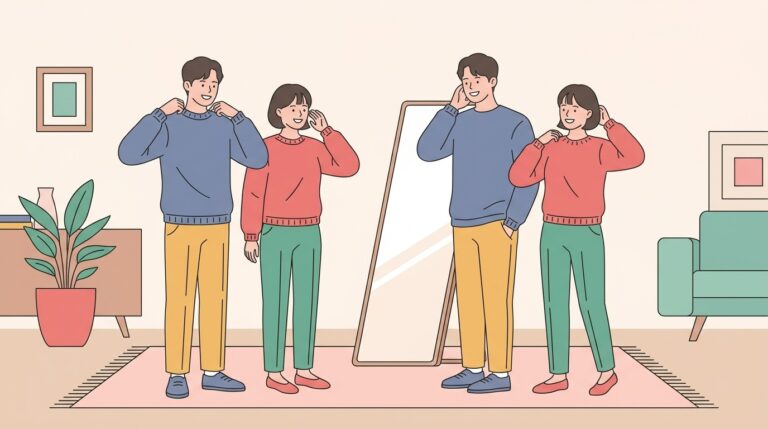
Dress to Impress: The Ultimate Guide to Korean Blind Date Fashion (Kku-An-Kku Style!)
Phase 1: Empathy (스토리 몰입형 오프닝)
안녕하세요! (Annyeonghaseyo!) It’s your favorite local cultural navigator from Daily Hangul!
Imagine this: you have your very first Korean blind date (소개팅 – Sogaeting) scheduled in Hongdae this Friday. You open your closet, and panic sets in. “Is this shirt too formal? Is this hoodie too casual?” You want to look like you put in effort, but you don’t want to look like you’re trying too hard.
If you’ve felt this styling anxiety, you are definitely not alone! Many of our intermediate learners ask us how to hit that perfect “effortlessly chic” vibe that Koreans absolutely love. Today, we’re diving deep into the cultural codes of Korean blind date fashion, along with realistic vocabulary and conversational drills so you can step out with absolute confidence!
Phase 2: 핵심 표현 3선 심층 분석
1. 꾸안꾸 (Kku-an-kku)
- Pronunciation: Kku-an-kku (Sounds like “coo-ahn-coo” with a short, tense ‘k’ sound at the beginning)
- Meaning: Effortless chic / Dressed up but looking natural (Literal: 꾸민 듯 안 꾸민 듯)
- K-Culture Moment: You’ll see this phrase used constantly in K-Beauty and K-Fashion vlogs. In K-Dramas like True Beauty, characters spend hours styling their hair and makeup just to make it look like they “woke up like this.”
- Editor’s Insight: It represents the peak of modern Korean styling aesthetics. It means you look polished, clean, and put-together without looking stiff or overly formal.
- Situation Spectrum: Casual (✅) / Semi-formal (✅) / Formal (⚠️)
- 🤔 Think About It: Why do you think looking “effortlessly stylish” is more highly valued in modern Korea than looking overly formal? How does this compare to dating fashion in your home country?
2. 옷이 날개다 (Osi nalgaeda)
- Pronunciation: Osi nalgaeda (Sounds like “oh-shee nahl-gae-dah”)
- Meaning: Clothes make the man / Dress to impress (Literal: “Clothes are your wings”)
- K-Culture Moment: When a character in a drama steps out of a fitting room in a stunning outfit, their friends will gasp and say, “Wow, 역시 옷이 날개네!” (Wow, as expected, clothes are indeed wings!)
- Editor’s Insight: This ancient proverb emphasizes that your outfit elevates your natural charm and shows respect to the person you are meeting.
- Situation Spectrum: Casual (✅) / Semi-formal (✅) / Formal (✅)
- 🤔 Think About It: Is there a similar bird or wing metaphor in your native language, or do you use different imagery to talk about the power of clothes?
3. 신경 쓰다 (Singyeong sseuda)
- Pronunciation: Singyeong sseuda (Sounds like “sheen-gyung sseu-dah”, making sure to keep the flat ‘u’ sound as in “good”)
- Meaning: To pay attention to / To put effort into / To care about
- K-Culture Moment: Often said in romantic dramas when one lead notices a tiny detail about the other: “오늘 신경 좀 썼는데?” (You put some effort into your look today, huh?)
- Editor’s Insight: While ‘신경’ means nerves or mind, ‘쓰다’ means to use. Putting them together means you are actively directing your mental energy to make sure everything looks perfect.
- Situation Spectrum: Casual (✅) / Semi-formal (✅) / Formal (✅)
- 🤔 Think About It: How does paying attention to small details (like perfume, accessories, or ironed collars) show your respect and interest in a Korean social context?
Phase 3: 교과서 한국어 vs 진짜 한국어
Scenario 1: Asking a friend what they are wearing tonight
- 📖 교과서 한국어: “무슨 옷을 입을 것입니까?” (Museun oseul ibeul geosimnikka? – “What clothes will you wear?”)
- 🗣️ 진짜 한국어: “오늘 어떻게 입고 가?” (Oneul eotteohge ipgo ga? – “How are you dressing today? / What’s the look today?”)
- 💡 왜 다를까?: The textbook version is grammatically flawless but sounds incredibly robotic and unnatural. Real Koreans use “어떻게 입고 가” (how are you going dressed) to ask about the overall style, vibe, or dress code.
Scenario 2: Suggesting someone should dress nicely
- 📖 교과서 한국어: “단정하게 옷을 입으세요.” (Danjeonghage oseul ibuseyo. – “Please dress neatly.”)
- 🗣️ 진짜 한국어: “TPO 맞춰서 입어야지!” (TPO majchwoseo ibeoyaji! – “You’ve got to dress for the TPO!”)
- 💡 왜 다를까?: Koreans love the English acronym TPO (Time, Place, Occasion). Reminding someone to match the “TPO” sounds modern, practical, and culturally savvy, whereas “단정하게” sounds like a strict school principal talking to a student.
Phase 4: K-Culture 딥다이브 & 비언어적 매너
4-1. 눈치(Nunchi) & Gestures
When styling for a Korean blind date, 눈치 (situational quick-wittedness) is key. You shouldn’t wear clothes that are too revealing, flashy, or wrinkled. A clean, neat silhouette (깔끔한 스타일) is universally preferred. When complimenting your date’s outfit, Koreans rarely say direct physical compliments like “You look sexy.” Instead, they observe the overall style with a warm smile and say, “오늘 스타일 되게 좋으시네요” (Your style is really nice today) with a polite, appreciative head tilt.
4-2. 문화 코드 분석 (Culture Code)
In romantic K-Dramas like Business Proposal or What’s Wrong with Secretary Kim, the “sogaeting” scene is a staple. The characters always stress over looking classic yet approachable—often featuring trench coats, soft knitwear, or pastel shirts. This reflects the Korean social emphasis on making an excellent 첫인상 (first impression) through visual neatness, which is seen as a basic social etiquette.
Phase 5: 실전 롤플레이 시나리오
Setting: A trendy fashion boutique in Garosu-gil, Sinsa-dong. You are trying on outfits with your close Korean friend, Minji (민지), who is helping you curate your look for a blind date tonight.
- Minji: (Holding two hangers with critical, scanning eyes) “흠… 왼쪽 셔츠가 더 나은가? 아니면 오른쪽 니트?”
- You: “글쎄… 오늘 소개팅이니까, 좀
🎭 신경 쓰고싶어.” - Minji: “맞아! 첫인상이 진짜 중요하잖아. ‘옷이 날개’라구!”
- You: “
🎭 (Looking worriedly at the mirror)너무 과하게 입은 것처럼 보이지는 않겠지?” - Minji: “걱정 마! 내가 ‘꾸안꾸’ 정석으로 맞춰줄게.”
- You: “고마워! 가디건에 슬랙스 매치하면 괜찮을까?”
- Minji: “
🎭 (Clapping her hands in approval)오, 완전 딱이야! 깔끔하고 예뻐.” - You: “좋아, 오늘 이 스타일로 간다!”
- Minji: “대박! 오늘 소개팅 무조건 성공하겠는데?”
🔀 인터랙티브 분기점
You are finally at the cafe, and your blind date smiles and says: “오늘 옷 정말 예쁘게 입고 오셨네요!” (You dressed so beautifully today!) How do you reply?
- Option A: “감사합니다. 이거 진짜 비싼 브랜드 옷이에요.” (Thank you. This is a really expensive brand’s outfit.)
- 🚫 Feedback (Bad): Oops! This breaks the humble “꾸안꾸” vibe completely. It sounds boastful and materialistic.
- Option B: “아, 정말요? 너무 대충 입고 온 것 같아서 걱정했어요.” (Ah, really? I was worried it looked like I dressed too lazily.)
- ⚠️ Feedback (Risk): Too self-deprecating! It might make it sound like you didn’t value the meeting enough to dress up.
- Option C: “감사합니다! 오늘 잘 보이고 싶어서 신경 좀 썼어요.” (Thank you! I put some effort in today because I wanted to look good for you.)
- ✅ Feedback (Best): Perfect! It is honest, sweet, and shows genuine interest while acknowledging your effort beautifully.
Phase 6: 10초 감정 섀도잉 드릴
Let’s practice the natural rhythm and tone of spoken Korean! Pay attention to the pauses (/) and the emotional cues.
- “오늘 / 신경 좀 / 썼어요.” (Oneul / singyeong jom / sseosseoyo.) ->
[😊 shyly but happily, with a soft smile] - “완전 / 꾸안꾸 / 스타일인데?” (Wanjeon / kku-an-kku / style-inde?) ->
[🤩 impressed and excited, raising the pitch at the end] - “첫인상이 / 제일 / 중요하니까요.” (Cheot-insangi / jeil / jungyohanikkanyo.) ->
[😌 confident, gentle, and polite]
Phase 7: K-Culture 미니 사전 (핵심 키워드 4개)
- 꾸안꾸 (Kku-an-kku) | Effortless Chic | The ultimate gold standard in Korean lifestyle, fashion, and natural makeup.
- 소개팅 (Sogaeting) | Blind Date | A casual blind date arranged by mutual friends, usually involving coffee, dinner, and walking.
- 첫인상 (Cheot-insang) | First Impression | Highly emphasized in Korean culture; often decided within the first 3 seconds of a meeting.
- 깔끔하다 (Kkal-kkeum-hada) | Clean/Neat | The highest compliment for anyone’s style, room, or general presentation in Korea.
Phase 8: 여행자를 위한 생존 키트
Survival Expressions TOP 3
- 이거 잘 어울려요? (Igeo jal eoulryeoyo?) | Does this suit me well?
- Pro Tip: Use this while shopping in Seoul or sending a mirror selfie to a Korean friend!
- 요즘 유행하는 스타일이에요. (Yojeum yuhaenghaneun style-ieyo.) | This is the trendy style these days.
- Pro Tip: Shop staff will often say this to point you to the most popular items.
- 오늘 스타일 완전 대박! (Oneul style wanjeon daebak!) | Your style today is absolutely amazing!
- Pro Tip: Use this to instantly boost your Korean friend’s confidence before a big event.
Editor’s Travel Note ✈️
If you want to shop for the perfect Korean blind date outfit, head over to the boutique shopping streets of Garosu-gil or the underground fashion hubs like Goto Mall in Express Bus Terminal. Before you go, make sure to download the Naver Map App to easily find boutique locations, as Google Maps is notoriously unreliable in South Korea!
Note: Operating hours of individual boutique shops may vary based on local conditions.
Phase 9: “한 발 더 깊이” (생각 질문)
In Korea, dressing neatly isn’t just about personal vanity; it is widely viewed as a form of 상대방에 대한 예의 (respect toward the other person). Showing up to a formal blind date in overly casual attire like sweatpants or plastic slides signals that you do not value the other person’s time or the matchmaker’s effort. This deep connection between external appearance and social consideration showcases the collectivist mindset of Korean society, where your presentation directly impacts the comfort of those around you.
💬 Your Turn: What is the most important “unwritten dress code rule” for dating in your country? Let us know in the comments below!
Phase 10: FAQ & 오해 방지 (FAQ Schema)
Q: Is it okay to wear a full business suit to a Korean blind date?
A: Unless you are meeting at a 5-star hotel restaurant, a full business suit might look too rigid and formal. It’s much better to aim for smart casual—like a neat blazer with slacks or a clean knit sweater.
Q: Can women wear high heels on a first date in Seoul?
A: Yes, but keep in mind that Korean dates often involve walking to nearby cafes, strolling through scenic parks, or walking up hilly streets. Opt for comfortable yet stylish footwear!
Q: What colors are best for a blind date outfit?
A: Soft neutrals, pastel tones, or classic black/white are highly recommended. Avoid bright neon colors or extremely busy patterns that might distract your date from your face.
🚨 흔한 실수 (Common Mistakes) 경고판
- Wearing sweatpants or slippers. -> Correct Action: Always aim for 깔끔한 (neat) clothes, even if the cafe is casual.
- Saying “I didn’t care about my look today” to seem cool. -> Correct Action: Say “I dressed up a bit since we are meeting!” It shows sweet respect.
- Over-styling like a K-pop idol on stage. -> Correct Action: Stage outfits are for performing! Stick to the classic daily 꾸안꾸 look for dates.
Phase 11: 액션 미션 & 참여 유도
- 🥉 Bronze Mission: Stand in front of your mirror and practice saying “오늘 신경 좀 썼어요!” three times with a confident smile!
- 🥈 Silver Mission: Post a picture of your favorite “꾸안꾸” outfit on your Instagram story and tag #DailyHangul for feedback!
- 🥇 Gold Mission: The next time you meet a Korean friend, compliment them using “오늘 스타일 완전 깔끔하고 예뻐요!”
🎮 K-Culture Mission: Watch any modern romantic K-drama and count how many times characters comment on each other’s outfits or use the word “깔끔하다”!
Phase 12: 인터랙티브 퀴즈 챌린지
Test your knowledge!
1. What does the word ‘꾸안꾸’ (Kku-an-kku) stand for?
A) Wearing bright neon sportswear
B) Effortlessly chic (dressed up but looking natural)
C) Wearing a formal wedding dress
See Answer & Explanation
Answer: B! It is a portmanteau of “꾸민 듯 안 꾸민 듯” (looks dressed up, yet not dressed up). It is the golden rule of Korean casual styling!
2. Fill in the blank: “옷이 ______다.” (Clothes make the man / Clothes are your wings)
See Answer & Explanation
Answer: 날개 (nalgae – wings). The full phrase is “옷이 날개다,” meaning good clothes elevate your natural beauty.
3. True or False: In Korea, showing up to a blind date in sweatpants is considered polite and relaxed.
See Answer & Explanation
Answer: False! Showing up in sweatpants or slippers is considered disrespectful to both the date and the person who arranged the introduction.







