

Comforting Your Soldier Friend on Military Leave: The Ultimate K-Culture Guide
Phase 1: Empathy (Welcome to the Daily Hangul Family!)
안녕하세요! (Annyeonghaseyo!) Welcome back to Daily Hangul! It’s your favorite local culture navigator here, ready to guide you through another beautiful, heart-warming, and deeply unique layer of Korean life.
Imagine this: Your close Korean friend, boyfriend, or favorite K-drama protagonist suddenly vanishes into thin air for a few months, only to reappear with a shaved head, a sharp green uniform, and a slightly dazed, exhausted look in their eyes. Yes, they are on 휴가 (hyuga – military leave)!
In Korea, mandatory military service is a significant rite of passage for young men. When soldiers get their precious few days of freedom, their friends and family rally together to pamper them, feed them, and help them forget the strict schedule of the barracks. But for a non-Korean friend, this situation can feel like a cultural minefield. What do I say? How do I comfort them without sounding awkward or overly formal?
Don’t worry! Based on real-world experiences from our global learners who wanted to support their loved ones in the military, we’ve crafted this guide. By the end of this post, you’ll know exactly how to treat your soldier friend like royalty and speak to them with the perfect blend of warmth and local slang. Let’s dive in!
Phase 2: Deep Dive into 3 Essential Expressions
Let’s master the three most powerful phrases you can use when your friend is on leave. These aren’t just textbook phrases; they carry deep emotional resonance in Korean culture.
1. 고생이 많다 (Gosaeng-i manta)
- Pronunciation: Go-saeng-ee mahn-tah (Sounds like “Go-sang” + “i” + “man-tah”)
- Meaning: “You are going through so much hardship” (Literal) vs. “Thank you for your hard work/sacrifice” (Nuance).
- K-Culture Moment: You see this in K-Dramas constantly. A character comes back from a difficult task, and their partner hugs them, saying this softly.
- Editor’s Insight: This is the ultimate empathy phrase. It acknowledges the physical and mental toll of military service without being overly dramatic. It shows you truly understand that military life is tough.
- Situation Spectrum: Casual ✅ | Semi-formal ✅ | Formal ⚠️
- 🤔 Think About It: In English, we often say “Thank you for your service,” which feels very formal and distant. Why do you think Korean focuses more on sharing the feeling of “hardship” (고생) between friends?
2. 맛있는 거 사줄게 (Masinneun geo sajulge)
- Pronunciation: Mah-shin-neun guh sah-jool-gae (Sounds like “Ma-shin-noon” + “geo” + “sah-jool-gae”)
- Meaning: “I will buy you delicious food.” (Direct translation and actual nuance)
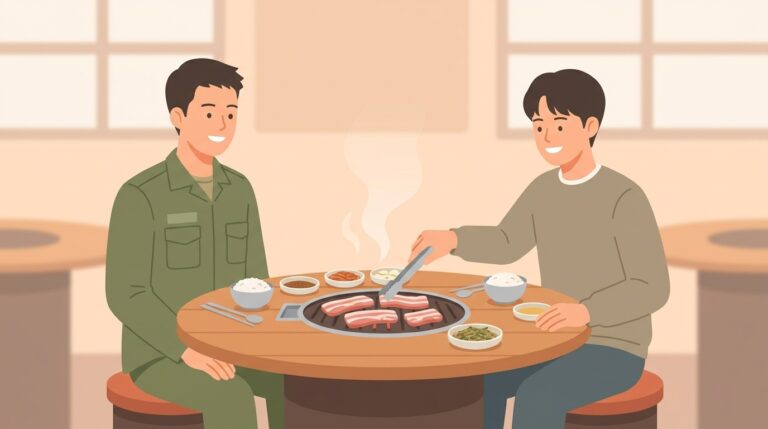
- K-Culture Moment: Soldiers survive on cafeteria food (짬밥 – jjambap). The moment they step out, they crave social food like Korean BBQ (삼겹살) or fried chicken. Saying this is the ultimate act of love.
- Editor’s Insight: In Korea, feeding someone is the highest form of care. For a soldier on leave, being treated to a meal is both a financial relief and an emotional comfort.
- Situation Spectrum: Casual ✅ | Semi-formal ⚠️ | Formal 🚫
- 🤔 Think About It: If food represents love in Korea, how does your culture typically show comfort to someone returning from a long journey?
3. 몸 건강히 잘 다녀와 (Mom geonganghi jal danyowa)
- Pronunciation: Mom guhn-gang-hee jahl dah-nyuh-wah (Sounds like “Mom” + “gun-gang-hee” + “jal” + “dah-nyuh-wah”)
- Meaning: “Go and return in good health.”
- K-Culture Moment: Said at the very end of the leave when the soldier has to pack up and head back to the military base (복귀 – bokgwi).
- Editor’s Insight: The biggest worry for family and friends is the soldier getting hurt during training. This phrase prioritizes their physical well-being over everything else.
- Situation Spectrum: Casual ✅ | Semi-formal ✅ | Formal ⚠️
- 🤔 Think About It: Why is wishing for “health” more powerful than wishing for “success” or “strength” in a military context?
Phase 3: Textbook Korean vs. Real-World Korean
When talking to a friend on leave, textbook phrases can sound cold or like a military report. Let’s look at how to sound like a real Korean friend.
Scenario A: Asking if military life is tough
- 📖 Textbook Korean: “군대 생활이 힘듭니까?” (Gun-dae saenghwal-i himdeumnikka? – Is military life difficult?)
- 🗣️ Real-World Korean: “요즘 군대 생활 할 만해?” (Yo-jeum gun-dae saenghwal hal man-hae? – Is military life bearable these days? / How are you holding up?)
- 💡 Why the difference? The textbook version sounds like an officer interviewing a private. The real-world version is casual, warm, and invites an honest, relaxed answer.
Scenario B: Offering to buy them a drink
- 📖 Textbook Korean: “제가 술을 사겠습니다.” (Je-ga sul-eul sageda-seumnida. – I will buy alcohol.)
- 🗣️ Real-World Korean: “오늘 형이 술 한잔 시원하게 쏜다!” (Oneul hyeong-i sul han-jan siwon-hage ssonda! – Tonight, Hyeong is treating you to a cold drink! – Note: Use ‘Nuna’ or ‘Oppa’ depending on your gender/age relation!)
- 💡 Why the difference? “쏘다” (ssonda) literally means “to shoot” but is the most common slang for “paying for someone.” It sounds fun and generous!
Phase 4: K-Culture Deep Dive & Non-Verbal Manners
4-1. The Art of “Nunchi” (눈치) with Soldiers
When your friend is on leave, their brain is still partially adjusted to the hyper-vigilant military lifestyle. Here are a few physical and social cues to keep in mind:
* Don’t ask about traumatic or secret details: Keep the conversation light. Don’t press them on difficult training unless they bring it up first.
* The “Presents” Gesture: If you buy them a small gift (like skincare cream, as military air is very dry!), present it with both hands with a slight, warm head nod. It shows respect for their hard work.
* Let them choose the pace: Some soldiers want to party all night, while others just want to sit in a quiet cafe and stare at the ceiling. Read their vibe (눈치).
4-2. The “K-Food” Comfort Ritual
Nothing says “welcome back” like a warm meal. The classic military leave food route usually starts with 삼겹살 (Pork Belly) because soldiers crave high-quality, freshly grilled meat. It is often followed by a trip to a trendy dessert cafe, as sweet foods are highly craved in the barracks.
Phase 5: Real-Life Roleplay Scenario
Meet Minho (민호), your close friend who has been in the army for 6 months. He is on his first official 4-day leave (신병 위로휴가) and is looking a bit tired but excited to see you at a restaurant in Hongdae.
The Dialogue (8 Turns)
- Minho: (Smiling weakly, saluting playfully) “야, 진짜 오랜만이다! 나 군인 다 됐지?”
(Ya, jinjja oraenman-ida! Na gunin da dwaet-ji? / Hey, it’s been so long! I look like a real soldier now, right?) - You: (👀 Looking at him up and down with an affectionate smile) “와, 민호야! 살 많이 빠졌다. 고생이 진짜 많았네.”
(Wa, Minho-ya! Sal mani ppajyeotda. Gosaeng-i jinjja mananne. / Wow, Minho! You lost so much weight. You’ve really gone through a lot.) - Minho: (Sighing with relief, sitting down) “말도 마. 매일 아침 6시에 일어나는 거 진짜 적응 안 돼.”
(Mal-do ma. Maeil achim yeoseot-si-e ireonaneun geo jinjja jeogung an dwae. / Don’t even get me started. Getting up at 6 AM every day is so hard to get used to.) - You: (👋 Waving the waiter over enthusiastically) “여기 삼겹살 4인분 먼저 주세요! 민호야, 오늘 맛있는 거 사줄 테니까 벨트 풀고 마음껏 먹어!”
(Yeogi samgyeopsal sainbun meonjeo juseyo! Minho-ya, oneul masinneun geo sajul tenikka belteu pulgo maeumkkeot meogo! / Please give us 4 portions of pork belly first! Minho, I’m buying you delicious food today, so loosen your belt and eat as much as you want!) - Minho: (Eyes lighting up) “대박! 역시 너밖에 없다. 진짜 고마워!”
(Daebak! Yeoksi neobakke eopda. Jinjja gomawo! / Awesome! As expected, you’re the best. Thank you so much!) - You: (🍻 Clinking glasses) “많이 먹고 스트레스 다 풀고 가. 휴가 동안은 군대 생각 아예 하지 마!”
(Mani meog-go seuteureseu da pulgo ga. Hyuga dongan-eun gundae saenggak aye haji ma! / Eat up, relieve all your stress. Don’t think about the military at all during your leave!) - Minho: (Laughing) “응, 오늘 복귀하기 싫을 정도로 놀 거야.”
(Eung, oneul bokgwihagi sireul jeongdoro nol geoya. / Yeah, I’m going to play so hard today that I won’t want to go back.) - You: (🥺 Looking warm and supportive) “그래, 신나게 놀고 들어갈 때는 몸 건강히 잘 다녀와.”
(Geurae, sinnage nolgo deureogal ttae-neun mom geonganghi jal danyowa. / Right, have fun, and when you go back, make sure to stay healthy and safe.)
🔀 Interactive Choice Point
At the end of the meal, Minho asks: “I have to buy some gifts for my military buddies before I go back. What should I get them?”
- Choice A: “Just buy some cheap snacks from the convenience store.”
- Choice B: “Let’s go to Olive Young and buy some nice sheet masks or sunscreen!”
- Choice C: “You don’t need to buy them anything. Save your money!”
Choice Feedback:
- Best Choice (B): Fantastic! Soldiers spend hours under the hot sun and dry wind. Skincare items (especially sunscreen and soothing masks) are highly prized in the military. Showing you understand this makes you an incredibly thoughtful friend!
- Risk Choice (A): Not bad, but basic. While snacks are nice, the military PX (post exchange) already sells cheap snacks. It doesn’t feel very special.
- Bad Choice (C): Too cold. In Korean military culture, returning from leave with a small treat for your squad mates (분대원) is a common way to maintain good relationships and show camaraderie.
Phase 6: 10-Second Emotion Shadowing Drill
Let’s practice speaking with real Korean emotions. The / indicates a natural pause. Accentuate the bold words with feeling!
- [🥺 Empathizing and warm]
- “민호야, / 진짜 / 고생이 많다.”
- Minho-ya, / jinjja / gosaeng-i manta.
- (Minho, / you are really / going through a lot.)
- [😊 Cheerful and generous]
- “오늘 / 맛있는 거 사줄게 / 많이 먹어!”
- Oneul / masinneun geo sajulge / mani meogo!
- (Today, / I will buy you delicious food / so eat a lot!)
- [🥺 Caring and sincere]
- “다치지 말고 / 몸 건강히 잘 다녀와.”
- Dachiji malgo / mom geonganghi jal danyowa.
- (Don’t get hurt, / and return in good health.)
Phase 7: K-Culture Mini Dictionary
- 휴가 (Hyuga) | Military Leave / Vacation
- The precious vacation days earned by soldiers. It is their only window to connect with the outside world.
- 복귀 (Bokgwi) | Returning to the Base
- The dreaded moment when a soldier’s leave ends and they must return to their military unit by a specific hour.
- px (피엑스) | Post Exchange
- The military supermarket. It sells snacks, cosmetics, and necessities tax-free. Highly popular for cheap skincare goods.
- 군기 (Gungi) | Military Discipline / Spirit
- The strict, disciplined mindset of a soldier. When someone acts too stiff or salutes too sharply, Koreans say “군기가 들었다” (they are full of military discipline).
Phase 8: Survival Kit for Travelers & Friends
Top 3 Survival Phrases
- 휴가 나왔어요? (Hyuga nawat-seoyo?)
- Pro Tip: If you see a young man in military uniform traveling on the subway, you can ask this friendly question. It means “Are you on leave?”
- 힘내세요! (Him-naeseoyo!)
- Pro Tip: “Cheer up! / Hang in there!” A great, simple phrase to say to any soldier you meet.
- 제가 살게요. (Je-ga sal-geyo.)
- Pro Tip: “I will pay.” If you want to surprise a young soldier by paying for their coffee or meal anonymously (a growing trend in Korea!).
Editor’s Travel Note 🗺️
If you want to meet up with a friend on leave, they will likely want to hang out in accessible transit hubs because they have to travel back to distant provincial bases. Popular meeting spots include Seoul Station (서울역) or Yongsan Station (용산역). Use the Naver Map App to find cozy restaurants near these transit hubs so your friend doesn’t have to rush to catch their train back to the base!
Phase 9: “Going One Step Deeper” (Reflective Thought)
In many Western cultures, military service is a career choice. However, in Korea, conscription means almost every young male citizen shares this collective experience. This creates a deep, unspoken bond of empathy among Korean men—and a unique social duty for friends to “take care” of those currently serving. When you support your friend on leave, you aren’t just being nice; you are participating in a core communal ritual of Korean society.
💬 Your Turn: Have you ever had a friend go through mandatory military service? How did you keep in touch or support them? Let us know in the comments below!
Phase 10: FAQ & Avoiding Common Mistakes
Q: Can I use “고생해” (Keep working hard) when they go back?
A: It’s better to avoid “고생해” (Gosaeng-hae) because it can sound like you are telling them to go experience more hardship. Instead, use warm, supportive phrases like “몸 건강히 잘 다녀와” (Go and return in good health) or “몸 조심해” (Take care of your body).
Q: Is it okay to take photos of my friend in uniform?
A: Generally, yes, casual selfies are fine! However, be careful not to post photos online that clearly show military equipment, military base locations, or sensitive unit patches, as this can violate military security protocols.
Q: What is the best practical gift for a soldier returning to base?
A: Skincare items (like individual face masks, lip balm, and hand creams) or high-quality black pens and small notebooks are highly practical and beloved gifts that fit easily into their limited storage space.
🚨 Common Mistakes Warning Board
- Mistake: Pointing out that they look tired or different.
- Correct Action: Instead of saying “You look terrible,” say “고생이 많았지?” (You’ve gone through a lot, right?) to show empathy.
- Mistake: Forcing them to drink too much alcohol.
- Correct Action: Let them set the pace. Soldiers have strict return times and cannot return to the base intoxicated.
- Mistake: Asking them for military secrets.
- Correct Action: Keep conversations focused on their hobbies, food, and life outside the military.
Phase 11: Action Mission & Engagement
- 🥉 Bronze Mission: Write the phrase “고생이 많다” (Gosaeng-i manta) in your study notebook and practice saying it out loud 3 times with an empathetic voice.
- 🥈 Silver Mission: Share this post on your social media and tag a friend who loves K-dramas with military themes (like Descendants of the Sun or D.P.)!
- 🥇 Gold Mission: If you have a friend in the Korean military, send them a warm text message today using the phrase: “몸 건강히 잘 다녀와!”
- 🎮 K-Culture Mission: Watch an episode of a military-themed K-Drama and try to spot the moment characters use “고생했다” or wish each other good health.
Phase 12: Interactive Quiz Challenge
Test your knowledge of Korean military leave culture with this quick quiz!
1. Which phrase is best to say to a soldier who just arrived on their first leave?
- A) 요즘 군대 편하지? (Is the military easy these days?)
- B) 고생이 진짜 많았다. 맛있는 거 먹자! (You’ve really gone through a lot. Let’s eat delicious food!)
- C) 군대 다시 가고 싶어? (Do you want to go back to the military?)
Reveal Answer & Explanation
Correct Answer: B
Saying 고생이 진짜 많았다 acknowledges their hard work and immediately comforts them, while offering food shows genuine care. Avoid A (minimizes their effort) and C (nobody wants to go back!).
2. True or False: It is highly recommended to buy snacks as a return gift for a soldier.
- A) True
- B) False
-
Reveal Answer & Explanation
Correct Answer: B (False)
While snacks are nice, soldiers can buy them very cheaply at the military PX. Skincare products like sunscreen or sheet masks are much more appreciated because the military environment is very dry and harsh on the skin.
Thank you for studying with Daily Hangul! Keep spreading warmth, and we will see you in the next lesson! 안녕!







