

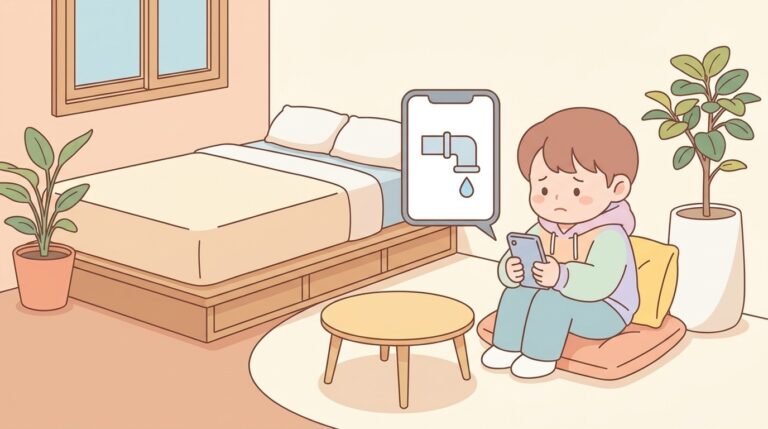
Oh No, My Boiler is Broken! How to Request Home Repairs in Korea Like a Pro
Phase 1: Empathy (Your Cozy Seoul Home Dilemma)
안녕하세요! (An-nyeong-ha-se-yo!) Hello! Your friendly Daily Hangul editor and local culture navigator is back.
Imagine this: You’ve finally settled into your dream studio apartment (called a one-room 원룸 in Korea) in the trendy streets of Mapo-gu. You’ve decorated it with cute K-pop merchandise, stocked your fridge with delicious convenience store snacks, and you’re feeling like the main character of a heartwarming K-drama.
But suddenly, it’s the middle of winter, and the floor feels ice-cold. You turn on the shower, and only freezing water pours out. Your boiler is broken! Or even worse, you spot water dripping from the bathroom ceiling. Panic sets in. How do you explain this to your Korean landlord without sounding rude or getting lost in translation?
Don’t pack your bags just yet! This guide is built from real-life survival stories of expats living in Korea. By the end of this post, you’ll have the exact words, the cultural “nunchi” (tact), and the confidence to get your apartment fixed in no time. Let’s dive in!
Phase 2: Core Expressions (Top 3 Deep Dive)
Here are the three magic phrases you need to memorize. They are simple, polite, and get straight to the point.
1. 물이 새요 (Muri saeyo)
- Pronunciation: Mu-ri sae-yo (Sounds like: “Moor-ee seh-yo”)
- Meaning: Water is leaking.
- K-Culture Moment: If you watch slice-of-life K-dramas, you’ve probably seen characters dealing with a sudden water leak during the heavy rainy season (Jangma). It’s an urgent issue!
- Editor’s Insight: 물 (mul) means water, and 새요 (saeyo) comes from 새다 (saeda), meaning to leak. You can use this for ceilings, faucets, or washing machines.
- Situation Spectrum: Casual (⚠️ – too informal for landlords), Semi-formal (✅ – Perfect!), Formal (✅ – 물이 샙니다 / Muri saemnida)
- 🤔 Think About It: In your home country, do you usually text or call your landlord first when there’s a leak? In Korea, texting with photos is the gold standard!
2. 보일러가 안 돼요 (Boilloga an dwaeyo)
- Pronunciation: Bo-il-leo-ga an dwae-yo (Sounds like: “Boiler-gah ahn dway-yo”)
- Meaning: The boiler (underfloor heater) isn’t working.
- K-Culture Moment: Korean apartments use Ondol (온돌), an underfloor heating system powered by a gas boiler. If your boiler is broken, your entire floor turns into an ice rink!
- Editor’s Insight: 안 돼요 (an dwaeyo) is the ultimate beginner cheat code. It literally means “It doesn’t work.” You can use it for anything: 에어컨이 안 돼요 (The AC doesn’t work), 와이파이가 안 돼요 (The Wi-Fi doesn’t work).
- Situation Spectrum: Casual (⚠️), Semi-formal (✅), Formal (✅ – 보일러가 안 됩니다)
- 🤔 Think About It: Why do you think Korea developed underfloor heating instead of wall radiators? It stems from the traditional floor-sitting culture!
3. 고쳐 주세요 (Gochyeo juseyo)
- Pronunciation: Go-chyeo joo-seh-yo (Sounds like: “Go-chyuh joo-say-yo”)
- Meaning: Please fix it.
- K-Culture Moment: In Korea, fast service (Palli-palli culture) is expected. When you say this politely, landlords usually coordinate with an “A/S” (After Service) technician quickly.
- Editor’s Insight: This combines 고치다 (gochida – to fix/repair) and the polite request ending -아/어 주세요 (please do for me).
- Situation Spectrum: Casual (⚠️ – 고쳐줘), Semi-formal (✅ – Perfect), Formal (✅ – 고쳐 주시기 바랍니다)
- 🤔 Think About It: Notice how polite requests in Korean always focus on asking the other person to do an action for you (주세요). How does this compare to how you ask for favors in your language?
Phase 3: Textbook Korean vs. Real Korean
Let’s look at how textbooks teach this versus how real Koreans actually talk.
Scenario 1: Requesting a repair
- 📖 Textbook Korean: 수리를 요청하고 싶습니다. (Suri-reul yocheong-hago sipseumnida.)
- Translation: “I would like to request repairs.”
- 🗣️ 진짜 (Real) Korean: OO이/가 고장 났는데 고쳐 주세요. (OO-i/ga gojang nanneunde gochyeo juseyo.)
- Translation: “[Something] is broken, so please fix it.”
- 💡 Why the difference? The textbook version is grammatically correct but sounds like a formal written business contract. In daily life, saying “고장 났는데” (it broke, so…) sounds much more natural and urgent.
Scenario 2: Describing a leak
- 📖 Textbook Korean: 누수 현상이 발생했습니다. (Nusu hyeonsangi balsaenghaesseumnida.)
- Translation: “A water leakage phenomenon has occurred.”
- 🗣️ 진짜 (Real) Korean: 물이 새요. (Muri saeyo.)
- Translation: “Water is leaking.”
- 💡 Why the difference? Unless you are writing an official insurance report, keep it simple! “물이 새요” is clear, direct, and immediately alerts the landlord to the danger of water damage.
Phase 4: K-Culture Deep Dive & Non-verbal Manners
4-1. Nunchi (눈치) & Repair Etiquette
- Take Photos & Videos First: Before you message your landlord, take clear photos and a short video of the problem. In Korea, sending proof via KakaoTalk is expected. It helps the landlord understand what kind of technician to hire.
- The Canned Coffee Gesture: When the repair technician (기사님 – gisanim) arrives at your house, it is highly polite to offer them a small drink. A cold canned coffee, a warm cup of barley tea, or a juice box shows massive respect and appreciation. It’s a warm Korean cultural touch called Jeong (정).
4-2. The Landlord-Tenant Dynamic
In Korea, the owner of the house is called the Imdaein (임대인), but colloquially, people call them Zip-ju-in (집주인 – house owner) or Ajeossi (아저씨 – middle-aged mister) / Ajumma (아줌마 – middle-aged lady). Under Korean rental customs, major structural repairs (like a broken boiler, water pipes, or structural ceiling leaks) are 100% the landlord’s financial responsibility. You do not have to pay for these!
Phase 5: Real-life Roleplay Scenario
Let’s practice! Meet Sarah, an expat tenant, and Mr. Kim, her friendly neighborhood landlord (집주인 아저씨).
[Scene: Sarah is in her apartment. Water is dripping from her bathroom sink. She calls Mr. Kim.]

Sarah: 안녕하세요, 집주인 아저씨! 저 302호 사라예요.
        (An-nyeong-ha-se-yo, jip-ju-in a-jeos-si! Jeo sam-baek-i-ho Sa-ra-yeo-yo.)
        "Hello, landlord! I'm Sarah from room 302."

Landlord: 아, 사라 씨! 안녕하세요. 무슨 일 있어요?
           (Ah, Sa-ra ssi! An-nyeong-ha-se-yo. Mu-seun il is-seo-yo?)
           "Ah, Sarah! Hello. Is everything okay?"

Sarah: 🎭 (Anxiously pointing to the sink) 화장실에 물이 새요.
        (Hwa-jang-si-re mu-ri sae-yo.)
        "Water is leaking in the bathroom."

Landlord: 아이구, 그래요? 어디에서 물이 새요?
           (Ai-gu, geu-rae-yo? Eo-di-e-seo mu-ri sae-yo?)
           "Oh dear, really? Where is it leaking from?"

Sarah: 세면대 밑에서 물이 계속 나와요.
        (Se-myeon-dae mi-te-seo mu-ri gye-sok na-wa-yo.)
        "Water keeps coming out from under the sink."

Landlord: 사진이나 동영상 좀 보내줄 수 있어요?
           (Sa-ji-ni-na dong-yeong-sang jom bo-nae-jul su is-seo-yo?)
           "Can you send me a photo or a video?"

Sarah: 🎭 (Nodding) 네, 카톡으로 바로 보낼게요. 고쳐 주세요.
        (Ne, Ka-to-geu-ro ba-ro bo-nael-ge-yo. Go-chyeo ju-se-yo.)
        "Yes, I'll send it via KakaoTalk right away. Please fix it."

Landlord: 네, 확인하고 오늘 오후에 사람 보낼게요!
           (Ne, hwa-gi-na-go o-neul o-hu-e sa-ram bo-nael-ge-yo!)
           "Okay, I'll check it and send someone over this afternoon!"
🔀 Interactive Choice Point
What should Sarah do next to ensure a smooth repair?
- Option A: Send the video immediately on KakaoTalk and write: “감사합니다, 아저씨! (Thank you, uncle!)”
- Feedback: BEST! This keeps the relationship warm, polite, and speeds up the repair.
- Option B: Wait for the landlord to come over without sending any photos.
- Feedback: BAD. The landlord won’t know what tools to bring or which technician to call, delaying the fix.
- Option C: Send a message saying: “Why is this house so bad? Fix it now!”
- Feedback: RISK. In Korea, politeness gets things done 10 times faster. Being aggressive might ruin your relationship with the landlord.
Phase 6: 10-Second Emotion Shadowing Drill
To sound natural, you need to practice with the right emotions! Try reading these sentences aloud, paying attention to the pauses (/).
보일러가 / 안 돼요. / 너무 추워요! 🥺- Pronunciation: Bo-il-leo-ga / an dwae-yo. / Neo-mu chu-wo-yo!
- Emotion: Cold, slightly pitiful, and urgent. Please help me warm up!
물이 / 계속 새요. / 확인해 주세요! 😰- Pronunciation: Mu-ri / gye-sok sae-yo. / Hwa-gi-nae ju-se-yo!
- Emotion: Worried and rushed. The water won’t stop!
Phase 7: K-Culture Mini Dictionary
- 집주인 (Jip-ju-in) | Landlord / House owner. Literally “house owner.”
- 보일러 (Bo-il-leo) | Boiler. Underfloor heating system, essential for surviving Korean winters.
- 카톡 (Ka-tok) | Short for KakaoTalk, the absolute king of messaging apps in Korea.
- 고장 (Go-jang) | Breakdown / Malfunction. Often used as 고장 나다 (to break down).
Phase 8: Survival Kit for Expats
Top 3 Emergency Expressions
- 뜨거운 물이 안 나와요. (Tteu-geo-un mu-ri an na-wa-yo.)
- Meaning: Hot water is not coming out. (Crucial for winter!)
- 에어컨이 고장 났어요. (E-eo-keo-ni go-jang nas-seo-yo.)
- Meaning: The air conditioner is broken. (Crucial for summer!)
- 변기가 막혔어요. (Byeon-gi-ga mak-hyeos-seo-yo.)
- Meaning: The toilet is clogged.
Editor’s Travel Note
- Must-Have App: Always have the translation app Papago downloaded on your phone. If your landlord sends a complex text, Papago’s image translation feature is highly accurate for real estate terms.
- Disclaimer: Maintenance response times may vary during public holidays like Chuseok or Seollal, as most repair shops close down. Try to report issues on weekday mornings!
Phase 9: Go One Step Deeper (Jeong & Korean Housing)
In many Western cultures, the landlord-tenant relationship is strictly transactional. In Korea, however, a unique social concept called Jeong (정)—a feeling of warm attachment and mutual care—often influences these interactions.
Landlords often live in the same building (especially in villa or one-room buildings). If you treat them with respect, greet them politely when you meet them in the hallway, and communicate issues calmly, they will often go out of their way to help you, sometimes even bringing you fresh fruit or food during traditional holidays!
💬 Your Turn: How does this compare to your country? Would you ever offer a cup of coffee to a repair technician? Let me know in the comments below!
Phase 10: FAQ & Avoiding Misunderstandings
Q: My lightbulb burned out. Does the landlord have to replace it?
A: No. In Korea, minor consumable items like lightbulbs, remote control batteries, or toilet paper holders are the tenant’s responsibility to replace.
Q: What is “A/S”?
A: “A/S” stands for “After Service.” It is the Konglish (Korean-English) term used for any product repair, customer service, or maintenance work.
Q: How do I tell my landlord “I’m freezing”?
A: You can say “너무 추워요” (Neo-mu chu-wo-yo), which means “It’s very cold.”
🚨 Common Mistakes Board
- Mistake 1: Saying “보일러가 고장이에요” (Boiler is a breakdown).
- Correct Action: Say “보일러가 고장 났어요” (The boiler broke down).
- Mistake 2: Calling the landlord at midnight for a non-emergency.
- Correct Action: Unless it’s a massive water flood, text them politely in the morning.
- Mistake 3: Fixing major structural issues yourself without telling the landlord.
- Correct Action: Always get permission first, or you might not get reimbursed!
Phase 11: Action Mission & Participation
- Bronze Mission: Say “물이 새요!” out loud 3 times with your eyes closed.
- Silver Mission: Save the phrase “보일러가 안 돼요” in your phone’s quick notes.
- Gold Mission: If you have a Korean friend, try texting them: “우리 집 에어컨이 고장 났어!” (My house AC is broken!) as a practice joke!
- 🎮 K-Culture Mission: The next time you watch a K-drama, look at the wall next to the front door. Can you spot the little white control pad? That is the boiler controller! Take a screenshot and share it with us!
Phase 12: Interactive Quiz Challenge
Test your skills! Can you get a perfect score?
1. Which phrase means “Water is leaking”?
- A) 보일러가 안 돼요
- B) 물이 새요
- C) 고쳐 주세요
2. Fill in the blank: “에어컨이 _______ 났어요.” (The AC is broken.)
- A) 물
- B) 고장
- C) 카톡
3. True or False: In Korea, tenants must pay for a completely broken heating boiler out of their own pocket.
- A) True
- B) False
🔍 Click here for the Answers & Explanations!
- Answer: B (물이 새요). 물 (Mul) means water, and 새요 (saeyo) means leaks.
- Answer: B (고장). 고장 나다 (gojang nada) is the verb meaning “to break down.”
- Answer: B (False). Major heating systems are the legal responsibility of the landlord (임대인) to repair or replace!







