

Master the Art of Korean Marketing Brainstorming: Speak Like a Local Marketer!
Phase 1: Empathy (스토리 몰입형 오프닝)
안녕하세요! Your friendly neighborhood Korean editor from 매일한글 (Daily Hangul) is here!
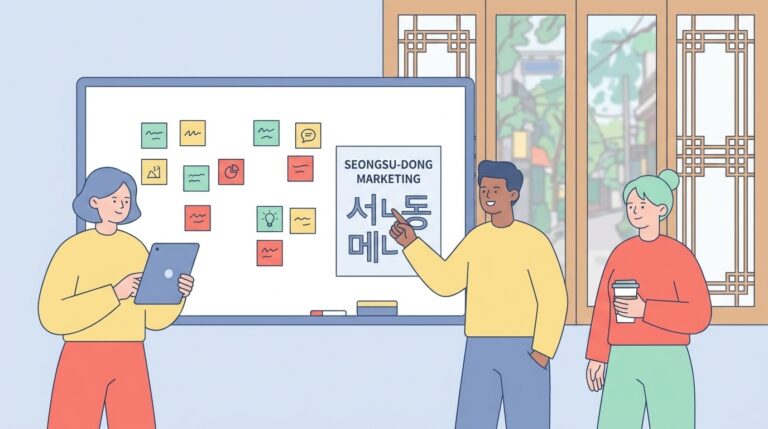
Imagine this: You are sitting in a sleek, glass-walled conference room in Seongsu-dong—the heart of Seoul’s trendiest startups. The whiteboards are covered in colorful sticky notes, and the smell of freshly brewed iced Americanos fills the air. Your team lead, Jimin-daeri, turns to you and asks: “이번 신제품 팝업스토어 프로모션, 다들 아이디어 좀 던져볼까요?” (Shall we throw out some ideas for our new product pop-up store promotion?)
Suddenly, your heart beats faster. You have amazing ideas in your head, but you feel stuck. Should you say something super formal like in a textbook? Or will that make the creative brainstorming vibe awkward?
Don’t worry! This is a classic pain point for intermediate (B2) learners. In Korean business settings—especially in creative fields like marketing—finding the sweet spot between respectful professionalism and dynamic, collaborative energy is key. Today, we are going to dive into the exact expressions, cultural nuances, and non-verbal cues that will make you sound like a seasoned local marketer. Let’s turn your brainstorming anxiety into absolute confidence!
Phase 2: Core Expressions Deep Dive (핵심 표현 3선 심층 분석)
1. 의견을 조율하다 (ui-gyeon-eul jo-yul-ha-da)
- Pronunciation: [Wee-gyeon-eul Jo-yool-ha-da] (Think of tuning a musical instrument, like jo-yool-ing a guitar!)
- Meaning: To fine-tune opinions / To coordinate and harmonize different viewpoints.
- K-Culture Moment: You will hear this constantly in workplace K-Dramas like Search: WWW or Misaeng when two strong-minded team members have different creative directions, and the manager step in to balance them.
- Editor’s Insight: The word 조율하다 (to tune/adjust) comes from music. Instead of saying “협의하다” (to negotiate), which sounds cold, saying “의견을 조율하다” shows that you view your team’s opinions as a beautiful melody that just needs a little alignment.
- Situation Spectrum: Casual ⚠️ | Semi-formal ✅ | Formal ✅
- 🤔 Think About It: In your culture, is aligning opinions compared to tuning an instrument, or do you use more competitive, analytical metaphors?
2. 대박을 터뜨리다 (dae-bak-eul teo-tteu-ri-da)
- Pronunciation: [Dae-bak-eul Teo-tteu-ri-da] (Rhymes with “bursting” a big balloon of success!)
- Meaning: To hit a massive jackpot / To launch a wildly successful, viral promotion.
- K-Culture Moment: Think of a viral K-Pop challenge on TikTok (like the Spicy or Super Shy challenge). When a marketing team creates something that takes over social media overnight, they say they “대박을 터뜨렸다!”
- Editor’s Insight: 대박 (jackpot/huge success) combined with 터뜨리다 (to pop/burst) creates an exciting image of popping a champagne bottle or a party cracker. It’s the ultimate goal of any promotion brainstorming.
- Situation Spectrum: Casual ✅ | Semi-formal ✅ | Formal 🚫 (In highly formal boardrooms, use “큰 성과를 거두다” instead)
- 🤔 Think About It: How does your language express “hitting it big”? Is it also a sudden, explosive action like popping a gourd?
3. 밀어붙이다 (mil-eo-but-i-da)
- Pronunciation: [Meel-uh-boo-chee-da] (Think of “pushing” (mil-da) and “sticking” (but-i-da) something together!)
- Meaning: To push forward aggressively / To drive a campaign idea home despite doubts.
- K-Culture Moment: When a passionate project manager in a startup drama strongly believes in an unconventional idea (like doing a retro-themed pop-up store) and says, “이 기획으로 끝까지 밀어붙여 봅시다!”
- Editor’s Insight: This word carries a strong sense of determination and speed. It can sound a bit strong, so in meetings, we often soften it by saying “~해 볼까요?” (Shall we try pushing it?) to keep it collaborative.
- Situation Spectrum: Casual ✅ | Semi-formal ✅ | Formal ⚠️
- 🤔 Think About It: Korean business culture values Pali-Pali (hurry, hurry) execution. How does “밀어붙이다” reflect this speed-oriented corporate value?
Phase 3: Textbook Korean vs. Real Korean (교과서 한국어 vs. 진짜 한국어)
Let’s compare stiff, academic Korean with the lively, natural language actually used in modern Seoul offices.
Situation 1: Asking team members for creative ideas
- 📖 Textbook: “새로운 프로모션 아이디어를 제안해 주십시오.” (Please propose new promotion ideas.)
- 🗣️ Real Korean: “자유롭게 아이디어 좀 던져주세요!” (Please throw out some ideas freely!)
- 💡 Why the difference? Modern Korean startups and marketing agencies love the verb 던지다 (to throw). It removes the heavy pressure of presenting a “perfect” proposal and invites casual, creative brainstorming.
Situation 2: Expressing confidence in a viral concept
- 📖 Textbook: “이 기획안은 대단히 큰 성공을 거둘 것으로 예상됩니다.” (It is anticipated that this plan will achieve a very big success.)
- 🗣️ Real Korean: “이거 무조건 반응 와요!” (This will definitely get an amazing reaction!)
- 💡 Why the difference? Saying “반응이 오다” (reaction comes) is how young marketers describe organic viral engagement, especially among Gen Z and Millennials on Instagram and YouTube.
Phase 4: K-Culture Deep Dive & Non-verbal Manners (K-Culture 딥다이브)
4-1. 눈치 (Nunchi) & Brainstorming Etiquette
In a Korean brainstorming session, physical gestures speak louder than words. To show you are engaged without interrupting:
1. The Fast Nod (고개 끄덕이기): When someone else is sharing an idea, nod slightly faster than usual to show enthusiastic agreement. It signals, “I’m with you!”
2. Soft Eyes, No Direct Staring: While direct, unblinking eye contact can sometimes feel confrontational in hierarchical settings, soft eye contact paired with a slight head tilt shows respectful attention.
3. The “Hand-Chop” Gesture (손짓): When presenting your idea, use a gentle flat-hand gesture (like a soft chop in the air) rather than pointing fingers to emphasize your points.
4-2. The Playground of Seoul: Seongsu-dong Pop-ups
Today, marketing in Korea isn’t just about online ads; it’s about the 팝업스토어 (Pop-up Store) culture. Seongsu-dong (성수동), often called the Brooklyn of Seoul, is the holy ground for this. Brands from K-Beauty to luxury fashion and even ramen brands build highly aesthetic, interactive spaces where consumers can take photos for Instagram. Understanding this space-driven marketing is crucial when discussing promotions in Korea!
Phase 5: Real-Life Roleplay Scenario (실전 롤플레이 시나리오)
Setting: The brainstorming room of “K-Wave Creative,” a marketing agency in Yeouido. You are brainstorming a viral launch campaign for a new spicy ramyun brand.
Your partner: 지민 대리 (Jimin-daeri), a passionate and trendy marketing team lead.
- 🎭 지민 (Jimin): “자, 다들 아이스 아메리카노 한 모금 마시고, 신제품 매운 라면 프로모션 아이디어 좀 던져주세요!”
(Now, everyone take a sip of iced americano, and throw out some ideas for our new spicy ramyun promotion!) - 🎭 You: “지민 대리님, 요즘 성수동에서 이색 팝업스토어가 대세잖아요. 저희도 매운맛 단계를 직접 조절하는 팝업을 열면 어떨까요?”
(Jimin-daeri, unique pop-up stores are the trend in Seongsu-dong these days. How about we open a pop-up where people can customize their own spiciness level?) - 🎭 지민 (Jimin): “오, 그거 좋은데요? 타겟층인 MZ세대 취향 저격이네요. 구체적으로 어떻게 알릴까요?”
(Oh, that’s great! It perfectly targets the taste of the MZ generation. Specifically, how should we promote it?) - 🎭 You: “인스타그램에서 ‘인생 매운맛 챌린지’ 숏폼 영상을 찍어 올리는 이벤트를 같이 하면 좋을 것 같아요.”
(I think it would be great to run an Instagram event where people upload short-form videos of their ‘Ultimate Spicy Challenge’.) - 🎭 지민 (Jimin): “숏폼 챌린지라… 재미있겠네요! 잘만 하면 SNS에서 대박을 터뜨릴 수 있겠어요.”
(A short-form challenge… sounds fun! If we do it right, we could hit a massive jackpot on social media.) - 🎭 You: “네, 맞아요. 오프라인 체험이랑 온라인 챌린지를 같이 밀어붙여 보면 시너지가 날 거예요.”
(Yes, exactly. If we push forward with both the offline experience and the online challenge, it will create great synergy.) - 🎭 지민 (Jimin): “좋습니다! 그럼 예산이랑 일정 관련해서 다른 부서랑 의견을 조율해 볼까요?”
(Excellent! Then shall we coordinate our opinions with other departments regarding budget and scheduling?) - 🎭 You: “네, 제가 기획안 초안을 작성해서 오늘 오후까지 공유해 드리겠습니다!”
(Yes, I will draft the initial proposal and share it with you by this afternoon!)
🔀 Choose Your Next Move (인터랙티브 분기점)
Jimin-daeri asks: “Which visual aesthetic should we focus on for the pop-up store poster?”
- A) “요즘 유행하는 Y2K 레트로 감성으로 밀어붙여 봐요!” (Let’s push forward with the trendy Y2K retro vibe!)
- B) “부장님들이 좋아하시는 깔끔한 클래식 스타일로 하죠.” (Let’s go with the clean, classic style that the senior directors like.)
- C) “아무거나 대리님이 고르시는 대로 할게요.” (I’ll just do whatever you choose, Daeri-nim.)
💡 Feedback on Your Choice:
- Select A (Best): Excellent choice! In a modern Korean marketing agency, showing that you know current trends (Y2K retro) and using the proactive term “밀어붙여 봐요” shows high confidence and cultural awareness.
- Select B (Risk): While respectful of senior directors, it might make you look a bit outdated or risk-averse in a creative brainstorming session targeting Gen Z.
- Select C (Bad): Avoid this! Passive answers like “whatever you choose” can damage your professional image. Koreans value collaboration and creative input in brainstorming.
Phase 6: 10-Second Emotion Shadowing Drill (10초 감정 섀도잉 드릴)
Practice speaking with the exact rhythm, pause (/), and emotional nuance of a native speaker.
- [🔥 Passionate & Confident]
“이 아이디어로 / 한 번 끝까지 밀어붙여 볼까요?”
(Ee ah-ee-dee-uh-ro / han beon kkeut-kka-ji meel-uh-boo-chyeo bol-kka-yo?)
(Shall we push forward with this idea all the way to the end?) -
[😊 Soft & Persuasive]
“디자인팀하고 / 의견을 조금만 더 조율해 봐요.”
(Dee-ja-in-teem-ha-go / ui-gyeon-eul jo-geum-man deor jo-yul-hae bwa-yo.)
(Let’s fine-tune our opinions with the design team just a bit more.)
Phase 7: K-Culture Mini Dictionary (K-Culture 미니 사전)
| Word (한글/로마자) | Meaning | How it’s used in meetings |
|---|---|---|
| 기획안 (Gi-hoegh-an) | Proposal / Draft | “오늘 중으로 기획안 초안 공유할게요.” (I’ll share the proposal draft today.) |
| 타겟층 (Ta-get-cheung) | Target Audience | “이번 팝업의 주 타겟층은 20대입니다.” (The main target audience of this pop-up is people in their 20s.) |
| 입소문 (Ip-so-mun) | Word of mouth (viral) | “입소문만 잘 나면 광고비 안 써도 돼요.” (If word of mouth spreads well, we don’t need to spend on ads.) |
| 가성비 (Ga-seong-bi) | Cost-effectiveness | “예산 대비 가성비 좋은 채널을 찾읍시다.” (Let’s find a highly cost-effective channel for our budget.) |
Phase 8: Traveler & Professional Survival Kit (여행자를 위한 생존 키트)
Survival Expressions for Office Visitors TOP 3:
- “회의실이 어디예요?” (Hwoi-ui-sil-ee eo-di-yeo-yo?)
- Meaning: Where is the meeting room? | Pro Tip: Use this when visiting a Korean partner company.
- “자료 공유해 주세요.” (Ja-ryo gong-yu-hae ju-se-yo.)
- Meaning: Please share the materials/files. | Pro Tip: Perfect to say at the end of a brainstorming session.
- “수고하셨습니다!” (Su-go-ha-syeot-seum-ni-da!)
- Meaning: Thank you for your hard work! | Pro Tip: Say this while bowing slightly when the meeting finishes.
📝 Editor’s Travel & Business Note:
If you are visiting Seoul for business or casual creative tours, make sure to download the Naver Map App to find the trendiest pop-up stores in Seongsu-dong or Hannam-dong. Since Google Maps is not fully optimized in Korea, Naver Map is your lifesaver! Note: App interface and features may change over time, so please check for the latest updates.
Phase 9: “One Step Deeper” (생각 질문: 비판적 사고)
In Western business cultures, brainstorming is often highly individualized—people pitch their own ideas and defend them vigorously. In Korea, however, the process values “조화” (Harmony) and shared responsibility. Even if you have a brilliant solo idea, using phrases like “의견을 조율하다” (tuning opinions) signals that you respect the team’s collective wisdom. It’s not about “my idea winning,” but about “our idea becoming beautiful through collective tuning.”
💬 Your Turn: How does brainstorming in your country differ from this collective “tuning” process? Let me know in the comments below!
Phase 10: FAQ & Common Mistakes (FAQ & 오해 방지)
Q: Can I use “대박” in formal marketing presentations to corporate executives?
A: It is better to avoid it in highly formal situations. While “대박” is widely accepted in creative, casual marketing team meetings, it is still considered slang. In front of directors or clients, use “긍정적인 시장 반응” (positive market response) or “큰 성과” (great result).
Q: Does “밀어붙이다” make me sound too aggressive?
A: It can if you use it as a direct command to someone else (e.g., “이걸로 밀어붙이세요!” – Push this forward!). However, if you use it in the collective form “~해 볼까요?” (Shall we try pushing…?) or express your own passion (“제가 이 기획안을 한번 책임지고 밀어붙여 보겠습니다”), it actually sounds very reliable and proactive.
Q: What is the most polite way to disagree with a colleague’s promotional idea during brainstorming?
A: Use the







