

Phase 1: Empathy (스토리 몰입형 오프닝)
안녕하세요! 매일한글 에디터입니다.
Have you ever found yourself wandering the vibrant, neon-lit alleys of Seoul at 11:00 PM, stomach rumbling, but completely overwhelmed by the sheer variety of yasik (야식 – late-night food) options? If you have, you’ve likely witnessed a peculiar scene: groups of Koreans huddled around smoky tables, wearing a single plastic glove, sweating profusely, yet smiling ecstatically while eating something fiery red.
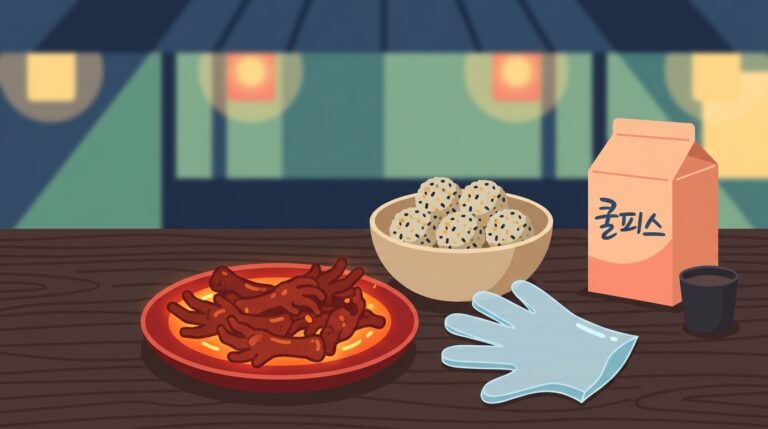
Yes, we are talking about the legendary 매운 닭발 (Maeun Dakbal – Spicy Chicken Feet) paired with its eternal sidekick, 주먹밥 (Jumeokbap – Seaweed Rice Balls).
For many advanced C1 learners, navigating this specific culinary subculture is a major pain point. It’s not just about knowing the word for chicken feet; it’s about understanding the subtle, unspoken social rules of maepbusim (맵부심 – spicy pride), learning how to request mild options without losing your cultural dignity, and mastering the physical choreography of eating them. This guide, curated from real-life dining experiences of long-term expats and native food lovers, will elevate your conversational Korean to a level that will make locals ask, “Are you sure you don’t have Korean blood?”
Phase 2: 핵심 표현 3선 심층 분석 (Deep Dive into 3 Key Expressions)
1. 스트레스 풀리는 매운맛 (seut-reu-seu pul-li-neun mae-un-mat)
- Pronunciation: Sounds like “stress pool-lee-noon meh-oon-mat”
- Meaning: Literally “stress-relieving spiciness.” It refers to that specific level of extreme heat that triggers an endorphin rush, supposedly wiping out all mental exhaustion.
- K-Culture Moment: You will hear this in K-Dramas when a character has had a horrific day at the office and tells their best friend, “오늘 진짜 스트레스 풀리는 매운맛 수혈해야 해!” (I seriously need a transfusion of stress-relieving spiciness today!).
- Editor’s Insight: In Korean culture, physical pain from spicy food is viewed as a therapeutic tool. It shifts your focus from mental stress to physical sensation, helping you sweat out your worries.
- Situation Spectrum: Casual ✅ / Semi-formal ✅ / Formal ⚠️
- 🤔 Think About It: Does your native culture have a food group designed to induce physical sweat as a form of comfort or therapy? How does this contrast with the concept of “comfort food” in the West?
2. 조물조물 동글동글하게 만들어 줘 (jo-mul-jo-mul dong-geul-dong-geul-ha-ge man-deul-eo jwo)
- Pronunciation: Sounds like “jo-mool-jo-mool dong-gool-dong-gool-ha-gheh man-deul-uh jwor”
- Meaning: “Squeeze it gently and roll it into little balls.”
- K-Culture Moment: When a bowl of seasoned rice, seaweed, and sesame oil arrives at the table with a single plastic glove, the self-appointed “rice-ball master” wears the glove and hears this playful command from their friends.
- Editor’s Insight: This phrase showcases beautiful Korean mimetic words (의태어). 조물조물 mimics the gentle, rhythmic squeezing of hands, while 동글동글 describes something delightfully round.
- Situation Spectrum: Casual ✅ / Semi-formal ⚠️ (Only with close colleagues) / Formal 🚫
- 🤔 Think About It: Mimetic words soften the tone of requests. How would you translate the tactile feel of “squeezing food with love” in your native language without sounding too clinical?
3. 쓰읍-하, 발라먹기 귀찮은데 뼈 없는 걸로 갈까? (sseu-eup-ha, bal-la-meok-gi gwi-chan-eun-de ppyeo eomn-neun geol-lo gal-kka?)
- Pronunciation: Sounds like “sseu-oop-ha, bal-la-muk-ghee gwee-chan-oon-deh ppyuh-up-noon gull-loh gal-kka?”
- Meaning: “Sigh/Gasp, stripping meat off the bones is a hassle, should we go with the boneless option?”
- K-Culture Moment: This is a crucial debate at the start of any chicken feet feast. Beginners usually opt for 무뼈 닭발 (boneless), while traditionalists insist on 뼈 있는 닭발 (bone-in) for the authentic texture.
- Editor’s Insight: 쓰읍-하 is the universal Korean onomatopoeia for sucking in air to cool down a burning tongue. The C1-level verb 발라먹다 is highly specific—it means to meticulously separate meat, skin, or fish flesh from the bone using your mouth or utensils.
- Situation Spectrum: Casual ✅ / Semi-formal ⚠️ / Formal 🚫
- 🤔 Think About It: Food textures play a massive role in Korean cuisine. Why do you think Koreans highly value “chewy, bony, and cartilage-heavy” textures, which are often avoided in Western dining?
Phase 3: 교과서 한국어 vs 진짜 한국어 (Textbook vs. Real-life Korean)
Situation 1: Requesting a milder version of a highly spicy dish
- 📖 Textbook: “덜 매운 맛으로 주문할 수 있을까요?” (Deol mae-un maseuro jumunhal su isseulkkayo? – Can I order a less spicy flavor?)
- 🗣️ 진짜 한국어: “사장님, 저 완전 맵찔이라 그런데 보통맛보다 덜 맵게 되나요?” (Sajangnim, jeo wan-jeon maep-jji-ri-ra geureonde botongmatboda deol maep-ge doenayo? – Owner, I am a total spicy-wimp, so can you make it less spicy than the regular level?)
- 💡 왜 다를까? While the textbook phrase is grammatically flawless, using the self-deprecating slang 맵찔이 (maep-jji-ri – spicy wimp) instantly breaks the ice with restaurant owners, signaling to them that they genuinely need to tone down the heat so you don’t end up crying at the table.
Situation 2: Praising the addictive quality of the spicy sauce
- 📖 Textbook: “아주 맛있고 매콤합니다.” (Aju masitgo maekomhamnida. – It is very delicious and spicy.)
- 🗣️ 진짜 한국어: “와, 이거 맛있게 매워서 계속 손이 가요!” (Wa, igeo masitge mae-wo-seo gye-sok son-i gayo! – Wow, this is ‘deliciously spicy’ so my hands keep reaching for it!)
- 💡 왜 다를까? In Korea, “맛있게 맵다” is the ultimate compliment for spicy food. It means the dish isn’t just painfully spicy; it has a rich, savory depth of flavor (umami) that makes it addictive. The idiomatic expression 손이 가다 (hands go to it) perfectly describes food you can’t stop eating.
Phase 4: K-Culture 딥다이브 & 비언어적 매너 (K-Culture Deep Dive & Non-verbal Manners)
4-1. 눈치(Nunchi) & Table Gestures
When eating Dakbal, there is an unspoken table choreo you must follow to show you have high nunchi:
* The Plastic Glove Duty: When the Jumeokbap arrives, do not wait for someone else. Grab the single-use plastic glove (위생장갑) and announce: “주먹밥은 제가 집도하겠습니다!” (I will perform the ‘surgery’ on the rice balls!). This playful initiative shows you are a team player.
* The Bone-in Etiquette: If eating bone-in chicken feet, wear the glove on your non-dominant hand. Use this hand to bring the foot to your mouth, dissect the soft cartilage using your teeth, and use your gloved hand to discreetly deposit the clean bones onto the designated side plate. Never spit them directly onto the table.
4-2. The Cultural Code of 맵부심 (Spicy Pride)
In Korea, eating spicy food is a social bonding ritual. Claiming to be a “맵찔이” is cute and relatable, but participating in the 맵부심 (spicy pride) culture shows you are willing to share in the collective suffering and joy of the table. Ordering Coolpis (쿨피스 – a sweet peach beverage) and Gyeranjjim (계란찜 – steamed egg) is not seen as a sign of weakness; it is a strategic “fire extinguisher” kit that keeps the party going.
Phase 5: 실전 롤플레이 시나리오 (Real-life Roleplay Scenario)
- Background: A bustling, retro late-night pojangmacha (street food style pub) in Hongdae on a Friday night.
- Characters: 지민 (Jimin) (Your close Korean friend who is stressed out from work) & 민우 (Minwoo) (The friendly, fast-paced waiter).
- 지민: “야, 오늘 진짜 부장님 때문에 킹받아서 닭발 각이다. 무뼈로 갈까, 뼈 있는 걸로 갈까?”
(Hey, my boss made me so mad today, we definitely need chicken feet. Should we go boneless or bone-in?) - You: “
🎭 (Nodding eagerly)난 발라먹기 귀찮으니까 무뼈 닭발에 주먹밥 세트로 가자!”
(Since stripping meat is a hassle, let’s go with the boneless chicken feet and rice ball set!) - 지민: “오케이, 주먹밥 제조는 내가 담당할게. 사장님! 여기 무뼈 세트 하나 주세요.”
(Okay, I’ll take charge of making the rice balls. Boss! One boneless set here, please.) - 민우 (Waiter): “주문하셨습니다! 저희 맵기 단계는 보통맛, 매운맛, 아주 매운맛 있는데 어떻게 해드릴까요?”
(Order received! Our spice levels are regular, spicy, and super spicy. Which would you like?) - You: “
🎭 (Smiling apologetically)제가 완전 맵찔이라서… 보통맛보다 조금만 더 안 맵게 조절 가능한가요?”
(I’m a total spicy-wimp… Is it possible to make it a little less spicy than the regular level?) - 민우: “아, 그럼 ‘보통보다 덜 맵게’ 해드릴게요. 쿨피스도 하나 추가하시는 게 좋을 거예요!”
(Ah, then I’ll make it ‘less spicy than regular’. Adding a Coolpis would probably be a good idea!) - 지민: “
🎭 (Giving a thumbs up)와, 완전 센스쟁이 사장님! 쿨피스랑 계란찜도 같이 주세요.”
(Wow, what a sensible boss! Please give us a Coolpis and steamed egg too.) - 민우: “네, 금방 준비해 드리겠습니다! 맛있게 드세요.”
(Yes, I’ll have it ready in no time! Enjoy your meal.)
🔀 Interactive Decision Point (선택 분기점)
What would you say next to make the meal even more fun?
* Option A: “매운맛도 괜찮아요, 그냥 원래 나오는 맵기로 주세요!” (I can handle spicy, just give me the original spiciness!)
👉 Feedback (Risk): Your Korean friend will admire your maepbusim, but unless you have an iron stomach, you might spend the next hour crying and downing cold water.
* Option B: “죄송하지만 아예 안 맵게 간장 양념으로 바꿀 수 있나요?” (Sorry, but can you change it to soy sauce seasoning so it’s not spicy at all?)
👉 Feedback (Bad): Asking for soy sauce chicken feet at a specialized spicy place is culturally awkward. It ruins the whole yasik vibe. The waiter might politely say it’s impossible.
* Option C: “보통맛보다 덜 맵게 해주시고, 주먹밥 얼른 나와서 동글동글하게 만들고 싶어요!” (Please make it less spicy than regular, and I hope the rice balls come out quickly so I can roll them!)
👉 Feedback (Best): Perfect! You successfully negotiated a manageable spice level while showing enthusiastic cultural participation in rolling the jumeokbap.
Phase 6: 10초 감정 섀도잉 드릴 (10-Second Emotion Shadowing Drill)
Practice these sentences with native prosody, paying attention to the emotional markers and rhythm breaks (/):
[🥺 Playfully complaining & craving convenience]
“아, 진짜 / 발라먹기 / 귀찮은데 / 그냥 / 무뼈로 / 가자~ / 쓰읍-하!”[🔥 Showing slight spicy-pride but admitting defeat]
“야, / 내가 / 아무리 / 맵찔이라도 / 닭발에 / 쿨피스는 / 안 빼먹지!”
Phase 7: K-Culture 미니 사전 (K-Culture Mini Dictionary)
- 맵부심 (Maep-bu-sim): Noun. Pride in one’s ability to eat incredibly spicy food. A blend of 매운맛 (spiciness) and 자부심 (pride).
- 맵찔이 (Maep-jji-ri): Noun (Slang). A lovable term for someone who has zero tolerance for spicy food. A blend of 매운맛 and 찌질이 (wimp).
- 무뼈 (Mu-ppyeo): Noun. Boneless. Essential for beginners who want a smooth, stress-free dining experience.
- 쿨피스 (Coolpis): Noun. A legendary peach-flavored milk-acid beverage that serves as the ultimate chemical antidote to fiery Korean red pepper paste (고추장).
Phase 8: 여행자를 위한 생존 키트 (Traveler’s Survival Kit)
Survival Phrases for the Late-Night Explorer:
- “덜 맵게 해주세요.” (Deol maep-ge hae-ju-se-yo.) -> Make it less spicy, please.
- “비닐장갑 하나 더 주실 수 있나요?” (Bi-nil-jang-gap ha-na deo ju-sil su in-na-yo?) -> Can I get one more plastic glove?
- “주먹밥 동그랗게 마는 거 도와주세요!” (Ju-meok-bap dong-geu-rat-ge ma-neun geo do-wa-ju-se-yo!) -> Help me roll these rice balls into perfect spheres! (A great bonding opener with locals).
Editor’s Travel Note:
When looking for authentic Dakbal, stay away from generic tourist hubs. Open the 네이버 지도 앱 (Naver Map App) and search for “닭발 맛집” (dakbal mat-jib). Look for places with high local ratings and dense review sections. Note: Spiciness scales and restaurant menu availability are subject to change over time, so always check the most recent digital menu uploaded by visitors before making your trip.
Phase 9: “한 발 더 깊이” (One Step Deeper)
In Western dining culture, individual portions and personal boundaries are highly respected. However, Korean yasik culture defies this individualism. Eating spicy chicken feet is a communal labor of love. One person wears the glove to knead and roll the jumeokbap for the entire table. Everyone shares from the same hot plate, laughing through tears as the spices kick in. This physical act of sharing food, pain, and the sweet relief of Coolpis represents 정 (Jeong)—the deep, sticky emotional bond that defines Korean relationships.
💬 Your Turn: Do you have a comfort food ritual in your culture that requires active teamwork or shared physical sensations? Let’s discuss in the comments below!
Phase 10: FAQ & 오해 방지 (FAQ & Avoiding Misunderstandings)
Q: Is chicken feet actually popular among young Koreans, or is it just a novelty?
A: It is highly mainstream! It is particularly popular among young professionals and college students (statistically, even more so among young women) as a go-to comfort food to release workplace stress.
Q: What is the cleanest way to eat bone-in chicken feet?
A: Put on your plastic glove. Hold the chicken foot by the “ankle” bone. Place the toes in your mouth and use your front teeth and tongue to peel off the skin and cartilage. Neatly spit the small joints onto your trash plate. It takes practice, but it’s incredibly satisfying once you get the hang of it!
Q: Are there non-spicy options for chicken feet?
A: Occasionally you can find soy-sauce-based (간장) or smoky charcoal grilled styles with mild heat, but chicken feet are fundamentally designed to be spicy. If you absolutely cannot tolerate spice, you might want to stick to Jumeokbap and Gyeranjjim while your friends eat the mains.
🚨 Common Mistakes Warning Board:
- Using chopsticks for bone-in chicken feet: You will lose grip, drop the sauce on your shirt, and look highly stressed. Correct Action: Always use your gloved hand.
- Drinking burning hot water to cure the spice: Hot liquids activate your tongue’s thermal pain receptors, making the spice feel 10x worse. Correct Action: Drink cold, sweet Coolpis or take a bite of warm, neutralizing steamed egg.
- Letting the rice bowl sit until the food gets cold: Jumeokbap rice is incredibly hot when it first arrives, but that’s when it binds best. Correct Action: Roll them into balls immediately while the rice is warm and fresh!
Phase 11: 액션 미션 & 참여 유도 (Action Mission & Participation)
- Bronze Mission: Mirror-practice saying: “제가 완전 맵찔이라서 보통맛보다 덜 매운 맛으로 주세요!” with a cute, apologetic facial expression.
- Silver Mission: The next time you visit a Korean restaurant or order delivery, take a picture of your spicy food and upload it to social media with the hashtag #Maepjjiri or #Maeunmat, tagging @DailyHangul.
- Gold Mission: Walk into an authentic, noisy Korean pojangmacha, order a spicy dish, and when the chef asks how it tastes, confidently look them in the eye and say: “와, 진짜 맛있게 매워요!”
- 🎮 K-Culture Mission: Watch an episode of a slice-of-life K-Drama (such as Work Later, Drink Now). Spot the scenes where characters eat late-night food and observe their gloved hand gestures!
Phase 12: 인터랙티브 퀴즈 챌린지 (Interactive Quiz Challenge)
Test your late-night food IQ with these quick questions:
- Which of the following is NOT a traditional “fire extinguisher” for spicy chicken feet?
(A) 계란찜 (Steamed Egg)
(B) 쿨피스 (Peach beverage)
(C) 뜨거운 아메리카노 (Hot Americano) -
What does the slang “맵찔이” mean?
(A) A master chef who cooks spicy food.
(B) Someone who cannot eat spicy food well.
(C) A specific type of boneless chicken foot. -
True or False: “무뼈” (Mu-ppyeo) means bone-in, which requires you to spit out the joints.
👉 Click here to reveal the answers and explanations!
- Answer 1: (C) – Drinking a hot coffee after eating spicy chicken feet is a recipe for instant tongue torture! Always stick to dairy, sweet beverages, or savory steamed egg.
- Answer 2: (B) – “맵찔이” is a playful, self-deprecating slang combining “spicy” and “wimp.”
- Answer 3: False – “무” (Mu) means “no/without” and “뼈” (ppyeo) means “bone.” So 무뼈 means “boneless.”







