

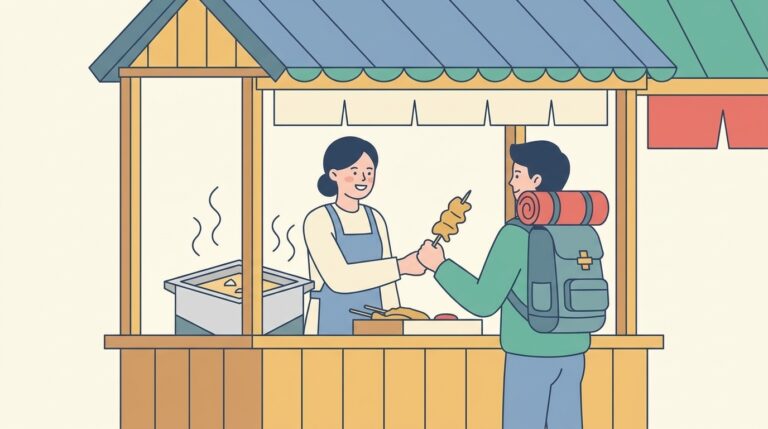
Welcome to the Sizzling Heart of Seoul! 🍢
안녕하세요! (Annyeonghaseyo!) I’m your Daily Hangul editor, and today, I’m taking you on a sensory journey through one of my absolute favorite places in Korea: the traditional market (전통시장 – jeon-tong-si-jang).
Imagine this: It’s a chilly evening. You are walking down the vibrant aisles of Mangwon Market. Your ears catch the rhythmic sizzling of hot oil, and your nose is hit with the warm, savory aroma of fresh fish and vegetables. You follow the scent and find yourself standing in front of a steam-shrouded stall. There they are—golden-brown, freshly fried fish cake bars (핫바 – hat-ba) stacked high, glistening under the warm lights.
But then, a wave of hesitation hits you. The stall is crowded, the owner is moving lightning-fast, and locals are pointing and shouting orders. You want that piping hot one right out of the fryer, but how do you ask for it without sounding like a robotic textbook?
Don’t worry! This guide is built from the real-life struggles of hundreds of our learners. Today, you will learn how to order like a true local and unlock the warm, fuzzy culture of Korean street food. Let’s dive in!
Phase 2: Three Golden Expressions to Melt the Ice
To sound like a natural in the middle of a bustling market, you only need these three powerful expressions. Let’s break them down.
1. 방금 나온 걸로 주세요. (Bang-geum na-on geol-lo ju-se-yo.)
- Pronunciation: Bahng-geum nah-ohn guhl-loh joo-seh-yo (Think of “bang-geum” as “just a second ago” and “na-on” as “came out”).
- Meaning: “Please give me the one that just came out (the freshest batch).”
- K-Culture Moment: You see this in almost every K-food vlog. The creator points to the steaming rack and politely asks for the absolute freshest piece to get that perfect “crispy outside, chewy inside” (겉바속촉 – geot-ba-sok-chok) texture.
- Editor’s Insight: Traditional fish cake stands continuously fry new batches. Asking for “방금 나온 것” shows you appreciate the culinary craft of fresh frying. Owners love this!
- Situation Spectrum: Casual (⚠️ – change to ‘방금 나온 걸로 줘’ for friends), Semi-formal (✅ – Perfect for vendors), Formal (🚫).
- 🤔 Think About It: In Korea, eating food while it is piping hot is considered a way to fully respect the chef’s effort. Does your culture prefer street food served immediately, or do you mind if it has sat on the rack for a bit?
2. 국물 좀 마셔도 돼요? (Gung-mul jom ma-syeo-do dwae-yo?)
- Pronunciation: Goong-mool johm mah-shuh-doh dweh-yo? (Note the sound change: 국물 is written as guk-mul but pronounced gung-mul due to nasalization!).
- Meaning: “May I have some broth?”
- K-Culture Moment: Think of classic winter K-dramas where characters stand at a stall, shivering, holding a paper cup of steaming broth close to their face.
- Editor’s Insight: At fish cake stands, the savory broth (국물) is free and unlimited. While you can technically grab a paper cup and ladle it yourself, asking first is a beautiful display of manners (예의 – ye-ui).
- Situation Spectrum: Casual (⚠️), Semi-formal (✅), Formal (🚫).
- 🤔 Think About It: Offering free, unlimited hot broth is a classic example of 정 (Jeong)—the Korean concept of warm, unconditional affection. Is there a similar “freebie” culture in your country?
3. 소스는 뭐 뿌려 먹어요? (So-seu-neun mwo ppu-ryeo meog-eo-yo?)
- Pronunciation: Soh-seu-neun mwoh ppoo-ryuh muhg-uh-yo? (The double ‘pp’ in 뿌려 is a tense, sharp sound—like the ‘p’ in “spit”).
- Meaning: “Which sauce should I drizzle on this?”
- K-Culture Moment: You are standing in front of four different squeeze bottles: ketchup, mustard, spicy tteokbokki sauce, and sweet chili. You have no idea what goes best with a vegetable hot bar.
- Editor’s Insight: Instead of guessing, ask the owner! By asking for their recommendation, you show respect for their recipe, and they will usually happily drizzle the perfect combination for you.
- Situation Spectrum: Casual (⚠️), Semi-formal (✅), Formal (🚫).
- 🤔 Think About It: Asking for advice is a quick way to build rapport in Korea. How do you feel about asking food vendors for their personal recommendations?
Phase 3: Textbook Korean vs. Real-Life Korean
Let’s compare the stiff expressions you find in outdated apps with what native Koreans actually say at a street stall.
Situation 1: Ordering your fish cake
- 📖 Textbook Korean: “어묵 한 개를 구입하고 싶습니다.” (I would like to purchase one fish cake.)
- 🗣️ Real-Life Korean: “사장님, 이거 하나 주세요! 바로 먹을게요.” (Boss, give me one of these, please! I’ll eat it right away.)
- 💡 Why the difference? Traditional markets run on speed and warmth. Referring to the owner as 사장님 (Sajangnim – Boss/Owner) instantly establishes a friendly connection, and saying “바로 먹을게요” tells them they don’t need to wrap it up.
Situation 2: Inquiring about spicy options
- 📖 Textbook Korean: “이 어묵은 매운 성분이 포함되어 있습니까?” (Does this fish cake contain spicy ingredients?)
- 🗣️ Real-Life Korean: “이거 많이 매워요? 저 맵찔이라서요…” (Is this very spicy? I’m a bit of a spicy-wimp…)
- 💡 Why the difference? 맵찔이 (Maep-jji-ri) is a super popular, cute slang term for someone who can’t handle spicy food. Using it makes the vendor laugh and protect your tastebuds!
Phase 4: K-Culture Deep Dive & Non-Verbal Manners
4-1. Nunchi (눈치) & Stall Etiquette
- The Paper Cup Etiquette: When pouring your free broth, always use the ladle provided, pour it into a small paper cup (종이컵), and step slightly back from the main counter so other customers can order. Never drink directly from the ladle!
- The Sauce Shield: When applying sauce from the squeeze bottles, keep the fish cake skewer close to the counter or tray. Drizzling sauce while holding it high in the air is a recipe for staining your (or someone else’s) coat!
4-2. The Culture of ‘Gil-meok’ (길먹)
In many Western cultures, eating while standing on the street can feel rushed or awkward. In Korea, 길먹 (Gil-meok – street eating) at market stalls is a celebrated social ritual. It’s where businesspeople in luxury suits stand shoulder-to-shoulder with students, sharing the same warm broth. It’s a space where socioeconomic barriers disappear over a 2,000 KRW stick of fried fish cake.
Phase 5: Real-Life Roleplay Challenge
Setting: “Imo-ne Eomuk” (Auntie’s Fish Cake Stall) at Mangwon Market. The oil is bubbling merrily.
Characters:
* Imo (이모): The friendly, energetic stall owner who loves chatting with travelers.
* Yong-gi (용기 – You): A hungry traveler eager for fresh food.
1. Imo: "어서 오세요! 따끈따끈한 어묵 새로 나왔어요!"
   (Welcome! Hot, fresh fish cakes just came out!)

2. Yong-gi: "🎭 (Smiling warmly and bowing slightly) 안녕하세요! 우와, 냄새 진짜 좋네요. 사장님, 방금 튀긴 거 어떤 거예요?"
   (Hello! Wow, it smells amazing. Boss, which one is freshly fried?)

3. Imo: "요 고추 어묵하고 치즈 어묵이 방금 기름에서 건진 거야! 진짜 바삭해!"
   (This chili fish cake and cheese fish cake just came out of the oil! Real crispy!)

4. Yong-gi: "🎭 (Pointing to the cheese one) 그럼 치즈 어묵으로 하나 주세요! 바로 먹을게요."
   (Then please give me one cheese fish cake! I'll eat it right away.)

5. Imo: "오케이! 꼬치에 꽂아 줄게. 소스는 저기서 뿌려 먹어~"
   (Okay! I'll put it on a skewer for you. Put the sauce on over there~)

6. Yong-gi: "감사합니다! 혹시... 어묵 국물도 좀 마셔도 돼요?"
   (Thank you! By the way... may I have some fish cake broth too?)

7. Imo: "그럼~ 종이컵에 마음껏 떠 마셔! 우리 집 국물이 끝내줘."
   (Sure~ help yourself using the paper cup! Our broth is the best.)

8. Yong-gi: "🎭 (Taking a sip and widening your eyes) 와, 국물이 진짜 깊고 시원해요! 잘 먹겠습니다!"
   (Wow, the broth is really deep and refreshing! I will eat well!)
🔀 Interactive Choice Point!
What do you do next to show your market savvy?
* A) Ask for Tteokbokki sauce on top: “이모, 여기에 떡볶이 소스 좀 발라주실 수 있어요?”
👉 [BEST] Imo will absolutely adore your food styling! She’ll likely ladle a generous scoop of sweet and spicy sauce over your cheese hot bar for free.
* B) Hand over a 50,000 KRW bill for a 2,000 KRW bar:
👉 [RISK] While they will accept it, market vendors prefer small change, card payments, or mobile bank transfers (계좌이체). Try to use smaller bills!
* C) Double-dip your half-eaten fish cake into the communal soy sauce container:
👉 [BAD] A major health and cultural crime! Always use the spray bottle or the brush provided to apply soy sauce before taking a bite.
Phase 6: 10-Second Emotion Shadowing Drill
To master the friendly, natural tone of Korean market speech, practice these phrases with the correct rhythm and emotional cues. (The / indicates a natural pause).
- [😊 Bright & Excited]
“사장님, / 이거 방금 튀긴 거예요? / 하나 주세요!”
(Sa-jang-nim, / i-geo bang-geum twi-gin geo-yeo? / ha-na ju-se-yo!) -
[🥺 Polite & Cozy]
“국물 좀 / 마셔도 돼요? / 오늘 너무 춥네요.”
(Gung-mul jom / ma-syeo-do dwae-yo? / o-neul neo-mu chup-ne-yo.)
Phase 7: K-Culture Mini-Dictionary
- 핫바 (Hat-ba): Hot Bar. A deep-fried fish cake bar served on a wooden skewer, often mixed with fillings like hot chili, cheese, rice cake, or sausages.
- 국물 (Gung-mul): Broth/Soup. The lifeblood of Korean street food stalls, slow-simmered with anchovies, daikon radish, and kelp.
- 길먹 (Gil-meok): Street eating. Eating food right where you bought it while standing up.
- 계좌이체 (Gye-jwa-i-che): Bank transfer. A highly common payment method in modern Korean markets where you instantly send money to the owner’s bank account via a banking app.
Phase 8: Traveler’s Survival Kit
Survival Expressions TOP 3
- “이거 매워요?” (I-geo mae-wo-yo?): Is this spicy? (Essential if you see red specks on the fish cake!).
- “포장해 주세요.” (Po-jang-hae ju-se-yo.): Please pack it to go. (Use this if you want to eat it back in your cozy hotel room).
- “카드 돼요?” (Ka-deu dwae-yo?): Do you take card? (Almost all vendors do nowadays!).
🗺️ Editor’s Travel Note
When navigating traditional markets, don’t rely on global map apps as they often miss small alleys. Download the Naver Map App for pinpoint accuracy. Also, note that while most stalls open around 9:00 AM, the fried fish cake stands are liveliest in the late afternoon (around 4:00 PM) when a fresh batch of oil is prepared!
(Note: Vendor operational hours and accepted payment methods may vary depending on local conditions.)
Phase 9: “One Step Deeper” (Reflective Mini-Essay)
In Korea, traditional markets are not just places of commerce; they are the living rooms of the neighborhood. The informal language, the generous portions, and the lack of strict boundaries form the foundation of 정 (Jeong). When you ask “국물 좀 마셔도 돼요?”, you aren’t just asking for free soup—you are participating in a communal dining legacy that has kept Koreans warm through tough winters for centuries.
💬 Your Turn!
Does your culture have a concept similar to 정 (Jeong) when it comes to local food and hospitality? Let us know in the comments below! We love reading your stories.
Phase 10: FAQ & Common Mistakes
Q: Do I have to pay extra for the paper cup of broth?
A: No! The broth is completely free. It is a complimentary gesture for anyone buying food at the stall. Just remember to only take what you can drink so you don’t waste it.
Q: Can I sit down while eating my hot bar?
A: Most freshly fried fish cake stalls are standing-only (길먹). If you see a row of plastic stools, you are welcome to sit, but if it is crowded, standing is the default manner.
Q: How do I pay if I only have my phone?
A: Look around the stall banner. You will likely see a bank logo and account number printed on a laminated sheet. You can perform a quick mobile 계좌이체 (bank transfer), which owners highly appreciate!
🚨 Common Mistakes Warning Board!
- Mistake 1: Double-dipping into the communal soy sauce pot.
👉 Correct Action: Use the spray bottle to mist your hot bar, or use the brush to paint the sauce on before taking your first bite! - Mistake 2: Leaving your wooden skewer on the counter.
👉 Correct Action: Hand it back to the owner or throw it into the designated tall cup/box meant for used skewers. - Mistake 3: Standing right in front of the fryer to eat.
👉 Correct Action: Step slightly to the side after purchasing so the next customer can approach the hot food.
Phase 11: Action Missions
- 🥉 Bronze Mission: Practice saying “방금 나온 걸로 주세요!” out loud three times in front of your mirror.
- 🥈 Silver Mission: Share this post on your social media and tag your favorite K-food buddy with the caption: “Next stop, Mangwon Market!”
- 🥇 Gold Mission: Go to a Korean traditional market, order a cheese hot bar, and successfully ask: “국물 좀 마셔도 돼요?”
- 🎮 K-Culture Mission: Watch a street food scene in a drama like Reply 1988 and spot the characters standing at the market stalls drinking broth.
Phase 12: Interactive Quiz Challenge
Test your market wisdom! Click on the toggle to check your answers.
1. Which expression should you use to get the freshest fried fish cake?
- A) 이거 어제 만든 거예요? (Is this made yesterday?)
- B) 방금 나온 걸로 주세요. (Please give me the one that just came out.)
- C) 아무거나 하나 주세요. (Give me anything.)
2. What is the correct way to eat soy sauce at a communal stand?
- A) Dip your hot bar into the big cup, bite, and dip again.
- B) Pour the soy sauce directly onto the floor.
- C) Spray the soy sauce using the provided spray bottle or brush before biting.
🎉 Click here to reveal the answers and explanations!
- Question 1 Answer: B
Explanation: “방금 나온 걸로 주세요” targets the freshest, hot-off-the-fryer batch. A is polite but means the opposite, and C is too passive! - Question 2 Answer: C
Explanation: Hygiene is incredibly important! Double-dipping is a major social error. Always use the spray bottle or brush provided.







