

Master the Art of Interlibrary Loans in Korea: Navigating 도서관 상호 대차 서비스 Like a Local
Phase 1: Empathy (스토리 몰입형 오프닝)
안녕하세요! (Annyeonghaseyo!) It’s your trusty Daily Hangul editor and cultural navigator here.
Imagine this: You are writing a book review or researching a deeply niche Korean historical topic, and you find the perfect source material online. But there’s a catch—it’s physically sitting in a small municipal library on the other side of Seoul, or worse, in another province entirely. Traveling three hours for one book sounds exhausting, right?
This is where many advanced K-learners hit a wall. In Korea, the library system is incredibly integrated through a service called 상호 대차 (Sangho Daecha – Interlibrary Loan). Yet, asking a librarian to coordinate a transfer between different library networks using advanced, polite Korean can feel incredibly intimidating.
Today, we are going to master the high-level vocabulary, subtle cultural etiquettes, and natural expressions needed to navigate Korea’s public library networks smoothly. This guide is built based on real-world feedback from C1-level learners who wanted to transition from basic library tasks to fully utilizing national academic resources. Ready to level up your literary life in Korea? Let’s dive in!
Phase 2: Deep Dive into 3 Key Expressions (핵심 표현 3선 심층 분석)
1. 상호 대차 신청하려고 하는데요. (Hangeul)
- Pronunciation: Sang-ho dae-cha sin-cheong-ha-ryeo-go han-eun-de-yo. (Sounds like: Sahng-hoh deh-chah seen-chuhng-hah-ryuh-goh hah-neun-deh-yoh)
- Meaning: “I would like to apply for an interlibrary loan.”
- K-Culture Moment: You will hear this precise phrasing in academic slice-of-life K-Dramas like Law School or Our Beloved Summer, where characters spend late nights tracking down rare references.
- Editor’s Insight: The structure -려고 하는데요 is the gold standard for initiating a transaction politely in Korea. It translates to “I intend to do X, so…” which leaves the conversational space open for the staff member to guide you.
- Situation Spectrum:
- Casual: 상호 대차 신청할래. ⚠️ (Too blunt for public spaces)
- Semi-formal/Formal: 상호 대차 신청하려고 하는데요. ✅ (Perfect for library desks)
- 🤔 Think About It: Why does Korean use indirect openings like “-는데요” rather than direct imperatives like “Give me the book from the other library”? It reflects the cultural value of mitigating direct pressure on the listener.
2. 타 관 도서 반납도 여기서 가능한가요? (Hangeul)
- Pronunciation: Ta gwan do-seo ban-nap-do yeo-gi-seo ga-neung-han-ga-yo? (Sounds like: Tah gwahn doh-suh bahn-nahp-doh yuh-ghee-suh gah-neung-hahn-gah-yoh?)
- Meaning: “Is it also possible to return books from other library branches here?”
- K-Culture Moment: Essential for busy students or workers who borrow books near their office but want to return them closer to home.
- Editor’s Insight: 타 관 (Ta-gwan) literally means “other institution/building.” In C1 Korean, using Sino-Korean compounds like 타 관 (other library) instead of 다른 도서관 (dareun doseogwan) immediately elevates your speaking level, showing a deep grasp of formal administration terminology.
- Situation Spectrum:
- Casual: 다른 도서관 책 여기서 돌려줘도 돼? ⚠️
- Semi-formal/Formal: 타 관 도서 반납도 여기서 가능한가요? ✅
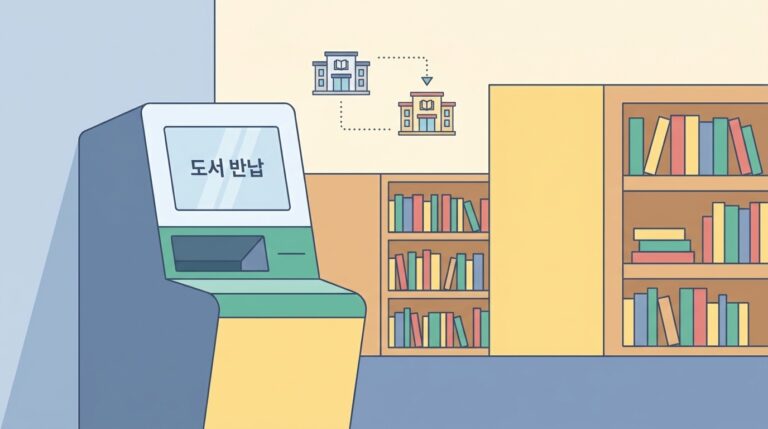
- 🤔 Think About It: How does your home country manage book returns? In Korea, high-tech return slots (무인 반납기) often process cross-district returns automatically!
3. 소장 자료 검색결과에는 나오는데, 대출 가능 상태인가요? (Hangeul)
- Pronunciation: So-jang ja-ryo geom-saek-gyeol-gwa-e-neun na-o-neun-de, dae-chul ga-neung sang-tae-in-ga-yo? (Sounds like: Soh-jahng jah-ryoh guhm-sek-gyuhl-gwah-eh-neun nah-oh-neun-deh, deh-chool gah-neung sahng-teh-een-gah-yoh?)
- Meaning: “It shows up in the collection search results, but is it currently available for checkout?”
- K-Culture Moment: Often muttered when a book’s online status is glitchy, or when you are trying to verify if a rare edition is actually on the shelves before placing a hold.
- Editor’s Insight: 소장 자료 (So-jang ja-ryo) refers to “held collection/materials.” Asking about the 대출 가능 상태 (Dae-chul ga-neung sang-tae – checkout availability) prevents unnecessary processing delays.
- Situation Spectrum:
- Casual: 이거 빌릴 수 있어? ⚠️ (Too informal for staff)
- Semi-formal/Formal: 소장 자료 검색결과에는 나오는데, 대출 가능 상태인가요? ✅
Phase 3: Textbook Korean vs. Real-Life Korean
Let’s compare the sterile phrases found in standard textbooks with the dynamic, natural Korean used by real patrons.
Situation 1: Asking if a book has arrived
- 📖 Textbook Korean: “제가 신청한 상호 대차 도서가 도착했습니까?” (Has the interlibrary loan book I requested arrived?)
- 🗣️ Real-Life Korean: “저, 상호 대차 신청한 책 도착했다는 문자를 받고 왔는데요.” (Hi, I’m here because I got a text message saying my interlibrary loan book has arrived.)
- 💡 Why the difference? Real Koreans rarely use “-습니까” in daily interactions; it sounds overly robotic and confrontational. Using the context of the text message (문자) as a natural opener is much more common.
Situation 2: Asking about limits on borrowing
- 📖 Textbook Korean: “상호 대차는 몇 권까지 할 수 있습니까?” (How many books can be loaned through interlibrary services?)
- 🗣️ Real-Life Korean: “상호 대차는 인당 최대 몇 권까지 신청돼요?” (How many books can be requested per person for interlibrary loans?)
- 💡 Why the difference? 인당 (In-dang – per person) is a highly practical, conversational Sino-Korean contraction used daily instead of “한 사람당”.
Phase 4: K-Culture Deep Dive & Non-Verbal Manners
4-1. Silent Manners in Korean Libraries
- The “Quiet Nod” (목례 – Mok-rye): When approaching the desk in a quiet library room, avoid loud vocal greetings. Give a slight, silent 15-degree head bow first, then speak in a soft, low-toned whisper (속삭임).
- The Two-Handed Hand-Off: When handing over your library card (회원증) or returning books, always present them with both hands or with your right hand supported at the elbow by your left hand. Doing it with one hand can appear dismissive.
4-2. The ” 책바다 (Chaekbada)” Culture
Did you know Korea has a nationwide interlibrary system called 책바다 (Chaekbada, literally meaning “Ocean of Books”)? It links public libraries with national and university libraries across the entire country. If a book you need for a book review (서평) is out of print, you can get it shipped to your local neighborhood library for a very small fee! This hyper-convenience represents Korea’s modern “pali-pali” (fast-paced) public infrastructure.
Phase 5: Interactive Roleplay Scenario
Here is a realistic scenario at the Mapo District Library desk. You are speaking with Librarian Kim (김 사서), who is helpful but very systematic.
Characters:
- 유진 (You/Yujin): An avid reader working on an in-depth book review.
- 김 사서 (Librarian Kim): A detail-oriented library worker who values official protocols.
유진: 🎭 (Approaches the desk and bows slightly) 안녕하세요, 상호 대차 도서 수령하러 왔는데요.
(Annyeonghaseyo, sangho daecha doseo suryeonghareo wanneundeyo.)
"Hello, I'm here to pick up an interlibrary loan book."

김 사서: 🎭 (Looks up from computer) 네, 회원증이나 모바일 바코드 좀 보여주시겠어요?
(Ne, hoejeonjeung-ina mobail bakodeu jom boyeojusigesseoyo?)
"Yes, could you please show me your library card or mobile barcode?"

유진: 🎭 (Hands over phone with barcode using both hands) 네, 여기 있습니다. 혹시 연체된 건 없죠?
(Ne, yeogi isseumnida. Hoksi yeonchedoen geon eopjyo?)
"Yes, here it is. By the way, there are no overdue items on my account, right?"

김 사서: 🎭 (Scans barcode) 네, 연체는 없으시고요. 신청하신 책이 다른 구립 도서관에서 어제 도착했네요.
(Ne, yeonche-neun eopseusigoyo. Sincheonghasin chaegi dareun gurip doseogwan-eseo eoje dochakhaenneyo.)
"That's correct, no overdue items. The book you requested arrived yesterday from another district library."

유진: 🎭 (Relieved) 다행이네요. 이 책 다 읽고 반납할 때도 꼭 여기 마포 도서관으로 와야 하나요?
(Dahaeng-ineyo. I chaek da ilgo bannaphal ttaedo kkok yeogi Mapo doseogwan-euro waya hanayo?)
"What a relief. When I finish reading this and return it, do I absolutely have to come back to this Mapo Library?"

김 사서: 🎭 (Nods) 아뇨, 마포구 내에 있는 구립 도서관 어디서든 반납하셔도 됩니다.
(Anyo, Mapogu nae-e inneun gurip doseogwan eodiseodeun bannaphasyeodeun doemnida.)
"No, you may return it to any municipal library within Mapo district."

유진: 🎭 (Smiles) 정말 편리하네요! 대출 기간 연장도 가능한가요?
(Jeongmal pyeonlihaneyo! Daechul gigan yeonjangdo ganeunghan-gayo?)
"That is so convenient! Is it also possible to extend the loan period?"

김 사서: 🎭 (Points to screen) 죄송하지만 상호 대차 도서는 예약자가 많아 연장이 불가능합니다.
(Joesonghajiman sangho daecha doseo-neun yeyakja-ga mana yeonjang-i bulganeunghamnida.)
"I'm sorry, but because demand is high, extensions are not permitted for interlibrary loans."
🔀 Choose Your Next Move! (Interactive Branching)
Now you must reply to Librarian Kim about the non-extendable book limit. What do you say?
- Choice A: “아, 그래요? 그럼 그냥 지금 취소해 주세요.” (“Oh, really? Then please just cancel it now.”)
- Choice B: “아, 그렇군요. 그럼 기한 내에 다 읽고 반납하도록 하겠습니다. 감사합니다!” (“Ah, I see. Then I will make sure to finish reading and return it within the deadline. Thank you!”)
- Choice C: “왜 연장이 안 돼요? 특별히 편의를 봐주실 수는 없나요?” (“Why is an extension not allowed? Can’t you make a special exception for me?”)
💡 Feedback on Your Choice:
- Choice A (Risk): While grammatically correct, cancelling immediately after they processed an interlibrary transfer makes you look slightly impatient, and the effort of the transferring library goes to waste.
- Choice B (BEST): Highly polite, shows respect for public rules, and demonstrates C1 linguistic maturity with the proactive resolution grammar (-도록 하겠습니다).
- Choice C (BAD): Asking for “special favors” (편의) in public institutions in Korea is highly discouraged and violates modern administrative equity rules. It will make the librarian very uncomfortable!
Phase 6: 10-Second Emotional Shadowing Drill
Practice saying these lines out loud with the correct intonations, emotional markers, and pauses (/).
- [😊 Expressing Gratitude & Relief]
- “상호 대차가 / 엄청 빨리 처리되었네요! / 정말 감사합니다.”
- Sang-ho dae-cha-ga / eom-cheong ppal-li cheo-ri-doe-eon-ne-yo! / Jeong-mal gam-sa-ham-ni-da.
- [🥺 Polite Inconvenience/Apology]
- “혹시 / 대출 카드를 두고 왔는데, / 모바일 앱 바코드로 / 대체할 수 있을까요?”
- Hok-si / dae-chul ka-deu-reul du-go wan-neun-de, / mo-ba-il aep ba-ko-deu-ro / dae-che-hal su is-seul-kka-yo?
Phase 7: K-Culture Mini Dictionary
- 도서 연체 (Doseo Yeonche) | Book Overdue | Getting blacklisted from borrowing because you didn’t return a book on time. If you are 5 days late, your checkout rights are usually suspended for 5 days.
- 통합 대출증 (Tonghap Daechuljeung) | Integrated Library Card | One single library card that works across all public libraries in a specific city or region (e.g., 책이음 card).
- 희망 도서 신청 (Heuimang Doseo Sincheong) | Wishlist Book Request | Requesting the library to purchase a newly released book that they do not currently own.
- 무인 반납함 (Muin Bannapham) | Unmanned Return Box | Smart automated boxes placed near subway exits or library entrances for 24/7 returns.
Phase 8: Traveler/Resident Survival Kit
Survival Phrases TOP 3
- “이거 책이음 카드로 대출되나요?” (Is this checkoutable with the Chaek-eum card?)
- Pro Tip: “책이음” is the national library integration service. Check if your card has the green “책이음” logo!
- “서평 쓰기에 좋은 조용한 열람실이 어디인가요?” (Where is a quiet reading room suitable for writing book reviews?)
- “대출 상태 확인 부탁드립니다.” (Please check my checkout status.)
Editor’s Travel Note
Before heading to any library in Seoul, download the 서울시민카드 (Seoul Citizen Card App) on your phone. It integrates multiple public facility memberships (libraries, museums, art centers) into one neat barcode. Disclaimer: Library system rules and transfer fees may change based on municipal district policies; always double-check with local library announcements.
Phase 9: “A Step Deeper” (생각 질문)
Korea’s highly integrated library systems are a direct reflection of Korea’s trust-based society and public digital infrastructure. In many countries, returning a book to a completely different institution is unthinkable due to logistics and loss risks. Yet in Korea, the “책이음” network operates seamlessly, built on the assumption that citizens will respect return deadlines and care for shared public goods.
💬 Your Turn: How do libraries in your country manage cross-regional borrowing? Do you prefer digital e-books, or do you still enjoy the physical weight of a borrowed library book? Let us know in the comments below!
Phase 10: FAQ & Avoiding Misunderstandings
Q: 외국인도 상호 대차 서비스를 이용할 수 있나요?
A: 네, 당연히 가능합니다! 외국인등록증(ARC)을 소지하고 계시다면 거주지 관할 도서관에서 회원증을 발급받은 뒤 동일한 상호 대차 서비스를 자유롭게 누리실 수 있습니다.
Q: 상호 대차로 빌린 책은 배송비가 드나요?
A: 대부분의 구립/시립 도서관 간의 상호 대차는 무료로 운영됩니다. 다만 국립중앙도서관이나 대학 도서관을 연결하는 전국 단위 ‘책바다’ 서비스의 경우 약간의 택배비(일부 지자체에서 보조금 지원)가 발생할 수 있습니다.
Q: 반납 기한을 하루 넘겼는데 바로 상호 대차가 정지되나요?
A: 일반적으로 연체한 일수만큼 도서 대출 및 상호 대출 신청이 일시 정지됩니다. 연체되지 않도록 반납 예정일 알림 문자를 꼭 확인하세요!
🚨 Common Mistakes Warning Sign
- Calling the service “빌려주기” (Borrowing/Lending): When dealing with library systems formally, use official terms like 대출 (checkout) or 상호 대차 (interlibrary loan) rather than informal words like “책 빌려주세요.”
- Ignoring regional boundaries: A library card from Busan won’t automatically let you request interlibrary loans in Seoul unless you are registered under the national “책이음” integration program first. Always check registration status!
- Returning to private libraries: Do not drop municipal books into university libraries or private book cafes. Use official designated public return boxes only.
Phase 11: Action Mission
- Bronze (Easy): Look up your local Korean library’s website and locate the tab labeled 상호대차 or 타관도서반납.
- Silver (Medium): Go to a library desk, politely bow, and ask: “여기서 타 관 도서 반납도 되나요?”
- Gold (Advanced/Expert): Successfully request a book through the 상호대차 service, retrieve it using your mobile barcode, and post a short book review (서평) on your SNS tag-marked
#DailyHangul!
Phase 12: Interactive Quiz Challenge
Test your library prowess! Click the details to reveal answers.
1. Which term refers to the “Interlibrary Loan” service in Korea?
- A) 희망 도서
- B) 상호 대차
- C) 도서 반납
Click for Answer & Explanation
Correct Answer: B) 상호 대차
* Explanation: “상호” means mutual/reciprocal, and “대차” means loaning/borrowing. (A means wishlist book, and C means book return).
2. True or False: You can extend the checkout period for an interlibrary loan book anytime.
Click for Answer & Explanation
Correct Answer: False
* Explanation: Since interlibrary books involve logistics between different branches and are often in high demand, many library systems prohibit loan extensions for them.






