

Master the Baskin Robbins 31 Game: How to Survive Korean Drinking Games Like a Local
Phase 1: Empathy (Dive Into the Scene)
안녕하세요! (Annyeonghaseyo!) I’m your Daily Hangul editor, your personal guide to the vibrant, fast-paced world of Korean social life.
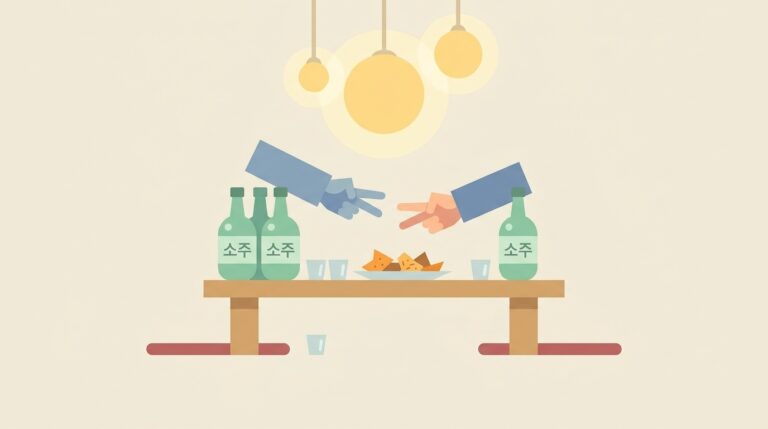
Picture this: You are at a lively suljib (술집 – pub) in Sinchon, surrounded by your Korean friends. The table is filled with sizzling korean pancake (전 – jeon), crispy fried chicken, and green bottles of Soju. Suddenly, someone starts clapping their hands to a rhythmic beat and chants:
“Baskin~ Robbins~ Thirty~ One~!”
Your heart rate spikes. You know this game from K-Dramas, but when the turns start coming at lightning speed, you freeze. “Wait, do I say one number or three? If I say 31, do I have to drink? What if I ruin the vibe?”
Don’t worry! Every Korean learner has been there. Today, we’re unlocking the Baskin Robbins 31 Game (베스킨라빈스 31 게임) so you can transition from a nervous observer to the life of the party. Let’s get you ready to play, laugh, and toast like a true insider!
Phase 2: Deep Dive into 3 Essential Expressions
1. 귀엽고 깜찍하게 (Gwi-yeop-go kkam-jjik-ha-ge)
- Pronunciation: Gwee-yup-go kkam-jjik-ha-ge (Sounds like “gwee-yup” + “kam-jeek-ha-ge”)
- Meaning: “Cute and lovely” / “In a cute and adorable way”
- K-Culture Moment: Before starting the Baskin Robbins 31 game, the starter has to sing the intro song. Often, the crowd demands: “귀엽고 깜찍하게!” meaning you must sing the intro theme in your most adorable, high-pitched voice (aegyo).
- Editor’s Insight: This isn’t just about being cute; it’s a social icebreaker. It forces everyone to let their guard down and laugh.
- Situation Spectrum: Casual: ✅ | Semi-formal: ⚠️ | Formal: 🚫
- 🤔 Think About It: Why does Korean social culture place so much value on showing aegyo (cuteness) during informal gatherings compared to Western drinking cultures?
2. 눈치싸움 (Nunchi-ssa-um)
- Pronunciation: Noon-chee-ssa-oom (Rhymes with “noon-chi” + “sah-um”)
- Meaning: “Nunchi battle” / “Wits game”
- K-Culture Moment: Baskin Robbins 31 can be played in two ways: taking turns in a circle, or through a Nunchi-ssa-um where anyone can shout the next numbers at any time without a set order. If two people shout at the same time, they both drink!
- Editor’s Insight: Nunchi (tact/social reading) is the ultimate Korean survival skill. Doing a Nunchi-ssa-um means reading the room’s energy and timing your numbers perfectly.
- Situation Spectrum: Casual: ✅ | Semi-formal: ✅ | Formal: ⚠️
- 🤔 Think About It: How does Nunchi reflect the collectivist nature of Korean society where harmony and timing are prioritized over individual spotlight?
3. 벌칙 (Beol-chik)
- Pronunciation: Bul-chik (Sounds like “buhl-cheek”)
- Meaning: “Penalty” / “Punishment”
- K-Culture Moment: The person forced to call out the number “31” loses the game and must face the beol-chik—which usually involves taking a shot of Soju or performing a silly dare.
- Editor’s Insight: Beol-chik is never malicious. It is a playful way to keep the game’s stakes high and ensure everyone stays focused.
- Situation Spectrum: Casual: ✅ | Semi-formal: ✅ | Formal: 🚫
- 🤔 Think About It: How does having a structured “penalty” in games make losing feel more like a shared, fun experience rather than an embarrassment?
Phase 3: Textbook Korean vs. Real-Life Korean
Situation 1: Passing your turn in a game
- 📖 Textbook Korean: “제 차례가 끝났습니다.” (Je cha-rye-ga kkeut-nas-seub-ni-da.)
- “My turn is finished.”
- 🗣️ 진짜 Korean: “패스! 너 해!” (Paeseu! Neo hae!)
- “Pass! Your turn!”
- 💡 Why the difference? Drinking games move at a breakneck speed. Textbook Korean is too polite and slow; short, snappy slang keeps the momentum alive.
Situation 2: Asking someone to drink the penalty shot
- 📖 Textbook Korean: “당신이 졌으니 술을 마십시오.” (Dang-sin-i jyeot-eu-ni sul-eul ma-sip-si-o.)
- “Since you lost, please drink alcohol.”
- 🗣️ 진짜 Korean: “마셔라! 마셔라!” (Ma-syeo-ra! Ma-syeo-ra!)
- “Drink! Drink!” (The iconic Korean drinking chant)
- 💡 Why the difference? Koreans love group rhythm. Rhythmic chanting creates a fun peer-pressure environment where everyone shares the excitement.
Phase 4: K-Culture Deep Dive & Non-verbal Etiquette
4-1. Nunchi & Body Language
During the game, keeping eye contact is crucial. If you’re playing the Nunchi-ssa-um variation, slouching or looking away will make you an easy target. Sit slightly forward, keep your hands ready to clap, and read the lip movements of your friends to predict when they are about to speak.
4-2. The Etiquette of the
Frequently Asked Questions (FAQ)
Q: What does "귀엽고 깜찍하게 (Gwi-yeop-go kkam-jjik-ha-ge)" mean in Korean and how do you pronounce it?
A: In Korean, "귀엽고 깜찍하게 (Gwi-yeop-go kkam-jjik-ha-ge)" is pronounced [Gwee-yup-go kkam-jjik-ha-ge (Sounds like "gwee-yup" + "kam-jeek-ha-ge"] and means: "Cute and lovely" / "In a cute and adorable way"
Q: What does "눈치싸움 (Nunchi-ssa-um)" mean in Korean and how do you pronounce it?
A: In Korean, "눈치싸움 (Nunchi-ssa-um)" is pronounced [Noon-chee-ssa-oom (Rhymes with "noon-chi" + "sah-um"] and means: "Nunchi battle" / "Wits game"
Q: What does "벌칙 (Beol-chik)" mean in Korean and how do you pronounce it?
A: In Korean, "벌칙 (Beol-chik)" is pronounced [Bul-chik (Sounds like "buhl-cheek"] and means: "Penalty" / "Punishment"







