

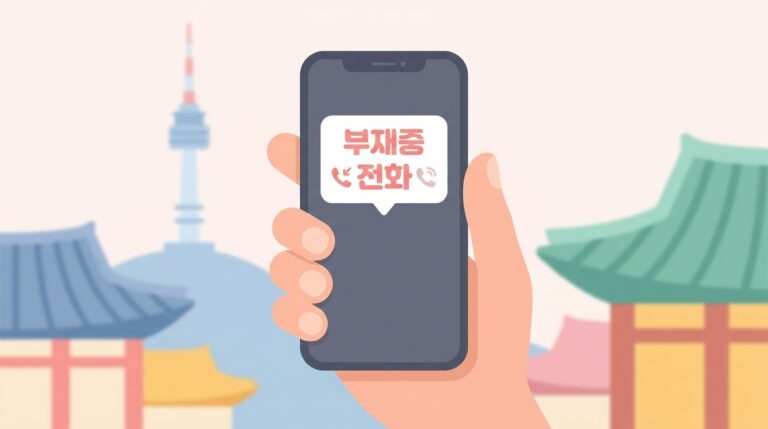
Master Calling Back in Korean: How to Handle Missed Calls Like a Local
Phase 1: Empathy (Your Friendly Korean Bestie is Here!)
안녕하세요! (An-nyeong-ha-se-yo!) Your Korean bestie and Daily Hangul Editor is here!
We’ve all been there: You look down at your phone, and there’s a missed call from an unknown Korean number, or worse—a Korean colleague or a delivery person. Your heart does a little nervous flutter. “Should I call back? What do I say first? What if they speak too fast?”
In K-dramas, you often see characters flip open their phones and say a quick, cool line. But in real life, especially in professional or semi-formal situations, calling someone back requires a delicate mix of politeness and clarity. This guide is based on real struggles from our Daily Hangul learners who wanted to sound polite without being overly stiff. By the end of this post, you’ll be calling back with absolute confidence!
Phase 2: Core Expressions Deep Dive
Let’s look at the three most essential ways to say “I’m calling because I saw a missed call from you.”
1. 부재중 전화가 와서 연락드렸어요 (Bu-jae-jung jeon-hwa-ga wa-seo yeon-rak-deu-ryeo-sseo-yo)
- Pronunciation: Boo-jae-joong jun-hwa-gah wah-suh yuhn-rock-deu-ryuh-ssuh-yo (Think of “boo” like a friendly ghost, and “jung” like a soft “jung-le”)
- Meaning: “A missed call came, so I am contacting you.”
- K-Culture Moment: You’ll hear this in K-dramas like Start-Up or Business Proposal when characters are returning business calls or calling a landlord back.
- Editor’s Insight: This is the absolute gold standard of polite phone calls. It uses “연락드리다” (yeon-rak-deu-ri-da), which is the humble form of “to contact.” It shows great respect to the receiver.
- Situation Spectrum: Casual (⚠️ – too formal for close friends) | Semi-formal (✅) | Formal (✅)
- 🤔 Think About It: Why does Korean have a specific word for “missed call” (부재중 전화 – literally “absent-middle call”) instead of just “call I didn’t get”? It reflects the value Korean culture places on being present for others.
2. 전화하셨어서 다시 걸었어요 (Jeon-hwa-ha-syeo-sseo-seo da-si geo-reo-sseo-yo)
- Pronunciation: Jun-hwa-hah-shuh-ssuh-suh dah-she guhr-uh-ssuh-yo (Sounds like “dah-she” as in “she is back”)
- Meaning: “You called, so I called back.”
- K-Culture Moment: Perfect when a delivery rider (Baemin rider) called you while you were in the restroom, and you need to get your food ASAP!
- Editor’s Insight: A bit more active and direct than the first one. It’s warm but respectful.
- Situation Spectrum: Casual (✅) | Semi-formal (✅) | Formal (⚠️)
- 🤔 Think About It: Notice the double past tense “하셨었-” (ha-syeo-sseo-). It emphasizes that the action of them calling is fully in the past, giving a polite distance.
3. 왜 전화했어? (Wae jeon-hwa-hae-sseo?)
- Pronunciation: Weh jun-hwa-heh-ssuh?
- Meaning: “Why did you call?”
- K-Culture Moment: Best friends calling each other back after a chaotic night out, or siblings bickering.
- Editor’s Insight: Use this only with close friends, younger people, or siblings. Using this with an older colleague or a stranger will make them freeze in shock!
- Situation Spectrum: Casual (✅) | Semi-formal (🚫) | Formal (🚫)
- 🤔 Think About It: How does your native language handle casual call-backs compared to this direct short-form?
Phase 3: Textbook Korean vs. Real-Life Korean
Let’s compare what textbooks teach with how real Koreans actually talk on the phone.
Scenario 1: Identifying yourself
- 📖 Textbook Korean: “저는 김민수라고 합니다.” (Jeo-neun Kim Min-su-ra-go hap-ni-da. – I am called Kim Min-su.)
- 🗣️ Real-Life Korean: “저 김민수인데요, 아까 전화하셨었죠?” (Jeo Kim Min-su-in-de-yo, a-kka jeon-hwa-ha-syeo-sseot-jyo? – I’m Kim Min-su, you called earlier, right?)
- 💡 Why the difference? Real-life Korean uses “-인데요” (-inde-yo) to soften the introduction and create a friendly bridge to the next sentence.
Scenario 2: Asking if it’s a good time to talk
- 📖 Textbook Korean: “지금 통화할 수 있습니까?” (Ji-geum tong-hwa-hal su it-seup-ni-ka? – Are you able to converse on the phone now?)
- 🗣️ Real-Life Korean: “지금 통화 가능하세요?” (Ji-geum tong-hwa ga-neung-ha-se-yo? – Is phone call possible now?)
- 💡 Why the difference? “통화 가능하세요?” is much punchier, natural, and highly preferred in modern daily life and business settings.
Phase 4: K-Culture Deepdive & Non-Verbal Etiquette
4-1. The “Bow on the Phone” Gesture
Have you ever seen a Korean bowing repeatedly while talking on the phone? It’s a real phenomenon! Even though the other person can’t see them, Koreans naturally bow their head and use polite hand gestures.
* Pro Tip: Smile while speaking. The physical smile actually changes the tone of your Korean pronunciation, making it sound much softer and more natural!
4-2. The Speed of “Palli-Palli” (빨리빨리)
Korea is a fast-paced society. If you miss a call, it’s polite to call back within 1 to 2 hours if it’s during business hours. If it’s too late (after 9 PM), it’s better to send a polite KakaoTalk message instead of calling.
Phase 5: Real-Life Roleplay Scenario
The Setup: You missed a call from “Ji-won,” the manager of a Korean language academy where you registered for a class. You are calling her back.
Characters:
* 지원 (Ji-won): Polite and professional Academy Manager.
* 나 (Me / You): A polite B1-level Korean learner.
Dialogue
- 지원: 여보세요? 대안 한국어 학원 김지원입니다.
(Yeo-bo-se-yo? Dae-an han-guk-eo hag-won Kim Ji-won-im-ni-da.)
“Hello? This is Kim Ji-won from Dae-an Korean Academy.” -
나: 🎭 [Polite and clear] 안녕하세요, 저 메이슨인데요. 부재중 전화가 와서 연락드렸어요.
(An-nyeong-ha-se-yo, jeo Mei-seun-in-de-yo. Bu-jae-jung jeon-hwa-ga wa-seo yeon-rak-deu-ryeo-sseo-yo.)
“Hello, I’m Mason. I’m calling back because I had a missed call from you.” -
지원: 아, 메이슨 씨! 네, 연락 주셔서 감사합니다. 지금 통화 괜찮으세요?
(Ah, Mei-seun ssi! Ne, yeon-rak ju-shyeo-seo gam-sa-ham-ni-da. Ji-geum tong-hwa gwen-chan-eu-se-yo?)
“Ah, Mason! Yes, thank you for calling back. Is it okay to talk now?” -
나: 네, 지금 괜찮아요. 무슨 일로 전화하셨어요?
(Ne, ji-geum gwen-chan-a-yo. Mu-seun il-ro jeon-hwa-ha-syeo-sseo-yo?)
“Yes, I’m fine now. Why did you call?” -
지원: 다음 주 월요일 개강일 시간표가 조금 변경되어서 안내해 드리려고 전화했어요.
(Da-eum ju wol-yo-il gae-gang-il si-gan-pyo-ga jo-geum byeon-gyeong-doe-eo-seo an-nae-hae deu-ri-ryeo-go jeon-hwa-hae-sseo-yo.)
“I called to let you know that the timetable for next Monday’s opening class has changed slightly.” -
나: 아, 그래요? 바뀐 시간표를 문자로 보내주실 수 있나요?
(Ah, geu-rae-yo? Ba-kwin si-gan-pyo-reul mun-ja-ro bo-nae-ju-sil su in-na-yo?)
“Oh, really? Could you send me the changed timetable via text?” -
지원: 네, 바로 문자로 보내드릴게요.
(Ne, ba-ro mun-ja-ro bo-nae-deu-ril-ge-yo.)
“Yes, I will send it via text right away.” -
나: 네, 감사합니다. 들어가세요!
(Ne, gam-sa-ham-ni-da. Deu-reo-ga-se-yo!)
“Yes, thank you. Goodbye! (Literal: Please go in!)”
🔀 Interactive Choice Point!
Ji-won asks if you can talk now. How do you respond?
- A) “아니요, 바빠요.” (An-i-yo, ba-ppa-yo.)
- B) “지금은 좀 바쁜데, 30분 뒤에 다시 전화해도 될까요?” (Ji-geum-eun jom ba-ppeun-de, sam-sip-bun dwi-e da-si jeon-hwa-hae-do doel-kka-yo?)
- C) “지금 안 돼요.” (Ji-geum an dwae-yo.)
Feedback:
- Selection A (Bad): While honest, it sounds very blunt and almost rude.
- Selection B (Best!): Extremely polite! It explains your situation and offers a clear alternative time.
- Selection C (Risk): Too short. It might make the speaker feel dismissed.
Phase 6: 10-Second Emotional Shadowing Drill
Let’s practice speaking with native rhythm and emotion. Pause at the / marks!
-
[😊 Friendly & Bright]
아, 네! / 부재중 전화가 / 와서 연락드렸어요.
(Ah, ne! / Bu-jae-jung jeon-hwa-ga / wa-seo yeon-rak-deu-ryeo-sseo-yo.) -
[🥺 Apologetic & Soft]
죄송해요, / 회의 중이라 / 전화를 못 받았어요.
(Joe-song-hae-yo, / hoe-ui jung-i-ra / jeon-hwa-reul mot ba-da-sseo-yo.) -
[👋 Cheerful & Polite Ending]
네, 감사합니다! / 들어가세요~
(Ne, gam-sa-ham-ni-da! / Deu-reo-ga-se-yo~)
Phase 7: K-Culture Mini Dictionary
- 부재중 전화 (Bu-jae-jung Jeon-hwa): Missed call. Literally “call during absence.”
- 연락처 (Yeon-rak-cheo): Contact information (phone number/email).
- 문자 (Mun-ja): Text message. (Koreans also often say “카톡” [Ka-tok] for KakaoTalk messages).
- 들어가세요 (Deu-reo-ga-se-yo): “Please go in.” The standard polite phone ending, meaning “Hang up and return to what you were doing.”
Phase 8: Survival Kit for Travelers
- **Expression 1:
Frequently Asked Questions (FAQ)
Q: What does "부재중 전화가 와서 연락드렸어요 (Bu-jae-jung jeon-hwa-ga wa-seo yeon-rak-deu-ryeo-sseo-yo)" mean in Korean and how do you pronounce it?
A: In Korean, "부재중 전화가 와서 연락드렸어요 (Bu-jae-jung jeon-hwa-ga wa-seo yeon-rak-deu-ryeo-sseo-yo)" is pronounced [Boo-jae-joong jun-hwa-gah wah-suh yuhn-rock-deu-ryuh-ssuh-yo (Think of "boo" like a friendly ghost, and "jung" like a soft "jung-le"] and means: "A missed call came, so I am contacting you."
Q: What does "전화하셨어서 다시 걸었어요 (Jeon-hwa-ha-syeo-sseo-seo da-si geo-reo-sseo-yo)" mean in Korean and how do you pronounce it?
A: In Korean, "전화하셨어서 다시 걸었어요 (Jeon-hwa-ha-syeo-sseo-seo da-si geo-reo-sseo-yo)" is pronounced [Jun-hwa-hah-shuh-ssuh-suh dah-she guhr-uh-ssuh-yo (Sounds like "dah-she" as in "she is back"] and means: "You called, so I called back."
Q: What does "왜 전화했어? (Wae jeon-hwa-hae-sseo?)" mean in Korean and how do you pronounce it?
A: In Korean, "왜 전화했어? (Wae jeon-hwa-hae-sseo?)" is pronounced [Weh jun-hwa-heh-ssuh?] and means: "Why did you call?"







