

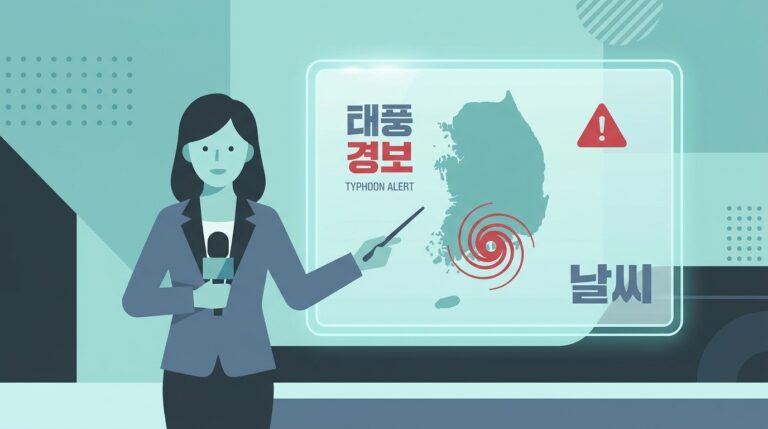
Master the Eye of the Storm: Navigating Korea’s Typhoon Prediction Models and Emergency Broadcasts Like a Native Expert
Phase 1: Empathy (스토리 몰입형 오프닝)
안녕하세요! 매일한글 (Daily Hangul)의 수석 에디터이자 여러분의 든든한 한국 문화 길잡이입니다.
Imagine this: You are relaxing in your cozy Seoul apartment on a late August evening. Suddenly, a high-pitched, warbling siren pierces the air. It is not an air raid; it is the collective screaming of every smartphone in your neighborhood. You look down and see an emergency alert (재난문자) filled with advanced Sino-Korean characters like 북상 (buk-sang), 예상 경로 (ye-sang gyeong-ro), and 강풍반경 (gang-pung-ban-gyeong). You turn on the TV, and a news anchor is rapidly analyzing meteorological satellite images with a gravity that makes your heart beat faster.
As a C2-level learner, you already know how to talk about “rain” and “wind.” But when natural disasters strike, survival and integration in Korea depend on understanding the highly technical, nuanced vocabulary of the Korea Meteorological Administration (기상청) and emergency broadcast systems.
Many of our advanced learners have told us: “I can read Korean novels, but the moment a typhoon warning broadcasts, I feel completely lost in the specialized jargon!” That is why we have prepared this masterclass. By the end of this guide, you will not only comprehend Korea’s advanced weather forecasting language but also understand the unique social dynamic and collective responsibility that shapes how Korea handles emergencies.
Phase 2: 핵심 표현 3선 심층 분석
1. 예상 경로를 이탈하다 (ye-sang gyeong-ro-reul i-tal-ha-da)
- Pronunciation: Yeh-sang gyeong-ro-reul ee-tal-ha-da (Think of “yehs” like “yes” + “sang” like “song” but with an ‘a’ sound; “ee-tal” sounds like “detail” without the ‘d’).
- Meaning: To deviate from the predicted path.
- K-Culture Moment: You will hear this phrase constantly on major networks like KBS during live typhoon tracking. The anchor, pointing to a spinning satellite graphic, will say: “태풍이 기존 예상 경로를 이탈하여 동쪽으로 급선회하고 있습니다.” (The typhoon has deviated from its previously predicted path and is pivoting sharply to the east.)
- Editor’s Insight: 이탈 (i-tal) means “deviation” or “secession” (from a group or track). In Korea’s fast-paced disaster management, predicting path deviation is crucial because even a 10km shift can mean the difference between minor rainfall and catastrophic coastal surges in cities like Busan.
- Situation Spectrum: Casual (🚫) / Semi-formal (⚠️) / Formal (✅)
- 🤔 Think About It: How does your home country’s meteorological service describe an unpredictable storm path? Does it use formal Latinate verbs, or is it more colloquial?
2. 특보를 발령하다 (teuk-bo-reul bal-ryeong-ha-da)
- Pronunciation: Teuk-bo-reul bal-ryeong-ha-da (“Teuk” sounds like “took” with a sharper ‘u’; “bal-ryeong” is pronounced with a soft double ‘l’ sound due to assimilation: bal-lyeong).
- Meaning: To issue a special advisory/warning.
- K-Culture Moment: This is the legal term used when the government upgrades alerts from warnings to high-alert status. On-screen graphics will flash: “기상청, 서울 전역에 태풍경보 특보 발령.” (KMA issues Typhoon Warning special advisory across the entire Seoul area.)
- Editor’s Insight: 특보 (teuk-bo) is a portmanteau of 특별 (special) and 보고/보도 (report/broadcast). 발령 (bal-ryeong) is a highly formal verb used for official decrees, appointments, or military orders. Using this verb shows you understand official Korean administrative actions.
- Situation Spectrum: Casual (🚫) / Semi-formal (⚠️) / Formal (✅)
- 🤔 Think About It: In Korea, issuing an official warning triggers automatic closures of public parks and mountain trails. Why do you think Korean authorities act so preemptively compared to other nations?
3. 유동적인 경로를 보이다 (yu-dong-jeok-in gyeong-ro-reul bo-i-da)
- Pronunciation: Yoo-dong-jeok-in gyeong-ro-reul bo-ee-da (“Yu-dong” sounds like “you-dong”; “jeok” is a sharp, short syllable).
- Meaning: To exhibit a highly volatile/fluid/unpredictable path.
- K-Culture Moment: During roundtable discussions with meteorological experts on news networks, analysts will caution: “이번 태풍은 고기압 가장자리를 따라 매우 유동적인 경로를 보이고 있습니다.” (This typhoon is exhibiting a highly fluid path along the edge of the high-pressure system.)
- Editor’s Insight: 유동적 (yu-dong-jeok) literally translates to “flowing movement-like” (fluid). While casual speakers might say “경로가 자꾸 변해요” (The path keeps changing), utilizing “유동적인 경로” marks you as a true near-native speaker capable of professional analysis.
- Situation Spectrum: Casual (⚠️ – used when joking about personal plans being fluid) / Semi-formal (✅) / Formal (✅)
- 🤔 Think About It: In Korea’s highly connected society, public plans are often adjusted instantly based on these fluid weather predictions. How does “fluidity” affect your daily planning in Korea?
Phase 3: 교과서 한국어 vs 진짜 한국어
Situation 1: Describing a looming storm
- 📖 교과서 한국어: “태풍이 한반도에 접근하고 있으니 주의하십시오.”
(Please be careful as the typhoon is approaching the Korean peninsula.) - 🗣️ 진짜 한국어: “태풍이 한반도를 직격할 기세로 북상하고 있어요.”
(The typhoon is heading north, looking as if it’s going to make a direct hit on the Korean peninsula.) - 💡 왜 다를까? Textbook Korean uses passive, warning-style verbs. Real-life Korean broadcasts and everyday conversations use expressive, highly visual metaphors like 직격할 기세 (jik-gyeok-hal gi-se – momentum to make a direct hit) to emphasize the sheer force and velocity of the oncoming hazard.
Situation 2: Checking on someone during heavy weather alerts
- 📖 교과서 한국어: “기상 변화에 유의하시고 안전한 곳에 머무르십시오.”
(Pay attention to weather changes and stay in a safe place.) - 🗣️ 진짜 한국어: “오늘 재난문자 폭탄 터졌던데, 퇴근길 괜찮으시겠어요?”
(The disaster alerts have been bombing my phone today; will your commute home be okay?) - 💡 왜 다를까? While formal advisories are polite, Koreans colloquially refer to the frequent, loud emergency alerts as 재난문자 폭탄 (jae-nan-mun-ja pok-tan – disaster message bombs). Using this term shows you empathize with the daily annoyance yet serious nature of the situation.
Phase 4: K-Culture 딥다이브 & 비언어적 매너
4-1. 눈치 (Nunchi) & Gestures in a Crisis
When a typhoon warning is officially active in Korea, your non-verbal cues must shift to match the collective mood of 조심 (jo-sim – caution).
* The “Cell Phone Check” Etiquette: If your phone blares a disaster alert during a business meeting, do not panic. Simply make eye contact, nod slightly (an acknowledgment of the shared situation), and quickly swipe it away. Turning off your phone’s emergency alert system entirely is considered poor etiquette, as it shows a lack of civic integration.
* Disaster News Body Language: When watching weather reports with Korean colleagues, cross your arms slightly and tilt your head. Nod in agreement with the anchor’s gravity. Expressing overly relaxed or dismissive attitudes (e.g., “It’s just a bit of rain”) can be perceived as 안전불감증 (an-jeon-bul-gam-jeung – safety insensitivity), which is highly frowned upon in modern Korea.
4-2. The Cultural Fabric of KBS Disaster Broadcasting
In Korea, KBS (Korean Broadcasting System) is legally designated as the primary disaster broadcasting host. During major typhoons, regular entertainment programming is entirely suspended for 24-hour live coverage. Koreans share a collective memory of historic typhoons like Maemi (매미) in 2003 or Hinnamnor (힌남노) in 2022. Watching the news together, analyzing the 예상 진로 (predicted trajectory), and calling family members to ask, “Have you taped up your windows?” is a deeply rooted cultural ritual of communal survival.
Phase 5: 실전 롤플레이 시나리오
Setting: The National Typhoon Center (국가태풍센터) in Jeju Island. Min-woo, a senior Korean forecaster, is discussing a volatile storm path with Alex, a visiting international meteorological specialist.
- Min-woo (민우): 알렉스 박사님, 천리안 2A호 위성 영상을 보면 태풍의 눈이 아주 또렷해지고 있습니다.
(Dr. Alex, looking at the Cheollian 2A satellite imagery, the eye of the typhoon is becoming very distinct.) - Alex (알렉스): 네, 민우 씨. 기압골의 배치로 볼 때, 한반도 상륙 시점이 당초 예상보다 앞당겨질 가능성이 큽니다.
(Yes, Min-woo. Judging by the trough configuration, there is a high probability that the landfall on the Korean peninsula will occur earlier than initially expected.) - Min-woo (민우): 맞습니다. 현재 세력이 ‘매우 강’ 단계인데, 남해안을 관통할 때 막대한 피해가 우려되는 상황입니다.
(Exactly. It is currently at the ‘Very Strong’ intensity level, and we are highly concerned about catastrophic damage as it penetrates the southern coast.) - Alex (알렉스): 내일 오전 중으로 전국에 태풍 특보를 발령해야 하지 않을까요?
(Should we not issue a nationwide typhoon special advisory by tomorrow morning?) - Min-woo (민우): 네, 기상청 본청과 협의하여 재난 방송 시스템을 가동할 준비를 서둘러야겠습니다.
(Yes, we must coordinate with the KMA headquarters and hurry our preparations to activate the disaster broadcasting system.) - Alex (알렉스): 그런데 동풍의 영향으로 태풍이 동쪽으로 경로를 이탈할 가능성도 배제할 수는 없습니다.
(However, due to the easterly winds, we cannot entirely rule out the possibility of the typhoon deviating from its path to the east.) - Min-woo (민우): 맞습니다. 기압계가 워낙 유동적인 흐름을 보이고 있어, 1시간 간격으로 모델을 재수행해 봐야겠습니다.
(Agreed. The barometric pressure fields are showing a highly fluid flow, so we must rerun our models at one-hour intervals.) - Alex (알렉스): 철저히 모니터링해서 실시간으로 재난 문자가 발송되도록 조치합시다.
(Let’s monitor this thoroughly and take action to ensure disaster alerts are sent out in real time.)
🔀 인터랙티브 분기점: How should Alex reply to Min-woo’s concern about the model run?
- Choice A: “모델 결과가 어떻게 나오든 퇴근 시간 전에는 결정하시죠.”
(No matter what the model results are, let’s make a decision before off-work hours.) - Choice B: “유동성이 큰 만큼, 다양한 앙상블 모델 예측치를 교차 검증하는 것이 안전하겠습니다.”
(Since the fluidity is high, it would be safer to cross-verify various ensemble model predictions.) - Choice C: “대충 대피 문자 하나 보내고 상황을 지켜보면 됩니다.”
(Let’s just roughly send out one evacuation alert and watch how things unfold.)
💡 Feedback & Results:
- Choice A (Risk): Professional but slightly insensitive to the extreme urgency of a natural disaster in Korea. Pointing out strict work hours during a national crisis can damage professional rapport.
- Choice B (Best): Excellent! This is standard professional terminology for a C2 meteorologist. It shows scientific depth and fits the high-stakes atmosphere perfectly.
- Choice C (Bad): Extremely unprofessional and displays 안전불감증 (safety insensitivity), which could severely damage your career in Korean public service.
Phase 6: 10초 감정 섀도잉 드릴
To sound truly Korean, you must master the serious, urgent tone of a news broadcast or a concerned citizen. Practice these with the correct emotional pauses.
- Drill 1 (Emergency Tone):
- “태풍이 / 급격히 북상하면서 / 현재 남해안 전역에 / 태풍경보가 발령되었습니다.”
- [Tae-pung-i / geup-gyeok-hi buk-sang-ha-myeon-seo / hyeon-jae nam-hae-an jeon-yeok-e / tae-pung-gyeong-bo-ga bal-ryeong-doe-eot-seup-ni-da.]
- [🚨 Urgent, authoritative voice of a news anchor reporting a crisis]
- Drill 2 (Anxious & Concerned):
- “이번 태풍은 / 경로가 워낙 유동적이라 / 주말 계획은 / 다 취소해야 할 것 같아요.”
- [I-beon tae-pung-eun / gyeong-ro-ga wo-nak yu-dong-jeok-i-ra / ju-mal gye-hoe-geun / da chwi-so-hae-ya hal geot gat-a-yo.]
- [😟 Worried, sighing tone of someone discussing weekend plans during a typhoon warning]
Phase 7: K-Culture 미니 사전
| Word (한글/Romanization) | Meaning | Real-world Contextual Usage |
|---|---|---|
| 1. 기상청 (Gi-sang-cheong) | Korea Meteorological Administration | The ultimate source of all weather data. Often humorously teased as ‘구라청’ (Liar-cheong) when the forecast is off, but universally relied upon in crises. |
| 2. 재난문자 (Jae-nan-mun-ja) | Emergency Disaster Alert | Geo-targeted text alerts sent to phones. They cover everything from heatwaves to missing persons and heavy typhoons. |
| 3. 정체전선 (Jeong-che-jeon-seon) | Stationary Front | The boundary of air masses that causes the dreaded monsoon season (장마) in Korea, often paving the way for late-summer typhoons. |
| 4. 안전불감증 (An-jeon-bul-gam-jeung) | Safety Insensitivity / Complacency | A highly critical social term used to describe individuals or organizations that ignore safety regulations and warnings. |
Phase 8: 여행자를 위한 생존 키트 (Survival Kit)
Survival Phrases TOP 3
- “인근 대피소가 어디인가요?” (In-geun dae-pi-so-ga eo-di-in-ga-yo?)
- -> Where is the nearest emergency shelter?
- “대중교통 운행이 중단되었나요?” (Dae-jung-gyo-tong un-haeng-i jung-dan-doe-eot-na-yo?)
- -> Has public transportation been suspended?
- “침수 위험 지역이 어디인지 확인할 수 있을까요?” (Chim-su wi-hyeom ji-yeok-i eo-di-in-ji hwa-gin-hal su is-seul-kka-yo?)
- -> Can I check where the flood-risk areas are?
📝 Editor’s Travel Note
If you are traveling in Korea during the summer/autumn typhoon season (July to October), your best friend is the official emergency app. Go to the app store and download the Emergency Ready App (안전디딤돌 앱 다운로드) provided by the Ministry of the Interior and Safety. It provides English alerts, maps of nearby civil defense shelters, and real-time medical facility statuses.
Note: Weather dynamics and transport schedules are subject to sudden change during natural disasters; always check live status reports.
Phase 9: “한 발 더 깊이” (생각 질문)
In many Western cultures, disaster management heavily emphasizes individual preparation—stocking up on food, generator testing, and personal evacuation choices. In contrast, Korea’s system relies on a tightly integrated, centralized, and digitized community-level response. The immediate broadcast of detailed information to every citizen’s phone, the mobilization of local apartment broadcast speakers, and the societal expectation to cooperate with administrative directives represent a deeply collectivist approach to crisis. It is a system built on high civic trust and rapid-response infrastructure.
💬 Your Turn: How does your home country handle disaster warnings compared to Korea’s ultra-connected “disaster alert bomb” system? Share your experiences in the comments below!
Phase 10: FAQ & 오해 방지 (FAQ Schema)
Q: Why do Korean emergency alerts sound so terrifyingly loud, even when my phone is on silent mode?
A: Under Korean telecommunications law, Class 1 disasters (such as immediate air raids, extreme earthquakes, or catastrophic typhoons) bypass your phone’s volume settings to guarantee you receive the warning immediately. You can customize these settings in your phone’s notification settings under “Emergency Alerts,” but keeping them active is highly recommended for survival.
Q: What is the difference between a 기상주의보 (Weather Advisory) and a 기상특보/경보 (Weather Warning)?
A: A 주의보 (Ju-ui-bo – Advisory) is issued when weather conditions could potentially cause minor damage or disruptions. A 경보 (Gyeong-bo – Warning) is issued when severe damage is imminent or already occurring. A 특보 (Teuk-bo) is the umbrella term for all official special weather announcements.
Q: Does the metro (subway) stop running during typhoons in Seoul?
A: Subways in Seoul usually run even in extreme weather because most lines are underground. However, elevated sections (like Line 2 bridges crossing the Han River) or ground-level lines may slow down or temporarily halt operations if wind speeds exceed 25 m/s. Always monitor Seoul Metro Live Operation Status (서울교통공사 실시간 운행정보).
🚨 흔한 실수 (Common Mistakes) 경고판
- Confusing ‘북상’ (Heading North) with ‘상륙’ (Landfall):
- Incorrect: 태풍이 내일 서울에 북상합니다.
- Correct: 태풍이 내일 한반도에 상륙합니다. (Use 북상 for general northward movement of the storm over the ocean, and 상륙 when the eye physically hits the land.)
- Using ‘이탈하다’ for minor shifts:
- Incorrect: 제 차가 차선에서 좀 이탈했어요. (Sounds too dramatic, like a train derailment.)
- Correct: 제 차가 차선을 밟았어요 / 넘었어요. (Reserve 이탈하다 for major trajectory deviations, organizational defections, or severe path alterations.)
- Mispronouncing ‘발령’ as ‘발영’:
- Incorrect: 발영 [bal-yeong]
- Correct: 발령 [bal-lyeong] (Due to Korean liquid consonant assimilation, the ‘ㄹ’ sound doubles. Pronounce it as bal-lyeong to avoid sounding like a beginner.)
Phase 11: 액션 미션 & 참여 유도
Action Mission 3단계
- 🥉 Bronze: Open any Korean news portal (Naver, Daum, or KBS) and find one article about weather or climate change. Highlight three words containing the root characters 경 (Gyeong – warning) or 보 (Bo – report).
- 🥈 Silver: Take a screenshot of a Korean 재난문자 you have received (or find one online) and translate the main action directive into English. Share it on your social media and tag
#DailyHangul! - 🥇 Gold: Draft a short paragraph in Korean (4-5 sentences) analyzing a hypothetical typhoon trajectory using at least two advanced vocabulary words we learned today (유동적인 경로, 예상 경로 이탈, etc.).
🎮 K-Culture Mission
Watch a clip of the classic K-Drama “Weather People: Forecasting Love and Weather” (기상청 사람들: 사내연애 잔혹사 편). Listen closely to how Park Min-young’s character delivers her weather analysis in the briefing room. Can you spot any of our target terms?
Phase 12: 인터랙티브 퀴즈 챌린지
Test your mastery of advanced Korean meteorological and disaster vocabulary!
Q1. Fill in the blank with the most appropriate C2-level term:
“현재 북상 중인 태풍 ‘카눈’은 주변 기압골의 배치에 따라 매우 __________ 경로를 보이고 있어 기상청도 예의주시하고 있습니다.”
1) 귀여운 (gwi-yeo-un)
2) 유동적인 (yu-dong-jeok-in)
3) 안정적인 (an-jeong-jeok-in)
👉 정답 및 해설 보기
- 정답: 2) 유동적인 (Fluid/Volatile)
- 해설: A typhoon’s path in a complex pressure field is characterized by high variability and unpredictability, which is professionally referred to as ‘유동적인 경로’. ‘안정적인’ means stable, which is the opposite of a volatile storm!
Q2. True or False?
When a typhoon warning is officially upgraded, the Korean government ‘발행’ (bal-haeng) the warning.
👉 정답 및 해설 보기
- 정답: False
- 해설: The government 발령 (bal-ryeong – issues/decrees) a warning or advisory. 발행 (bal-haeng) means to publish (books, magazines) or print (currency, tickets). Do not confuse these two similar-looking Sino-Korean words!
Did you enjoy today’s deep-dive? Stay safe, keep your safety apps updated, and we will see you in the next lesson of Daily Hangul! 다음에 또 만나요! 👋







