

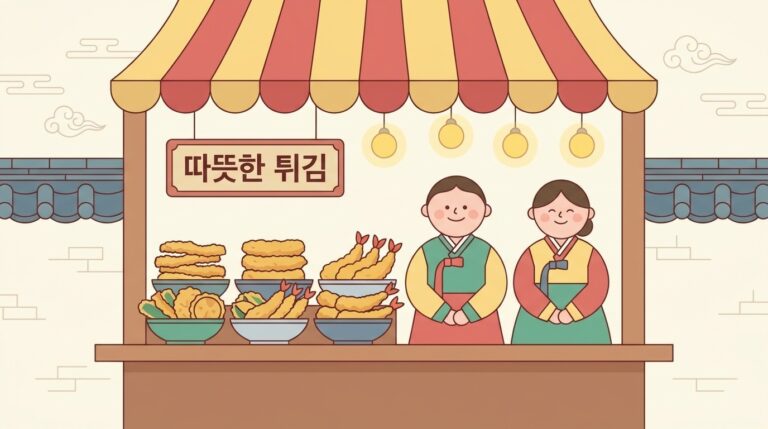
Phase 1: Welcome to the Sizzling Korean Market! 🍤
안녕하세요! (An-nyeong-ha-se-yo!) I’m your Daily Hangul Senior Editor and your local Korean best friend. Welcome back to our language journey!
Imagine this: You are walking down a lively aisle at Mangwon Market (망원시장) in Seoul. Your eyes catch a towering golden pile of freshly fried vegetables, sweet potatoes, and squid. The delicious, crackling sound of hot oil fills the air, and you can smell the cozy, savory aroma from a mile away. You want to try one, but you freeze. “How do I order? What if I get cold ones? How do I ask them to make it super crispy?”
Don’t worry! Today, we are conquering the art of ordering 갓 튀긴 튀김 (gat twi-gin twi-gim – freshly fried tempura). This guide is built based on real feedback from absolute beginners who went from pointing silently to ordering like absolute market pros. Let’s make sure you get the crispiest, warmest bite of your life!
Phase 2: 3 Golden Expressions for Your Twigim Adventure 🌟
Here are three simple, magic phrases that will make the market owner (usually a super warm grandma or auntie) smile and give you the best batch!
1. 이거 무슨 튀김이에요? (i-geo mu-seun twi-gim-i-e-yo?)
- Pronunciation: “ee-goh moo-seun twi-gim-ee-eh-yo?” (Think of “twi” as in “twin”, and “gim” like the English name “Kim” with a soft G)
- Meaning: “What kind of fried food is this?”
- K-Culture Moment: You’ll see this in almost every street food K-Drama scene. Characters stand in front of a market stall, pointing at different golden treats, trying to guess what’s inside.
- Editor’s Insight: Market owners often make unique creations—some are filled with sweet potato, some with glass noodles wrapped in seaweed (김말이 – gim-ma-ri), and some with green peppers! Asking this shows you are genuinely curious and respectful.
- Situation Spectrum: Casual ✅ | Semi-formal ✅ | Formal ⚠️
- 🤔 Think About It: In many Western supermarkets, everything is labeled with barcodes. In a Korean traditional market, verbal interaction is the label. How does talking to the person who made your food change your eating experience?
2. 따뜻하게 데워 주세요. (tta-tteut-ha-gae de-wo ju-sae-yo.)
- Pronunciation: “tah-theut-ha-gae deh-wojoo-seh-yo” (The “tt” sounds are tight and crisp, like the ‘t’ in ‘star’)
- Meaning: “Please warm it up for me.”
- K-Culture Moment: Locals never eat cold twigim! When you order, the vendor will drop your selected items back into the hot oil for a quick 10-second flash-fry to make them piping hot again.
- Editor’s Insight: This is the ultimate insider phrase. If you don’t say this, they might assume you want them packed cold to go. Say this phrase to unlock the ultimate crunch!
- Situation Spectrum: Casual ✅ | Semi-formal ✅ | Formal ⚠️
- 🤔 Think About It: Re-frying food for a customer at no extra cost shows the Korean concept of Jeong (정)—warm affection and sharing. Can you think of a similar custom in your country?
3. 떡볶이 국물도 주세요. (tteok-bok-ki gung-mul-do ju-sae-yo.)
- Pronunciation: “ttuk-bokee goong-mool-do joo-seh-yo”
- Meaning: “Please give me some Tteokbokki sauce (soup) too.”
- K-Culture Moment: This is the golden rule of Korean street food: Twigim must be dipped in spicy rice cake sauce!
- Editor’s Insight: Even if you only buy 튀김 (twigim), most sellers will happily ladle a bit of sweet and spicy Tteokbokki sauce over your fried treats for free if you ask nicely. It’s a flavor explosion!
- Situation Spectrum: Casual ✅ | Semi-formal ✅ | Formal ⚠️
- 🤔 Think About It: Mixing sweet, spicy, and greasy flavors is highly celebrated in Korean casual dining. What is your favorite food combo that sounds weird but tastes amazing?
Phase 3: Textbook Korean vs. Real Market Korean 🗣️
Let’s throw away the stiff classroom phrases and speak like a real local!
Scenario 1: Asking if it can be warmed up
- 📖 Textbook style: “튀김을 다시 튀겨 주실 수 있습니까?” (twi-gim-eul da-si twi-gyeo ju-sil su it-seum-ni-ka? – “Is it possible for you to fry the tempura again?”)
- Why it feels weird: It’s way too long, formal, and sounds like a robot reading a manual.
- 🗣️ Real Korean style: “데워 주세요!” (de-wo ju-sae-yo! – “Warm it up, please!”)
- 💡 Why it works: It’s short, polite, and exactly what locals say. Simple is best in a busy market!
Scenario 2: Ordering sweet potato tempura
- 📖 Textbook style: “저는 고구마 튀김을 원합니다.” (jeo-neun go-gu-ma twi-gim-eul won-ham-ni-da. – “I desire sweet potato tempura.”)
- Why it feels weird: Saying “원합니다” (I desire/want) sounds dramatic, like you are in a Shakespeare play.
- 🗣️ Real Korean style: “고구마 튀김 주세요!” (go-gu-ma twi-gim ju-sae-yo! – “Sweet potato tempura, please!”)
- 💡 Why it works: Just say the name of the food + Ju-sae-yo (Please give me). It’s the ultimate beginner cheat code.
Phase 4: K-Culture Deep Dive & Non-verbal Manners 🇰🇷
4-1. The Art of “Nunchi” (눈치) at the Stall
When you approach a busy market stall, use your Nunchi (situational awareness):
* Use the Tongs (집게): Do NOT touch the fried food with your hands! Look around for a metal tray and a pair of tongs (jip-gae). Grab the tongs, pick the pieces you want, and place them on the tray to hand to the owner.
* The Two-Hand Hand-off: When passing the tray or your cash/card to the elderly owner, always hold it with two hands or support your right elbow with your left hand. This is a massive sign of respect in Korea!
4-2. The “Twigim-Tteokbokki” Alliance
In Korea, fried food is rarely eaten alone. It belongs to the holy trinity of Korean street food: 떡튀순 (Tteok-Twi-Sun), which stands for Tteokbokki (rice cakes), Twigim (fried food), and Sundae (Korean blood sausage). Dip your crispy twigim into the red sauce, let it soak for 3 seconds, and enjoy the perfect harmony of crispy and chewy!
Phase 5: Live Roleplay at Mangwon Market 🎭
Setting: A vibrant, steaming street food stall. Golden mountains of twigim are sizzling. You are standing with a tray in hand, looking at the warm owner (Imo – Auntie).
- Imo (Owner): “어서 와요! 맛있는 튀김 많아요!”
(eo-seo wa-yo! ma-sin-neun twi-gim man-ha-yo!)
“Welcome! We have lots of delicious fried treats!” -
You (Excited beginner): “안녕하세요! 이거 무슨 튀김이에요?” 🎭 (Point with an open palm to the long golden roll)
(an-nyeong-ha-se-yo! i-geo mu-seun twi-gim-i-e-yo?)
“Hello! What kind of fried food is this?” -
Imo (Smiling): “아, 그거 김말이 튀김이에요. 맛있어!”
(a, geu-geo gim-ma-ri twi-gim-i-e-yo. ma-si-sseo!)
“Ah, that’s Gim-mari (seaweed glass noodle roll) tempura. It’s delicious!” -
You: “그럼 김말이 두 개랑 고구마 튀김 한 개 주세요.”
(geu-reom gim-ma-ri du gae-rang go-gu-ma twi-gim han gae ju-sae-yo.)
“Then, please give me two Gim-mari and one sweet potato tempura.” -
Imo: “네! 포장해 줄까요? 여기서 먹고 갈래요?”
(nae! po-jang-hae jul-kka-yo? yeo-gi-seo meog-go gal-lae-yo?)
“Sure! To go? Or eating here?” -
You: “여기서 먹고 갈게요. 그리고 따뜻하게 데워 주세요.”
(yeo-gi-seo meog-go gal-ge-yo. geu-ri-go tta-tteut-ha-gae de-wo ju-sae-yo.)
“I’ll eat here. And please warm it up.” -
Imo (Nods happily, re-frying them): “오케이! 떡볶이 국물도 줄까요?”
(o-kei! tteok-bok-ki gung-mul-do jul-kka-yo?)
“Okay! Shall I put some Tteokbokki sauce on it too?” -
You: “네, 떡볶이 국물 많이 주세요! 감사합니다!”
(nae, tteok-bok-ki gung-mul ma-ni ju-sae-yo! gam-sa-ham-ni-da!)
“Yes, please give me lots of Tteokbokki sauce! Thank you!”
🔀 Choose Your Path!
Situation: Imo hands you the plate of freshly fried food. What do you do?
- Option A: You grab a piece immediately with your fingers and eat it while standing.
- Feedback: Risk! It is incredibly hot! You might burn your tongue, and using fingers directly on shared spaces might earn you some worried looks from locals.
- Option B: You grab the provided wooden toothpick or skewer, dip it into the sauce, blow on it softly twice, and take a bite.
- Feedback: BEST! You enjoy the perfect crunch safely. Perfect market etiquette!
- Option C: You walk away to find a bench outside the market to eat.
- Feedback: Bad. Twigim gets cold and soggy fast! The best way to eat market food is standing right there at the stall while talking to the owner.
Phase 6: 10-Second Emotion Shadowing Drill 🗣️⚡
Speak with emotion! Follow the / pauses and match the feelings.
- [😊 Curious & Friendly]
- “이거 / 무슨 / 튀김이에요?”
- i-geo / mu-seun / twi-gim-i-e-yo?
- [🥺 Polite & Craving]
- “따뜻하게 / 데워 / 주세요.”
- tta-tteut-ha-gae / de-wo / ju-sae-yo.
- [😆 Big Bright Smile]
- “떡볶이 국물 / 많이 / 주세요!”
- tteok-bok-ki gung-mul / ma-ni / ju-sae-yo!
Phase 7: K-Culture Mini Dictionary 📖
- 튀김 (Twigim) | Deep-fried food / Tempura. It includes sweet potato, squid, vegetables, and mandu (dumplings).
- 시장 (Sijang) | Traditional market. A treasure trove of affordable, fresh Korean soul food.
- 이모 (Imo) | Literally “maternal aunt,” but used warmly to address middle-aged female restaurant or stall owners.
- 서비스 (Seo-bi-seu) | “Service.” In Korea, this means getting something for free as a friendly gesture from the business owner.
Phase 8: Survivor Kit for Market Travelers 🎒
Survival Phrases TOP 3
- 얼마예요? (eol-ma-yae-yo?) – “How much is it?”
- 카드 돼요? (ka-deu dwae-yo?) – “Do you take cards?” (Most market stalls accept cards, but carrying cash is highly appreciated!)
- 여기서 먹을게요. (yeo-gi-seo meog-eul-gae-yo.) – “I will eat here.”
💡 Editor’s Travel Note
Before heading out, download the Naver Map App to find hidden local markets like Mangwon Market or Tongin Market. While major credit cards are widely accepted now, keeping 5,000 to 10,000 KRW in physical cash is a lifesaver for small street food vendors!
Phase 9:
Frequently Asked Questions (FAQ)
Q: What does "이거 무슨 튀김이에요? (i-geo mu-seun twi-gim-i-e-yo?)" mean in Korean and how do you pronounce it?
A: In Korean, "이거 무슨 튀김이에요? (i-geo mu-seun twi-gim-i-e-yo?)" is pronounced ["ee-goh moo-seun twi-gim-ee-eh-yo?" (Think of "twi" as in "twin", and "gim" like the English name "Kim" with a soft G] and means: "What kind of fried food is this?"
Q: What does "따뜻하게 데워 주세요. (tta-tteut-ha-gae de-wo ju-sae-yo.)" mean in Korean and how do you pronounce it?
A: In Korean, "따뜻하게 데워 주세요. (tta-tteut-ha-gae de-wo ju-sae-yo.)" is pronounced ["tah-theut-ha-gae deh-wojoo-seh-yo" (The "tt" sounds are tight and crisp, like the 't' in 'star'] and means: "Please warm it up for me."
Q: What does "떡볶이 국물도 주세요. (tteok-bok-ki gung-mul-do ju-sae-yo.)" mean in Korean and how do you pronounce it?
A: In Korean, "떡볶이 국물도 주세요. (tteok-bok-ki gung-mul-do ju-sae-yo.)" is pronounced ["ttuk-bokee goong-mool-do joo-seh-yo"] and means: "Please give me some Tteokbokki sauce (soup) too."







