

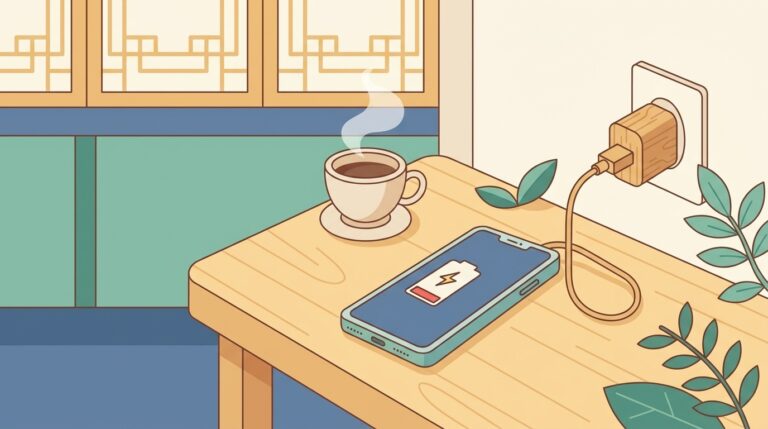
Emergency in Seoul! How to Ask to Charge Your Phone in Korean
안녕하세요! (Hello!) I am your friendly Korean neighborhood guide and the senior editor of Daily Hangul.
Imagine this: You are walking through the beautiful streets of Hanok Village in Seoul. You’ve been taking gorgeous photos all day, mapping your way using Naver Map, and translating menus. Suddenly, you look at the top right corner of your phone screen. 1% battery.
Panic sets in. Your hotel booking is on your phone, and you don’t know the way back! Don’t worry, my friend. In Korea, asking to charge your phone is incredibly common and easy once you know a few simple words. Today, I’m going to teach you exactly how to save your phone’s life like a real Seoul local! Let’s dive in.
Phase 2: 3 Crucial Charging Phrases
1. 배터리가 없어요 (baet-teo-ri-ga eop-seo-yo)
- Pronunciation: baet-tory-gah up-suh-yo (Think of “battery” with a Korean accent + “up-suh-yo” which means “does not exist”).
- Meaning: I don’t have battery. / My battery is dead (or very low).
- K-Culture Moment: You will often hear this in K-dramas when the main character’s phone dies right before an important phone call!
- Editor’s Insight: While English speakers say “My battery is low” or “My phone is dead,” Koreans literally say “I don’t have battery.”
- Situation Spectrum: Casual (✅) | Semi-formal (✅) | Formal (⚠️)
- 🤔 Think About It: Why do you think Korean uses “don’t have” (없어요) instead of “dead” (죽었어요)? It shows a focus on the presence or absence of the resource!
2. 충전기 빌릴 수 있을까요? (chung-jeon-gi bil-ril su is-seul-kka-yo?)
- Pronunciation: choong-jun-gi bil-reel soo ees-seul-ka-yo?
- Meaning: Can I borrow a charger?
- K-Culture Moment: Asking the staff at a trendy cafe in Hongdae while sitting near a wall outlet.
- Editor’s Insight: “충전기” means charger, and “빌릴 수 있을까요?” is a super polite way to ask “Can I borrow?”
- Situation Spectrum: Casual (⚠️) | Semi-formal (✅) | Formal (✅)
- 🤔 Think About It: Borrowing things politely in Korean often ends with “~을 수 있을까요?” which acts like “Would it be possible to…?”
3. 충전 좀 해주실 수 있어요? (chung-jeon jom hae-ju-sil su is-seo-yo?)
- Pronunciation: choong-jun johm hae-joo-shil soo ees-suh-yo?
- Meaning: Could you charge this for me, please?
- K-Culture Moment: When you hand your phone over to a restaurant cashier or a bar counter so they can plug it in behind the desk.
- Editor’s Insight: “좀” (johm) means “a little,” but in Korean requests, it acts as a magic word like “please” to soften the tone.
- Situation Spectrum: Casual (⚠️) | Semi-formal (✅) | Formal (✅)
- 🤔 Think About It: Handing your expensive smartphone to a complete stranger behind a counter might feel risky in some countries, but in Korea, it is extremely safe and common!
Phase 3: Textbook Korean vs. Real Korean
Situation 1: Asking the cafe barista to charge your phone
- 📖 Textbook: “제 휴대 전화를 충전해 주십시오.” (je hyu-dae jeon-hwa-reul chung-jeon-hae ju-ship-shi-o. – Please charge my mobile phone.)
- 🗣️ Real Korean: “혹시 충전 좀 부탁드려요!” (hok-shi chung-jeon johm bu-tak-deu-ryeo-yo! – By any chance, could you charge this for me, please?)
- 💡 Why the difference? The textbook version is too robotic and sounds like a military command. Real Koreans use “혹시” (by any chance) and “부탁드려요” (I request of you politely) to sound warm and natural.
Situation 2: Asking if you can use the wall outlet near your seat
- 📖 Textbook: “콘센트가 어디에 존재합니까?” (kon-sen-teu-ga eo-di-e jon-jae-hap-ni-kka? – Where does an outlet exist?)
- 🗣️ Real Korean: “여기 콘센트 써도 돼요?” (yeo-gi kon-sen-teu sseo-do dwae-yo? – Can I use the outlet here?)
- 💡 Why the difference? “존재합니까” is too academic. Simply asking “써도 돼요?” (Is it okay to use?) is practical and polite enough for daily life.
Phase 4: K-Culture Deep Dive & Non-verbal Manners
4-1. Nunchi & Gestures: Handing Over Your Phone
When you ask someone to charge your phone behind a counter, always hand your phone over using both hands (두 손). This is a crucial sign of respect in Korea. Keep your head slightly bowed (a mini-nod) and maintain soft eye contact. When they hand it back to you fully charged, receive it with both hands and say a warm “감사합니다!” (Thank you!).
4-2. Korea’s Extreme “Battery Culture”
Korea is one of the most connected countries in the world. Because of this, “battery anxiety” is real! You will find wall outlets with USB ports at bus stops, inside subway trains, and even on some public benches. Many cafes offer free wireless charging pads on the tables.
Phase 5: Real-World Roleplay Scenario
Setting: A cozy cafe in Insadong. You have been walking all day. Your phone screen is black. You walk up to Min-su, the friendly cafe barista.
Characters:
* You (Desperate tourist with 0% battery)
* 민수 (Min-su) (Helpful cafe barista)
- You: 🎭 (Holding dead phone with both hands, looking slightly embarrassed)
저기요, 혹시 핸드폰 충전 좀 할 수 있을까요?
(jeo-gi-yo, hok-shi haen-deu-pon chung-jeon johm hal su is-seul-kka-yo?)
“Excuse me, by any chance, could I charge my phone?” -
민수: 아, 네! 충전기 필요하세요, 아니면 제가 카운터에서 해드릴까요?
(a, ne! chung-jeon-gi pil-yo-hae-se-yo, a-ni-myeon je-ga ka-un-teo-e-seo hae-deu-ril-kka-yo?)
“Ah, yes! Do you need a charger, or should I charge it for you at the counter?” -
You: 🎭 (Pointing gently to the counter)
카운터에서 좀 해주실 수 있어요? C타입이에요.
(ka-un-teo-e-seo johm hae-ju-shil su is-seo-yo? C-ta-ip-i-e-yo.)
“Could you charge it at the counter, please? It’s a USB-C type.” -
민수: 네, 핸드폰 이쪽으로 주세요. 충전 시작할게요!
(ne, haen-deu-pon i-jjo-geu-ro ju-se-yo. chung-jeon shi-jak-hal-ge-yo!)
“Sure, please hand me your phone. I will start charging it!” -
You: 🎭 (Handing over the phone with both hands, bowing slightly)
정말 감사합니다!
(jeong-mal gam-sa-hap-ni-da!)
“Thank you so much!” -
민수: 🎭 (Smiling, placing the phone on the dock)
아닙니다. 다 되면 말씀해 주세요.
(a-nip-ni-da. da dwae-myeon mal-sseum-hae ju-se-yo.)
“No problem. Let me know when you want it back.”
(One hour later…)
- You: 저… 이제 제 핸드폰 받을 수 있을까요?
(jeo… i-je je haen-deu-pon ba-deul su is-seul-kka-yo?)
“Excuse me… can I get my phone back now?” -
민수: 🎭 (Handing the phone back with both hands)
여기 있습니다. 100% 완충됐어요!
(yeo-gi is-seup-ni-da. baek-pro wan-chung-dwaes-seo-yo!)
“Here you go. It is 100% fully charged!”
🔀 Interactive Choice Point
What would you say if the barista asked: “충전기 필요하세요?” (Do you need a charger?) but you actually need to borrow a cable too?
- Option A: “아니요, 괜찮아요.” (No, it’s fine.) ➡️ Result: You get no charger and your phone stays dead! (Bad)
- Option B: “네, 충전기랑 케이블 다 빌릴 수 있어요?” (Yes, can I borrow both the charger and the cable?) ➡️ Result: Clear, natural, and polite! (Best)
- Option C: “핸드폰 주세요.” (Give me phone.) ➡️ Result: Sounds incredibly rude and demanding! (Risk)
Phase 6: 10-Second Emotion Shadowing Drill
Practice speaking like a native by pausing at the slashes (/) and channeling these emotions!
[🥺 Desperate & Pleading]
배터리가 / 진짜 / 없어요…
(baet-teo-ri-ga / jin-jja / eop-seo-yo…)-
[😊 Polite & Hopeful]
혹시 / 충전기 / 빌릴 수 있을까요?
(hok-shi / chung-jeon-gi / bil-ril su is-seul-kka-yo?) -
[🥳 Happy & Relieved]
와! / 완충 / 됐어요!
(wa! / wan-chung / dwaes-seo-yo!)
Phase 7: K-Culture Mini Dictionary
- 보조배터리 (bo-jo-baet-teo-ri): Portable power bank. A absolute must-have for traveling in Seoul!
- 콘센트 (kon-sen-teu): Wall outlet (derived from “concentric plug”).
- 완충 (wan-chung): Short for “완전 충전” (fully charged/100%).
- 급속 충전 (geup-sok chung-jeon): Fast charging.
Phase 8: Traveler’s Survival Kit
Top 3 Survival Phrases
- “충전기 있어요?” (chung-jeon-gi is-seo-yo?) – Do you have a charger?
- “C타입이에요?” (C-ta-ip-i-e-yo?) – Is it USB-C type?
- “8핀이에요?” (pal-pin-i-e-yo?) – Is it an 8-pin (iPhone lightning cable) type?
Editor’s Travel Note 🗺️
If you are on the go and can’t find a cafe, download the Naver Map App and search for “충전돼지” (Chung-jeon-dwae-ji – “Charging Pig”). It is Korea’s most popular portable battery rental service found in subway stations and convenience stores. You can rent a power bank for a small fee and return it at any other station!
Phase 9: “One Step Deeper” (Reflective Essay)
In many countries, leaving your laptop or smartphone on a cafe table while you go to the restroom is an open invitation for theft. However, in Korea, you will see people leave their high-end laptops, iPads, and phones completely unattended. This reflects Korea’s high level of social trust and community safety. Asking a barista to charge your phone behind the desk is built on this shared trust.
💬 Your Turn: Would you feel comfortable leaving your phone at a cafe counter to charge in your home country? Let me know in the comments below!
Phase 10: FAQ & Common Mistakes
Q: Can I charge my phone at any convenience store (GS25, CU, 7-Eleven)?
A: Yes, but they usually do not charge it for you behind the counter anymore. Instead, they sell cheap cables or have a “충전돼지” (portable battery rental machine) where you can rent a power bank.
Q: Do Korean outlets use the same voltage as my country?
A: Korea uses 220V, 60Hz outlets (Type C and F, same as Europe). If you are coming from the US or UK, you will need a travel adapter plug.
Q: Is it okay to use cafe outlets without asking?
A: If the outlet is right next to your seat, it is generally okay! However, if you have to stretch a long cable or unplug something else, always ask: “여기 써도 돼요?” (Can I use this?).
🚨 Common Mistakes Alert!
- Mistake 1: Saying “핸드폰을 죽었어요” (haen-deu-pon-eul jug-eot-seo-yo) to mean “my phone is dead”.
- Correct Action: Say “배터리가 없어요” (I have no battery) or “핸드폰 꺼졌어요” (My phone turned off).
- Mistake 2: Grabbing a charger from behind the counter without asking.
- Correct Action: Always ask first using “혹시 충전기 빌릴 수 있을까요?”
Phase 11: Action Mission & Challenge
- 🥉 Bronze Mission: Practice saying “배터리가 없어요” out loud 5 times in front of the mirror.
- 🥈 Silver Mission: Write “충전기 빌릴 수 있을까요?” on a sticky note and place it near your computer charger.
- 🥇 Gold Mission: Next time you go to a Korean restaurant or cafe in your local Koreatown, ask the staff: “혹시 핸드폰 충전 좀 할 수 있을까요?”
Phase 12: Interactive Quiz Challenge
1. Match the word to its correct meaning:
- 콘센트 (kon-sen-teu)
- 보조배터리 (bo-jo-baet-teo-ri)
- 완충 (wan-chung)
👉 Click here for the Answer!
- 콘센트 = Wall outlet
- 보조배터리 = Portable power bank
- 완충 = Fully charged (100%)
2. Fill in the blank:
“혹시 충전 ___ 빌릴 수 있을까요?” (By any chance, can I borrow a charger?)
👉 Click here for the Answer!
정답 (Answer): 기 (The full word is 충전기 – charger).







