

Avoid the Bargain Battles: How to Politely Say ‘No Negotiation’ in Korean Secondhand Markets
Phase 1: Empathy (안녕하세요! Welcome to Daily Hangul!)
Have you ever uploaded a perfectly priced jacket or a barely used K-pop album on Karrot Market (당근마켓) or Joonggonara (중고나라), only to be flooded with messages like “Can you lower the price by 10,000 won?” or “Can I get a discount?”
We feel your pain! Bargaining is an art form in Korea, but sometimes you just want a quick, clean, and hassle-free transaction. If you don’t set boundaries early, you might find yourself trapped in an endless stream of negotiation battles that drain your energy. Today, we’re going to teach you exactly how to write “No Negotiation” in your listings politely yet firmly, so you can save time and protect your peace of mind.
Phase 2: Core 3 Expressions Deep-Dive
1. 네고 사절합니다 (Nego sa-jeol-im-ni-da)
- Pronunciation: “Ne-go sa-jeol-im-ni-da” (Sounds like “Nego” + “surgeon” without the ‘n’ + “im-nee-da”)
- Meaning: “I politely decline negotiation/bargaining.”
- K-Culture Moment: This is the absolute golden standard on Korean secondhand apps. You will see this line pinned at the very bottom of almost every popular listing. It’s direct, highly professional, and leaves zero room for misinterpretation.
- Editor’s Insight: “네고” (Nego) is short for negotiation, and “사절” (sa-jeol) means refusal or rejection. While “refusal” sounds harsh in English, adding “합니다” (ham-ni-da) makes it standard, polite, and socially acceptable.
- Situation Spectrum: Casual 🚫 / Semi-formal ✅ / Formal ✅
- 🤔 Think About It: Why do you think Korean sellers prefer using a clipped English word like “네고” instead of the native Korean word for bargaining? How does this compare to how you say “Firm Price” in your country?
2. 에누리 불가능합니다 (E-nu-ri bul-ga-neung-ham-ni-da)
- Pronunciation: “Eh-nu-ri bool-gah-nung-ham-nee-da” (Eh-nu-ri sounds like “energy” but with ‘u’ and ‘i’)
- Meaning: “Discounts are not possible.”
- K-Culture Moment: Used by slightly older sellers or in traditional web-based forums like Joonggonara. It has a cozy, traditional vibe but still draws a clear line.
- Editor’s Insight: “에누리” (enuri) is a beautiful, native Korean word for discount or premium. Using this instead of “네고” shows a high level of vocabulary and commands respect from the buyer.
- Situation Spectrum: Casual ⚠️ / Semi-formal ✅ / Formal ✅
- 🤔 Think About It: Traditional Korean markets thrive on “enuri” as a form of bonding. Why do you think digital markets are moving away from this culture?
3. 가격 제안 불가 (Ga-gyeok je-an bul-ga)
- Pronunciation: “Gah-gyuk jeh-ahn bool-gah”
- Meaning: “Price offer not allowed.”
- K-Culture Moment: This is a system-generated term you will see as a tag on Karrot Market. Many sellers simply copy-paste this tag straight into their text description.
- Editor’s Insight: This is the most objective, emotionless way to set your boundary. It sounds like an app setting, which helps remove any personal awkwardness between you and the buyer.
- Situation Spectrum: Casual ✅ / Semi-formal ✅ / Formal ✅
- 🤔 Think About It: Does using objective system terms make you feel more comfortable setting boundaries than using personal statements?
Phase 3: Textbook Korean vs. Real Korean
Let’s look at how textbooks teach this versus how real Koreans write in their deal descriptions.
- Situation 1: Declining price cuts in the description
- 📖 Textbook: “가격을 깎아줄 수 없습니다.” (I cannot lower the price.)
- 🗣️ Real Korean: “네고 문의는 답장 안 합니다.” (I won’t reply to nego inquiries.)
- 💡 Why is it different? The textbook version is too passive. The real Korean version saves time by setting a clear consequence: if you ask for a discount, you will be ignored (읽씹 – read and ignored).
- Situation 2: Offering a benefit instead of a discount
- 📖 Textbook: “빠르게 사면 무료로 배송해 줍니다.” (If you buy quickly, I will ship for free.)
- 🗣️ Real Korean: “쿨거래 시 택포(택배비 포함) 해드려요!” (Free shipping for a ‘cool’ deal!)
- 💡 Why is it different? Real Koreans love speed. A “쿨거래” (Cool deal) means the buyer asks no tedious questions and pays immediately. Offering “택포” (shipping included) as a reward for a cool transaction is the ultimate pro-move.
Phase 4: K-Culture Deep-Dive & Non-verbal Manners
4-1. Manner Temperature & Digital Nunchi (눈치)
In Korea, digital transaction etiquette is highly rated. On the Karrot Market app, every user has a “Manner Temperature” (매너온도) starting at 36.5°C (matching human body temperature).
* The Non-verbal Rule: If you want to keep your manner temperature high, never ask for a discount if the description says “네고 사절” (Nego sa-jeol). Doing so is considered a lack of “Nunchi” (social wit/tact).
* The Soft Refusal: If a buyer still asks for a discount despite your post, don’t argue. Send a polite refusing phrase followed by a bowing emoji (🙇♂️/🙇♀️). This protects your Manner Temperature while firmly shutting down the nego.
4-2. The “Cool Deal” Culture (쿨거래)
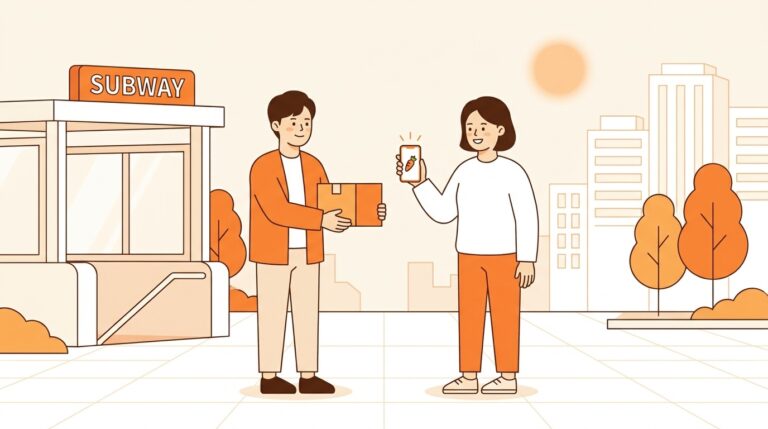
Koreans value efficiency. In K-Dramas, you might see busy characters meeting up briefly at subway exits to swap boxes. The ideal transaction is under 10 seconds: “안녕하세요” (Hello), swap items, “감사합니다” (Thank you), and walk away. That is the essence of a “Cool Deal.”
Phase 5: Real-life Roleplay Scenario
Meet the Characters:
* Min-su (민수): An eager buyer trying to score a bargain.
* You (지우 – Ji-woo): A busy seller who just wants a clean transaction.
Setting: A chat room inside the Karrot Market app.
- Min-su: 안녕하세요! 올려두신 패딩 아직 파나요? 🎭 [Hopeful and polite]
(An-nyeong-ha-se-yo! Ol-lyeo-du-sin pae-ding a-jik pa-na-yo? / Hello! Are you still selling the padding jacket you posted?) - You: 네, 아직 판매 중입니다! 😊 🎭 [Friendly and welcoming]
(Ne, a-jik pan-mae jung-im-ni-da! / Yes, it is still available for sale!) - Min-su: 혹시… 조금만 네고 가능할까요? 바로 살게요! 🥺 🎭 [Cautiously testing the waters]
(Hok-si… jo-geum-man ne-go ga-neung-hal-ka-yo? Ba-ro sal-ge-yo! / By any chance… is a little negotiation possible? I’ll buy it right away!) - You: 죄송합니다, 본문에 적어둔 대로 네고 사절합니다. 🙇♂️ 🎭 [Firm but polite]
(Joe-song-ham-ni-da, bon-mun-e jeog-eo-dun dae-ro ne-go sa-jeol-ham-ni-da. / I’m sorry, as written in the listing description, I decline negotiations.) - Min-su: 아쉽네요 ㅠㅠ 그럼 깎아주는 대신 택배비 무료로 해주시면 안 되나요? 🤔 🎭 [Trying one last negotiation trick]
(A-swip-nae-yo… Geu-reom kkak-a-ju-neun dae-sin taek-bae-bi mu-ryo-ro hae-ju-si-myeon an doe-na-yo? / That’s too bad… Then instead of a discount, could you give me free shipping?) - You: 대신 쿨거래 하시면 택포(택배비 포함)로 해드릴게요! 😉 🎭 [Compromising with a smart system]
(Dae-sin kul-geo-rae ha-si-myeon taek-po-ro hae-deu-ril-ge-yo! / Instead, if we do a fast ‘cool deal’, I’ll include shipping!) - Min-su: 대박! 그럼 지금 계좌번호 보내주세요. 바로 입금할게요! 😆 🎭 [Excited and agreeing instantly]
(Dae-bak! Geu-reom ji-geum gye-jwa-beon-ho bo-nae-ju-se-yo. Ba-ro ip-geum-hal-ge-yo! / Awesome! Please send me your account number now. I will transfer the money immediately!) - You: 감사합니다! 입금 확인 후 바로 편의점 택배로 보낼게요. 📦 🎭 [Polite closure]
(Gam-sa-ham-ni-da! Ip-geum hwag-in hu ba-ro pyeon-ui-jeom taek-bae-ro bo-nae-ge-yo. / Thank you! I’ll send it via convenience store delivery right after confirming the deposit.)
🔀 Interactive Choice Points
If Min-su asks for a discount again, what do you do?
* Choice A: “안 된다고 했잖아요!” (I said no!) -> [Bad 🚫] Your Manner Temperature will drop instantly due to aggressive language.
* Choice B: “네, 그럼 3천원 깎아드릴게요.” (Okay, I’ll discount 3,000 won.) -> [Risk ⚠️] You lose money and teach buyers that your rules don’t matter.
* Choice C: “죄송합니다. 에누리 없이 진행합니다.” (Sorry. Proceeding without discounts.) -> [Best ✅] Polite, uncompromising, and highly efficient.
Phase 6: 10-Second Emotional Shadowing Drill
Practice saying these lines with the right rhythm (/ represents pauses) and emotion!
- [😊 Soft but resolute]
네고는 / 정중히 / 사절합니다.
(Ne-go-neun / jeong-jung-hi / sa-jeol-ham-ni-da.) -
[😉 Encouraging a fast transaction]
쿨거래 하시면 / 택포로 / 해드릴게요!
(Kul-geo-rae ha-si-myeon / taek-po-ro / hae-deu-ril-ge-yo!)
Phase 7: K-Culture Mini-Dictionary
- 당근 (Dang-geun) | Karrot Market
- Literally means “carrot.” It is the biggest local community market app in Korea. People often say “당근마켓에서 만나요” (Let’s meet on Karrot Market).
- 쿨거래 (Kul-geo-rae) | Cool Deal
- A clean, quick transaction with no negotiation, no unnecessary questions, and fast payment.
- 택포 (Taek-po) | Tax/Delivery Included
- Short for 택배비 포함 (Taek-bae-bi po-ham). It means the seller pays the shipping cost.
- 반택 (Ban-taek) | Half-Price Delivery
- Short for 반값택배 (Ban-gaps-taek-bae). A ultra-cheap shipping system between GS25 or CU convenience stores popular among young Koreans.
Phase 8: Travel & Local Survival Kit
Top 3 Survival Phrases for Fast Deals:
- 직거래 가능합니다 (Jig-geo-rae ga-neung-ham-ni-da) – “Face-to-face deal is possible.”
- 택배 거래 선호해요 (Taek-bae geo-rae seon-ho-hae-yo) – “I prefer shipping/delivery.”
- 예약은 안 받습니다 (Ye-yag-eun an bat-seum-ni-da) – “I do not accept reservations (first come, first served).”
💡 Editor’s Travel Note:
To experience real Korean local life, search for Karrot Market in Google Play/App Store and download the app when you land in Korea. You’ll get to practice your Korean with neighbors, find cheap treasures, and experience Korea’s high-trust society firsthand!
Phase 9: “One Step Deeper” (Cultural Insights)
Traditionally, Korea is a culture of Jeong (정)—deep affection, warmheartedness, and sharing. In old traditional markets, “enuri” (discounts) and giving “service” (free extra items) were symbols of this warm connection. However, modern Korea is incredibly fast-paced and privacy-focused. Today’s young generation prioritizes clear boundaries and time-saving efficiency over long social interactions. Saying “Nego Sa-jeol” is not rude; it’s simply a modern respect for each other’s busy schedules.
💬 Your Turn: Do you prefer negotiating to feel a human connection, or do you prefer fixed prices for speed? Share your thoughts in the comments below!
Phase 10: FAQ & Common Mistakes
Q: What should I do if a buyer asks for a discount after we agree to meet?
A: This is considered bad mannered in Korea. You can politely say: “현장에서 가격 변경은 어렵습니다.” (It is difficult to change the price on-site.) If they persist, you have the right to cancel the transaction.
Q: Can I use “네고 불가” (Nego bul-ga) in a chat?
A: Yes! “네고 불가” is a bit more blunt than “네고 사절합니다,” but it is perfectly fine for text messages to save time.
Q: Does “택포” mean I can use any delivery service?
A: Usually, sellers use convenience store post offices (편의점 택배) because they are cheap and open 24/7. Always clarify if you are using regular delivery or “반택” (half-price delivery to their local convenience store).
🚨 Common Mistakes Alert!
- Mistake 1: Writing “돈 깎지 마세요” (Don’t cut money).
- Why: It sounds very aggressive and childlike.
- Correct Action: Use “네고 사절합니다” instead.
- Mistake 2: Ignoring a nego message completely without setting “Nego Sa-jeol” in the post.
- Why: This could slightly lower your Manner Temperature.
- Correct Action: Write “네고 사절” in the body text beforehand, so you have the right to ignore without guilt.
Phase 11: Action Mission
- Bronze Mission: Write down “네고 사절합니다” on a sticky note and practice pronouncing it three times.
- Silver Mission: Find a listing on a Korean website or app and check if they used “네고 사절” or “가격 제안 불가.”
- Gold Mission: Mock-up a fake Karrot listing for an item you want to sell, and write a complete description in Korean including the terms “네고 사절” and “쿨거래 환영”!
Phase 12: Interactive Quiz Challenge
Test your knowledge to see if you are ready for the Korean secondhand market!
1. Which term means “I decline bargaining” politely but firmly?
- A) 에누리 좋아해요
- B) 네고 사절합니다
- C) 그냥 공짜로 드려요
2. Fill in the blank:
“네고 문의는
Click here to reveal answers & explanations!
Answers:
1. B) 네고 사절합니다 (A means ‘I like discounts’, and C means ‘I give it for free’.)
2. 답장 안 합니다 (dap-jang an ham-ni-da – I will not reply. This is the ultimate time-saver phrase!)
Great job today! You are now fully equipped to conquer Korea’s digital marketplaces like a local. See you in the next unit of Daily Hangul!







