

Phase 1: Empathy & Storytelling
안녕하세요! (An-nyeong-ha-se-yo!) Hello! I’m your Korean bestie and editor at Daily Hangul.
Have you ever watched legendary Korean variety shows like Running Man, New Journey to the West, or 2 Days & 1 Night? If you have, you probably noticed how much fun they have when someone fails a game! In Korean variety shows, failing isn’t sad—it is the funniest moment of the night!
When a favorite K-pop idol or actor messes up a game, the screen flashes with red letters, a loud buzzer rings, and everyone bursts out laughing. But how do they talk about these hilarious “fails” in real life? Today, we are going to learn 3 super easy, iconic Korean variety show words for failure.
Whether you are playing a game with Korean friends or watching your favorite show without English subtitles, these words will make you sound instantly like a native! Let’s dive in!
Phase 2: Top 3 Variety Show Failure Words
Here are the 3 magic words you will hear in almost every single episode of a Korean variety show when something goes wrong.
1. 망했다 (Mang-haet-da)
- Pronunciation: [mahng-haet-dah]
- Meaning: “I’m ruined!” / “Oh no!” / “It went totally wrong!”
- K-Culture Moment: Picture a member of Running Man trying to guess a word in a silent headphone game. They say something completely wrong, realize their mistake, and scream: “망했다!”
- Editor’s Insight: This comes from the verb 망하다 (mang-ha-da), which means “to go bankrupt” or “to be ruined.” But in daily life and variety shows, it is used casually whenever a small plan fails (like dropping your ice cream or burning your toast).
- Situation Spectrum: Casual (✅) / Semi-formal (⚠️ – only with close colleagues) / Formal (🚫)
- 🤔 Think About It: In English, we might say “I messed up.” Why do you think Koreans use a dramatic word like “ruined” (망했다) for tiny mistakes? It’s all about dramatic, self-deprecating humor!
2. 꽝 (Kkwang)
- Pronunciation: [kkwang] (Sounds like the “quack” of a duck, but with a strong ‘K’ sound!)
- Meaning: “Wrong!” / “No Prize!” / “Empty!”
- K-Culture Moment: A variety show member reaches their hand into a box to draw a lucky prize. They pull out a slip of paper, open it, and it just says one giant word: “꽝” (No Prize/Bomb).
- Editor’s Insight: This is an onomatopoeia! It mimics the sound of a small explosion or a sudden stop. It is a cute, lighthearted way to say “better luck next time!”
- Situation Spectrum: Casual (✅) / Semi-formal (⚠️) / Formal (🚫)
- 🤔 Think About It: Does your language have a fun, short sound like “Kkwang” when you get a wrong answer or win absolutely nothing?
3. 실패 (Sil-pae)
- Pronunciation: [shil-pae]
- Meaning: “Failure” / “Failed”
- K-Culture Moment: The producer (PD) counts down “Three, Two, One!” and the cast member fails to answer a quiz. Immediately, a loud buzzer sound (Ttaeng!) rings, and the PD shouts: “실패!”
- Editor’s Insight: While “실패” is a real noun meaning “failure,” in variety shows, it is used like an exclamation. It is the official verdict that the game is over and you lost!
- Situation Spectrum: Casual (✅) / Semi-formal (✅) / Formal (✅)
- 🤔 Think About It: Even though “실패” is a formal word, saying it loudly with a smile makes it fun. It teaches us that failing is just part of the game!
Phase 3: Textbook Korean vs. Real Korean
Let’s compare what traditional textbooks teach you versus how Koreans actually talk when they make a mistake!
Situation 1: When you fail a game or test
- 📖 Textbook Korean: “저는 실패했습니다.” (Jeo-neun sil-pae-haet-seub-ni-da.)
- Translation: “I have failed.”
- Why it feels awkward: It sounds way too serious! It sounds like you failed a major life mission, not a fun game.
- 🗣️ 진짜 (Real) Korean: “아, 망했다!” (Ah, mang-haet-da!)
- Translation: “Oh, I ruined it!” / “Oh, no!”
- 💡 Why it’s better: It is playful, dramatic, and expresses instant emotion just like a real Korean show.
Situation 2: When you draw a blank card or lose a raffle
- 📖 Textbook Korean: “당첨되지 않았습니다.” (Dang-cheom-deon-ji a-nat-seub-ni-da.)
- Translation: “You have not been selected.”
- Why it feels awkward: It is too robotic, like a computer message.
- 🗣️ 진짜 (Real) Korean: “아쉽다, 꽝이네!” (A-swip-da, kkwang-i-ne!)
- Translation: “What a bummer, it’s a blank!”
- 💡 Why it’s better: “아쉽다” (a-swip-da) means “it’s a pity/bummer,” and combining it with “꽝” sounds extremely natural and friendly.
Phase 4: K-Culture & Non-Verbal Manners
4-1. The “X” Gesture and the “Ttaeng” Sound
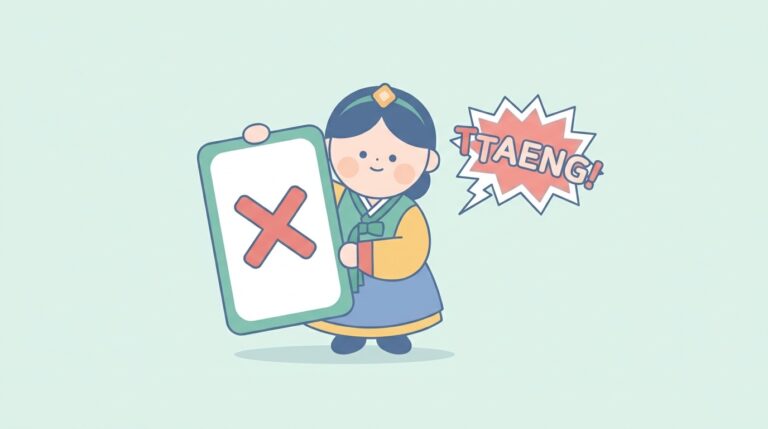
In Korea, non-verbal signals are just as important as words! If someone fails or says the wrong answer, people will instantly cross their forearms or wrists to make a giant “X” sign in front of their chest.
Along with this “X”, they often mimic the variety show buzzer sound: “땡!” (Ttaeng!). If you want to playfully tell your friend they are wrong, cross your arms and say “Ttaeng!” with a big smile!
4-2. The Art of the “Deung-gwan-ryeong” (Over the Mountain)
In many classic Korean shows, when a team fails, a sad, slow, traditional melody starts playing (often the song Sad Romance or a classical piece). The screen turns black and white. To blend in with Korean humor, when you fail, don’t get angry! Smile, shrug, and say “아쉽다!” (A-swip-da – What a bummer!). Being a good sport is highly valued in Korean culture.
Phase 5: Real-Life Roleplay Scenario
Meet Minji (민지), your cheerful Korean friend. You are sitting at a cozy cafe in Seoul, playing a simple word-guessing game for fun. The loser has to buy the next round of drinks!
- Minji: “자, 준비됐어? 3, 2, 1! 한국의 수도는?”
(Ja, jun-bi-dwaet-eo? Sam, i, il! Han-guk-ui su-do-neun?)
(🎭 Cheerful and exciting)
“Okay, ready? 3, 2, 1! What is the capital of Korea?” - You: “어… 부산!”
(Eo… Bu-san!)
(🎭 Hesitant but confident)
“Uh… Busan!” - Minji: “땡! 실패!”
(Ttaeng! Sil-pae!)
(🎭 Crossing her arms into a giant ‘X’ and laughing)
“Ttaeng! Fail!” - You: “아, 망했다! 서울인데!”
(Ah, mang-haet-da! Seo-ul-in-de!)
(🎭 Facepalming and smiling)
“Ah, I ruined it! It is Seoul!” - Minji: “맞아! 진짜 아쉽다~ 다음 문제!”
(Ma-ja! Jin-짜 a-swip-da~ Da-um mun-je!)
(🎭 Teasingly rolling her eyes)
“Right! What a bummer~ Next question!” - You: “이번에는 꼭 맞출 거야. 던져봐!”
(I-beon-e-neun kkok ma-chul geo-ya. Deon-jyeo-bwa!)
(🎭 Pumping your fist with determination)
“I will definitely get it right this time. Hit me!” - Minji: “좋아! 이번에 틀리면 커피 사기!”
(Jo-ha! I-beon-e teul-li-myeon keo-pi sa-gi!)
(🎭 Pointing at you playfully)
“Okay! If you get it wrong this time, you buy coffee!” - You: “콜! 준비 완료!”
(Kol! Jun-bi wan-ryeo!)
(🎭 Nodding confidently)
“Deal! Ready!”
🔀 Your Turn! Choose your reaction:
Minji asks the next question, but you completely forget the answer. What do you do?
* A) Say “망했다…” with a dramatic sigh.
* B) Run out of the cafe because you don’t want to fail.
* C) Say “실패!” yourself before Minji can say “Ttaeng!”
💡 Feedback on your choice:
- If you chose A (Best Choice): ⭐⭐⭐
Perfect! Saying “망했다…” dramatically will make Minji laugh, and she might even give you a second chance or a hint! - If you chose B (Bad Choice): ❌
Oh no! Don’t run away! Failure is just part of the fun in Korean game culture. - If you chose C (Risk Choice): ⚠️
Funny! Self-declaring “실패” (Fail!) is a great variety show tactic to save face, but you might lose the coffee bet instantly!
Phase 6: 10-Second Emotion Shadowing Drill
Let’s practice saying these like a real entertainer! Read these out loud, pausing at the / marks, and matching the emotion in the brackets.
[🥺 Comically crying]
“아… / 망했다! / 진짜 / 망했다!”
(Ah… / mang-haet-da! / jin-jja / mang-haet-da!)
“Oh… / I’m ruined! / Seriously / I’m ruined!”-
[😜 Playful and cute]
“이것도 / 꽝이네? / 에이~ / 아쉽다!”
(I-geot-do / kkwang-i-ne? / e-i~ / a-swip-da!)
“This one is / a blank too? / Aww~ / What a bummer!”
Phase 7: K-Culture Mini Dictionary
To help you watch variety shows better, here are 4 essential mini-words:
- 땡 (Ttaeng) | The Buzzer Sound | The funny sound made when you get an answer wrong. You can say this to your friends when they make a silly mistake!
- 벌칙 (Beol-chik) | Penalty / Punishment | The funny punishment the loser has to do (like wearing a silly outfit at the airport or eating spicy food).
- 바보 (Ba-bo) | Fool / Dummy | A very light, cute way to call someone silly. Usually used affectionately between friends in variety shows.
- 아쉽다 (A-swip-da) | What a pity / Close! | Used when you almost won but missed it by a hair. It shows empathy to the loser.
Phase 8: Survivor Kit for Travelers
If you ever visit Korea and find yourself playing a game, trying to win a prize, or even just ordering at a restaurant and making a mistake, use these 3 emergency phrases:
- 어떡해요? (Eo-tteok-hae-yo?)
- Meaning: “What do I do?” / “Oh no!”
- Pro Tip: Use this when something goes wrong and you need friendly help.
- 한 번만요! (Han beon-man-yo!)
- Meaning: “Just once!” / “Please give me one more chance!”
- Pro Tip: The ultimate variety show phrase! If you fail, look cute, hold up one finger, and beg for another try.
- 살려주세요! (Sal-lyeo-ju-se-yo!)
- Meaning: “Save me!”
- Pro Tip: A super dramatic way to say “Please have mercy on me!” when you are about to do a funny penalty.
🗺️ Editor’s Travel Note
When traveling in Korea, you might occasionally get lost or fail to find a restaurant. Don’t worry! Instead of feeling bad, just smile and say “망했다~” to yourself, open the Naver Map App (highly recommended over Google Maps in Korea), and find your way back. Every fail is just another fun adventure!
Phase 9:
Frequently Asked Questions (FAQ)
Q: What does "망했다 (Mang-haet-da)" mean in Korean and how do you pronounce it?
A: In Korean, "망했다 (Mang-haet-da)" is pronounced [mahng-haet-dah] and means: "I'm ruined!" / "Oh no!" / "It went totally wrong!"
Q: What does "꽝 (Kkwang)" mean in Korean and how do you pronounce it?
A: In Korean, "꽝 (Kkwang)" is pronounced [kkwang] and means: "Wrong!" / "No Prize!" / "Empty!"
Q: What does "실패 (Sil-pae)" mean in Korean and how do you pronounce it?
A: In Korean, "실패 (Sil-pae)" is pronounced [shil-pae] and means: "Failure" / "Failed"







