

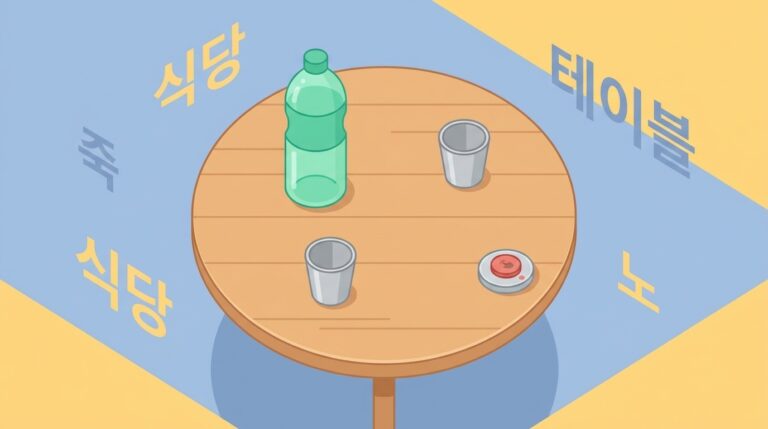
Welcome to Korea’s Dining Table! Learn ‘물 주세요’ (Please Give Me Water)
Phase 1: Empathy & Connection
안녕하세요! (An-nyeong-ha-se-yo!) I’m your Daily Hangul lead editor and your personal Korean culture guide.
Imagine this: You are sitting in a legendary, mouth-watering K-BBQ restaurant in Seoul. The grill is sizzling, the room is filled with laughter, and you’ve just taken a bite of some spicy kimchi stew. Whew! Your tongue is on fire, and you urgently need a glass of cold water.
You look around. The restaurant is buzzing, and the staff is running busy. How do you grab their attention and ask for water without sounding rude or looking completely lost?
Don’t worry! Today, we are going to master “물 주세요” (Mul ju-se-yo)—your ultimate survival phrase in any Korean restaurant. This guide is crafted from real-world dining experiences and feedback from hundreds of beginners just like you. By the end of this post, you’ll be ordering water like a true local!
Phase 2: Core Expressions Deep Dive
1. 물 주세요 (Mul ju-se-yo)
- Pronunciation: mool joo-seh-yo (Think of ‘mool’ like a cool swimming pool but starting with an ‘M’; ‘joo-seh-yo’ sounds like saying “Juice-say-yo” quickly without the ‘i’ sound).
- Meaning: Please give me water.
- K-Culture Moment: You will see this phrase used in every K-Drama food scene. From upscale dining in Gangnam to street stalls in Insadong, it’s the golden standard of asking for water.
- Editor’s Insight: This phrase is incredibly polite yet simple. It uses the magic ending 주세요 (ju-se-yo), which is the Korean equivalent of “please give me.”
- Situation Spectrum: Casual ✅ / Semi-formal ✅ / Formal ⚠️
- 🤔 Think About It: In English, we often say “Can I have some water?” focusing on ability. In Korean, we say “Please give me water,” focusing directly on the giving. How does this change your mindset when ordering?
2. 여기요 (Yeo-gi-yo)
- Pronunciation: yuh-ghee-yo (Sounds like “Yo-gee-yo“).
- Meaning: “Over here, please!” or “Excuse me (to get attention).”
- K-Culture Moment: Whenever a K-Drama lead wants to order another bottle of Soju, they confidently raise a hand and call out, “여기요!”
- Editor’s Insight: Never snap your fingers or yell “Hey!” in Korea. Simply raise your hand slightly, make eye contact, and say “여기요” in a clear, friendly voice.
- Situation Spectrum: Casual ✅ / Semi-formal ✅ / Formal 🚫
3. 물은 셀프입니다 (Mur-eun sel-peu-im-ni-da)
- Pronunciation: mool-eun sel-peu-im-nee-da.
- Meaning: “Water is self-service.”
- K-Culture Moment: Seen on bright plastic signs taped next to water purifiers in casual snack bars (분식집 – bun-sik-jip).
- Editor’s Insight: If you ask for water and the server points to a corner, look for this sign! In many casual spots, you have to grab your own stainless steel cup and fill it from the water machine.
- Situation Spectrum: Written/Formal ✅ (This is a sign, not something you say to others!)
Phase 3: Textbook Korean vs. Real Korean
Scenario 1: Asking for water politely
- 📖 Textbook Korean: “혹시 물을 좀 주실 수 있습니까?” (Hok-si mur-eul jom ju-sil su it-seum-ni-da-kka? / Could you possibly give me some water?)
- 🗣️ Real Korean: “여기 물 좀 주세요~” (Yeo-gi mool jom joo-seh-yo~ / Water here, please~)
- 💡 Why the difference? The textbook version is grammatically correct but sounds way too stiff—like you are asking for a royal favor. Adding 좀 (jom – just/a bit) makes your request sound much more natural and soft.
Scenario 2: Calling the server
- 📖 Textbook Korean: “종업원님, 이쪽으로 와 주십시오.” (Jong-eop-won-nim, i-jjok-eu-ro wa ju-sip-si-o / Waiter, please come this way.)
- 🗣️ Real Korean: “여기요~” (Yeo-gi-yo~ / Over here~)
- 💡 Why the difference? Calling someone “종업원” (employee) directly is incredibly awkward and clinical. Koreans prefer spatial terms like “여기요” (here) or “저기요” (there) to keep things warm yet respectful.
Phase 4: K-Culture Deep-dive & Non-verbal Manners
4-1. Nunchi & Table Manners
When you sit down at a Korean restaurant, you need to use your 눈치 (Nunchi – situational awareness).
* The Call Button (벨 – Bel): Look at the side of your table. Do you see a small round plastic button? That’s the “Bel”! Press it once, and a ding-dong sound will ring. The server will come to you. No need to yell!
* The Hidden Drawer: Can’t find chopsticks or napkins on the table? Slide your hand under the side of the table. There is almost always a hidden drawer full of spoons, chopsticks, and tissues!
4-2. The Free Water Culture
In Korea, water is 100% free and always served ice-cold. Along with your water, you will get 반찬 (Banchan – side dishes) that are also free and refillable! This stems from Korea’s deep-rooted culture of hospitality, where sharing food and drink is a sign of affection.
Phase 5: Real-World Roleplay Scenario
Setting: A vibrant, sizzling Korean BBQ spot in Hongdae.
Characters: You (thirsty and excited) and Minho (a friendly, fast-moving restaurant server).
- You: (🎭 Looking around the table for water) “저기요~” (Jeo-gi-yo~ / Excuse me~)
- Minho: (🎭 Rushes over with a warm smile) “네! 주문하시겠어요?” (Ne! Ju-mun-ha-si-get-eo-yo? / Yes! Are you ready to order?)
- You: “네, 물 좀 주세요.” (Ne, mool jom joo-seh-yo. / Yes, please give me some water.)
- Minho: “아, 물은 저기서 셀프입니다!” (Ah, mur-eun jeo-gi-seo sel-peu-im-ni-da! / Oh, water is self-service over there!)
- You: (🎭 Nodding understandingly) “아, 셀프예요? 감사합니다!” (Ah, sel-peu-yeo-yo? Gam-sa-ham-ni-da! / Oh, is it self-service? Thank you!)
- Minho: “아니에요, 반찬은 더 필요하시면 말씀하세요!” (An-i-e-yo, ban-chan-eun deo pil-yo-ha-si-myeon mal-sseum-ha-se-yo! / No problem, let me know if you need more side dishes!)
- You: “네, 고맙습니다!” (Ne, go-map-seum-ni-da! / Yes, thank you!)
🔀 Interactive Choice Point!
Minho points to the corner. What do you do?
* A) Walk over to the water purifier, grab a steel cup, and fill it yourself.
* B) Stay seated and ask Minho again: “물 그냥 가져다주시면 안 돼요?” (Can’t you just bring it to me?)
* C) Go into the kitchen to find a water jug.
Feedback:
- If you chose A (Best Option): 🌟 Perfect! You showed great Nunchi and adapted to the local self-service culture. Minho respects your independence!
- If you chose B (Bad Option): ⚠️ Oops! When a restaurant says “물은 셀프,” asking them to bring it anyway can seem a bit demanding when they are extremely busy.
- If you chose C (Risk Option): 🚨 Danger! Entering a commercial kitchen in Korea is a major safety hazard. Stick to the public dining area!
Phase 6: 10-Second Emotional Shadowing Drill
Let’s practice speaking with real Korean emotion! Pronounce the words matching the rhythm and emotional cues below:
- “여기 / 물 좀 / 주세요!”
- [😊 Brightly & Thirsty]
- yeo-gi / mool jom / joo-seh-yo!
- “아 / 셀프 / 예요?”
- [🥺 Slightly surprised but understanding]
- ah / sel-peu / ye-yo?
Phase 7: K-Culture Mini-Dictionary
- 반찬 (Banchan): Free, refillable Korean side dishes (like kimchi, yellow radish, or fish cakes) served with your meal.
- 벨 (Bel): The table call button. Press it to summon the server without raising your voice.
- 셀프 (Sel-peu): Konglish (Korean-style English) meaning “Self-service.”
- 이모님 (I-mo-nim): Literally “Auntie.” A warm, polite way to call older female restaurant owners or staff. Use this to instantly sound like a local!
Phase 8: Survival Kit for Travelers
Survival Expressions TOP 3
- 메뉴판 주세요 (Me-nyu-pan ju-se-yo): “Please give me the menu.”
- 이거 주세요 (I-geo ju-se-yo): “Please give me this (while pointing at the menu).”
- 계산해 주세요 (Gye-san-hae ju-se-yo): “Please bring the check / I’d like to pay.”
🗺️ Editor’s Travel Note
When traveling in Korea, Google Maps won’t show you the best walking routes due to local mapping laws. To find the coolest local restaurants and read authentic reviews, always use 네이버 지도 앱 다운로드 (Naver Map App). Note: Information on restaurant policies is subject to change; always check the latest local details.
Phase 9: “One Step Deeper” (Thinking Question)
In many Western restaurants, water is either billed or served only upon request, and side dishes always cost extra. In Korea, ice water and endless side dishes are given freely the moment you sit down. This reflects the Korean concept of 정 (Jeong)—a deep feeling of warmth, attachment, and community sharing. Feeding others well is the ultimate form of love in Korean culture.
💬 Your Turn: Have you ever experienced a culture where free food or drinks surprised you? Let us know in the comments below!
Phase 10: FAQ & Mistakes
Q: Can I ask for hot water in a Korean restaurant?
A: Standard Korean restaurants almost always serve ice-cold water by default. If you prefer warm water, you can ask for “따뜻한 물 주세요” (Tta-tteut-han mool joo-seh-yo).
Q: Is it okay to yell “여기요” loudly if the restaurant is busy?
A: While “여기요” is polite, yelling it across a quiet restaurant is frowned upon. Raise your hand slightly, wait for a gap in the noise, or use the table call button (벨) if available.
Q: What should I do if the cup has a little water left in it when I go to refill?
A: There is usually a small sink or tray next to the water purifier where you can discard leftover ice or water before refilling.
🚨 The Common Mistakes Board
- Mistake 1: Snapping your fingers to call a server. (Correction: Use the table call button or say “여기요” softly.)
- Mistake 2: Waiting forever for water at a snack bar with a “물은 셀프” sign. (Correction: Look around for the water machine and get it yourself!)
- Mistake 3: Saying “물 주세요” in a demanding, flat tone. (Correction: Smile and add “좀” -> “물 좀 주세요~” to sound friendly!)
Phase 11: Action Mission
- Bronze Mission 🥉: Stand in front of your mirror and practice saying “여기 물 좀 주세요” three times with a bright smile.
- Silver Mission 🥈: Share a picture of your favorite cup of water or tea on Instagram, tag us, and write “물 주세요” in the caption!
- Gold Mission 🥇: Next time you go to a local Korean restaurant, find the call button, press it, and order water entirely in Korean!
💡 K-Culture Mission: Watch a food scene in a K-Drama today and see if you can spot the green/blue plastic water bottles on the tables!
Phase 12: Interactive Quiz
1. What does “물 주세요” mean?
- A) Please give me kimchi.
- B) Please give me water.
- C) Excuse me.
2. What should you do if you see the sign “물은 셀프”?
- A) Wait for the server to bring it.
- B) Go to the kitchen and wash the dishes.
- C) Go to the water purifier and fill your cup yourself.
🎉 Click here to see the answers and explanations!
- Question 1 Answer: B) Please give me water. (“물” = water, “주세요” = please give me).
- Question 2 Answer: C) Go to the water purifier and fill your cup yourself. “셀프” means self-service, so go grab your delicious cold water!







