

Surviving ‘Hell-Traffic’ (헬교통): How to Describe Chuseok & Seollal Traffic Jams Like a Native Korean
Phase 1: Empathy (공감)
안녕하세요! Welcome back to another edition of Daily Hangul, your premium Korean culture navigator! I’m your Korean bestie and lead editor, here to help you navigate the beautiful—yet sometimes chaotic—realities of Korean life.
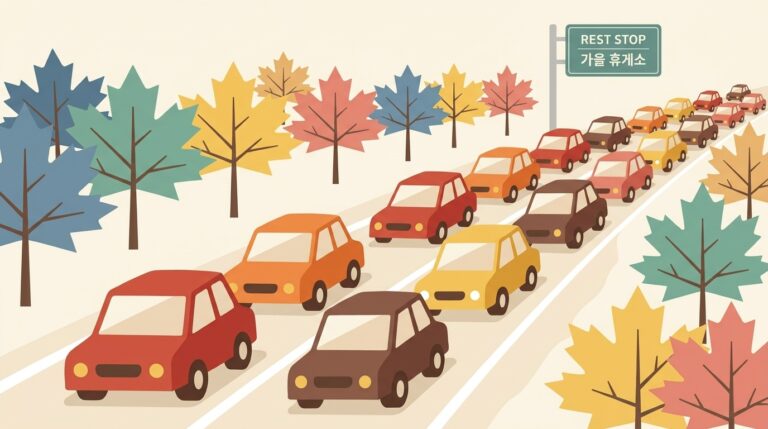
Imagine this: It’s the evening before Chuseok (추석), one of Korea’s biggest traditional holidays. You’ve packed your bags, you’re excited to eat delicious food, and you jump into a car heading toward the countryside. But thirty minutes in, you realize… you haven’t moved more than ten meters. Red tail lights stretch into the horizon like a never-ending holiday light show.
This is the legendary Gwiseong-gil (귀성길 – the journey home to one’s hometown), and the traffic jam? It’s on another level. Many of our intermediate (B2) students tell us: “I know how to say ‘교통 체증이 있습니다’ (There is traffic), but it sounds too much like a robotic news report! How do I complain about this naturally with my Korean friends or in-laws?”
Today, we’re moving past sterile textbook phrases. You’ll learn the exact expressions Koreans use to vent their frustration, look at the cultural phenomenon of road trips, and even master survival strategies for long hours on the expressway. Let’s dive in!
Phase 2: Core Expressions (핵심 표현 3선)
Here are three highly descriptive B2-level phrases that will instantly make you sound like you’ve lived in Seoul for a decade.
1. 주차장이 따로 없네요 (juchajangi ttaro eomneyo)
- Pronunciation: Ju-cha-jang-i tta-ro eom-ne-yo (Think of “ttaro” like “taro” boba tea, and “eomneyo” with a nasal ‘n’ sound).
- Meaning: “It’s literally a parking lot here.”
- K-Culture Moment: You’ll hear this in K-dramas whenever characters are stuck on the Gyeongbu Expressway during Chuseok. A character sighs, rolls down the window, looks at the endless row of stopped cars, and Mutters this line.
- Editor’s Insight: Literally translating to “There is no separate parking lot [because the road itself has become one],” this expression is the perfect blend of sarcasm and frustration.
- Situation Spectrum: Casual ✅ | Semi-formal ✅ | Formal ⚠️
- 🤔 Think About It: In your culture, what metaphor do you use when traffic is completely dead? Is it as visual as calling the highway a “parking lot”?
2. 거북이걸음이에요 (geobugigeoreumieyo)
- Pronunciation: Geo-bug-i-geol-eum-i-e-yo (Flow the ‘g’ sound in “geobugi” naturally into the next vowel).
- Meaning: “It’s moving at a snail’s pace” (Literally: “It’s a turtle’s walk”).
- K-Culture Moment: This phrase is heavily used by Korean traffic reporters on TV and radio during holiday rush hours to describe crawling traffic.
- Editor’s Insight: While English speakers use “snail,” Koreans use 거북이 (turtle). It paints a vivid picture of heavy, slow-moving lines of vehicles.
- Situation Spectrum: Casual ✅ | Semi-formal ✅ | Formal 🚫
- 🤔 Think About It: Why do you think different cultures choose different animals (snails vs. turtles) to describe slow motion?
3. 꼼짝달싹 못 하고 있어요 (kkomjjak-dalssak mot hago isseoyo)
- Pronunciation: Kkom-jjak-dal-ssak mot ha-go is-seo-yo (Focus on the tense double consonants kk and ss for emphasis).
- Meaning: “I’m completely stuck” / “I can’t budge an inch.”
- K-Culture Moment: Perfect for texting your Korean friends when you are running incredibly late because your bus is trapped in holiday gridlock.
- Editor’s Insight: 꼼짝달싹 is an onomatopoeic/mimetic word describing slight movement. Saying you “cannot even 꼼짝달싹” means you are entirely paralyzed by the traffic.
- Situation Spectrum: Casual ✅ | Semi-formal ✅ | Formal 🚫
- 🤔 Think About It: How does using double consonants in Korean express physical frustration or tightness better than English?
Phase 3: Textbook Korean vs. Real-Life Korean
Let’s see how school-taught Korean compares to the vibrant language spoken on the actual streets.
Situation 1: Describing bad traffic
- 📖 Textbook: “교통 체증이 매우 심합니다.” (The traffic congestion is very severe.)
- 🗣️ Real-Life: “길이 아주 꽉 막혔어요.” (The road is squeezed/plugged tight.)
- 💡 Why the difference? While the textbook version is grammatically flawless, it sounds like a government bulletin. Real Koreans use 막히다 (to be blocked) paired with the adverb 꽉 (tightly/completely) to emphasize physical confinement.
Situation 2: Expressing physical fatigue from a long drive
- 📖 Textbook: “오랫동안 차에 타서 매우 피곤합니다.” (I am very tired from riding in the car for a long time.)
- 🗣️ Real-Life: “계속 앉아 있었더니 몸이 찌푸둥하고 좀이 쑤셔 죽겠어요.” (My body feels heavy and I’m itching to move/getting fidgety.)
- 💡 Why the difference? Intermediate speakers should master idioms! 좀이 쑤시다 (literally, “to be bitten by moths”) means to feel extremely restless from sitting still for too long. Adding 죽겠다 (to die) emphasizes how unbearable it is.
Phase 4: K-Culture Deep-Dive & Non-Verbal Manners
4-1. Nunchi & Gesture: The Silent Road Language
When stuck in Korean holiday traffic, certain physical gestures speak louder than words:
* The Deep Sigh (한숨 – hansum): Letting out a long, audible sigh is a culturally accepted way to release stress in a packed car.
* The Neck Massage (목덜미 잡기): Placing one hand on the back of your neck while grimacing is a dramatic, physical sign of fatigue that everyone in Korea instantly recognizes.
4-2. The Highway Oasis: 휴게소 (Hyugeso) Culture
You cannot discuss gwiseong-gil without mentioning Korea’s legendary highway rest areas (휴게소). They are not just bathrooms; they are gourmet culinary hubs!
* 알감자 (Al-gamja): Butter-roasted mini potatoes sprinkled with sugar or salt. It’s the ultimate road trip comfort food.
* 소떡소떡 (Sotteok-sotteok): Skewers of fried rice cake (떡) and sausage (소시지) glazed in sweet, spicy sauce. Made globally famous by comedian Lee Young-ja.
Pro Tip: Stopping at a rest area during Chuseok requires serious tactical planning because the entrance to the rest area itself can have a 30-minute queue!
Phase 5: Real-Life Roleplay Scenario
Setting: Mark (B2 level foreigner) is traveling to Busan with his Korean colleague, Jimin, to visit Jimin’s family for the Seollal holiday. They are stuck on the highway.
Characters:
* 지민 (Jimin): Driving, exhausted but trying to keep a polite face.
* 마크 (Mark): Passenger, eager to practice his natural Korean.
[Roleplay Dialogue]
- 지민:
🎭 (한숨을 쉬며 핸들을 두드린다)마크 씨, 진짜 미안해요. 길이 이렇게까지 막힐 줄은 몰랐어요.
(Jimin: (Sighs, tapping the steering wheel) Mark, I’m so sorry. I didn’t expect the road to be blocked like this.) -
마크:
🎭 (창밖을 보며 미소를 지으며)괜찮아요, 지민 씨! 고속도로가 아니라 완전 주차장이 따로 없네요!
(Mark: (Looking out the window with a smile) It’s okay, Jimin! It’s not an expressway, it’s literally a parking lot!) -
지민:
🎭 (허탈하게 웃으며)하하, 맞아요. 완전 주차장 맞네요. 거의 거북이걸음으로 가고 있어요.
(Jimin: (Laughing hollowly) Haha, right. It really is a parking lot. We are moving at a snail’s pace.) -
마크:
🎭 (스트레칭을 하며)두 시간 동안 차가 거의 꼼짝달싹 못 하고 있네요. 슬슬 좀이 쑤시기 시작해요.
(Mark: (Stretching) We’ve been completely unable to budge for two hours. I’m starting to get really fidgety.) -
지민:
🎭 (걱정스러운 목소리로)아이구, 많이 힘들죠? 엉덩이도 아프고… 저 앞 휴게소에서 좀 쉬었다 갈까요?
(Jimin: (In a worried tone) Oh dear, it must be really tough, right? Does your back hurt? Shall we rest at that rest stop ahead?) -
마크:
🎭 (눈을 반짝이며)휴게소요? 대찬성이에요! 거기 가면 알감자랑 소떡소떡 먹을 수 있죠?
(Mark: (Eyes shining) A rest stop? I highly agree! Can we eat butter potatoes and Sotteok-sotteok there?) -
지민:
🎭 (웃음을 터뜨리며)역시 마크 씨, 한국 문화 다 배웠네요! 먹을 거 생각하니까 저도 힘이 나네요. 우리 꼭 들러요!
(Jimin: (Bursting into laughter) As expected, Mark, you’ve learned all of Korean culture! Thinking about food gives me energy too. We must stop by!) -
마크:
🎭 (엄지척을 하며)좋아요! 휴게소 맛집 투어라고 생각하면 이 헬교통도 견딜 수 있어요!
(Mark: (Giving a thumbs up) Great! If I think of it as a rest stop food tour, I can survive even this hell-traffic!)
🔀 Interactive Decision Points
Now, how would you respond to Jimin if she said: “마크 씨, 명절 교통 체증 겪어 보니까 어때요? 다음에는 기차 타고 갈까요?” (Mark, now that you’ve experienced holiday traffic, what do you think? Shall we take the train next time?)
- Option A: (Polite but dry)
- “네, 교통 체증이 심해서 다음에는 기차가 더 좋겠습니다.” (Yes, because traffic is severe, the train would be better next time.)
- Feedback (Bad): Grammatically correct, but sounds distant and overly formal. It kills the warm, friendly vibe you’ve built.
- Option B: (Witty & Culturally Immersive – BEST)
- “기차도 좋지만, 휴게소 알감자를 포기할 수 없어서 다음에도 차 타고 올래요!” (Trains are nice, but I can’t give up rest area butter potatoes, so I’ll ride in the car next time too!)
- Feedback (Best): Fantastic! You lightened the mood, showed off your cultural knowledge, and made Jimin feel relieved and amused.
- Option C: (Too dramatic / Complaining too much)
- “네, 차 안에서 진짜 꼼짝달싹 못 해서 죽을 뻔했어요. 차는 다시는 안 타고 싶어요.” (Yes, I couldn’t move an inch in the car and almost died. I never want to ride a car again.)
- Feedback (Risk): While using ‘꼼짝달싹’ and ‘죽을 뻔했다’ is natural, using it to completely reject Jimin’s ride offer might make her feel guilty for inviting you on this trip.
Phase 6: 10-Second Emotional Shadowing Drill
Try reading these out loud with the exact emotion marked in the brackets. The slashes / represent natural pauses.
- [🥺 Exhausted and whining slightly]
- 길이 / 꽉 / 막혀서 / 주차장이 따로 없네!
- Gi-ri / kkwak / ma-khyeo-seo / ju-cha-jang-i tta-ro eom-ne!
- [😋 Excited and full of anticipation]
- 우리 / 다음 휴게소 들러서 / 소떡소떡 먹고 가요!
- U-ri / da-eum hyu-ge-so deul-leo-seo / so-tteok-so-tteok meok-go ga-yo!
- [😫 Restless and fidgety, stretching your body]
- 아, / 오래 앉아 있었더니 / 좀이 쑤셔 죽겠어요.
- A, / o-rae an-ja is-seo-tteo-ni / jo-mi ssu-syeo juk-ges-seo-yo.
Phase 7: K-Culture Mini Dictionary
- 귀성길 (Gwiseong-gil) | The homeward path. Specifically refers to the massive mass migration of people returning to their hometowns during traditional holidays like Seollal and Chuseok.
- 헬교통 (Hel-gyotong) | Hell-traffic. A modern slang combination of “Hell” (헬) and “Gyotong” (교통 – traffic), used to describe completely paralyzed road conditions.
- 명절 증후군 (Myeongjeol Jeunghugun) | Holiday Syndrome. The physical and mental stress/exhaustion resulting from heavy labor (cooking, driving long hours) during traditional family holidays.
- 우회로 (Uhoero) | Bypass/Detour. An alternative, smaller road taken to avoid highway traffic congestion.
Phase 8: Survival Kit for Travelers
Survival Phrases (TOP 3)
- “화장실이 급한데 다음 휴게소까지 얼마나 걸려요?”
- Hwajangsiri geuphande daeum hyugesokkaji eolmana geollyeoyo?
- Pro Tip: “I urgently need the restroom; how long until the next rest area?” Use this if you are trapped in gridlock and need an emergency toilet stop!
- “네비게이션 보니까 우회로가 더 빠른 것 같아요.”
- Nebigeisyeon bonikka uhoeroga deo ppareun geot gatayo.
- Pro Tip: “Looking at the navigation, it seems the detour route is faster.” Perfect for suggesting a different path politely.
- “운전 교대해 드릴까요? 저 국제면허증 있어요.”
- Unjeon gyodaehae deurilkayo? Jeo gukjemyeonheojeung isseoyo.
- Pro Tip: “Shall we switch drivers? I have an international driving permit.” This will make you the ultimate hero to your Korean hosts!
📝 Editor’s Travel Note
- Essential Navigation Apps: Do not rely on foreign maps in Korea. Download T-map App Store Download or Naver Map App Store Download before your road trip. They have highly accurate real-time traffic updates and will route you through uhoero (detours) to shave hours off your trip!
- Note: Traffic app features are subject to update over time.
Phase 9: “A Step Deeper” (한 발 더 깊이)
Why do millions of Koreans willingly subject themselves to 10-hour traffic jams every year instead of staying in Seoul? The answer lies in two deep-seated cultural concepts: Jeong (정 – affection/bonds) and Hyo (효 – filial piety).
In Korea’s rapid modernization, families dispersed to big cities like Seoul. Holiday seasons are considered a sacred time to reconnect with roots, show respect to parents, and eat home-cooked ancestral food. The traffic jam is almost seen as a “shared nationwide ritual.” Everyone complains, but in that collective complaining, there’s a warm feeling of “we are all doing this out of love for our families.”
💬 Your Turn: How about you? Do you have similar holiday migration traffic jams in your country? Let us know in the comments below! We love reading your stories!
Phase 10: FAQ & Avoiding Misunderstandings
Q: Can I use “차가 아파요” (cha-ga apayo) to mean “the car is slow/troubled” in traffic?
A: No, “아프다” is strictly for humans or animals feeling pain. If your car is breaking down, say “차가 고장 났어요” (The car is broken). If it’s just slow due to traffic, say “차가 밀려요” (The cars are being pushed back/crowded).
Q: What is the difference between “막히다” and “막다”?
A: 막다 (mak-da) is active: “to block” (e.g., 경찰이 길을 막았어요 – The police blocked the road). 막히다 (ma-khi-da) is passive: “to be blocked” (e.g., 길이 막혀요 – The road is blocked). Always use 막히다 when talking about traffic jams!
Q: Is it okay to use “헬교통” (Hell-traffic) in front of elderly relatives?
A: It is better to avoid slang like “헬교통” around grandparents as they might not understand it or might find it slightly vulgar. Instead, use “길이 많이 막히네요” (The road is blocked a lot) or “차가 많이 밀리네요” (The cars are backing up quite a bit) to show polite respect.
🚨 Common Mistakes Alert!
- Mistake 1: Saying “교통이 무거워요” (Traffic is heavy) because of direct English translation.
- Correct Action: Use “차가 밀려요” or “길이 막혀요”.
- Mistake 2: Thinking “휴게소” is only for trucks and quick gas stops.
- Correct Action: Treat it as a primary travel destination! Plan your snacks beforehand.
Phase 11: Action Mission & Engagement
Ready to put your learning to the test? Take on these three challenges!
- 🥉 Bronze Mission: Write a comment below describing your worst traffic experience using the phrase: “길이 완전 주차장이 따로 없었어요!”
- 🥈 Silver Mission: Record yourself doing the 10-Second Shadowing Drill (Phase 6) on your phone and check your pronunciation of the double consonants (kk and ss).
- 🥇 Gold Mission: Next time you watch a K-drama set during Chuseok or Seollal, listen closely and spot the characters using “거북이걸음” or “좀이 쑤시다”! Tag us on social media with a screenshot when you do!
Phase 12: Interactive Quiz Challenge
Test your knowledge before you hit the road!
1. Which animal is used in Korean to describe slow-moving traffic?
- A) 달팽이 (Snail)
- B) 거북이 (Turtle)
- C) 나무늘보 (Sloth)
2. Fill in the blank: “오래 앉았더니 엉덩이도 아프고 아주 좀이 ( ) 죽겠어요.”
- A) 아파
- B) 쑤셔
- C) 막혀
3. [True or False] It is perfectly natural and polite to say “헬교통” when speaking to your Korean boss or grandmother.
- True / False
👉 Click here to reveal the answers and explanations!
1. Correct Answer: B) 거북이 (Turtle)
* Explanation: Koreans use 거북이걸음 (turtle’s walk) to describe bumper-to-bumper traffic crawls!
2. Correct Answer: B) 쑤셔 (ssusyeo)
* Explanation: The idiom is 좀이 쑤시다, meaning to be restless and fidgety!
3. Correct Answer: False
* Explanation: “헬교통” is highly casual internet slang. Use “교통 체증” or “길이 많이 막힙니다” in polite, formal settings.
Safe travels on your language journey! See you in the next premium guide of Daily Hangul!







