

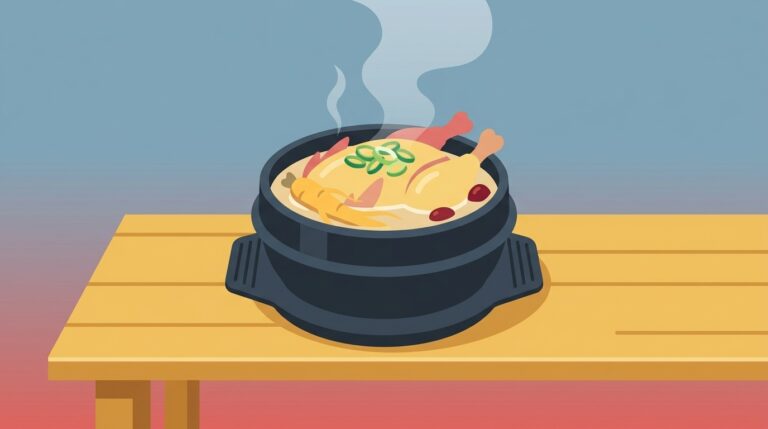
Beat the Korean Summer Heat with Samgyetang: Your Guide to Boknal Customs
Phase 1: Empathy (안녕하세요! 매일한글 에디터입니다.)
Imagine this: It is mid-July in Seoul. The humidity is so thick you feel like you are walking through warm soup. You are sweating, exhausted, and desperately dreaming of an ice-cold iced Americano. Suddenly, your Korean friend grabs your arm, excited. “Let’s go grab lunch!” they say.
You follow them, expecting a cold noodle joint, but instead, you end up standing in a massive, 50-person line under the blazing sun. The destination? A steaming hot restaurant serving boiling chicken soup in heavy stone pots!
You might think, Are they crazy? Why are we eating boiling soup in this heat?
Welcome to Boknal (복날), Korea’s official hot summer days! In this guide, based on real-life stories from our expat students who survived their first Korean summer, we will show you how to embrace this unique tradition like a true local. By the end of this post, you won’t just understand the culture—you’ll know exactly what to say to join in on the fun!
Phase 2: Deep Analysis of 3 Key Expressions
Let’s look at three essential expressions that will help you talk about summer wellness like a native speaker.
1. 이열치열 (I-yeol-chi-yeol)
- Pronunciation: ee-yeol-chee-yeol (Sounds like “ee-yawn” but with an ‘l’ sound: ee-yawl-chee-yawl)
- Meaning: “Fighting heat with heat” (Literal: Control heat with heat)
- K-Culture Moment: You will see this phrase everywhere on Korean food shows (먹방) in July. The host will take a sip of boiling soup, sweat dripping down their face, and sigh happily: “역시 여름엔 이열치열이지!” (Yeok-si yeo-reum-en i-yeol-chi-yeol-i-ji! – “As expected, summer is all about fighting heat with heat!”)
- Editor’s Insight: This isn’t just a saying; it’s rooted in traditional medicine. Eating hot foods dilates your blood vessels, causing you to sweat, which naturally cools your core body temperature. It actually works!
- Situation Spectrum: Casual (✅) | Semi-formal (✅) | Formal (⚠️ – used in lighthearted presentations or ads)
- 🤔 Think About It: In your culture, do you believe in eating hot food during summer, or do you strictly stick to ice creams and cold drinks? How do our bodies react differently to both?
2. 몸보신하다 (Mom-bo-sin-ha-da)
- Pronunciation: mom-bo-shin-ha-da
- Meaning: To replenish, nourish, or restore physical strength (usually by eating highly nutritious, stamina-boosting food).
- K-Culture Moment: In K-Dramas, when a character looks overworked or pale, their mother or best friend will cook a special meal and say, “몸보신 좀 해야겠어.” (Mom-bo-sin jom hae-ya-gess-eo. – “You need to replenish your body.”)
- Editor’s Insight: “몸” means body, and “보신” means protecting or restoring health. It carries a warm, caring nuance. Telling someone to “몸보신” is a way of showing deep affection.
- Situation Spectrum: Casual (✅) | Semi-formal (✅) | Formal (✅)
- 🤔 Think About It: Is there a specific “stamina food” in your country that people eat when they are physically drained or exhausted?
3. 더위 먹다 (Deo-wi meok-da)
- Pronunciation: deo-wi meok-da (Sounds like “duh-wee muk-da”)
- Meaning: To suffer from heat exhaustion / To get sick from the heat (Literal: “To eat the heat”)
- K-Culture Moment: When you are feeling dizzy, sluggish, and lose your appetite during a humid July afternoon, your coworker might look at you and ask: “더위 먹었어?” (Deo-wi meog-eoss-eo? – “Did you ‘eat’ the heat?”)
- Editor’s Insight: In Korean, the verb “먹다” (to eat) is used metaphorically for many negative or physical experiences—like getting older (나이를 먹다) or being scared (겁을 먹다). Here, you literally “absorb” too much heat.
- Situation Spectrum: Casual (✅) | Semi-formal (✅) | Formal (🚫)
- 🤔 Think About It: Why do you think Korean uses the verb “to eat” for heat? How does your native language describe feeling sick due to hot weather?
Phase 3: Textbook Korean vs. Real Korean
Let’s see how to sound natural instead of sounding like a robotic language textbook!
Scenario 1: Checking on someone during a heatwave
- 📖 Textbook Korean: “날씨가 더운데 건강은 괜찮습니까?” (Nal-ssi-ga deo-un-de geon-gang-eun gwen-chan-seup-ni-ka? – “The weather is hot, is your health okay?”)
- 🗣️ Real Korean: “오늘 진짜 더운데 더위 안 먹게 조심해!” (O-neul jin-jja deo-un-de deo-wi an meok-ge jo-sim-hae! – “It’s crazy hot today, be careful not to get heat exhaustion!”)
- 💡 Why is it different? Textbook phrases can sound overly formal and stiff for everyday check-ins. Asking someone to avoid “eating the heat” (더위 안 먹게) sounds warm, modern, and caring.
Scenario 2: Suggesting healthy food
- 📖 Textbook Korean: “건강에 좋은 삼계탕을 먹으러 갑시다.” (Geon-gang-e jo-eun sam-gye-tang-eul meog-eu-reo gap-si-da. – “Let us go eat Samgyetang, which is good for health.”)
- 🗣️ Real Korean: “우리 오늘 삼계탕으로 몸보신하러 가자!” (U-ri o-neul sam-gye-tang-eu-ro mom-bo-sin-ha-reo ga-ja! – “Let’s go replenish our stamina with Samgyetang today!”)
- 💡 Why is it different? While “건강에 좋은” (good for health) is correct, “몸보신” is the exact cultural concept for Boknal. Using it instantly makes you sound like an insider.
Phase 4: K-Culture Deep Dive & Non-verbal Manners
4-1. Nunchi (눈치) & Table Manners for Samgyetang
When eating Samgyetang (삼계탕), there are a few unspoken rules to keep in mind:
* The Bone Bowl (뼈그릇): Every table will have a small metal bowl. Never leave chicken bones on your plate or table. Always discard them immediately into the bone bowl.
* Sharing is Caring, but… Samgyetang is typically served in individual stone pots (ttukbaegi). It is considered personal, so you don’t need to share your main chicken. However, the side dishes (like kkakdugi radish kimchi) are shared. Use nunchi to make sure your friends have enough kimchi!
* Patience with the Heat: It will arrive boiling furiously. Do not eat directly from the pot immediately! Use the small side plate (ap-jeop-si) to transfer small pieces of chicken and let them cool down.
4-2. The Cultural Code of Boknal (복날)
Boknal consists of three days spread across July and August: Chobok (초복), Joongbok (중복), and Malbok (말복). Together, they are called Sambok (삼복). Historically, farming ancestors needed high-calorie, high-protein meals to survive the grueling summer farming season. Today, even office workers in suits queue up for hours on these days to eat Samgyetang to keep their energy up.
Phase 5: Real-life Roleplay Scenario
Setting: You are at a legendary Samgyetang restaurant in Seoul on Chobok with your Korean friend, Yujin.
- Yujin: “우와, 오늘 초복이라 그런지 줄이 진짜 기네!”
(Wow, maybe because it’s Chobok today, the line is really long!) - You: “대기 줄이 길지만 이열치열로 참아볼게!”
(The waiting line is long, but I’ll endure it through ‘iyeolchiyeol’!) - Yujin: “대단한데? 한국 패치 완벽하다! ㅋㅋㅋ”
(Impressive! You are fully Koreanized! lol) - Server: “두 분 들어오세요! 주문은 뭘로 도와드릴까요?”
(Two people, please come in! How can I help you with your order?) - Yujin: “여기 삼계탕 두 그릇 주세요. 인삼주도 같이 나오죠?”
(Two bowls of Samgyetang, please. Ginseng wine comes with it, right?) - Server: “네, 삼계탕 주문하시면 인삼주 한 잔씩 기본 서비스로 나갑니다.”
(Yes, when you order Samgyetang, a small glass of ginseng wine is served as a basic service.) - You: “와, 몸보신 제대로 하겠네! 먹는 법 좀 알려줘.”
(Wow, we’re really going to replenish our stamina! Teach me how to eat it.) - Yujin: “닭고기는 소금에 찍어 먹고, 안에 든 찹쌀은 국물에 풀어서 먹으면 돼!”
(You dip the chicken in salt, and eat the glutinous rice stuffed inside mixed in the broth!)
🔀 Interactive Choice Point
The server sets down a small glass of clear alcohol (인삼주 – Ginseng wine). What do you do?
- Choice A: “인삼주 한 잔 더 마셔도 돼요?” (Can I have another glass of ginseng wine?)
- Choice B: “너무 더운데 그냥 냉면 먹으러 가면 안 돼요?” (It’s too hot, can’t we just go eat cold noodles instead?)
- Choice C: “여기 뼈는 그냥 테이블에 버려요?” (Do I just throw the bones on the table here?)
💡 Feedback on your choice:
- Choice A (Best): “Excellent!” The server will likely smile and refill it for you. It shows you love local traditions.
- Choice B (Bad): “Uh-oh!” Yujin stood in line for 40 minutes just to show you this culture. Saying this now might kill the mood!
- Choice C (Risk): “Oops!” Keep the table clean. Throwing bones directly on the table is considered messy in Korean dining etiquette.
Phase 6: 10-Second Emotion Shadowing Drill
Practice these sentences with the right tone and pauses (/) to sound natural!
- “오늘 / 진짜 / 더운데 / 더위 / 조심해!”
- Emotion Tag: [😊 Warm, caring, and sweet]
- How to say: Smile as you say “더위 조심해” to show you genuinely care.
- “이열치열이라고 / 했잖아! / 뜨거운 것 / 먹자!”
- Emotion Tag: [🔥 Enthusiastic, playful, and confident]
- How to say: Emphasize the word “이열치열” with a high energy level!
Phase 7: K-Culture Mini Dictionary
- 초복 (Cho-bok): The first of the three official hot days of summer, marking the beginning of the midsummer peak.
- 뚝배기 (Ttuk-bae-gi): A traditional Korean glazed earthenware pot that retains heat remarkably well, keeping food boiling even on the table.
- 인삼주 (In-sam-ju): Ginseng wine. Often served in a small shot glass alongside Samgyetang to boost blood circulation.
- 찹쌀 (Chap-ssal): Glutinous rice. Stuffed inside the chicken cavity along with jujubes, garlic, and ginseng, absorbing all the healthy broth.
Phase 8: Survival Kit for Travelers
Survival Expressions TOP 3:
- “삼계탕 두 그릇 주세요.” (Sam-gye-tang du geu-reot ju-se-yo.)
- Pro Tip: “Two bowls of Samgyetang, please.”
- “덜어 먹을 접시 주세요.” (Deol-eo meok-eul jeop-si ju-se-yo.)
- Pro Tip: Use this to ask for a small cooling plate so you don’t burn your tongue.
- “인삼주 빼고 주세요.” (In-sam-ju ppae-go ju-se-yo.)
- Pro Tip: If you do not drink alcohol, use this to politely ask them to skip the ginseng wine.
🗺️ Editor’s Travel Note:
Famous Samgyetang joints like Tosokchon near Gyeongbokgung Palace have notoriously long lines on Boknal. To navigate like a pro, use the Naver Map App to find highly-rated, local “neighborhood spots” (동네 맛집) instead. Alternatively, go around 11:00 AM or 3:00 PM to bypass the peak lunch crowd!
(Note: Restaurant operations and waiting times may vary dynamically based on seasons.)
Phase 9: “One Step Deeper” (Thinking Points)
In Korean culture, food is never just about filling your stomach; it is deeply tied to community and care. On Boknal, coworkers, family members, and friends check in on each other. It is very common to send a mobile gift voucher for a Samgyetang meal to someone you appreciate. This shows Korea’s unique culture of Jeong (정)—a deep, collective affection that ensures everyone in the community stays healthy together through the harsh season.
💬 Your Turn: How do people in your country check on their loved ones during severe weather? Let us know in the comments below!
Phase 10: FAQ & Common Mistakes
Q: Can vegetarians participate in Boknal food traditions?
A: Since traditional Samgyetang is chicken-based, it isn’t vegetarian-friendly. However, many vegetarians in Korea opt for Deulkke-sujebi (들깨수제비)—a hot, thick, and highly nutritious perilla seed noodle soup that offers the same comforting “이열치열” effect!
Q: Am I supposed to drink the ginseng wine or pour it into the soup?
A: You can do both! Some prefer to drink it as a shot before eating. Others pour it directly into the boiling soup to neutralize any gamey chicken aroma and add a herbal depth to the broth.
Q: Do the dates of Boknal change every year?
A: Yes! They are calculated using solar terms and the lunar calendar, usually falling between mid-July and mid-August.
🚨 Common Mistakes Alert!
- Eating the whole ginseng root if you are sensitive: Ginseng drastically raises body heat. If you naturally have a high body temperature, it’s safer to set the ginseng root aside!
- Leaving bones in the broth: Always pick the bones out completely first, or you might choke on tiny chicken bones hidden in the glutinous rice.
- Leaving a messy table: Do not leave chicken bones scattered on napkins. Use the provided bone bowl (뼈그릇).
Phase 11: Action Mission & Participation
- 🥉 Bronze Mission: Say “오늘 너무 덥다!” (O-neul neo-mu deop-da! – It’s so hot today!) out loud to yourself or a friend.
- 🥈 Silver Mission: Take a photo of a hot soup or stew you are eating on a hot day and post it on social media with the hashtag
#이열치열. - 🥇 Gold Mission: Walk into a Korean restaurant and order using: “삼계탕 주세요!” (Sam-gye-tang ju-se-yo!).
- 🎮 K-Culture Mission: Watch a food vlog or K-drama episode featuring summer scenes and try to spot someone saying “시원하다” (so refreshing!) while eating boiling hot food.
Phase 12: Interactive Quiz Challenge
Test your knowledge with these quick questions!
1. What does “이열치열” mean?
- A) Eating cold food to fight cold weather
- B) Fighting hot weather with hot food
- C) Avoiding the heat altogether
2. Fill in the blank: “오늘 너무 더워서 ________ 먹었어.”
- A) 삼계탕
- B) 더위
- C) 인삼
3. True or False: Koreans only eat ice-cold foods during the humid summer.
- True / False
🔍 Click here to check the answers!
- 1. Answer: B (이열치열 means controlling heat with heat!)
- 2. Answer: B (더위 먹다 means to get heat exhaustion/eat the heat.)
- 3. Answer: False (Koreans love hot, nourishing soups on Boknal to keep their stamina up!)







