

Navigating the New Era of Korean Workplace Safety: Mastering SAPA (중대재해처벌법) Vocabulary
Phase 1: Empathy (스토리 몰입형 오프닝)
안녕하세요! Your premium tutoring companion and cultural navigator from 매일한글 (Daily Hangul) is back!
Imagine walking into a bustling construction site in Songdo, or a high-tech semiconductor plant in Suwon today. If you worked there a few years ago, you might have heard the relentless, echoing chants of “Ppalli-ppalli!” (빨리빨리 – Hurry, hurry!). But step onto that same site today, and you’ll find a radically different atmosphere. Giant digital banners glow with the words 안전 제일 (Safety First), and supervisors meticulously check safety harnesses before a single foot is lifted.
What caused this massive shift in Korea’s corporate and industrial DNA? It’s the implementation of the landmark 중대재해처벌법 (Serious Accident Punishment Act – SAPA). Since its enforcement, the legal responsibility for workplace safety has shifted straight to the very top—the CEOs and business owners themselves. For C2-level learners navigating corporate, legal, or industrial environments in Korea, mastering these safety-centric terms is no longer optional; it is a critical skill for boardrooms, field management, and high-level negotiations. Let’s unpack the linguistic and cultural nuances of this monumental shift.
Phase 2: 핵심 표현 3선 심층 분석
1. 안전보건관리체계 구축 (안전보건관리체계 구축)
- Pronunciation: [An-jeon-bo-geon-gwal-li-che-gye gu-chuk] (Think of “ahn-jeon” like the safety of an on button, “bo-geon” like a beacon of health, and “guchuk” like go-chook)
- Meaning: Establishing a Safety and Health Management System.
- K-Culture Moment: In corporate K-dramas like Queen of Tears or Misaeng, whenever an audit or legal crisis looms, executives can be seen frantically reviewing binders labeled 안전보건관리체계. It is the ultimate shield for modern Korean CEOs against legal liability.
- Editor’s Insight: Under SAPA, simply telling workers to “be careful” is legally meaningless. Companies must prove they have an active guchuk (systemic establishment). If a CEO fails to set up this system and a fatal accident occurs, they face severe, non-commutable prison sentences.
- Situation Spectrum: Casual: 🚫 | Semi-formal: ⚠️ | Formal: ✅
- 🤔 Think About It: How does your home country’s legal system distribute workplace safety accountability compared to Korea’s direct-to-CEO punishment model?
2. 중대산업재해 (중대산업재해)
- Pronunciation: [Jung-dae-san-eop-jae-hae] (Sounds like Joong-dae as in major, sahn-up like industry, and jae-hae like disaster)
- Meaning: Serious Industrial Accident.
- K-Culture Moment: This term regularly dominates the evening news (KBS News 9). The moment a mishap on an offshore plant or subway construction line involves a fatality or multiple severe injuries, it is officially classified as a Jungdae-saneop-jaehae.
- Editor’s Insight: Do not confuse this with a standard workplace injury (산업재해). A Jungdae (serious) designation is triggered legally by specific criteria: at least one fatality, or two or more injured workers requiring over six months of treatment from the same accident.
- Situation Spectrum: Casual: 🚫 | Semi-formal: ⚠️ | Formal: ✅
- 🤔 Think About It: Why does Korean law differentiate “serious” accidents from regular industrial mishaps with such severe legal penalties?
3. 작업중단권 (작업중단권)
- Pronunciation: [Jak-eop-jung-dan-gwon] (Sounds like jahg-up [work], joong-dahn [halt/suspension], and gwon [right/authority])
- Meaning: The Right to Halt Work (Stop-Work Authority).
- K-Culture Moment: In modern industrial safety training videos across Korea, workers are shown confidently raising a hand and saying, “작업 중단하겠습니다!” (I am stopping work!). This empowerment represents a massive cultural shift in hierarchical Korean workplaces.
- Editor’s Insight: Traditionally, hierarchy made it incredibly difficult for lower-ranking subcontractors or workers to halt operations. Today, the Jak-eop-jung-dan-gwon is legally protected, and employers cannot penalize workers for exercising it in hazardous conditions.
- Situation Spectrum: Casual: ⚠️ | Semi-formal: ✅ | Formal: ✅
- 🤔 Think About It: Given Korea’s deep-rooted respect for hierarchy, how challenging do you think it is for a junior worker to actually execute their Jak-eop-jung-dan-gwon in real life?
Phase 3: 교과서 한국어 vs 진짜 한국어
Scenario 1: Discussing safety inspections at a job site
- 📖 교과서 한국어: “오늘 공사 현장 안전 점검을 실시하십시오.”
(Conduct the safety inspection of the construction site today.) - 🗣️ 진짜 한국어: “오늘 TBM(Tool Box Meeting) 때 위험성평가 피드백 확실히 공유하고, 누락된 곳 없는지 밀착 마크하세요.”
(Make sure to share the risk assessment feedback during today’s TBM and monitor closely to ensure nothing is missed.) - 💡 왜 다를까? Textbook Korean uses generic verbs like “conduct safety inspection.” Real industrial sites use specific global and localized jargon like TBM and “밀착 마크” (man-to-man marking/close monitoring) to emphasize relentless, detailed safety oversight.
Scenario 2: Dealing with a potential hazard
- 📖 교과서 한국어: “위험 요소가 발견되었으니 작업을 멈추십시오.”
(A risk factor has been discovered, so please stop working.) - 🗣️ 진짜 한국어: “거기 안전고리 체결 안 됐습니다! 바로 작업중단권 행사하고 현장 정리할게요.”
(Your safety harness isn’t hooked up there! We are exercising our stop-work right immediately and clearing the area.) - 💡 왜 다를까? In the post-SAPA era, instead of passive warnings, direct references to specific safety gear (안전고리 체결) and legal rights (작업중단권 행사) are used to assert immediate control and protect lives.
Phase 4: K-Culture 딥다이브 & 비언어적 매너
4-1. 눈치 (Nunchi) & Gestures in Modern Safety Culture
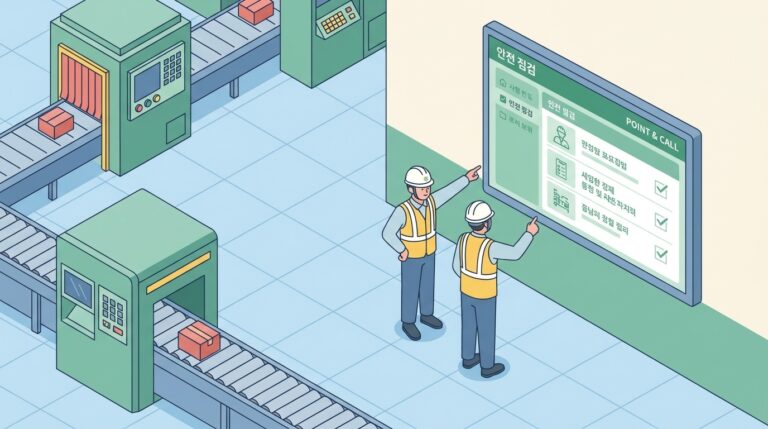
In Korean heavy industries, the most vital non-verbal gesture today is 지적확인 (Point-and-Call). When walking through a site, you must point directly at safety features (like pressure gauges or scaffold joints) with your index and middle finger extended, and call out “좋아!” (All clear/Good!). This isn’t just a physical act; it is the ultimate expression of Nunchi—keeping your situational awareness sharp. Avoiding eye contact with safety supervisors or ignoring their physical signals is considered a major corporate offense.
4-2. The Cultural Shift in K-Media
In older K-dramas, construction sites were often depicted as chaotic backdrops where corporate villains took shortcuts to maximize profit. However, modern legal and corporate K-dramas reflect the reality of SAPA. Corporations now employ entire departments dedicated to compliance, and the role of the CSO (Chief Safety Officer – 안전보건최고책임자) has become highly prestigious, often wielding as much power as the CEO.
Phase 5: 실전 롤플레이 시나리오
Characters & Setting
- 김 대표 (CEO Kim): The anxious CEO of Hansung Engineering, desperately trying to ensure compliance before a national safety audit.
- 박 소장 (Director Park): The seasoned, meticulous Safety Director on-site who values lives over speed.
[Scene: Inside the mobile office at a massive urban construction site in Seoul. Safety blueprints cover the walls.]

김 대표: (불안한 표정으로 땀을 닦으며) 박 소장님, 내일 고용노동부 합동 감사가 나온다는데, 우리 현장 안전보건관리체계는 정말 완벽히 구축된 겁니까?

박 소장: (단호하게 서류를 가리키며) 예, 대표님. 유해·위험요인 확인 및 개선 절차는 지난달에 다 완료했습니다. 특히 원·하청 상생협력 안전보건 예산도 전액 집행 완료된 상태입니다.

김 대표: (한숨을 쉬며) 다행이군요. 요즘 중대재해처벌법 때문에 다른 회사 대표들도 밤에 잠을 못 잡니다. 혹시라도 하청 업체 작업 중에서 중대산업재해가 발생하면 바로 내 책임이 되니까요.

박 소장: (진지한 눈빛으로 바라보며) 맞습니다. 그래서 저희가 매일 아침 협력업체 대표들과 함께 합동 TBM을 실시하고 있으며, 작업자들의 작업중단권 사용 현황도 실시간으로 모니터링 중입니다.

김 대표: (고개를 끄덕이며) 아주 잘하고 계십니다. 혹시 공기(공사 기간)가 지연되더라도 절대 안전을 양보해서는 안 됩니다. 서두르다 사고 나면 다 끝장입니다.

박 소장: (경례하듯 안전모를 톡 치며) 안심하십시오, 대표님. 현장 소장인 제가 책임지고 '안전제일' 수칙을 절대 타협하지 않겠습니다.

김 대표: (박 소장의 손을 잡으며) 고맙습니다, 박 소장님. 내일 감사에서 지적 사항이 안 나오도록 마지막까지 밀착 마크 부탁합니다.

박 소장: (신뢰감 주는 미소를 지으며) 예, 걱정 마십시오. 오늘 저녁 최종 리허설까지 마친 후 보고드리겠습니다.
🔀 인터랙티브 분기점 (What should CEO Kim prioritize next?)
- Option A: “Let’s speed up the paperwork audit and ignore minor gear non-compliance on the ground for today.”
- Feedback: 🚫 Risk (위험)! Paperwork means nothing if an inspector catches an unharnessed worker. A single violation during a live audit will trigger a full-site shutdown and place you on the authorities’ watchlist.
- Option B: “Let’s check the subcontractor’s safety budget and ensure they have adequate personal protective equipment (PPE).”
- Feedback: 🏆 Best (최상)! Under SAPA, prime contractors are fully responsible for subcontractor safety. Ensuring their equipment is flawless demonstrates active duty of care and legally insulates the CEO.
- Option C: “Let’s prepare a lavish dinner for the inspectors to build good rapport.”
- Feedback: ⚠️ Bad (최악)! In modern Korea, bribery and soliciting laws (김영란법) are strictly enforced. Attempting to influence inspectors will land you in a corruption scandal long before a safety audit even begins.
Phase 6: 10초 감정 섀도잉 드릴
Practice these emotionally charged, high-stakes safety phrases with perfect intonation! Use the / to pause and breathe.
[단호하고 강력하게 - Resolute and Firm]- “아무리 / 공기가 급해도 / 안전조치 미흡 상태에서는 / 작업을 진행할 수 없습니다!”
- [A-mu-ri / gong-gi-ga geup-hae-do / an-jeon-jo-chi mi-heup / sang-tae-e-seo-neun / jak-eop-eul jin-haeng-hal su eop-seumnida!]
[간절하고 호소하듯이 - Urgent and Pleading]- “대표님, / 중대재해처벌법 시행 이후로는 / 하청의 안전사고도 / 원청의 법적 책임이 됩니다!”
- [Dae-pyo-nim, / jung-dae-jae-hae-cheo-beol-bop / si-haeng i-hu-ro-neun / ha-cheong-ui an-jeon-sa-go-do / won-cheong-ui beop-jeok chaek-im-i doemnida!]
Phase 7: K-Culture 미니 사전 (핵심 키워드 4개)
- 안전보건최고책임자 (CSO) | Chief Safety Officer
- Usage: The newly created C-suite executive role in Korea tasked with bearing the legal heat and managing safety systems under SAPA.
- 위험성평가 | Risk Assessment
- Usage: A mandatory process where workers and managers jointly identify workplace hazards before work begins.
- 아차사고 | Near-miss Accident
- Usage: Literally “Oops! Accident.” An incident that did not result in injury but had the potential to do so; keeping track of these is vital to prevent Jungdae-jaehae.
- 신호수 | Signalman / Banksman
- Usage: The designated personnel directing heavy machinery traffic. Under the new safety laws, a machine operating without an active shinhosu is immediately fined.
Phase 8: 여행자를 위한 생존 키트 (Survival Kit)
Even if you are not a construction manager, knowing these survival safety terms as a traveler or expat in industrial or transport zones can save your life.
| Expression (Korean) | Romanization | Pro Tip |
|---|---|---|
| 안전모 필수 착용 | An-jeon-mo pil-su chak-yong | “Safety Helmet Mandatory.” If you see this sign, do not enter without head protection! |
| 대피로가 어디예요? | Dae-pi-ro-ga eo-di-yeo-yo? | “Where is the evacuation route?” Essential to ask during safety drills. |
| 119에 신고해 주세요! | Il-il-gu-e sin-go-hae ju-se-yo! | “Please call 119!” (Korea’s emergency services number for fire and medical rescue). |
📌 Editor’s Travel Note
Before visiting heavy industrial tour sites or remote areas, download the official emergency alert app provided by the Korean government. We highly recommend accessing the 안전디딤돌 앱 다운로드 to receive real-time disaster alerts, shelter locations, and English safety protocols directly on your smartphone. (Note: Government app features and compatibility may vary depending on device OS.)
Phase 9: “한 발 더 깊이” (생각 질문)
The implementation of SAPA reveals a fascinating philosophical evolution in modern South Korean society. Historically, Korea’s rapid economic miracle was fueled by a collective rush to build infrastructure and manufacture goods. However, this legislative pivot proves that the nation is transitioning from prioritizing raw economic output to cherishing individual human dignity and collective well-being. It is a bold, controversial step where legal structures are used to forcibly break old habits of convenience.
💬 Your Turn: Do you believe heavy punitive laws against executives are the most effective way to change a country’s safety culture? Or do you prefer safety incentivization? Share your thoughts in the comments below!
Phase 10: FAQ & 오해 방지 (FAQ Schema)
Q: Does the Serious Accident Punishment Act (SAPA) apply to foreign companies operating in South Korea?
A: Yes, absolutely. SAPA applies to all business entities operating within South Korean territory, regardless of the nationality of the parent company or the CEO. Foreign executives can be prosecuted and imprisoned under Korean law if their local operations fail to comply and a fatal accident occurs.
Q: What is the difference between the standard Occupational Safety and Health Act (OSHA / 산업안전보건법) and SAPA?
A: The standard OSHA targets direct supervisors and focuses on specific, physical safety violations on the ground (e.g., missing guardrails). SAPA, however, targets top-tier decision-makers (CEOs/owners) and punishes their systemic failure to establish and fund a comprehensive safety management network.
Q: Does SAPA protect foreign or undocumented workers in Korea?
A: Yes, Korean labor laws and safety regulations protect all workers on Korean soil, regardless of their nationality or legal visa status. Any serious accident involving a foreign worker triggers the same severe SAPA investigation.
🚨 흔한 실수 (Common Mistakes) 경고판
- Mistake 1: Referring to a minor cut or bruise as a 중대재해 (Serious Accident).
- Correct Action: Reserve Jungdae-jaehae for fatalities or incidents requiring long-term hospitalization. For minor incidents, use 경미한 부상 (Minor Injury).
- Mistake 2: Thinking 원청 (Prime Contractor) can blame 하청 (Subcontractor) for accidents.
- Correct Action: Remember that SAPA explicitly holds the prime contractor accountable. Always emphasize joint responsibility using the term 원·하청 공동책임.
- Mistake 3: Treating the daily TBM (Tool Box Meeting) as a casual coffee break.
- Correct Action: In Korea, TBM is a legal record-keeping process. Treat it with high professional formality.
Phase 11: 액션 미션 & 참여 유도
Action Mission 3단계
- 🥉 Bronze Level: Read our Phase 6 shadowing sentences out loud 3 times. Focus on holding your breath during the
/pauses. - 🥈 Silver Level: Write a short corporate email scenario in the comments using the term 안전보건관리체계 구축.
- 🥇 Gold Level: During your next business meeting or Korean class, confidently use the term 작업중단권 to explain how safety rights are protected in your organization.
🎮 K-Culture Mission
Watch a recent legal or slice-of-life K-drama (like Divorce Attorney Shin or Law School) and spot references to workplace compensation, corporate safety compliance, or the term 산재 처리 (Worker’s Compensation). Tell us which drama you watched in the comments!
Phase 12: 인터랙티브 퀴즈 챌린지
Test your knowledge of Korea’s new industrial safety culture!
Q1. If a construction CEO fails to set up a safety budget and a fatal accident occurs, they are prosecuted under which act?
- A) 산업안전보건법 (OSHA)
- B) 중대재해처벌법 (SAPA)
- C) 근로기준법 (Labor Standards Act)
👀 정답 및 해설 보기
정답: B) 중대재해처벌법 (SAPA)
해설: While OSHA tackles specific field violations, the failure of a CEO to systematically manage safety resulting in death is penalized under the Serious Accident Punishment Act (SAPA).
Q2. Complete the sentence: “위험 요소를 발견하면 즉시 ( )을 행사하여 작업을 멈추어야 합니다.”
- A) 면책조항 (Exemption clause)
- B) 작업중단권 (Stop-work right)
- C) 징계권 (Disciplinary right)
👀 정답 및 해설 보기
정답: B) 작업중단권 (Stop-work right)
해설: The right to halt work when a hazard is found is called Jak-eop-jung-dan-gwon.
Q3. True or False: SAPA does not hold a prime contractor liable if the serious accident happened to a subcontractor’s employee.
👀 정답 및 해설 보기
정답: False!
해설: One of the most critical aspects of SAPA is that prime contractors (원청) are held directly accountable for the safety of subcontractors (하청) working under their control.







