

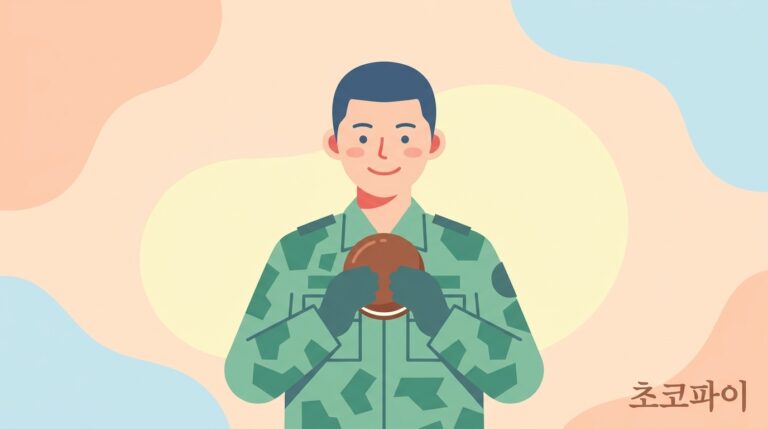
The Sweetest Secret of Korean Military Culture: The Power of a Chocopie
안녕하세요! This is your favorite Korean study buddy and the senior editor of Daily Hangul.
Have you ever seen a grown man cry over a tiny, marshmallow-filled chocolate snack? If you have watched Korean military dramas or variety shows, this scene might look familiar. In Korea, almost every able-bodied man must complete mandatory military service. During those grueling, isolated months, a simple chocolate snack called the Chocopie (초코파이) becomes more than just junk food—it becomes a symbol of survival, comfort, and deep human connection.
Today, we are diving into the warm and fascinating world of Korean military culture and the legendary status of the Chocopie. Through this guide, you will master essential intermediate (B1) Korean expressions that will instantly make your conversations with Korean friends feel deeper and more authentic!
1. Three Key Expressions Deep Dive
1. 군기가 바짝 들다 (gungiga bajjak deulda)
- Pronunciation: [Goon-gi-ga ba-jjak deul-da] (Think of “goon-key” + “bah-jjack”, where “bajjak” sounds like the sharp snap of a dry twig, representing alertness).
- Meaning: To be highly disciplined / To be sharply alert.
- K-Culture Moment: This expression is a staple in military dramas like D.P. or Descendants of the Sun. When a new recruit stands frozen like a statue, answering every command with a thunderous voice, the senior officers nod and say, “군기가 바짝 들었네” (He is fully disciplined).
- Editor’s Insight: Although “군기” literally means “military discipline,” Koreans use this in everyday life! If a new employee at an office is extremely polite, stiff, and eager to please, colleagues will jokingly say they have “군기가 바짝 들었다.”
- Situation Spectrum: Casual (⚠️ – sounds a bit dramatic/playful), Semi-formal (✅), Formal (✅)
- 🤔 Think About It: Why do you think Korean society values this sharp, collective discipline even in corporate offices? How does it compare to the work culture in your country?
2. 눈물 젖은 초코파이 (nunmul jeojeun chocopai)
- Pronunciation: [Noon-mool jeo-jeun cho-co-pie] (“Noon-mool” rhymes with “spoon-rule” + “jeojeun” sounds like “george-un” without the ‘g’ sound).
- Meaning: Literally “tear-soaked Chocopie.” It refers to finding intense comfort in small things during your darkest, hardest times.
- K-Culture Moment: A character in a movie reminisces about their struggling youth when they had no money, saying they survived on “눈물 젖은 초코파이.”
- Editor’s Insight: This phrase was born directly in the military training camps. Exhausted, hungry recruits often get their first sweet taste of freedom during weekend religious services where Choco Pies are handed out. Eating that sweet snack while crying from homesickness is a rite of passage.
- Situation Spectrum: Casual (✅), Semi-formal (✅), Formal (⚠️ – too metaphorical for official business settings)
- 🤔 Think About It: Is there a specific “comfort food” in your culture that represents overcoming hard times?
3. 정(情)을 나누다 (jeong-eul nanuda)
- Pronunciation: [Jeong-eul nah-noo-dah] (“Jeong” is a soft ‘j’ sound, followed by “eul” and “nah-noo-dah” like “nah-new-dah”).
- Meaning: To share warmth, affection, and mutual emotional bonding.
- K-Culture Moment: Sharing food, helping a stranger, or looking out for a coworker. Chocopie’s famous marketing campaign in Korea literally revolves around the single Hanja character 情 (Jeong).
- Editor’s Insight: “Jeong” is one of those beautiful, untranslatable Korean concepts. It is not just love; it is a mixture of empathy, shared history, and mutual duty. When you share a Chocopie, you aren’t just sharing sugar—you are sharing Jeong.
- Situation Spectrum: Casual (✅), Semi-formal (✅), Formal (✅)
- 🤔 Think About It: Jeong involves an unspoken obligation to care for those around you. Does your native language have a word for this communal warmth?
2. Textbook Korean vs. Real Korean
Let’s see how textbook phrases compare to the lively, emotional language Koreans actually use when they are exhausted or bonding.
Situation 1: Expressing that you are crazily craving sweets.
- 📖 Textbook Korean: “아주 맛있습니다. 단 것이 먹고 싶습니다.”
[Aju masitseumnida. Dan geosi meoggo sipseumnida.]
(It is very delicious. I want to eat something sweet.) - 🗣️ Real Korean: “단 게 미치도록 땡겨요!”
[Dan ge michidorog ttaenggyeoyo!]
(I am crazily craving sweet stuff!) - 💡 Why is it different? Textbook expressions are often too formal and dry. Real Koreans use the verb “땡기다” (to pull/crave) when their body desperately wants a specific food under stress.
Situation 2: Emphasizing loyalty and bond with your team.
- 📖 Textbook Korean: “우리는 좋은 친구입니다.”
[Urineun joeun chingu-imnida.]
(We are good friends.) - 🗣️ Real Korean: “우리는 의리로 똘똘 뭉쳤어요.”
[Urineun uiri-ro ttolttol mungchyeosseoyo.]
(We are tightly bound by loyalty/comradeship.) - 💡 Why is it different? “의리” (uiri – loyalty/honor) is a huge cultural keyword stemming from military camaraderie. Saying you are “똘똘 뭉치다” means you are firmly united as one tight unit.
3. K-Culture Deep Dive & Non-verbal Manners
3-1. Nunchi & Physical Gestures (눈치와 몸짓)
In Korea, how you receive food is just as important as what you say. If a senior soldier or your Korean boss offers you a Chocopie:
1. Two Hands (두 손): Always accept the item with both hands. Keep your elbows tucked close to your body as a sign of respect.
2. The Bow: Lower your head slightly while receiving it and make eye contact only after you have safely taken the snack.
3. Speech Tone: In the military, recruits must use “다나까” (danakka) style, meaning sentences must end in “-다” (statement) or “-까” (question) instead of the casual “-요”. Keep your posture straight!
3-2. The Chocopie Miracle in Training Camps
Why Chocopie? During basic training, recruits are cut off from phones, television, and outside food. The physical training is brutal, and sugar is highly restricted. However, on Sundays, recruits are allowed to attend military religious services (Christian, Catholic, or Buddhist).
To attract soldiers, these religious centers offer a prize: Choco Pies. Soldiers would famously attend Protestant services in the morning, Catholic in the afternoon, and Buddhist in the evening just to collect three Choco Pies. It represents a brief moment of sweet sanctuary.
4. Real-life Roleplay Scenario
Setting: A military barracks (생활관) late at night. Private Min-jun is exhausted, and Private Smith (a foreign recruit) is trying to cheer him up with a hidden treasure.
- 민준 (Min-jun): 🎭 (한숨을 쉬며 관물대를 정리한다) 하… 오늘 훈련 진짜 힘들었지 말입니다.
[Ha… oneul hullyeon jinjja himdeoreotji marimnida.]
(Sighing while organizing his military locker) Sigh… today’s training was seriously tough, sir. - 스미스 (Smith): 🎭 (좌우를 살피며 조용히 다가온다) 민준 이병, 힘내세요. 제가 비밀 선물을 가져왔어요.
[Min-jun ibyeong, himnaeseyo. Jega bimil seonmureul gajyeowasseoyo.]
(Looking left and right, whispering) Private Min-jun, cheer up. I brought a secret gift. - 민준 (Min-jun): 🎭 (눈이 동그래지며) 비밀 선물 말입니까? 이 좁은 내무반에서 말입니까?
[Bimil seonmul marimnika? I jobeun naemuban-eseo marimnika?]
(Eyes widening) A secret gift, sir? In this tiny barracks? - 스미스 (Smith): 🎭 (전투복 주머니에서 조심스럽게 꺼낸다) 쉿! 목소리 낮추세요. 짜잔! 초코파이입니다!
[Swit! Moksori natchuseyo. Jjajan! Chocopai-imnida!]
(Carefully pulling it out of his fatigue pocket) Shh! Lower your voice. Ta-da! It’s a Chocopie! - 민준 (Min-jun): 🎭 (초코파이를 보며 눈물을 글썽인다) 헉… 이거 진짜 눈물 젖은 초코파이네요. 어떻게 구하셨습니까?
[Heok… igeo jinjja nunmul jeojeun chocopai-neyo. Eotteokke guhasyeotseumnika?]
(Tears welling up) Oh my… this is truly a tear-soaked Chocopie. How did you get this? - 스미스 (Smith): 🎭 (어깨를 으쓱하며) 오늘 종교 행사 때 남은 걸 의리로 챙겼죠! 우리 나눠 먹어요.
[Oneul jonggyo haengsa ttae nameun geol uiri-ro chaenggyeotjyo! Uri nanwo meogeoyo.]
(Shrugging) I saved the leftover from today’s religious service out of loyalty! Let’s share it. - 민준 (Min-jun): 🎭 (감격해서 두 손으로 초코파이를 받는다) 스미스 이병, 정말 정이 넘치십니다. 평생 잊지 않겠습니다!
[Smith ibyeong, jeongmal jeong-i neomchisimnida. Pyeongsaeng itji angetseumnida!]
(Deeply moved, receiving it with both hands) Private Smith, you are truly overflowing with ‘Jeong’. I will never forget this for the rest of my life! - 스미스 (Smith): 🎭 (미소를 지으며 주먹을 쥔다) 별말씀을요! 우리 같이 끝까지 버텨봅시다. 파이팅!
[Byeolmalsseumeulyo! Uri gachi kkeutkkaji beotyeobopsida. Paiting!]
(Smiling and making a fist) Don’t mention it! Let’s endure together until the end. Fighting!
🔀 Interactive Choice: What if a strict Senior Officer suddenly walks in?
- Choice A: “죄송합니다! 너무 배가 고파서 먹었습니다!” (I’m sorry! I was so hungry I ate it!)
- Choice B: “아닙니다! 아무것도 안 먹었습니다!” (No, sir! I didn’t eat anything! while chocolate is smudged on your lips)
- Choice C: “선임병님도 한 입 드시겠습니까? 정을 나누고 싶습니다!” (Would you like a bite too, senior? I want to share some ‘Jeong’!)
💡 Feedback:
- Choice A (Best – Honest & Disciplined): Perfect choice! Admitting your hunger with a loud, disciplined voice (“군기 바짝 든 목소리”) works best in the military. You might get a light scolding, but they will respect your honesty.
- Choice B (Bad – Obvious Lie): Worst choice! Lying to a senior officer with chocolate on your face will lead to intensive extra training. Never lie in the barracks!
- Choice C (Risk – Hilarious but Dangerous): Extremely risky! While sharing “Jeong” is sweet, offering a tiny bite of a smuggled snack to a strict officer might be seen as mocking. Only try this if your senior is secretly a sweetheart!
5. 10-Second Emotion Shadowing Drill
Let’s practice speaking like a real Korean soldier with authentic emotions. Pause at the / marks!
[🥺 Desperate & Longing]
단 게 / 미치도록 / 땡깁니다!
(Dan ge / michidorog / ttaenggimnida!)
(I crave / sweet stuff / crazily!)-
[😭 Deeply Touched]
눈물 젖은 / 초코파이의 맛은 / 평생 / 못 잊습니다.
(Nunmul jeojeun / chocopai-ui maseun / pyeongsaeng / mot itseumnida.)
(The taste of / tear-soaked Chocopie / forever / I cannot forget.) -
[✊ Brave & Determined]
끝까지 / 동기들과 / 의리로 / 버티겠습니다!
(Kkeutkkaji / donggideul-gwa / uiri-ro / beotigessumnida!)
(Until the end / with my comrades / with loyalty / I will endure!)
6. K-Culture Mini Dictionary
- 군대 (Gundae) | Military / Army | Mandatory military service in Korea that deeply influences male bonding, slang, and social hierarchy.
- 동기 (Donggi) | Peer / Comrade | Soldiers who entered the training camp in the same month. They share a unique, lifelong bond of equality.
- 종교 행사 (Jonggyo Haengsa) | Religious Service | Weekend services that offer recruits a temporary escape from strict discipline and free snacks.
- 관물대 (Gwanmuldae) | Military Locker | A soldier’s personal locker. Keeping it perfectly organized is a primary test of discipline.
7. Survival Kit for Travelers
Survival Phrases
- 이거 드셔보세요. (Igo deushyeoboseyo.)
Pro Tip: Use this when sharing snacks with Korean colleagues or hosts to show warmth and respect. - 정말 고맙습니다. (Jeongmal gomapseumnida.)
Pro Tip: Say this with a slight bow when someone helps you during a stressful situation. It sounds incredibly sincere. - 우리는 친구잖아요! (Urineun chingujannayo!)
Pro Tip: Use this playfully to break the ice and highlight a close bond with a Korean peer.
🗺️ Editor’s Travel Note
If you want to try the legendary Chocopie or other military-favorite snacks like Moncher (몽쉘), head to the nearest local convenience store (CU, GS25, or 7-Eleven). To find one easily, make sure to download the Naver Map App (네이버 지도 앱 다운로드) since Google Maps does not update real-time routes well in Korea. Grab a sweet treat and experience the taste of Korean comfort food! (Note: Convenience store layouts and stock may vary by location.)
8. “One Step Deeper” (한 발 더 깊이)
This military obsession with Chocopie highlights the deep collectivism of Korean culture. When placed in highly stressful, hierarchical environments, Koreans naturally look for small escape hatches of warmth. Sharing a sweet snack is not just about the sugar; it is a silent agreement of empathy. Even after leaving the army, Korean men carry this “Chocopie sentimentality” into their corporate lives, maintaining loyalty (의리) and affection (정) through long working hours.
💬 Your Turn: What is one snack or comfort food in your culture that represents solidarity and emotional warmth during hard times? Let us know in the comments below!
9. FAQ & Common Mistakes
Q: Is Chocopie still that popular in the modern Korean military?
A: Yes! While military diets have improved and modern soldiers can access PX stores and smartphones, the Chocopie remains a nostalgic symbol of basic training survival and military humor.
Q: Can I use the military tone (다나까) in everyday life?
A: Unless you are in a highly traditional corporate environment or a strict sports team, using “다나까” (ending sentences with -다 or -까) in daily life will make you sound robotic or like you are roleplaying a K-drama. Stick to standard polite “-요” (haeyo-che)!
Q: What is the exact difference between “정 (Jeong)” and “사랑 (Sarang – Love)”?
A: “Sarang” is active, passionate, and usually romantic or familial. “Jeong” is a slow-growing, sticky bond of affection and duty built over shared time. You can even feel “Jeong” for a rival or an old, broken object!
🚨 Common Mistakes
- Mistake 1: Shaking hands with a senior while your other hand is in your pocket.
Correct Action: Use two hands (or support your right elbow with your left hand) as a sign of respect. - Mistake 2: Using casual “반말” (banmal) to convenience store workers because you saw friends do it in dramas.
Correct Action: Always use polite “존댓말” (jondaetmal, ending in -요). - Mistake 3: Pronouncing “초코파이” like the flat English phrase “Choco-pie”.
Correct Action: Pronounce it with sharp Korean vowels: [Cho-co-pah-ee].
10. Action Mission
- Bronze Mission (Level 1): Buy a box of Choco Pies and practice handing one to a friend with two hands, saying, “이거 드셔보세요.”
- Silver Mission (Level 2): Snap a photo of your favorite comfort food, post it on social media, and tag us
@DailyHangulwith the caption: “이것은 저의 ‘눈물 젖은’ [Food Name]입니다!” - Gold Mission (Level 3): The next time your coworker is having a rough day, place a Chocopie on their desk with a small sticky note to share some “정”.
🎮 K-Culture Mission: Watch an episode of a military-themed K-drama (like *D.P. on Netflix) and listen closely to how many times characters end their sentences with military-style speech!*
11. Interactive Quiz Challenge
Quiz 1: Social Judgment
Your Korean coworker is working late and looks extremely exhausted. What is the most culturally warm (“정”-filled) thing to do?
* A) Tell them to go home immediately in a loud voice.
* B) Silently place a Chocopie on their desk with a supportive sticky note.
* C) Ignore them so you do not break their focus.
Click to reveal the Answer & Explanation
Correct Answer: B
Small, silent gestures of care (정) are highly appreciated in Korean office culture. It shows you notice their hard work without putting them on the spot.
Quiz 2: Fill in the Blank
“이번 시험 공부는 정말 힘들어서, 마치 ( ) 초코파이를 먹는 느낌이었어요.”
* Hint: “Tear-soaked”
Click to reveal the Answer & Explanation
Correct Answer: 눈물 젖은 (nunmul jeojeun)
This expression perfectly fits situations where you finally achieve comfort after intense struggle.
Quiz 3: True or False
“In modern Korea, the word ‘의리’ (uiri – loyalty) is strictly used inside military bases.”
Click to reveal the Answer & Explanation
Correct Answer: False
“의리” is a beloved everyday concept used among close friends, teammates, and coworkers to describe deep loyalty and mutual trust!







