

Phase 1: Empathy (스토리 몰입형 오프닝)
안녕하세요! (An-nyeong-ha-se-yo!) Your Korean best friend and Daily Hangul Editor is here!
Imagine this: You are walking through a beautiful, quiet museum in Insadong, Seoul. The scent of old wood and fresh green tea fills the air. You spot a cozy corner where people are making gorgeous traditional Hanji (Korean paper) lamps and enjoying a traditional tea ceremony (Dado). You really, really want to join in, but a sudden wave of anxiety hits you:
“What if I ruin the craft? How do I even ask to join in Korean? What if I accidentally do something rude?”
Many of our sweet Daily Hangul family members have shared this exact feeling. It’s totally normal to feel shy! But traditional culture experiences (체험 – Che-eom) are the absolute best way to feel the heartbeat of Korea. Today, we are going to learn super easy, friendly, and practical A2-level expressions so you can confidently say, “Let me try!” without breaking a sweat. Let’s dive in!
Phase 2: Core Expressions Deep Dive (핵심 표현 3선 심층 분석)
Let’s master the three magic keys to unlocked hands-on traditional culture experiences!
1. 이거 어떻게 해요? (I-geo eo-tteo-ke hae-yo?)
- Pronunciation: “Ee-geo uh-ttuh-keh hae-yo?” (The eo-tteo-ke sounds like saying “auto-care” really fast without the ‘r’ sound!)
- Meaning: “How do I do this?”
- K-Culture Moment: You will hear this in almost every Korean reality show (like Run BTS or I Live Alone) whenever the cast members are sat down to cook, make pottery, or try a traditional craft and look completely lost.
- Editor’s Insight: This is the ultimate survival phrase. Instead of struggling in silence, showing this polite curiosity instantly makes the museum staff want to help you. It sounds natural and friendly.
- Situation Spectrum:
- Casual: 이거 어떻게 해? (Ee-geo eo-tteo-ke hae?) ⚠️ (Only with close friends)
- Semi-formal: 이거 어떻게 해요? (Ee-geo eo-tteo-ke hae-yo?) ✅ (Perfect for instructors!)
- Formal: 이것은 어떻게 합니까? (I-geo-seun eo-tteo-ke ham-ni-ka?) 🚫 (Too stiff, sounds like a military manual!)
- 🤔 Think About It: In many Western cultures, people prefer to read instructions first. In Korea, asking for hands-on, face-to-face guidance (이거 어떻게 해요?) is a lovely way to build a quick, warm connection (정 – Jeong) with your instructor.
2. 직접 해보고 싶어요. (Jik-jeop hae-bo-go si-peo-yo.)
- Pronunciation: “Jeek-jup hae-bo-go she-puh-yo.” (Think of jik-jeop as ‘jeep-job’ but with a quick ‘k’ sound at the end of the first syllable.)
- Meaning: “I want to try it myself.” (Literally: “I want to try doing it directly.”)
- K-Culture Moment: Remember that iconic pottery scene in K-dramas where the lead character wants to get their hands dirty and mold the clay? This is the perfect line for that!
- Editor’s Insight: 직접 (Jik-jeop) means “directly” or “personally.” Using this word shows the instructor that you are enthusiastic and ready to participate, not just watch!
- Situation Spectrum:
- Casual: 직접 해볼래. (Jik-jeop hae-bol-rae.) ⚠️
- Semi-formal: 직접 해보고 싶어요. (Jik-jeop hae-bo-go si-peo-yo.) ✅
- Formal: 직접 체험해보고 싶습니다. (Jik-jeop che-eom-hae-bo-go sip-seum-ni-da.) ✅ (Very polite and respectful!)
3. 예약해야 돼요? (Ye-yak-hae-ya dwae-yo?)
- Pronunciation: “Yeh-yak-hae-ya dweh-yo?” (Think of ye-yak as saying “Yeah, yak!”)
- Meaning: “Do I need to make a reservation?”
- K-Culture Moment: Many beautiful museum craft programs in Korea are highly popular and fill up fast. Asking this save you from the heartbreak of missing out.
- Editor’s Insight: The structure -해야 돼요 (-hae-ya dwae-yo) means “have to / must.” It is a core A2 grammar point you will use daily in Korea!
- Situation Spectrum:
- Casual: 예약해야 돼? (Ye-yak-hae-ya dwae?) ⚠️
- Semi-formal: 예약해야 돼요? (Ye-yak-hae-ya dwae-yo?) ✅
- Formal: 예약을 해야 합니까? (Ye-yak-eul hae-ya ham-ni-ka?) 🚫 (Too formal for a casual walk-in inquiries)
Phase 3: Textbook Korean vs. Real Korean (교과서 한국어 vs 진짜 한국어)
Let’s look at how textbooks teach you, and how real Koreans actually talk at cultural centers!
Scenario A: Asking to participate
- 📖 Textbook style: “체험 프로그램에 참여하고 싶습니다.” (I would like to participate in the experience program.) – Too dry and robotic! Sounds like filling out an official application form.
- 🗣️ Real Korean: “저도 이거 해볼 수 있어요?” (Can I try this too?)
- 💡 Why it’s different: It’s simple, soft, and naturally invites the instructor to welcome you into the group.
Scenario B: Asking for guidance
- 📖 Textbook style: “설명서를 제공해 주십시오.” (Please provide the manual.) – Sounds like you’re talking to a machine!
- 🗣️ Real Korean: “한 번만 보여주세요!” (Please show me once!)
- 💡 Why it’s different: Koreans love visual learning. Asking them to “show you once” (한 번만 보여주세요) is incredibly polite and lets the instructor guide your hands directly.
Phase 4: K-Culture Deep Dive & Non-verbal Manners (비언어적 매너)
4-1. The Magic of Two Hands (두 손 – Du Son)
When you are doing a tea ceremony (다도) or traditional craft class, always use two hands when passing or receiving items (like a teacup, a paintbrush, or scissors) to/from the instructor.
* How to do it: Place your left hand gently under your right wrist or forearm while extending your right hand. This shows deep respect and immediately marks you as a culturally polite traveler!
4-2. The “Jeong” (정) of Cultural Teachers
Korean instructors at traditional museums are incredibly passionate. If you show interest by saying “우와, 신기해요!” (Wow, amazing!), they will often give you extra snacks, more tea, or spend extra time helping you perfect your craft. This warm, unconditional sharing is called 정 (Jeong)!
Phase 5: Real-Life Roleplay Scenario (실전 롤플레이 시나리오)
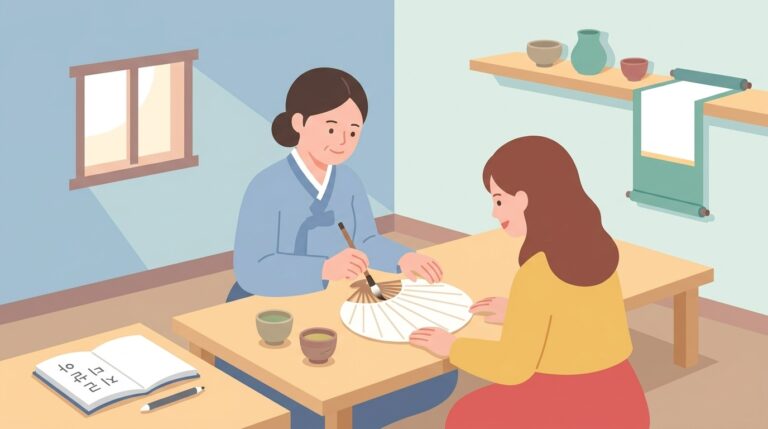
Setting: You are inside the National Folk Museum of Korea. There is a wooden table where Min-ji, a warm-faced instructor, is teaching tourists how to paint traditional folding fans (부채 – Buchae).
- Min-ji (Instructor): 안녕하세요! 전통 부채 만들기 체험이에요.
(An-nyeong-ha-se-yo! Jeon-tong bu-chae man-deul-gi che-eom-i-e-yo.)
“Hello! This is the traditional fan-making experience.” - You: 🎭 [Politely pointing at the beautiful finished fans]
저도 이거 직접 해보고 싶어요.
(Jeo-do ee-geo jik-jeop hae-bo-go si-peo-yo.)
“I want to try this myself too.” - Min-ji: 네, 환영합니다! 자리에 앉으세요.
(Ne, hwan-yeong-ham-ni-da! Ja-ri-e an-jeu-se-yo.)
“Yes, welcome! Please take a seat.” - You: 🎭 [Sitting down, looking at the ink brush]
예약해야 돼요? 저 예약 안 했어요.
(Ye-yak-hae-ya dwae-yo? Jeo ye-yak an hae-sseo-yo.)
“Do I need a reservation? I didn’t make one.” - Min-ji: 괜찮아요! 지금은 자리가 있어요.
(Gwen-chan-a-yo! Ji-geum-eun ja-ri-ga i-sseo-yo.)
“It’s okay! We have seats right now.” - You: 🎭 [Holding the brush awkwardly]
선생님, 이거 어떻게 해요?
(Seon-saeng-nim, ee-geo eo-tteo-ke hae-yo?)
“Teacher, how do I do this?” - Min-ji: 🎭 [Smiling warmly, guiding your hand]
이렇게 슥슥 그리시면 돼요. 참 쉽죠?
(Ee-reo-ke seuk-seuk geu-ri-si-myeon dwae-yo. Cham swip-jyo?)
“Just draw smoothly like this. Pretty easy, right?” - You: 🎭 [Genuinely amazed at your fan]
우와, 정말 감사합니다!
(U-wa, jeong-mal gam-sa-ham-ni-da!)
“Wow, thank you so much!”
🔀 Interactive Choice Point!
Now, Min-ji asks you to apply the final glue to your fan, but you aren’t sure how much to use. What do you say?
* A) “이거 어떻게 해요? 도와주세요!” (I-geo eo-tteo-ke hae-yo? Do-wa-ju-se-yo!)
* B) “내가 할게!” (Nae-ga hal-ge!)
* C) [Just sit in silence and try to do it secretly]
See Feedback for your choice!
- Best Choice – A: Excellent! You asked politely (How do I do this?) and added “Please help me” (도와주세요). Min-ji will gladly help you apply the perfect amount of glue.
- Bad Choice – B: Oh no! “내가 할게!” is very casual banmal (informal language) meaning “I will do it!” Saying this to an instructor sounds rude and demanding.
- Risk Choice – C: Uh-oh! If you do it in silence, you might put too much glue and tear the precious Hanji paper. Don’t be shy; Korean teachers love to help!
Phase 6: 10-Second Emotion Shadowing Drill (10초 감정 섀도잉 드릴)
Let’s practice speaking like a native! Pay attention to the pauses (/) and the emotional milestones.
- “저/도/ 이/거/ 직/접/ 해/보/고/ 싶/어/요!/”
- [😊 Excited and full of anticipation]
- Key stress: Put energy into 직접 (Jik-jeop) to show your passion!
- “선/생/님,/ 이/거/ 어/떻/게/ 해/요?/”
- [🥺 Curious, polite, and slightly helpless]
- Key stress: Soften the end of the sentence to sound super friendly.
Phase 7: K-Culture Mini Dictionary (K-Culture 미니 사전)
- 다도 (Da-do) | Traditional Tea Ceremony
- Usage: Slow down and find peace by trying a traditional tea ceremony inside museum quiet rooms.
- 한지 (Han-ji) | Traditional Korean Paper
- Usage: Strong, beautiful paper made from mulberry bark. Often used to make gorgeous lamps.
- 체험 (Che-eom) | Hands-on Experience
- Usage: You will see this word everywhere in Korea! Look for “체험관” (Experience Hall) in museums.
- 선생님 (Seon-saeng-nim) | Teacher / Instructor
- Usage: Even if they are not school teachers, address any workshop instructor as “선생님” to show respect.
Phase 8: Traveler’s Survival Kit (여행자를 위한 생존 키트)
Survival Phrases TOP 3
- “사진 찍어도 돼요?” (Sa-jin jjik-eo-do dwae-yo?)
- Meaning: “Can I take photos?” (Crucial for capturing your cute crafting memories!)
- “도와주세요.” (Do-wa-ju-se-yo.)
- Meaning: “Please help me.”
- “이거 가져가도 돼요?” (Ee-geo ga-jyeo-ga-do dwae-yo?)
- Meaning: “Can I take this with me?” (To make sure you can bring your masterpiece home!)
Editor’s Travel Note:
To find hidden cultural workshops, search “Traditional Experience (전통체험)” on the Naver Map App Download. It provides the most accurate local bookings, operating times, and reviews compared to other maps! (Note: Program fees and availability may change depending on the season).
Phase 9: “One Step Deeper” (한 발 더 깊이)
In many Western cultures, asking for help is sometimes seen as a last resort, as independence is highly valued. However, in Korea, the dynamic between a student and a 선생님 (Seon-saeng-nim) is built on shared warmth and trust. Asking “How do I do this?” is not a sign of weakness; it’s a sign of respect and eagerness to learn. It breaks the ice and creates a beautiful human connection.
💬 Your Turn!
Have you ever tried a traditional craft or experience in another country? What was it? Let me know in the comments below!
Phase 10: FAQ & Mistake Prevention (FAQ & 오해 방지)
Q: Do I have to pay for all museum experiences?
A: Not all of them! Many national museums offer free mini-crafts or dress-up experiences. However, premium crafts like high-quality pottery or lacquerware usually require a material fee (typically 5,000 KRW to 20,000 KRW).
Q: What if I don’t understand the teacher’s Korean instructions?
A: Don’t worry! Traditional crafts are highly visual. Just say “보여주세요” (Bo-yeo-ju-se-yo – Please show me), and they will kindly demonstrate the steps with their hands.
Q: Can I wear Hanbok inside the museum?
A: Absolutely! In fact, wearing a Hanbok often gets you free admission to royal palaces and museums neighboring Gyeongbokgung!
🚨 Common Mistakes Alert!
- Mistake 1: Grabbing tools before being told to.
- Correct Action: Wait until the instructor says “시작하세요” (Si-jak-ha-se-yo – Please begin).
- Mistake 2: Using one hand to receive a teacup from an elder/instructor.
- Correct Action: Always hold the teacup with two hands.
- Mistake 3: Calling the instructor “이모” (Auntie).
- Correct Action: Use “선생님” (Seon-saeng-nim – Teacher) to keep it highly polite and professional.
Phase 11: Action Mission (액션 미션 & 참여 유도)
- Bronze Mission: Read the expression “직접 해보고 싶어요” aloud 3 times with your happiest expression!
- Silver Mission: Save this post and write down “이거 어떻게 해요?” in your travel notes.
- Gold Mission: When you visit a local Korean market or museum, use one of these phrases and share your experience on Instagram tagging #DailyHangul!
-
🎮 K-Culture Mission: Watch a historical K-Drama (like The King’s Affection or Red Sleeve). See if you can spot characters doing calligraphy or enjoying tea, and notice how they use two hands!
Phase 12: Interactive Quiz Challenge (인터랙티브 퀴즈 챌린지)
1. What is the polite way to ask “How do I do this?” to an instructor?
- A) 이거 해봐 (Ee-geo hae-bwa)
- B) 이거 어떻게 해요? (Ee-geo eo-tteo-ke hae-yo?)
- C) 어떻게 해라 (Eo-tteo-ke hae-ra)
2. Fill in the blank: “I want to try it myself.” -> “_____ 해보고 싶어요.”
- A) 직접 (Jik-jeop)
- B) 대충 (Dae-chung)
- C) 빨리 (Ppal-ri)
3. True or False: It is polite to pass materials with one hand to your craft teacher in Korea.
- A) True
- B) False
🎉 Click here to see the Answers & Explanations!
- Answer: B. “이거 어떻게 해요?” is the polite semi-formal way to ask.
- Answer: A. “직접” means directly/personally. “직접 해보고 싶어요” means “I want to try it myself.”
- Answer: B (False). You should always use two hands (두 손) to show respect!
See you in the next lesson, my lovely friends! 행복한 하루 보내세요! (Have a happy day!)






