

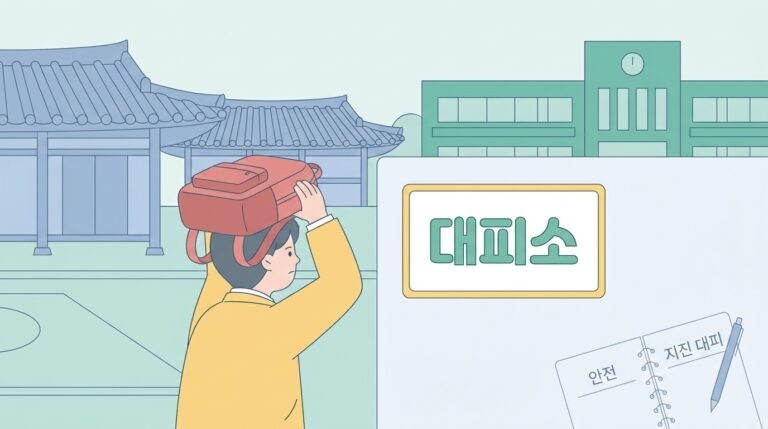
When the Ground Shakes: Your Advanced Guide to Earthquake Survival and Finding Shelters in Korea
Phase 1: Empathy (An Editor’s Letter)
안녕하세요! Welcome back to Daily Hangul. I’m your senior editor and local cultural navigator.
Imagine this: You are sipping a perfectly crafted hot matcha latte in a sleek, minimalist cafe on the 10th floor of a high-rise building in Gangnam. Suddenly, your phone screeches with that bone-chilling, high-pitched emergency alert sound—the 재난문자 (Disaster Alert). Before you can swipe it away, the ceiling lamps begin to sway gently, then violently. The floor vibrates beneath your feet.
For many expats and travelers, experiencing an earthquake in South Korea can feel uniquely terrifying, not just because of the physical hazard, but because the emergency instructions flashing on your screen are written in highly formal, administrative Korean. In moments of panic, translation apps can fail you, and looking for a safe zone becomes an immediate test of your linguistic agility.
Today, we are diving deep into C2-level emergency Korean tailored for earthquake scenarios, safety evacuations, and locating shelters. By mastering these high-level, real-world expressions, you won’t just survive an emergency—you’ll be equipped to lead others to safety and navigate local emergency infrastructure like a native civil servant. Let’s build your linguistic shield!
Phase 2: Deep Analysis of Core Phrases
In administrative situations, the Korean government uses precise, Sino-Korean heavy vocabulary (한자어). Understanding the lexical roots of these terms is key to instant recognition during a crisis.
1. 인근의 지진 옥외대피소로 신속하게 대피하십시오. (한글)
- Pronunciation: In-geun-ui ji-jin ok-oe-dae-pi-so-ro sin-sok-ha-ge dae-pi-ha-sip-si-o. (Think of in-geun sounding like ‘in-goon’, sin-sok like ‘seen-soke’ with a sharp, swift delivery.)
- Meaning: Please evacuate promptly to a nearby outdoor earthquake shelter.
- K-Culture Moment: You will hear this exact phrasing over district loudspeakers or subway broadcasting networks during a disaster or nationwide civil defense drill (민방위 훈련).
- Editor’s Insight: Note the term 옥외대피소 (outdoor shelter). During earthquakes, indoor shelters (like normal civil defense shelters in subway stations) can be traps due to structural collapse. Government guides will always emphasize “옥외” (outdoor space, e.g., school playgrounds, parks).
- Situation Spectrum: Casual: 🚫 | Semi-formal: ⚠️ | Formal: ✅
- 🤔 Think About It: In your native language, is there a sharp linguistic distinction between general safety shelters and specifically “outdoor” safe zones? Why does Korean administrative language place such emphasis on compounding nouns for clarity?
2. 여진에 의한 추가 피해를 막기 위해 건물 외부로 몸을 피하세요. (한글)
- Pronunciation: Yeo-jin-e ui-han chu-ga pi-hae-reul mak-gi wi-hae geon-mul oe-bu-ro mom-eul pi-ha-se-yo.
- Meaning: Please head outside the building to prevent additional damage/injury from aftershocks.
- K-Culture Moment: In K-dramas depicting disaster situations (like D-Day or Crash Landing on You), rescue workers and safety wardens constantly scream about 여진 (aftershocks) to prevent civilians from entering structurally compromised buildings.
- Editor’s Insight: The phrase 몸을 피하다 (literally “to hide one’s body”) is a natural, idiomatic way to express taking refuge or seeking safety, softer than the cold clinical term 대피하다.
- Situation Spectrum: Casual: ⚠️ | Semi-formal: ✅ | Formal: ✅
- 🤔 Think About It: The word 피해 (damage/harm) combined with 막다 (to block/prevent) forms a core pillar of disaster prevention jargon in Korea. How does this compare to how preventative safety is voiced in your country?
3. 낙하물에 유의하며 머리를 보호해 주십시오. (한글)
- Pronunciation: Nak-ha-mul-e yu-ui-ha-myeo meo-ri-reul bo-ho-hae ju-sip-si-o.
- Meaning: Please protect your head while remaining mindful of falling objects.
- K-Culture Moment: This is the default instruction shown on digital screens inside subways and public offices when seismic activity is detected.
- Editor’s Insight: 낙하물 (falling objects) is a high-level Sino-Korean compound (낙 to fall + 하 down + 물 object). The verb 유의하다 (to be mindful of / pay attention to) is much more formal than 조심하다 (to be careful) and is heavily preferred in written warnings.
- Situation Spectrum: Casual: 🚫 | Semi-formal: ⚠️ | Formal: ✅
- 🤔 Think About It: How does the register change when moving from written emergency broadcasts to direct verbal warnings during high-stress situations?
Phase 3: Textbook Korean vs. Real-world Korean
When emergencies happen, administrative announcements use formal text, but real human interactions on the ground are clipped, fast, and heavily reliant on context.
Situation 1: Recognizing an Emergency Broadcast
- 📖 Textbook Korean: “지진이 발생했으니 침착하게 밖으로 나가십시오.” (An earthquake has occurred, so please calm down and go outside.)
- 🗣️ Real-world Korean: “현 시간부로 규모 4.5 지진 감지. 낙하물 유의 및 안전지대 대피 요망.” (As of this hour, a magnitude 4.5 earthquake has been detected. Caution regarding falling objects and evacuation to a safe zone is requested.)
- 💡 Why the difference? Public broadcasting prioritizes absolute brevity and clarity over grammatical softness, using noun-ending demands like “대피 요망” (evacuation requested) to speed up communication.
Situation 2: Asking Locals for Shelter Locations
- 📖 Textbook Korean: “대피소가 어디에 있습니까? 그곳으로 가는 길을 알려주십시오.” (Where is the shelter? Please tell me the way to get there.)
- 🗣️ Real-world Korean: “혹시 근처에 대피할 만한 운동장이나 공터가 어디 있어요? 네이버 지도에 안 뜨네요!” (By any chance, where is there a schoolyard or open field nearby where we can take shelter? It’s not showing up on Naver Maps!)
- 💡 Why the difference? During chaotic moments, asking for specific official names (“지진 옥외대피소”) might stall people. Asking for “운동장” (school playground) or “공터” (vacant open lot) immediately communicates your survival-oriented goal to locals.
Phase 4: K-Culture Deep-dive & Non-verbal Manners
4-1. 눈치 (Nunchi) & Non-verbal Rescue Etiquette
In Korea, during any public emergency, 눈치 (quick situational assessment/tact) is your greatest ally. When an alert hits:
1. Do not scream or run blindly. Korean social cohesion emphasizes quiet efficiency in crises. Watch how locals react; if they immediately crouch or check their phones, copy their posture.
2. The “Bag Shield” Gesture: If you must move, hold your backpack or purse directly over your head with both hands. This is a universally understood non-verbal cue in Korea that you are protecting yourself from falling glass/debris.
4-2. The Civil Defense Culture of Korea
Korea possesses a highly organized civil protection system due to its geopolitical history. If you look at the streets, you will notice yellow-and-green signs saying 대피소 (Evacuation Shelter) on underpasses, subway entrances, and school gates.
Every year, the country conducts 민방위 훈련 (Civil Defense Drill). During these drills, traffic is halted, sirens wail, and citizens practice going underground or moving to open spaces. Understanding this structured preparedness helps you realize that in an emergency, there is always a designated, government-vetted plan nearby.
Phase 5: Real-world Roleplay Scenario
Context & Characters
You are on the 3rd floor of a modern building in Seoul when a sudden seismic tremor shakes the building. You are speaking with Min-ho (민호), a pragmatic local building warden who is trying to coordinate the immediate evacuation.
[Scene: Inside a shaken corporate building lobby. Ceiling tiles have slightly shifted.]

1. 민호: (긴박한 목소리로) 방금 엄청 크게 흔들렸죠? 지진인 것 같아요. 다들 우왕좌왕하고 있네요.
   *(Min-ho: (In an urgent voice) That shook really hard just now, didn't it? I think it's an earthquake. Everyone is panicking and running around.)*

2. Learner: (단호하게) 네, 저도 느꼈습니다. 휴대폰 재난문자를 보니 규모 5.0이라네요. 건물 내부가 위험하니 서둘러 나가야 합니다.
   *(Learner: (Resolutely) Yes, I felt it too. Looking at my phone's emergency alert, it says it's a magnitude 5.0. It's dangerous inside the building, so we must hurry out.)*

3. 민호: (계단 쪽을 가리키며) 엘리베이터는 멈출 수 있으니까 비상계단을 이용하는 게 안전하겠죠? 얼른 내려갑시다.
   *(Min-ho: (Pointing to the stairs) Since the elevators might stop, it's safer to use the emergency stairs, right? Let's get down quickly.)*

4. Learner: (머리를 가방으로 보호하며) 맞습니다. 가방으로 머리부터 감싸고, 낙하물을 피하면서 비상구로 신속하게 이동합시다.
   *(Learner: (Protecting head with a bag) Agreed. Let's cover our heads with our bags first and move quickly to the emergency exit while avoiding falling objects.)*

5. 민호: (건물 밖으로 나오며 주위를 둘러보고) 휴, 일단 밖으로 나오긴 했는데... 고층 빌딩 유리창이 깨져서 내릴까 봐 무섭네요. 어디로 가야 하죠?
   *(Min-ho: (Looking around after coming outside) Phew, we're out for now but... I'm scared the high-rise windows might shatter and fall. Where should we go?)*

6. Learner: (스마트폰 앱을 빠르게 확인하며) 근처 학교 운동장이 공식 '지진 옥외대피소'로 지정되어 있습니다. 인근 공터로 유도해 드리겠습니다.
   *(Learner: (Checking smartphone app quickly) A nearby school playground is designated as an official 'outdoor earthquake shelter'. I will guide you to the nearby open space.)*

7. 민호: (고개를 끄덕이며) 정말 다행이네요. 혼자였으면 당황했을 텐데 침착하게 이끌어 주셔서 감사합니다. 앞장서 주세요!
   *(Min-ho: (Nodding) What a relief. I would have panicked if I were alone, but thank you for leading so calmly. Please lead the way!)*

8. Learner: (신속히 움직이며) 천만에요. 여진이 발생할 수 있으니, 벽에서 최대한 떨어져서 넓은 도로 쪽으로 이동합시다.
   *(Learner: (Moving swiftly) Don't mention it. Since aftershocks could occur, let's keep as far away from walls as possible and move toward the wide streets.)*
🔀 Interactive Choice Point
Min-ho asks you how to find the exact outdoor shelter route when the GPS signal starts glitching due to cellular overload.
- Option A: “그냥 사람들이 많이 뛰어가는 방향으로 무조건 따라갑시다!” (Let’s just follow the direction most people are running to, no matter what!)
- Option B: “지진 옥외대피소 표지판이 보일 때까지 주변 골목길을 하나씩 찾아보시죠.” (Let’s search the surrounding alleys one by one until we see an outdoor earthquake shelter sign.)
- Option C: “통신망이 불안정하니, 인근의 넓은 초등학교 운동장이나 공원 같은 개방된 공간을 직관적으로 찾아 이동하는 편이 낫겠습니다.” (Since the network is unstable, it would be better to intuitively locate and move to open spaces like a nearby elementary school playground or park.)
Feedback
- Option A (Risk): Danger of stampedes or crowd crush. Following panicked crowds blindly without verified direction can lead to dead ends or high-debris areas.
- Option B (Bad): Wandering through narrow alleys during or immediately after seismic activity increases the risk of being hit by falling roof tiles, air conditioning units, or brick walls.
- Option C (Best): Excellent judgment! Highly logical for a C2 level. Schools and city parks are the default designated emergency zones in South Korea, and staying in open spaces minimizes structural hazards.
Phase 6: 10-Second Emotional Shadowing Drill
Practice delivery under high-stress conditions. Pay attention to pauses (/) and emotional weight.
- [🚨 Urgently and authoritatively – Warning others]
“가스 밸브 잠그고! / 엘리베이터 타지 말고! / 계단으로 신속히 / 이동하세요!”
(Gas val-beu jam-geu-go! / el-li-be-i-teo ta-ji mal-go! / gye-dan-eu-ro sin-sok-hi / i-dong-ha-se-yo!)
Translate: Shut off the gas valve! Don’t take the elevator! Move quickly down the stairs! -
[😰 Worried but looking for clarity – To a local]
“혹시 / 이 근처에 / 건물 붕괴 위험이 없는 / 넓은 공터가 / 어디에 있나요?”
(Hok-si / i geun-cheo-e / geon-mul bung-goe wi-heom-i eop-neun / neol-beun gong-teo-ga / eo-di-e in-na-yo?)
Translate: By any chance, is there a wide, open vacant lot nearby with no risk of building collapse?
Phase 7: K-Culture Mini Dictionary
- 재난안전대책본부 (Disaster and Safety Countermeasures Headquarters | Jae-nan-an-jeon-dae-chaek-bon-bu)
- The national command center that takes charge of coordinating rescue operations, issuing official updates, and directing municipal resources during crises.
- 여진 (Aftershock | Yeo-jin)
- Literally “remaining tremors”. Highly discussed in news broadcasts post-earthquake; a word every advanced learner must know to understand building re-entry safety timelines.
- 지진 옥외대피소 (Outdoor Earthquake Shelter | Ji-jin Ok-oe-dae-pi-so)
- Designated safe outdoor areas (parks, school fields) officially cleared of structural fall risks.
- 국민재난안전포털 (National Disaster Safety Portal | Guk-min-jae-nan-an-jeon-po-teol)
- The official central database run by the Ministry of the Interior and Safety for finding emergency codes and immediate action protocols.
Phase 8: Survival Kit for Travelers
Survival Expressions TOP 3
- “대피소 위치를 알고 계신 분 있으신가요?”
- Pronunciation: Dae-pi-so wi-chi-reul al-go gye-sin bun i-seu-sin-ga-yo?
- Pro Tip: Use this formal honorific phrasing to address crowds or group leaders to find directions instantly when digital maps fail.
- “여진 때문에 위험하니 넓은 곳으로 대피합시다.”
- Pronunciation: Yeo-jin ttae-mun-e wi-heom-ha-ni neol-beun go-seu-ro dae-pi-hap-si-da.
- Pro Tip: Useful to firmly convince panicked friends to leave structural overhangs or narrow alleys.
- “부상자가 있습니다! 119에 연락해 주세요!”
- Pronunciation: Bu-sang-ja-ga i-seup-ni-da! Il-il-gu-e yeon-rak-hae ju-se-yo!
- Pro Tip: Essential phrase if you find someone injured. Remember, 119 is Korea’s primary emergency number for fire and medical rescue.
Editor’s Travel Note: Essential Digital Lifelines
Before embarking on your travels or settling in Korea, download the safety app 안전디딤돌 (Safety Stepping Stone App). It is the government’s official disaster safety application that works even with unstable connections to map out your nearest evacuation points and shelters. Keep a power bank on hand, and memorize the location of the nearest elementary school (초등학교) or public park (공원) to your residence.
Phase 9: “Going One Step Deeper” (Cultural Reflection)
South Korea’s modern history is defined by highly dense, rapid urbanization. While the massive concrete landscape of Seoul is beautiful, it poses unique vulnerabilities during seismic events. This reality has fostered a deeply collectivist sense of responsibility called 공동체 의식 (Community Solidarity) during crises.
Unlike western individualism, in emergency situations in Korea, you will often find strangers immediately coordinating tasks together—forming human chains, passing information down lines, and looking out for vulnerable populations like the elderly or non-Korean speakers. Speaking high-level, clear Korean in these moments signals that you are an active, capable part of the community pool, ready to assist and be assisted.
💬 Your Turn: How does your home country handle civil emergency drills? Do you feel that your linguistic skills are ready to manage a crisis in a foreign language? Let’s talk in the comments below!
Phase 10: FAQ & Avoiding Misunderstandings
Q: Can I use subway stations as shelters during an earthquake in Korea?
A: Generally, no. While subway stations are the official 민방위 대피소 (Civil Defense Shelters) for air raids or extreme weather, earthquakes require you to avoid underground spaces due to structural collapse and flooding risks. Seek 옥외대피소 (outdoor spaces) instead.
Q: What is the fastest way to get real-time translated disaster alerts?
A: The Emergency Alert text (재난문자) sent to your phone is usually in Korean. However, the Safety Stepping Stone App (안전디딤돌) provides an English interface option with translated emergency warnings.
Q: Should I wait inside a building if the shaking stops?
A: Once the initial shaking subsides, immediately secure the exit door (earthquakes warp doorframes, locking you inside) and evacuate to an open space using the stairs, as aftershocks (여진) can compromise the building’s integrity.
🚨 Common Mistakes Warning Board
- Mistake 1: Waiting for the elevator (엘리베이터 대기) during evacuations.
- Correct Action: Always use the emergency stairs (비상계단). Power outages can trap you inside elevator shafts.
- Mistake 2: Relying on global search tools like Google Maps to find local shelters.
- Correct Action: Korean mapping data is tightly regulated. Use Naver Maps (네이버 지도) or Kakao Maps, search for “대피소” (Shelter) directly.
- Mistake 3: Assuming all yellow signs indicate earthquake shelters.
- Correct Action: Check the icon. An outdoor playground or park outline indicates a seismic-safe outdoor shelter, while underground symbols indicate general bomb/artillery shelters.
Phase 11: Action Mission & Engagement
Your Action Mission
- 🥉 Bronze: Open Naver Maps or Kakao Maps and search the term “지진옥외대피소” from your current location or hotel in Korea. Take a screenshot.
- 🥈 Silver: Share this guide on your social channels to help fellow expats recognize the critical visual differences between indoor civil defense shelters and outdoor earthquake zones.
- 🥇 Gold: Practice pronouncing the phrase: “낙하물에 유의하며 신속히 대피하십시오” in front of a mirror with crisp, commanding vocal delivery.
🎮 K-Culture Mission
Watch a clip from the Korean disaster film Concrete Utopia (콘크리트 유토피아) or the K-drama D-Day. Try to identify how characters phrase orders for evacuation and note down any administrative survival words you hear!
Phase 12: Interactive Quiz Challenge
Test your situational and linguistic mastery below!
1. Which of the following is the most suitable evacuation zone during a major earthquake?
- A) 지하철역 내 대피소 (Underground Subway Shelter)
- B) 학교 운동장 및 공원 같은 지진 옥외대피소 (School Ground/Park Outdoor Earthquake Shelter)
- C) 백화점 내부 지하 주차장 (Department Store Underground Parking Lot)
Reveal Answer & Explanation
- Correct Answer: B
- Explanation: Earthquakes risk structural collapse, making underground or indoor areas extremely hazardous. Seek wide, open outdoor spaces like school playgrounds (옥외대피소) immediately.
2. Fill in the blank: “여진에 대비하기 위해 건물을 벗어나 ______(으)로 몸을 피하십시오.”
- A) 실내 (Indoors)
- B) 공터 (Vacant Open Space)
- C) 고층 빌딩 (High-rise Building)
Reveal Answer & Explanation
- Correct Answer: B (공터)
- Explanation: “공터” means open, vacant land with no surrounding hazards, making it the perfect spatial match to safeguard against aftershocks (여진).
3. True or False: During a Korean earthquake emergency, you should call 112 for primary medical and physical rescue.
- True / False
Reveal Answer & Explanation
- Correct Answer: False
- Explanation: 112 is the police line. For medical emergencies, fire, and structural rescue, you must call 119 in South Korea.







