

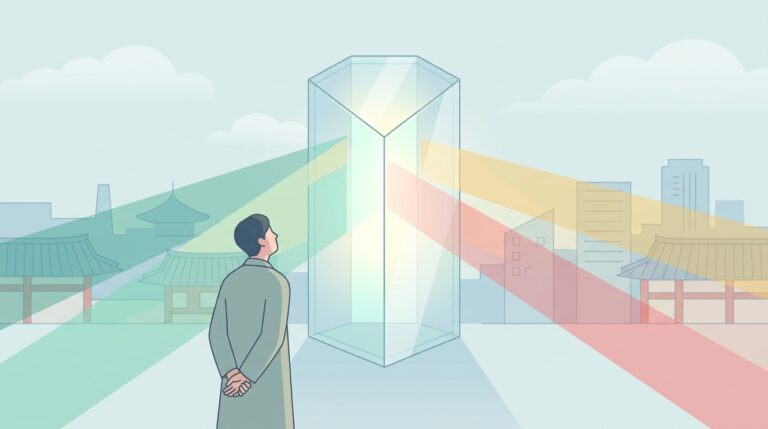
Master Advanced Korean Logic: How to Debias Your Conversations Like a Native
안녕하세요! Welcome back to Daily Hangul, your premium space for mastering not just the Korean language, but the intricate cultural soul behind it. I’m your head editor, and today we are diving deep into the intellectual stratosphere of Korean communication: Logic & Critique (논리와 비판).
Have you ever found yourself in an intense discussion in Korean—perhaps arguing about the intricate ending of a K-drama like Twenty-Five Twenty-One or discussing modern societal shifts over a cup of filter coffee in Hapjeong—and felt your linguistic tools fall short of your sharp analytical thoughts? Or worse, have you realized mid-debate that you’ve fallen into a cognitive trap, but lacked the sophisticated Korean phrasing to gracefully pull back and say, “Let’s check our biases”?
At the C2 (Advanced) level, fluency is no longer just about grammatically correct sentences; it is about cognitive empathy and intellectual agility. Today, we are training your brain to spot and dismantle Confirmation Bias (확증 편향) in Korean, ensuring you sound deeply logical, culturally empathetic, and incredibly articulate. Let’s elevate your Korean reasoning to the master level!
Phase 2: Core Expressions for Logical Debias
To think critically in Korean, you need more than simple negation. You need precise, nuanced tools. Here are three crucial expressions to help you navigate cognitive biases.
1. 확증 편향 (Hwak-jeung Pyeon-hyang)
- Pronunciation: [hwak-jeung pyeon-hyang] (Sounds like “hwahk-jeung pyun-hyahng”)
- Meaning: Confirmation Bias (seeking only information that aligns with one’s beliefs).
- K-Culture Moment: You will hear this term frequently on Korean intellectual talk shows like Ssuljeon (썰전) or in highly analytical YouTube video essays dissecting social phenomena.
- Editor’s Insight: This is a purely academic term that has successfully migrated into everyday intellectual discourse among young adults in Korea. Use it to gracefully point out when a discussion is becoming too one-sided without sounding confrontational.
- Situation Spectrum: Casual (⚠️ – too heavy for light banter) | Semi-formal (✅) | Formal (✅)
- 🤔 Think About It: Does your native culture address cognitive biases openly in casual debates, or is it reserved for academic settings?
2. 선입견을 깨다 (Seon-ip-gyeon-eul Kkae-da)
- Pronunciation: [seon-ip-gyeon-eul kkae-da] (Sounds like “sun-ip-gyun-ul kkae-dah”)
- Meaning: To shatter preconceived notions / To break prejudices.
- K-Culture Moment: Used when a K-pop idol breaks stereotypes (e.g., demonstrating incredible vocal prowess despite being labeled “just a visual”) or when an indie film subverts traditional Korean narrative tropes.
- Editor’s Insight: 선입견 (preconceived notion) is slightly different from 편견 (prejudice/bias). 선입견 refers to the initial, unverified lens through which you view something. “깨다” (to break/shatter) adds an active, intellectual dynamism to your statement.
- Situation Spectrum: Casual (✅) | Semi-formal (✅) | Formal (✅)
- 🤔 Think About It: What is one major 선입견 people outside of Korea have about contemporary Korean society that you love to shatter?
3. 역지사지 (Yeok-ji-sa-ji)
- Pronunciation: [yeok-ji-sa-ji] (Sounds like “yuck-jee-sah-jee”)
- Meaning: Putting yourself in another’s shoes (Traditional four-character idiom: 易地思之).
- K-Culture Moment: A staple phrase in Korean family dramas when an elder tries to mediate a conflict between siblings, or in business negotiations when finding a middle ground.
- Editor’s Insight: This is the ultimate linguistic shield in Korean debates. By invoking 역지사지, you show that you are not just trying to win the argument, but are actively practicing intellectual empathy—a highly valued trait in Korea’s collectivist-rooted intellectual culture.
- Situation Spectrum: Casual (✅) | Semi-formal (✅) | Formal (✅)
- 🤔 Think About It: How does utilizing a traditional Chengyu/Sajaseong-eo (사자성어) elevate your perceived logical standing in your own language?
Phase 3: Textbook Korean vs. Real-Life Logic
When we learn debate in textbooks, the phrases can sound cold or overly combative. To avoid confirmation bias, you must sound cooperative, not defensive.
Situation 1: Gently challenging someone’s biased stance
- 📖 Textbook Style: “당신의 의견은 틀렸습니다. 확증 편향입니다.” (Your opinion is wrong. It is confirmation bias.)
- 🗣️ Real-Life Logic: “그렇게 보실 수도 있겠네요. 하지만 우리가 특정 단면만 보고 있는 건 아닐지 자문해 볼 필요가 있어요.” (I see how you could view it that way. However, we might need to ask ourselves if we are only looking at one specific side of the coin.)
- 💡 Why the Difference? Calling someone out directly in Korean can shut down the conversation instantly. Using soft qualifiers like “~지 않을지” (whether or not) and “자문해 볼 필요가 있다” (need to ask ourselves) invites joint reflection.
Situation 2: Admitting your own biased perspective
- 📖 Textbook Style: “내가 오해했습니다.” (I misunderstood.)
- 🗣️ Real-Life Logic: “제가 너무 한쪽 방향으로만 생각의 가닥을 잡았던 것 같아요. 역지사지로 다시 짚어봐야겠네요.” (I think I was leaning too heavily in one direction. I should look at it again from another perspective.)
- 💡 Why the Difference? “생각의 가닥을 잡다” (to thread/weave one’s thoughts) is a beautiful, advanced idiomatic expression that shows deep self-awareness and linguistic elegance.
Phase 4: K-Culture Deep-Dive & Non-Verbal Manners
4-1. The Body Language of Intellectual Humility
In Korean culture, logical sharpness must be balanced with relational harmony. When engaging in a debate to avoid confirmation bias:
* The Head Tilt and Nod: Before introducing a counter-argument, nod slightly and tilt your head by about 5 degrees. This non-verbal cue signals: “I am actively processing your logic, not just waiting for my turn to speak.”
* Avoid Pointing: Never point with your index finger when highlighting a logical flaw. Instead, use an open palm facing upward to refer to the other person or their points. This keeps the atmosphere collaborative.
* Tone Softeners (어조 조절): Keep your pitch low. Rapid, high-pitched delivery in Korean debates is perceived as emotional instability rather than intellectual passion.
4-2. The “Nate Pann” and Debate Show Culture
Korea is a highly digitalized, discourse-driven society. Platforms like Nate Pann (네이트판) or Everytime (에브리타임) are famous for passionate, sometimes hyper-biased debates. To survive and thrive in these spaces (or when discussing them with Korean friends), you must master the art of being “팩트 기반” (fact-based) while respecting “심증” (circumstantial/emotional evidence). Koreans highly appreciate when a speaker can dissect internet groupthink by pointing out the “필터 버블” (Filter Bubble) without sounding patronizing.
Phase 5: Live Roleplay – The Hapjeong Book Club (합정 북클럽)
Setting: A cozy, warm-lit book cafe in Hapjeong, Seoul. Rain is tapping gently on the window. You are sitting with Min-woo (민우), a sharp but polite Korean graduate student, discussing a controversial social essay.
민우: 요즘 미디어를 보면 다들 자기 보고 싶은 것만 보고 믿는 것 같아요. 세상이 점점 양극화되는 느낌이랄까요?
      (Yo-jeum mi-di-eo-reul bo-myeon da-deul ja-gi bo-go sip-eun geot-man bo-go min-neun geot gat-a-yo. Se-sang-i jeom-jeom yang-geuk-hwa-doe-neun neu-kkim-i-ral-kka-yo?)
      "Looking at media these days, everyone seems to see and believe only what they want. It feels like the world is becoming increasingly polarized."

You: 🎭 (Nodding thoughtfully, open palm)
     맞아요, 민우 씨. 그게 바로 전형적인 '확증 편향'의 메커니즘이 아닐까 싶어요.
     (Mat-a-yo, Min-woo ssi. Geu-ge ba-ro jeon-hyeong-jeok-in 'hwak-jeung pyeon-hyang'-ui me-keo-ni-jeum-i a-nil-kka sip-eo-yo.)
     "Exactly, Min-woo. I suspect that is the classic mechanism of 'confirmation bias.'"

민우: 🎭 (Leaning in, intrigued)
     확증 편향이요? 확실히 알고리즘이 우리를 그런 확신에 가두는 주범이겠죠? 다른 정보는 아예 차단되니까요.
     (Hwak-jeung pyeon-hyang-i-yo? Hwak-sil-hi al-go-ri-jeum-i u-ri-reul geu-ren hwak-sin-e ga-du-neun ju-beom-i-get-jyo? Da-reun jeong-bo-neun a-ye cha-dan-doe-ni-kka-yo.)
     "Confirmation bias? Surely the algorithm is the main culprit trapping us in those convictions, right? Since other information is completely blocked off."

You: 🎭 (Softening the counter-argument with a gentle smile)
     물론 알고리즘의 영향도 크지만, 우리 스스로가 '선입견을 깨려는' 노력을 멈춘 탓도 있지 않을까요?
     (Mul-ron al-go-ri-jeum-ui yeong-hyang-do keu-ji-man, u-ri seu-seu-ro-ga 'seon-ip-gyeon-eul kkae-ryeo-neun' no-ryeo-geul meom-chun tat-do it-ji a-nil-kka-yo?)
     "Of course, the algorithm plays a huge part, but shouldn't we also consider if we ourselves have stopped trying to break our own preconceived notions?"

민우: 🎭 (Slightly taken aback but deeply reflective)
     아... 우리가 스스로 눈을 가리고 있었다는 말씀이시네요. 하지만 가끔은 반대 의견을 들으면 화부터 나는 걸요.
     (Ah... u-ri-ga seu-seu-ro nun-eul ga-ri-go is-seot-da-neun mal-sseum-i-si-ne-yo. Ha-ji-man ga-kkeum-eun ban-dae ui-gyeon-eul deu-reu-myeon hwa-bu-teo na-neun geol-yo.)
     "Ah... so you're saying we are blinding ourselves. But honestly, sometimes hearing opposing views just makes me frustrated right away."

You: 🎭 (Putting down your coffee cup gently)
     그 감정도 정말 자연스러운 거예요. 그래서 옛날 선조들도 '역지사지'라는 지혜를 그토록 강조했나 봅니다.
     (Geu gam-jeong-do jeong-mal ja-yeon-seu-ro-un geo-ye-yo. Geu-rae-seo yet-nal seon-jo-deul-do 'yeok-ji-sa-ji'-ra-neun ji-hye-reul geu-to-rok gang-jo-haet-na bom-ni-da.)
     "That feeling is completely natural. That must be why our ancestors emphasized the wisdom of 'Yeok-ji-sa-ji' (putting oneself in others' shoes) so much."

민우: 🎭 (Smiling warmly, raising his cup for a toast)
     와, 역시 대화가 깊어지니까 제 편협한 생각의 틀이 깨지는 기분이에요. 다음 책 토론도 기대되네요!
     (Wa, yeok-si dae-hwa-ga gip-eo-ji-ni-kka je pyeon-hyeop-han saeng-gak-ui teul-i kkae-ji-neun gi-bun-i-e-yo. Da-eum chaek to-ron-do gi-dae-doe-ne-yo!)
     "Wow, as our conversation deepens, I feel the rigid frame of my narrow thoughts shattering. I'm looking from a fresh perspective now!"
🔀 Interactive Choice Point
How would you respond to Min-woo’s final comment to maintain this highly intellectual, debiased conversation?
* Option A: “제 논리가 좀 무결하긴 하죠? 다음에도 가르쳐 드릴게요.” (My logic is quite flawless, right? I’ll teach you again next time.)
* Option B: “저도 오늘 민우 씨 덕분에 세상을 바라보는 시야가 한층 더 넓어진 느낌이에요.” (I also feel like my perspective on the world has broadened significantly today, thanks to you, Min-woo.)
* Option C: “맞아요, 사람은 늘 토론을 해야 바보가 안 돼요.” (True, people need to debate constantly so they don’t become foolish.)
💡 Feedback:
- Option A (Bad): High risk of sounding arrogant. Destroys the relational harmony (인간관계) built during the conversation.
- Option B (Best): Perfect C2 level humility. It reaffirms the collaborative nature of logical inquiry and avoids self-complacency.
- Option C (Risk): A bit too blunt and preachy. Might make Min-woo feel subtly insulted.
Phase 6: 10-Second Emotional Shadowing Drill
To sound naturally objective, your pacing must be calm, reflective, and deliberate. Practice this sentence with the indicated emotional pauses.
“내가 맞다는 생각만 하다 보면, / 정작 중요한 / 본질을 놓치기 마련이니까요.”
[Nae-ga mat-da-neun saeng-gak-man ha-da bo-myeon, / jeong-jak jung-yo-han / bon-jil-eul not-chi-gi mae-ryeon-i-ni-kka-yo.]
- Tone Marker:
[😌 Calmly, with deep, warm contemplation] - Chop Guide:
- 내가 맞다는 생각만 하다 보면, (Pause for breath, let the listener absorb the premise)
- 정작 중요한 (Slightly slower, emphasizing “truly important”)
- 본질을 놓치기 마련이니까요. (Drop your pitch at the end for a authoritative yet gentle conclusion)
- English Translation: “Because if we only focus on being right, we are bound to miss the actual core essence.”
Phase 7: K-Culture Mini Dictionary
- 내로남불 (Nae-ro-nam-bul):
- Meaning: “Double standard.” (Literal shortcut for: 내가 하면 로맨스, 남이 하면 불륜 – If I do it, it’s romance; if others do it, it’s an affair).
- Usage: Use this to mock hypocritical biases in public discourse or politics.
- 팩폭 (Paek-pok):
- Meaning: “Fact violence” (Fact Bombing).
- Usage: When someone dismantles a biased narrative with brutal, undeniable empirical data.
- 일반화의 오류 (Il-ban-hwa-ui o-ryu):
- Meaning: Overgeneralization fallacy.
- Usage: Crucial for C2 debates to point out when someone uses a single anecdote to paint an entire demographic.
- 필터 버블 (Pil-teo Beo-beul):
- Meaning: Filter Bubble.
- Usage: Highly used in modern Korean essays discussing algorithms and media polarization.
Phase 8: The Intellectual Traveler’s Survival Kit
Survival Expressions TOP 3
- “혹시 제가 놓치고 있는 다른 측면이 있을까요?”
- [Hok-si je-ga not-chi-go is-neu-n da-reun cheung-myeon-i is-seul-kka-yo?]
- Pro Tip: Use this to preemptively bypass your own confirmation bias in academic or business meetings.
- “성급한 일반화일 수도 있으니 조심스럽네요.”
- [Seong-geup-han il-ban-hwa-il su-do is-seu-ni jo-sim-seu-reop-ne-yo.]
- Pro Tip: A sophisticated way to say “I don’t want to make a hasty generalization.”
- “다각도로 분석해 봐야 할 문제입니다.”
- [Da-gak-do-ro bun-seok-hae bwa-ya hal mun-je-im-ni-da.]
- Pro Tip: Perfect for formal presentations or advanced Korean interviews.
🗺️ Editor’s Travel Note: If you want to experience the intellectual hub of Seoul, head over to the indie bookshops near Hapjeong or the Kyobo Book Centre in Gwanghwamun. Use the Naver Map App Download to find cozy “북카페” (Book Cafes) where you can sit down and read modern Korean philosophical essays. (Note: Travel app interface layouts may vary by OS update).
Phase 9: Deep Dive Essay – “Jeong” meets “Iseong” (정과 이성의 조화)
Traditional Korean society is heavily anchored in 정 (Jeong – emotional attachment and communal warmth). However, modern Korea is a hyper-speed, highly educated meritocracy that demands fierce logical clarity, or 이성 (Iseong – reason). When practicing logic in Korea, remember that cold, Western-style analytical deconstruction can sometimes feel alienating if it is not wrapped in relational warmth. Avoiding confirmation bias in Korean is not just a personal intellectual exercise; it is an act of communal respect. By actively showing that you are willing to break your own preconceptions (선입견을 깨다), you build a bridge of trust with your conversational partner.
💬 Your Turn: Have you ever noticed your own biases changing after learning a new language? Leave a comment below and let’s discuss!
Phase 10: FAQ & Common Mistakes
Q: What is the difference between ‘틀리다’ and ‘다르다’?
A: This is the most common mistake even native Koreans make when they are biased! 틀리다 means “to be wrong (factually incorrect)”, while 다르다 means “to be different”. In debates, saying “내 의견이랑 틀리네요” (Your opinion is wrong compared to mine) when you actually mean “다르네요” (It is different) immediately exposes cognitive bias. Always use 다르다 for opinions!
Q: Is ‘역지사지’ appropriate for business meetings?
A: Absolutely. In fact, using historical Hanja-derived four-character idioms (사자성어) in business negotiations shows that you possess a high-class, educated grasp of the Korean language, instantly boosting your credibility.
Q: How can I sound objective without sounding detached?
A: Use relational sentence endings such as “~지 않을까 싶어요” (I suspect it might be…) or “~라는 생각도 드네요” (I also get the thought that…). This frames your logic as an invitation to explore, rather than an absolute dogma.
🚨 Common Mistakes Alert!
- Using “너는” (You are…): In Korean debates, attacking the person (Ad Hominem) with direct pronouns is highly offensive. Always focus on “의견” (the opinion) or “관점” (the perspective).
- Overusing “무조건” (Unconditionally/Absolutely): Saying “무조건 제 말이 맞아요” sounds incredibly biased and uneducated at a C2 level.
- Confusing ‘편견’ and ‘선입견’: While interchangeable to some, remember that 편견 has a negative, biased moral connotation (prejudice), whereas 선입견 simply refers to initial cognitive impressions. Use 선입견 for a softer intellectual critique.
Phase 11: Action Missions
- 🥉 Bronze Mission: Write a 3-sentence diary entry in Korean about a minor bias you had today, using the word 선입견.
- 🥈 Silver Mission: Share this post on your social media or with your study group, and write down your definition of 역지사지 in Korean.
- 🥇 Gold Mission: Next time you watch a K-drama talk show or news debate, try to spot if the speakers are utilizing emotional arguments or logical arguments. Write a short paragraph in Korean analyzing their logic!
Phase 12: Interactive Quiz Challenge
Test your cognitive agility with this quick advanced check!
Q1. Choose the most polite and logically sound response when your friend expresses a highly biased opinion.
- A) 그건 전형적인 내로남불이네요.
- B) 사람의 의견은 다 다르니까요. 다만 다른 각도에서 볼 수 있는 여지도 있지 않을까요?
- C) 생각이 틀리셨어요. 다시 공부하고 오세요.
Q2. Fill in the blank with the correct term:
“우리는 보고 싶은 것만 보고 믿는 ( )에 빠지지 않도록 항상 스스로 성찰해야 합니다.”
Q3. True or False:
In Korean, saying “틀리다” is the best way to point out that someone has a different perspective from yours.
🔍 Check the Answers & Explanations!
- A1: B (It beautifully validates the difference in opinion while gently introducing the need for multi-angle analysis, bypassing confirmation bias without sounding condescending).
- A2: 확증 편향 (Hwak-jeung pyeon-hyang) (Confirmation bias fits perfectly into the cognitive context of seeing and believing only what we want).
- A3: False (Saying “틀리다” implies the other person is morally or factually incorrect. To maintain debiased and civilized discourse, you must use “다르다” – to be different).







