

Phase 1: 공감 (스토리 몰입형 오프닝)
안녕하세요! Welcome back to Daily Hangul. I’m your senior editor and cultural navigator, ready to guide you through the beautiful, sometimes complex layers of Korean life.
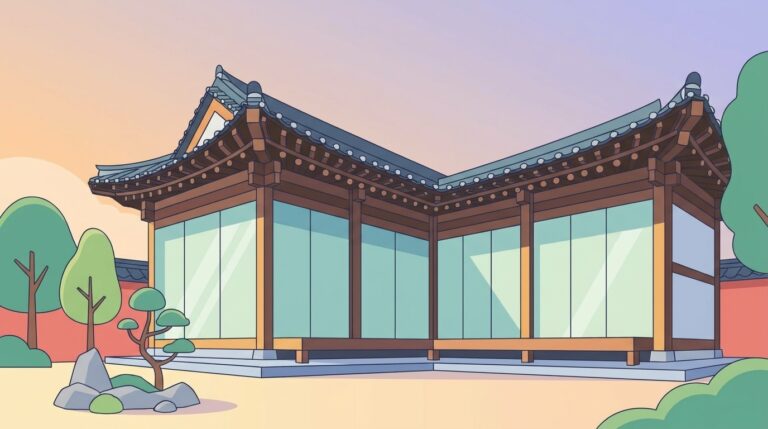
Have you ever caught yourself staring at a K-Drama scene where the protagonist sips tea in a breathtaking Hanok (ᔅᅩᄀ), watching rain cascade off the dark-tiled roof, and thought: “I want to live there”? You are definitely not alone. Many of our advanced learners who dream of relocating to or investing in Korea eventually fall in love with the idea of building a modern Hanok (현대식 한옥)—a gorgeous hybrid combining traditional structural timber with state-of-the-art double glazing and underfloor heating.
But here comes the reality check that every prospective builder faces: “How much is this actually going to set me back?” (현대식 한옥 건축 비용). When you start dealing with Korean contractors, master carpenters, and local district offices, standard textbook Korean simply won’t cut it. Today, we’re going beyond basic vocabulary to explore the actual financial terms, architectural nuances, and cultural negotiation skills you need to talk money like a seasoned local.
Phase 2: 핵심 표현 3선 심층 분석
To navigate the complex world of Korean construction, you need to master the terms that real builders use daily. Here are the top three expressions you must know:
1. 평당 단가 (펴ᄄ다ᄁ 다가)
- Pronunciation: pyeong-dang dan-ga (Sounds like “pyung-dahng dahn-gah”)
- Meaning: Unit cost per pyeong (approximately 3.3 square meters).
- K-Culture Moment: If you watch Korean reality shows focused on home building and real estate, like Save Me! Holmes (구해줘! 홈즈), you’ll hear this term constantly. Whenever someone wants to remodel or build a house, the first question is always: “평당 단가가 어떻게 돼요?” (What is the unit cost per pyeong?)
- Editor’s Insight: Traditional Hanoks require high-quality, aged wood (often domestic red pine, 래소ᄁ), which is hand-carved by master carpenters (도펴노서). This makes the pyeong-dang dan-ga of a Hanok significantly higher (often 1.5x to 2x) than a standard western-style concrete house.
- Situation Spectrum: Casual (✅) / Semi-formal (✅) / Formal (✅)
- ፔ Think About It: How does measuring living spaces in pyeong (based on the space one adult can comfortably lie down in) rather than square meters or feet shift your perspective on home layout design?
2. 배보다 배꼽이 더 크다 (배보다 배꼬버ᅵ 더 드다)
- Pronunciation: bae-boda bae-kkob-i deo keu-da (Sounds like “bae-boh-dah baek-kob-ee duh kuh-dah”)
- Meaning: “The belly button is bigger than the stomach” (Korean equivalent of “the tail wagging the dog” or auxiliary costs exceeding the main investment).
- K-Culture Moment: Used by homeowners when the basic structural cost of a Hanok seems reasonable, but the specialized permits (랴허가) and site preparation (토뵤ᄀ고ᄀ사) end up costing a fortune.
- Editor’s Insight: When building a modern Hanok, the wood frame might be affordable, but because it’s a traditional structure, you may need a specialized cultural heritage review or custom-engineered insulation. In these cases, builders sigh and say, “이러다간 배보다 배꼽이 더 크겠어요.” (At this rate, the extra costs will outgrow the house itself.)
- Situation Spectrum: Casual (✅) / Semi-formal (✅) / Formal (☀ – Use with caution in highly formal contract signings, but perfect for negotiations)
- ፔ Think About It: Have you ever experienced a “belly button bigger than the stomach” situation when budgeting for a major life event or project?
3. 평기와 vs. 수입기와 (펴ᄃ기ᅥᅡ vs. 수리ᄑ기ᅥᅡ)
- Pronunciation: pyeong-gi-wa vs. su-ip-gi-wa (Sounds like “pyung-ghee-wah” vs. “soo-ip-ghee-wah”)
- Meaning: Traditional flat clay tiles vs. imported/composite roof tiles.
- K-Culture Moment: Roofline aesthetics (로ᄄ바루) define the “soul” of a Hanok. Choosing the right tile is the peak point of discussion in modern architectural design forums in Korea.
- Editor’s Insight: Traditional hand-fired clay tiles (하ᄂ시ᄀ기ᅥᅡ) are gorgeous but heavy and incredibly expensive. Modern builders often recommend lightweight, imported composite tiles (su-ip-gi-wa) to save on load-bearing structural costs while maintaining that classic silhouette.
- Situation Spectrum: Casual (✅) / Semi-formal (✅) / Formal (✅)
- ፔ Think About It: Does substituting modern materials in heritage architecture compromise its authenticity, or is it a necessary evolution?
Phase 3: 교과서 한국어 vs 진짜 한국어
When you talk to contractors in Korea, textbook sentences will make you sound like a tourist. Let’s look at how to sound like a local project manager.
Situation 1: Asking if a tight budget is realistically feasible.
- ቀ Textbook: “이 예산으로 건축이 가능합니까?” (I ye-san-euro geon-chuk-i ga-neung-hap-ni-ka? – “Is construction possible with this budget?”)
- ቒ 진짜 한국어: “이 예산으로 선을 맞출 수 있을까요?” (I ye-san-euro seon-eul mat-chul su is-seul-kka-yo? – “Can we meet the line/make it work within this budget limit?”) or site-level slang: “이 예산으로 쇼부가 날까요?” (I ye-san-euro syo-bu-ga nal-kka-yo? – “Can we settle a deal with this budget?”)
- ᄃ Why? “선을 맞추다” (to meet the line) is a sophisticated way of asking if the budget and quality can align without compromise. “쇼부(를) 보다” (from Japanese shobu, meaning to settle/decide) is a very common colloquial term used by contractors on construction sites.
Situation 2: Expressing shock at escalating costs.
- ቀ Textbook: “비용이 생각했던 것보다 너무 비쌉니다.” (Bi-yong-i saeng-gak-haet-deon geot-boda neo-mu bi-ssap-ni-da. – “The cost is much more expensive than I thought.”)
- ቒ 진짜 한국어: “이러다 기둥뿌리 뽑히겠어요!” (I-reo-da gi-dung-ppu-ri ppop-hi-ges-seo-yo! – “At this rate, the house’s foundation pillars will be pulled out!”)
- ᄃ Why? Since traditional Hanoks are supported by heavy timber pillars (gi-dung), saying you are going to “pull out the pillars” is the ultimate Korean idiom for going completely broke. It adds a touch of dramatic, culturally-rooted humor that instantly breaks the ice with contractors.
Phase 4: K-Culture 딥다이브 & 비언어적 매너
4-1. 눈치 (Nunchi) & Negotiating Etiquette
When negotiating Hanok construction costs with a veteran master builder (도펴노서), never flatly reject a price by saying “That’s too expensive.” Traditional artisans take immense pride in their craft. Instead, utilize the “Soft Sigh and Tilt”:
1. Look down slightly at the quotation.
2. Tilt your head to the side gently.
3. Take a soft breath and say: “아… 생각했던 예산이랑 갭이 좀 크네요…” (Ah… there’s quite a gap from the budget I had envisioned…).
This signals that you respect their value but need them to help you find a compromised solution (like alternative timber).
4-2. The Cultural Philosophy of Hanok Space
Modern Hanok design is defined by the balance between “비움의 미학” (The Aesthetics of Emptiness) and modern comfort. In the past, Hanoks were drafty and required constant maintenance. Today’s modern Hanok incorporates structural laminated timber (글루램) to prevent warping and utilizes high-performance insulation. Understanding this integration shows builders that you don’t just want a “pretty house,” but that you respect the structural evolution of Korean architecture.
Phase 5: 실전 롤플레이 시나리오
Meet Sarah, an expat architect who wants to build a compact 20-pyeong modern Hanok in the gorgeous Eunpyeong Hanok Village (은평한옥마을). She is meeting Mr. Kim, a veteran Hanok construction manager, to discuss the initial estimate.
- Sarah: “김 소장님, 은평 한옥마을에 20평 규모로 현대식 한옥을 지으려고 하는데, 대략적인 평당 단가가 어떻게 될까요?”
- Mr. Kim: “하하, 은평 한옥마을이군요! 거기는 지구단위계획 심의 기준이 까다로워서 기본적으로 평당 천이백만 원은 잡으셔야 해요. 자재를 뭐 쓰느냐에 따라 천차만별이고요.”
- Sarah: “천이백만 원이요? ፀ (눈이 휘둥그레지며) 생각보다 시작가가 엄청 세네요. 목재는 주로 어떤 걸 쓰나요?”
- Mr. Kim: “전체 국산 육송을 쓰면 좋은데, 그러면 단가가 감당이 안 될 겁니다. 보통 북미산 더글라스 퍼를 섞어 쓰면 비용을 좀 세이브할 수 있죠.”
- Sarah: “아, 수입 목재를 섞어서 단가를 낮추는 거군요. 그럼 지붕 기와나 창호 쪽은 어때요? 거기서 배보다 배꼽이 더 커지는 건 아닌지 걱정돼요.”
- Mr. Kim: “ፀ (허허 웃으며) 정확히 보셨네요! 전통 창호는 단열이 안 돼서 시스템 유리창을 꼭 덧대야 하거든요. 거기서 돈이 엄청 깨집니다.”
- Sarah: “역시 현대식 생활을 하려면 창호 단열이 관건이군요. 진짜 기둥뿌리 안 뽑히려면 세부 견적서를 아주 꼼꼼히 봐야겠어요.”
- Mr. Kim: “그럼요. 저도 최대한 조율해 볼 테니, 다음 미팅 때 자세한 내역서 보고 이야기 나누시죠.”
ᕀ 인터랙티브 분기점: What should Sarah say next?
- A) “그냥 제일 저렴한 수입 자재로 전부 깔아주세요.” (Just cover everything in the cheapest imported materials.)
- B) “네, 평당 천만 원 초반대에서 절충할 수 있는 자재 대안 리스트를 같이 검토해 보고 싶어요.” (Yes, I’d like to review a list of alternative materials that can help us compromise around the low 10-million-won-per-pyeong mark.)
- C) “예산 초과네요. 깎아주지 않으시면 다른 업체 알아보겠습니다.” (This is over budget. If you don’t lower the price, I’ll look for another company.)
ᕕ Selection Feedback:
- Feedback A (Bad): Going too cheap ruins the architectural integrity of a Hanok, and the local district office might reject your design during the mandatory review process!
- Feedback B (Best): This shows you understand the budget boundaries while respecting the builder’s expertise. It invites collaborative problem-solving.
- Feedback C (Risk): Veteran Hanok master builders are highly sought after. Threatening them with “taking your business elsewhere” too early might burn a bridge with a highly skilled artisan.
Phase 6: 10초 감정 섀도잉 드릴
Let’s practice speaking with real native emotional cadence. Pay attention to the pauses (/) and the emotional markers!
- “생각보다 / 시작가가 / 엄청 세네요!”
- [ሕ 아쉽고 짐짓 당황스럽게 – Sounding slightly taken aback but polite]
- Saeng-gak-bo-da / si-jak-ga-ga / eom-cheong se-nae-yo!
- “여기서 / 배보다 배꼽이 / 더 커지는 거 아닌가요?”
- [ሒ 의심스럽고 매서운 눈초리로 – Sounding sharp, questioning the hidden costs]
- Yeo-gi-seo / bae-bo-da bae-kkob-i / deo keo-ji-neun geo an-in-ga-yo?
- “기둥뿌리 안 뽑히려면 / 견적을 잘 봐야겠어요.”
- [ቁ 다짐하듯 웃으며 – Laughing lightly, showing you are a smart customer]
- Gi-dung-ppu-ri an ppop-hi-lyeo-myeon / gyeon-jeok-eul jal bwa-ya-get-eo-yo.
Phase 7: K-Culture 미니 사전 (핵심 키워드 4개)
- 도편수 (Do-pyeon-su) | Master Carpenter
- The chief architect who hand-carves the wooden joinery of a Hanok without using nails. They hold immense prestige in Korea.
- 심의 (Sim-ui) | Architectural Review
- The official municipal screening process. Because Hanok conservation is heavily regulated, your modern Hanok plans must pass strict historic and aesthetic guidelines.
- 창호 (Chang-ho) | Hanok Windows & Doors
- Traditional wooden frames covered in mulberry paper (Hanji). In modern Hanoks, double-pane glass is integrated behind them for energy efficiency.
- 평 (Pyeong) | Pyeong
- The traditional unit of area (approx. 3.3 square meters). Knowing your target house size in pyeong is the absolute baseline of Korean real estate conversations.
Phase 8: 여행자를 위한 생존 키트
Even if you aren’t building a Hanok today, you will definitely stay in one! Here are the survival phrases for your next boutique Hanok stay:
- “한옥 체험 하루 숙박비가 얼마인가요?”
- Hanok che-heom ha-ru suk-bak-bi-ga eol-ma-in-ga-yo?
- “How much is the nightly rate for the Hanok stay experience?”
- “방에 보일러 온도를 어떻게 조절하나요?”
- Bang-e bo-il-leo on-do-reul eo-tteoh-ge jo-jeol-ha-na-yo?
- “How do I control the floor heating (boiler) temperature in the room?”
- “이 한옥은 언제 지어진 건물인가요?”
- I hanok-eun eon-je ji-eo-jin geon-mul-in-ga-yo?
- “When was this Hanok built?”
ᄒ Editor’s Travel Note: When navigating narrow Hanok alleyways in Bukchon or Eunpyeong, Google Maps often gets lost. Make sure to download the Naver Map App for real-time, highly accurate walking routes. Note: Operating hours and access regulations for Hanok villages may change seasonally, so check updates before visiting.
Phase 9: “한 발 더 깊이” (생각 질문)
The modern Hanok represents an intriguing cultural paradox. On one hand, it preserves the traditional Korean layout designed for community living and seasonal harmony (like the central open courtyard, Madang). On the other hand, modern Koreans demand high-speed internet, soundproofing, and flawless insulation. Building a modern Hanok is essentially a daily negotiation between preserving cultural heritage and enjoying modern, high-tech convenience.
ቕ Your Turn: If you were to build your own dream home in Korea, would you prioritize pure traditional aesthetics, or would you compromise with modern materials to save on costs? Let us know in the comments below!
Phase 10: FAQ & 오해 방지 (FAQ Schema)
Q: Is building a modern Hanok cheaper than building a standard western-style concrete house in Korea?
A: Absolutely not. Due to specialized carpentry labor (모서), structural timber procurement, and strict municipal building codes, building a modern Hanok is usually 1.5 to 2 times more expensive per pyeong than building a standard concrete house.
Q: Can foreigners legally purchase land and build a Hanok in Korea?
A: Yes! Registered foreigners can purchase land and build residential structures in Korea. However, obtaining the mandatory architectural review (시미) approval can be incredibly complex, so hiring a local architect specialized in Hanok design is highly recommended.
Q: Are there government subsidies available for building a modern Hanok?
A: Yes, many local governments (like the Seoul Metropolitan Government) offer significant grants and low-interest loans for building or restoring registered Hanoks in designated historical zones.
ᄐ 흔한 실수 (Common Mistakes) 경고판
- Assuming all timber is equal: Opting for the cheapest, unseasoned pine will lead to severe warping and cracking as the seasons change. Always budget for properly dried structural timber.
- Ignoring the “Sim-ui” (Review): Never purchase land in a Hanok conservation zone before ensuring your modern design can pass the local aesthetic guidelines.
- Underestimating the insulation budget: Standard traditional sliding doors leak heat. Skipping high-performance modern system windows will result in astronomically high heating bills in the winter.
Phase 11: 액션 미션 & 참여 유도
- Bronze Mission: Write a sentence in the comments using the idiom “배보다 배꼽이 더 크다” regarding a purchase you recently made!
- Silver Mission: Take a screenshot of your favorite modern Hanok design on Instagram, tag
@DailyHangul, and write why you like its roof structure in simple Korean. - Gold Mission: Search for “은평한옥마을 건축” (Eunpyeong Hanok Village Construction) on Naver or YouTube and spot if they mention 평당 단가 in their breakdown!
Phase 12: 인터랙티브 퀴즈 챌린지
Test your modern Hanok knowledge!
- Which term refers to the construction unit price per 3.3 square meters?
- A) 평당 단가
- B) 기둥뿌리
- C) 심의 기준
- True or False: Building a modern Hanok is generally cheaper than a western-style concrete house because it uses simple wood.
-
Fill in the blank: If auxiliary costs (like permits and site leveling) cost more than the wooden frame itself, it is a “배보다 배꼬버ᅵ 더 드다” situation.
በ Reveal the Answers & Explanations!
- Answer: A) 평당 단가 (Pyeong-dang dan-ga). This is the key metric contractors use to quote project costs.
-
Answer: False. Hanok construction is significantly more expensive due to specialized handcrafted joinery and premium structural timber.
-
Answer: 배보다 배꼽이 더 크다 (The belly button is bigger than the stomach). It’s the perfect idiom for hidden, bloated accessory costs!







