

Phase 1: Empathy (Welcome, My Friend!)
안녕하세요! (An-nyeong-ha-se-yo!) Hello! I’m your Daily Hangul editor and your personal Korean culture guide. Have you ever bought so many amazing K-pop albums, trendy Korean clothes, or delicious snacks in Seoul that your suitcase literally refused to close? We’ve all been there!
Your best solution is to head to the nearest Korean Post Office (우체국 – U-che-guk). But I know what you might be thinking: “What if the staff doesn’t speak English? How do I say ‘international shipping’? What if I fill out the wrong form?” Don’t worry! Sending a package back home in Korea is actually incredibly organized, safe, and fast—especially when you know a few golden phrases. Today, we’ll learn exactly what to say so you can ship your K-culture treasures home like a true local. Our previous students told us that practicing these A2-level phrases saved them so much time and anxiety. Let’s dive in!
Phase 2: Three Key Expressions Deep-Dive
1. 국제 택배 보내려고 하는데요. (Guk-je taek-bae bo-nae-ryeo-go ha-neun-de-yo.)
- Pronunciation: Gook-jeh taek-baeh bo-neh-ryuh-go ha-noon-deh-yo. (Sounds like: “Gook-jeh” as in international, “taek-baeh” like tech-bag without the ‘g’, and “bo-neh-ryeo-go ha-neun-de-yo” flowing smoothly like one soft wave.)
- Meaning: I’d like to send an international parcel.
- K-Culture Moment: You walk up to the counter in a clean, busy post office. The friendly officer smiles at you. You take a deep breath and say this phrase. It immediately tells them you need the international shipping service!
- Editor’s Insight: This uses the helper ending “~려고 하는데요” (~ryeo-go ha-neun-de-yo), which politely softens your request. It translates to “I intend to…,” leaving room for the listener to guide you. It sounds much friendlier than just saying “국제 택배 보내고 싶어요” (I want to send an international package).
- Situation Spectrum: Casual: 🚫 | Semi-formal: ✅ | Formal: ✅
- 🤔 Think About It: In your culture, do you state your goal immediately, or do you use polite softening phrases like “I was wondering if…”? Korean politeness heavily relies on these soft endings!
2. 안에 화장품이랑 과자가 들어 있어요. (An-e hwa-jang-pum-i-rang gwa-ja-ga deul-eo iss-eo-yo.)
- Pronunciation: Ahn-eh hwa-jang-pum-ee-rang gwa-jah-gah deul-uh eet-suh-yo. (Blend “pum-i-rang” as poo-mee-rang and “deul-eo” as deu-ruh.)
- Meaning: Inside, there are cosmetics and snacks.
- K-Culture Moment: In almost every K-drama where a character sends a care package to a friend studying abroad, they pack it full of Korean instant ramen, sweet snacks, and sheet masks!
- Editor’s Insight: You will always be asked what is inside the box for customs. The particle “~이랑” (~i-rang) means “and” for connecting nouns. If your noun ends in a consonant, use “이랑”; if it ends in a vowel, use “랑”.
- Situation Spectrum: Casual: ⚠️ | Semi-formal: ✅ | Formal: ✅
- 🤔 Think About It: Why do you think customs check is so strict? In Korea, safety and speed go hand-in-hand!
3. 제일 빠른 걸로 해 주세요. (Je-il ppa-reun geol-lo hae ju-se-yo.)
- Pronunciation: Jeh-eel ppah-reun guhl-loh heh joo-seh-yo. (Make sure to double the ‘p’ sound in “ppa-reun”—it’s a tense, strong sound!)
- Meaning: Please do it with the fastest option.
- K-Culture Moment: Korea is famous for its “Pali-Pali” (빨리빨리 – fast, fast) culture. If you want your K-beauty haul to arrive home before you even land, this phrase is your magic wand.
- Editor’s Insight: “제일” (je-il) means “the most” or “best,” and “빠른 걸로” (ppa-reun geol-lo) means “with the fast one.” This typically refers to EMS (Express Mail Service) in Korea.
- Situation Spectrum: Casual: 🚫 | Semi-formal: ✅ | Formal: ✅
- 🤔 Think About It: Does your home country prioritize speed or cost when shipping? Korea’s system is world-renowned for speed!
Phase 3: Textbook Korean vs. Real Korean
Let’s compare stiff textbook phrases with how real Koreans talk at the post office.
Situation 1: Selecting EMS (Express Shipping)
- 📖 Textbook Korean: “국제특급우편(EMS)으로 발송해 주십시오.” (Guk-je-teuk-geup-u-pyeon-eu-ro bal-song-hae ju-sip-si-o.)
- Translation: “Please dispatch it via International Express Mail Service (EMS).”
- 🗣️ Real Korean: “EMS로 보내 주세요.” (E-m-e-seu-ro bo-nae ju-se-yo.)
- Translation: “Please send it by EMS.”
- 💡 Why the difference? Nobody uses the full, heavy legal terms like “국제특급우편” in daily life unless it’s an official document. Just say “EMS”—everyone knows it!
Situation 2: Filling out the customs form
- 📖 Textbook Korean: “내용물의 품명과 수량을 기재해 주십시오.” (Nae-yong-mul-ui pum-myeong-gwa su-ryang-eul gi-jae-hae ju-sip-si-o.)
- Translation: “Please write down the name and quantity of the contents.”
- 🗣️ Real Korean: “여기에 안에 든 거 적어 주세요.” (Yeo-gi-e an-e deun geo jeog-eo ju-se-yo.)
- Translation: “Please write what’s inside here.”
- 💡 Why the difference? Clerks want to be helpful and quick. They will point at the tablet or paper and use simple, warm spoken language rather than bureaucratic terms.
Phase 4: K-Culture Deep-Dive & Non-Verbal Manners
4-1. Nunchi (눈치) & Handing Over the Box
When you present your box or your ID/payment card to the post office clerk, always hand it over using both hands. In Korea, using one hand for transactions can seem casual or even slightly impolite. By supporting your right wrist with your left hand, or holding the card with both hands, you show respect. Also, maintain friendly eye contact and give a small head bow when they accept your package. This is instant local etiquette!
4-2. The Korean Post Office Self-Service Station (포장대)
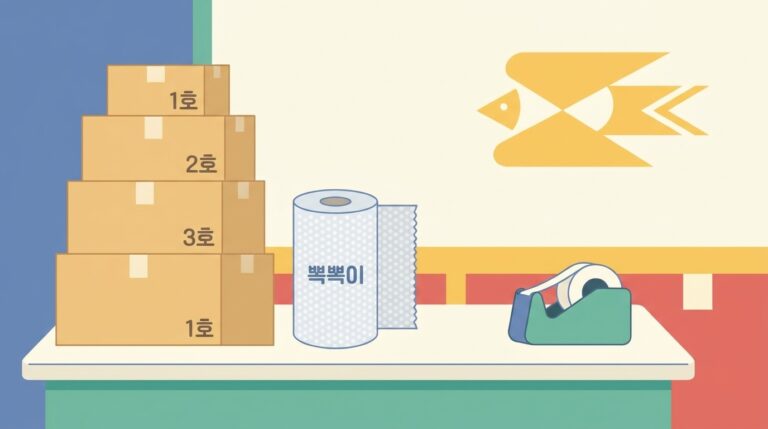
One of the coolest cultural shocks for travelers in Korea is the Packaging Station (포장대 – Po-jang-dae) inside every post office. You don’t need to bring your own tape, scissors, or bubble wrap! Korea provides a public table filled with:
1. Heavy-duty tape and tape dispensers.
2. Scissors and box cutters.
3. 뽁뽁이 (Bbok-bbok-i) – Bubble wrap (absolutely free to use for your items!).
4. Boxes of different sizes (Size 1 to 5) that you can buy for a very low price (usually 700 to 2,000 KRW).
You pack your own box at the station first, write down the address on the sticker, and then take a number ticket to go to the counter. It’s highly efficient and super satisfying!
Phase 5: Real Roleplay Scenario
Background: Alex is at the Seoul Central Post Office. He wants to send a heavy box of K-pop merchandise and Korean snacks to his home in the US. He meets Min-ji, a very kind post office clerk.
- Min-ji (Clerk): 어서 오세요! 번호표 먼저 보여주시겠어요?
(Eo-seo o-se-yo! Beon-ho-pyo meon-jeo bo-yeo-ju-si-gess-eo-yo?)
🎭 [Smiling warmly, pointing at the queue number ticket]
“Welcome! Could you show me your number ticket first?” -
Alex (Learner): 네, 여기요. 국제 택배 보내려고 하는데요.
(Ne, yeo-gi-yo. Guk-je taek-bae bo-nae-ryeo-go ha-neun-de-yo.)
🎭 [Politely handing over the ticket and pointing to his big box]
“Yes, here it is. I’d like to send an international parcel.” -
Min-ji (Clerk): 아, 미국으로 보내시는 건가요? 상자 저기 저울 위에 올려 주세요.
(A, mi-guk-eu-ro bo-nae-si-neun geon-ga-yo? Sang-ja jeo-gi jeo-ul wi-e ol-ryeo ju-se-yo.)
🎭 [Guiding Alex to the digital scale next to the counter]
“Ah, are you sending it to the US? Please place the box on the scale over there.” -
Alex (Learner): 네.
🎭 [Lifts the box with both hands and places it carefully on the scale]다 됐어요.
(Ne. Da dwaess-eo-yo.)
“Yes. It’s done.” -
Min-ji (Clerk): 안에 뭐 들어 있어요? 위험한 물건이나 배터리는 없나요?
(An-e mwo deul-eo iss-eo-yo? Wi-heom-han mul-geon-i-na bae-teo-ri-neun eop-na-yo?)
🎭 [Looking at the customs screen with a helpful expression]
“What is inside? Any dangerous items or batteries?” -
Alex (Learner): 화장품이랑 케이팝 앨범, 그리고 과자가 들어 있어요. 배터리는 없어요.
(Hwa-jang-pum-i-rang K-pop ael-beom, geu-ri-go gwa-ja-ga deul-eo iss-eo-yo. Bae-teo-ri-neun eop-seo-yo.)
🎭 [Speaking clearly while gesturing to the packed box]
“Cosmetics, K-pop albums, and snacks are inside. No batteries.” -
Min-ji (Clerk): 좋습니다. 항공편으로 하실 건가요, 선편으로 하실 건가요?
(Jo-seup-ni-da. Hang-gong-pyeon-eu-ro ha-sil geon-ga-yo, seon-pyeon-eu-ro ha-sil geon-ga-yo?)
“Great. Would you like to send it by airmail or sea mail?” -
Alex (Learner): 제일 빠른 걸로 해 주세요. EMS가 제일 빠르죠?
(Je-il ppa-reun geol-lo hae ju-se-yo. EMS-ga je-il ppa-reu-jyo?)
🎭 [Nodding eagerly with a smile]
“Please do it with the fastest option. EMS is the fastest, right?” -
Min-ji (Clerk): 네, 맞아요. EMS로 접수해 드릴게요. 여기에 서명해 주세요.
(Ne, maj-a-yo. EMS-ro jeop-su-hae deul-i-ge-yo. Yeo-gi-e seo-myeong-hae ju-se-yo.)
🎭 [Pointing to the electronic signature pad]
“Yes, that’s correct. I’ll register it as EMS. Please sign here.”
🔀 Choose Your Path!
Now, imagine the clerk asks: “카드결제 하실 건가요? (Would you like to pay by card?)” How do you respond?
- Option A: “아니요, 카드로 할게요.” (An-i-yo, ka-deu-ro hal-ge-yo.)
- Feedback (Risk): This is a bit confusing! You said “No (아니요)” but then said “I’ll pay by card (카드로 할게요)”. The clerk might get confused. Say “네, 카드로 할게요” (Yes, by card) instead!
- Option B: “네, 카드로 해 주세요.” (Ne, ka-deu-ro hae ju-se-yo.)
- Feedback (Best!): Perfect! You confirmed with “Yes (네)” and politely requested to pay by card. Smooth and natural!
- Option C: “돈 없어요.” (Don eop-seo-yo.)
- Feedback (Bad): Oh no! This means “I have no money.” The clerk will think you cannot pay for your parcel! Avoid this unless you actually forgot your wallet!
Phase 6: 10-Second Emotion Shadowing Drill
Let’s practice speaking with real Korean feelings. Pay attention to the pauses (/) and emotional cues!
- [😊 Friendly & Confident]
국제 택배 / 보내려고 하는데요.
(Guk-je taek-bae / bo-nae-ryeo-go ha-neun-de-yo.)
Target: Say it smoothly without pausing between “guk-je” and “taek-bae”. -
[😌 Calm & Reassuring]
배터리는 / 전혀 없어요.
(Bae-teo-ri-neun / jeon-hyeo eop-seo-yo.)
Target: Emphasize “jeon-hyeo” (not at all) to show you checked carefully! -
[🔥 Energetic & Decisive]
제일 빠른 걸로 / 해 주세요!
(Je-il ppa-reun geol-lo / hae ju-se-yo!)
Target: Put a little punch on “je-il” (the most) and “ppa-reun” (fast).
Phase 7: K-Culture Mini Dictionary
- 송장 (Song-jang) | Shipping Label / Waybill
- Usage: At the post office, you’ll hear “송장에 주소를 쓰세요” (Write the address on the shipping label). Nowadays, many offices use digital tablets to input addresses.
- 뽁뽁이 (Bbok-bbok-i) | Bubble Wrap
- Usage: This is a cute onomatopoeic word mimicking the popping sound of bubble wrap (“bbok bbok”). You can ask, “뽁뽁이 어디 있어요?” (Where is the bubble wrap?).
- 항공편 (Hang-gong-pyeon) | Airmail
- Usage: Literally “aviation flight”. Use this if you want quick delivery but EMS is slightly too expensive. It usually takes 1-2 weeks.
- 선편 (Seon-pyeon) | Sea mail / Surface mail
- Usage: Literally “ship flight”. It is very cheap but can take 2 to 3 months. Perfect for heavy books or winter clothes you don’t need immediately!
Phase 8: Traveler’s Survival Kit
Survival Expressions TOP 3
- “미국 주소 어떻게 적어요?” (Mi-guk ju-so eo-tteo-ke jeog-eo-yo?)
- Meaning: How do I write a US address?
- Pro Tip: Usually, you write the sender’s address in Korean/English, and the receiver’s address in English (or the destination country’s language) with the country name clearly marked in Korean (e.g., 미국 for USA, 영국 for UK).
- “상자 제일 작은 거 얼마예요?” (Sang-ja je-il ja-geun geo eol-ma-yeo-yo?)
- Meaning: How much is the smallest box?
- Pro Tip: Size 1 is the smallest and cheapest box, perfect for cosmetics or small items.
- “영수증 주세요.” (Yeong-su-jeung ju-se-yo.)
- Meaning: Please give me a receipt.
- Pro Tip: Keep the receipt because it has your tracking number (등기번호 – Deung-gi-beon-ho)!
🗺️ Editor’s Travel Note
To find the nearest post office, do not use Google Maps (it often has outdated locations in Korea). Instead, open the Naver Map App and type 우체국 (U-che-guk). It will show you the exact operating hours (usually Monday to Friday, 9:00 AM to 6:00 PM for mailing services). Most post offices only accept payments up to 5:50 PM, so make sure to arrive at least 30 minutes before closing!
Disclaimer: Postal rates and customs regulations change frequently. Please verify specific prohibited items at the counter before shipping.
Phase 9: “One Step Deeper” (Reflective Essay)
In Korea, the post office is not just a place of government business; it’s a symbol of trust and efficiency. The rapid rise of Korea’s e-commerce and the famous “Pali-Pali” (빨리빨리) culture mean that post offices function like high-speed machines. Yet, amidst this speed, you will find warmth. The free packaging tables, tape, and scissors are provided based on mutual trust that citizens will use them respectfully without wasting them. This mixture of high-tech organization and warm community sharing is uniquely Korean.
💬 Your Turn: How does sending mail in your country compare to Korea? Do you have free packaging stations? Let me know in the comments below!
Phase 10: FAQ & Avoiding Misunderstandings
Q: Can I send liquid items like Korean skincare toners or perfumes?
A: Perfumes and some alcohol-based products are strictly prohibited on airplanes due to flammability. Standard skincare creams and sheet masks are usually totally fine, but always double-check with the clerk!
Q: Do I need to write the address in Korean characters?
A: No! For international mail, you must write the destination country’s address in English so the local postal workers in your country can read it. However, write the destination country’s name in bold capital letters (e.g., USA, UK, GERMANY).
Q: Can I pay with a foreign credit card?
A: Yes! Visa, Mastercard, and other major foreign credit cards are widely accepted at all Korean post offices.
🚨 Common Mistakes Board
- Mistake: Putting power banks or items with lithium batteries in the box.
- Correct Action: Keep these in your carry-on luggage. They will be rejected at airport customs and sent back to the post office!
- Mistake: Going straight to the counter without packaging your box.
- Correct Action: Always go to the packing station, pack your items, tape the box, write your label, and then take a number ticket!
- Mistake: Writing the country name too small.
- Correct Action: Write the country name (e.g., CANADA, FRANCE) in huge letters at the bottom of the address label.
Phase 11: Action Mission & Engagement
🏆 Three-Step Challenge
- Bronze Medal: Read our Three Key Expressions out loud 3 times in front of a mirror.
- Silver Medal: Take a screenshot of the phrase “국제 택배 보내려고 하는데요” and save it as your phone wallpaper for your next trip to Korea.
- Gold Medal: Actually visit a Korean Post Office, pack a small box of snacks, and send it to your family using only Korean at the counter!
🎮 K-Culture Mission
Next time you watch a K-drama, keep an eye out for any scenes where characters are packing boxes. Look for the yellow-and-red post office boxes (with the swallow bird logo) and listen closely to see if they say 택배 (Taek-bae)!
Phase 12: Interactive Quiz Challenge
Test your new skills! Can you get 3/3?
1. What does “선편 (Seon-pyeon)” mean?
- A) Airmail
- B) Sea mail / Surface mail
- C) Overnight Express
2. Fill in the blank: “EMS가 제일 ______?” (Is EMS the fastest?)
- A) 비싸요 (expensive)
- B) 느려요 (slow)
- C) 빠르죠 (fast, right)
3. True or False: You have to bring your own scissors and tape to the Korean post office.
- A) True
- B) False
🎉 Click here to check the Answers & Explanations!
- Answer: B (Sea mail). “선” (Seon) refers to ships. It takes longer but is very wallet-friendly!
- Answer: C (빠르죠). “EMS가 제일 빠르죠?” means “EMS is the fastest, right?”.
- Answer: B (False). Korean post offices have awesome free self-packaging stations fully stocked with tape, scissors, and bubble wrap!
“, 200: 200,







