

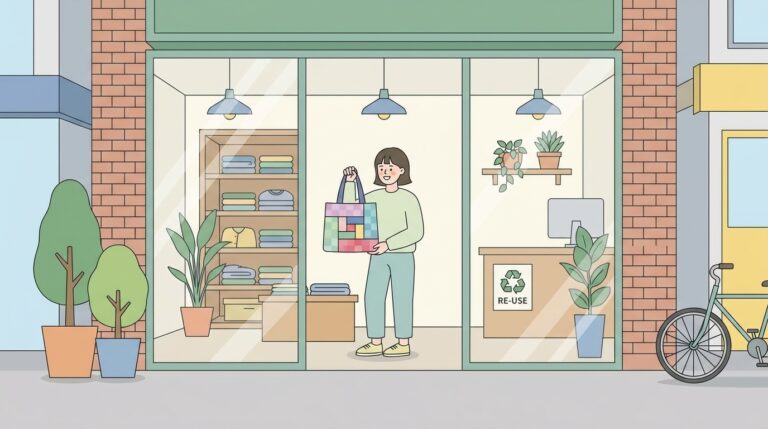
Saving the Planet in Style: Mastering Upcycled Shopping in Seoul (C1 Level)
안녕하세요! (An-nyeong-ha-se-yo!) I’m your senior editor and cultural guide from Daily Hangul. Have you ever walked through the ultra-hip streets of Seongsu-dong (성수동) or Yeonnam-dong (Yeon-nam-dong) and noticed those gorgeous, unique bags made from discarded truck tarps or chic accessories crafted from upcycled hanbok (traditional Korean clothing)?
In Korea, sustainability is no longer just a chore or a civic duty—it has evolved into a massive, trendy lifestyle movement known as ‘가치소비’ (Ga-chi-so-bi – Value-based/Ethical Consumption). While you might already know how to separate your plastics and food waste (분리수거 – bun-ri-su-geo), talking about ethical shopping and upcycled goods requires a sophisticated, nuanced vocabulary.
Today, we are going to dive deep into the world of K-Upcycling (새활용 – Sae-hwal-yong). This guide is crafted for C1-level learners who want to move past basic transactions and have meaningful, intellectually stimulating conversations with local eco-designers, trendsetters, and boutique owners. Let’s elevate your Korean to a level that truly reflects your values!
Phase 2: 3 Key Expressions Deep Dive
1. 가치소비를 실천하다 (Ga-chi-so-bi-reul sil-cheon-ha-da)
- Pronunciation: [gah-chee-so-bee-reul sheel-cheon-hah-dah]
- Meaning: To practice value-based / conscious consumption.
- K-Culture Moment: You will hear this phrase constantly on Korean lifestyle shows, independent YouTube vlogs focusing on minimalism, and read it in trendy magazine articles profiling eco-conscious Gen Z consumers.
- Editor’s Insight: While ‘소비’ (so-bi) means consumption, prefixing it with ‘가치’ (value) elevates it to an ethical statement. ‘실천하다’ (to practice/put into action) is a formal verb that shows you are active in your beliefs, rather than just talking about them.
- Situation Spectrum: Casual (⚠️ – too formal for casual banter, use ‘가치소비 하다’ instead), Semi-formal (✅), Formal (✅).
- 🤔 Think About It: How does your culture view the balance between price, convenience, and ethics when shopping? In Korea, publicizing one’s ‘가치소비’ is seen as a positive way to influence others (선한 영향력 – good influence).
2. 새활용 제품 (Sae-hwal-yong je-pum)
- Pronunciation: [sae-hwal-yong jeh-pum]
- Meaning: Upcycled product (Literal: ‘New-utilization product’).
- K-Culture Moment: In K-dramas, you might see characters carrying bags made from fire hoses or discarded sails. The term ‘새활용’ is a beautifully crafted Korean word meant to replace the English loanword ‘업사이클링’ (Upcycling), highlighting the creation of new value (‘새’) rather than just repeating a cycle (‘재’).
- Editor’s Insight: Do not confuse this with ‘재활용 제품’ (jae-hwal-yong je-pum – recycled products). While recycling downcycles materials into raw forms, ‘새활용’ breathes new design, art, and utility into waste materials directly.
- Situation Spectrum: Casual (✅), Semi-formal (✅), Formal (✅).
- 🤔 Think About It: Think of the linguistic compound here: 새 (New) + 활용 (Utilization). It sounds much warmer and more creative than the clinical ‘재활용’ (Recycling), doesn’t it?
3. 희소성이 있다 (Hui-so-seong-i it-da)
- Pronunciation: [hee-so-seong-ee eet-dah]
- Meaning: To have scarcity value / to be rare and unique.
- K-Culture Moment: Used by collectors, fashionistas, and eco-shoppers alike. Upcycled products in Korea are highly prized because no two items are identical due to the nature of the sourced materials.
- Editor’s Insight: This is a perfect C1-level academic/sociological term. Saying something is ‘특이하다’ (teuk-i-ha-da – unique/unusual) is fine, but ‘희소성이 있다’ highlights that the value of the item lies precisely in its rarity.
- Situation Spectrum: Casual (✅), Semi-formal (✅), Formal (✅).
- 🤔 Think About It: In a highly standardized, fast-fashion society like Korea, ‘희소성’ has become a luxury. Why do you think youth culture is pivoting towards unique, slightly flawed upcycled items over pristine mass-produced goods?
Phase 3: Textbook Korean vs. Real Native Korean
Situation 1: Expressing why you bought an upcycled bag
- 📖 Textbook Korean: “이것은 쓰레기를 재활용한 가방이라서 환경에 좋습니다.” (This is a bag made by recycling trash, so it is good for the environment.)
- Why it feels unnatural: It sounds like a middle school science textbook. It’s too dry and uses ‘쓰레기’ (trash) in a way that sounds slightly unappealing for a fashion item.
- 🗣️ Real Native Korean: “이거 버려진 천막을 새활용한 가방인데, 빈티지한 멋도 있고 세상에 하나뿐이라 희소성이 있더라고요.” (This is a bag upcycled from discarded tents; it has a cool vintage vibe and is super unique since it’s one-of-a-kind.)
- 💡 Why it works: It specifically names the material (천막 – tent), uses the sophisticated ‘새활용하다’, and highlights both aesthetic value (‘빈티지한 멋’) and rarity (‘희소성’).
Situation 2: Encouraging a friend to join a sustainable shopping trip
- 📖 Textbook Korean: “환경을 위해 업사이클링 가게에 같이 갑시다.” (Let us go to the upcycling store together for the environment.)
- Why it feels unnatural: It feels like a government campaign slogan rather than an invitation to a friend.
- 🗣️ Real Native Korean: “요즘 성수동에 힙한 제로웨이스트 숍 많잖아. 우리 가치소비도 할 겸 구경하러 갈래?” (There are so many hip zero-waste shops in Seongsu lately. Want to go check them out and practice some value-based consumption while we’re at it?)
- 💡 Why it works: It frames the activity as something trendy (‘힙한’) and casual, using ‘가치소비도 할 겸’ (while also practicing conscious shopping) to sound effortless and natural.
Phase 4: K-Culture Deep Dive & Non-verbal Manners
4-1. Nunchi & Shopping Etiquette in Eco-Boutiques
When entering an upcycling boutique in trendy areas like Samcheong-dong or Seongsu-dong, the atmosphere is often closer to an art gallery than a standard retail store.
* The Gentle Touch: Since upcycled products are made of varied, sometimes delicate, or unique aged materials (like vintage leather, old sails, or hanbok silk), handle them with care. Running your fingers gently over the texture while nodding slightly shows you appreciate the craftsmanship.
* The ‘Nunchi’ of Inquiring: Don’t just look at the price tag and gasp if it’s high. Upcycling in Korea involves labor-intensive sanitization, design, and manual rebuilding processes. Instead of asking “Why is this so expensive?”, say: “소재의 스토리가 궁금해요.” (I’m curious about the story of the material.) This shows high social intelligence and respects the artisan’s labor.
4-2. The
Frequently Asked Questions (FAQ)
Q: What does "가치소비를 실천하다 (Ga-chi-so-bi-reul sil-cheon-ha-da)" mean in Korean and how do you pronounce it?
A: In Korean, "가치소비를 실천하다 (Ga-chi-so-bi-reul sil-cheon-ha-da)" is pronounced [gah-chee-so-bee-reul sheel-cheon-hah-dah] and means: To practice value-based / conscious consumption.
Q: What does "새활용 제품 (Sae-hwal-yong je-pum)" mean in Korean and how do you pronounce it?
A: In Korean, "새활용 제품 (Sae-hwal-yong je-pum)" is pronounced [sae-hwal-yong jeh-pum] and means: Upcycled product (Literal: 'New-utilization product').
Q: What does "희소성이 있다 (Hui-so-seong-i it-da)" mean in Korean and how do you pronounce it?
A: In Korean, "희소성이 있다 (Hui-so-seong-i it-da)" is pronounced [hee-so-seong-ee eet-dah] and means: To have scarcity value / to be rare and unique.






