

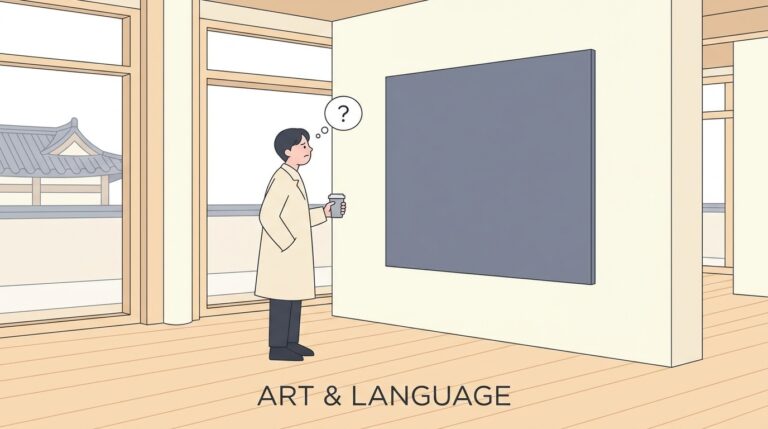
The Fine Line Between Genius and Pretension: Decoding Modern Art in Korean
안녕하세요! Your premium Korean culture and language navigator from Daily Hangul(매일한글) is here. Have you ever stood in front of a giant canvas painted entirely in a single shade of grey at a trendy gallery in Samcheong-dong, tilted your head, and silently wondered: “Is this high art, or is the artist just messing with us?”
If so, you are not alone. Korea’s contemporary art scene is booming, with world-class art fairs like Frieze Seoul drawing massive crowds. Yet, this has sparked an intense, sophisticated debate among Korean art lovers regarding the massive gap between the abstruse nature of modern art and its public accessibility. Today, we will dive into this exact cultural tension, mastering the high-level, C2-grade Korean vocabulary needed to articulate complex aesthetic arguments like a native public intellectual.
Phase 2: Core Expressions Deep Dive
1. 난해하다 (Esoteric / Abstruse)
- Pronunciation: [Nan-hae-ha-da] (Sounds like “nahn-heh-hah-dah”)
- Meaning: Visually complex, intellectually impenetrable, or deliberately obscure.
- K-Culture Moment: This is the word you will hear critics and gallery-goers whisper when viewing conceptual installations at the MMCA (National Museum of Modern and Contemporary Art) that consist of nothing but scattered pebbles and flickering neon lights.
- Editor’s Insight: While ‘어렵다’ (euryeop-da) means simply “difficult,” 난해하다 specifically denotes an intellectual or aesthetic impenetrability. It implies that the subject matter requires deep decoding.
- Situation Spectrum: Casual (⚠️) | Semi-formal (✅) | Formal (✅)
- 🤔 Think About It: Does art lose its intrinsic value when it becomes too 난해하다 for the general public to appreciate without reading a 500-word essay on the wall?
2. 그들만의 리그 (A League of Their Own / Closed Circle)
- Pronunciation: [Geu-deul-man-ui ri-geu] (Sounds like “guh-deul-mahn-ui lee-geu”)
- Meaning: An insular, exclusive circle of elites who validate only each other.
- K-Culture Moment: Used by Korean netizens and indie curators when criticizing mainstream art institutions that repeatedly award the same group of academic insiders, leaving independent local artists in the cold.
- Editor’s Insight: While originally borrowed from the movie title “A League of Their Own,” in Korean social commentary, it carries a sharp, satirical bite. Use it when pointing out elitism.
- Situation Spectrum: Casual (✅) | Semi-formal (✅) | Formal (⚠️)
- 🤔 Think About It: How does one prevent the contemporary art world from devolving into a 그들만의 리그 while still preserving high academic standards?
3. 대중성을 확보하다 (To Secure Mainstream/Popular Appeal)
- Pronunciation: [Dae-jung-seong-eul hwak-bo-ha-da] (Sounds like “dae-joong-sung-eul hwahk-bo-hah-dah”)
- Meaning: To successfully bridge the gap to the public and gain widespread commercial and emotional appeal.
- K-Culture Moment: This phrase is the holy grail for museum directors who want to maintain artistic integrity while pulling in massive ticket sales, often by blending high art with “Instagrammable” experiential spaces.
- Editor’s Insight: 대중성 (popular appeal) and 작품성 (artistic quality) are treated as two opposing poles in Korean critical theory. “Hwakbo-hada” (to secure) implies a strategic, hard-won victory.
- Situation Spectrum: Casual (⚠️) | Semi-formal (✅) | Formal (✅)
- 🤔 Think About It: Is it possible for an avant-garde artist to 대중성을 확보하다 without compromising their raw, anti-establishment message?
Phase 3: Textbook Korean vs. Real-World Korean
Case 1: Describing an overly complex exhibition
- 📖 Textbook Korean: “이 미술 전시회는 구성이 지나치게 복잡하여 일반 대중이 이해하기 매우 어렵습니다.”
(This art exhibition’s structure is excessively complex, making it very difficult for the general public to understand.) - 🗣️ Real-World Korean: “솔직히 이번 전시는 너무 난해해서 대중이랑 기싸움하는 것 같아요.”
(Honestly, this exhibition is so esoteric, it feels like it’s having a staring contest/power struggle with the public.) - 💡 Why it’s different: Modern Koreans use the term 기싸움 (nerve war/power struggle) humorously to describe art that feels actively hostile or dismissive toward the viewer’s intelligence.
Case 2: Critiquing institutional elitism
- 📖 Textbook Korean: “화랑과 기획자들이 권위주의적이라서 일반인들의 접근을 제한하고 있습니다.”
(Galleries and curators are authoritarian, restricting the access of ordinary people.) - 🗣️ Real-World Korean: “예술의 문턱을 너무 높여놓으니까 결국 그들만의 리그로 고이는 거죠.”
(Because they raised the threshold of art too high, it eventually rots in its own exclusive league.) - 💡 Why it’s different: 물이나 집단이 고이다 (to stagnate/gather) is a vivid metaphor used to describe how closed intellectual groups become stagnant and corrupt over time.
Phase 4: K-Culture Deep Dive & Non-verbal Etiquette
4-1. The “Nunchi” of Fine Art Admiration
When navigating upscale galleries in Seoul’s Bukchon or Hannam-dong, silence is golden, but body language speaks volumes. To show you are engaging deeply with a piece (even if you find it completely baffling):
* The Stance: Keep your hands clasped behind your back. Crossing them over your chest can look overly defensive or dismissive.
* The Tilt: Tilt your head slightly (about 15 degrees) to the side, narrow your eyes, and give a very slow, microscopic nod while exhaling a quiet, appreciative “Ah…” This indicates you are contemplating the “sublime empty space” (여백의 미) of the canvas rather than just staring blankly.
4-2. The Rise of “Exhibition-Goer” Culture in Korea
In Korea, art galleries are no longer just for the intellectual elite; they are prime locations for 문화 생활 (cultural life) and weekend dates. High-end brands host massive artistic pop-ups in Seongsu-dong, blending commercial product placements with surrealist installation art. This hybrid phenomenon has redefined the relationship between high art and pop culture. While purists argue this cheapens the aesthetic experience, others believe it democratizes art by lowering the physical and emotional “문턱” (barrier of entry).
Phase 5: Real-Life Roleplay Scenario
The Setting
A minimalist café inside the MMCA Seoul, overlooking the traditional hanok courtyards. Ji-woo (a progressive, passionate local art curator) and Mark (a discerning C2-level foreign collector) are having a heated but respectful debate over a newly opened, controversial sculpture exhibition.
Characters
- 지우 (Ji-woo): Believes that true art must challenge, disrupt, and sometimes deliberately alienate the audience to trigger deeper self-reflection.
- 마크 (Mark): Appreciates formal technique and believes that art which actively alienates its audience loses its socio-cultural purpose.
Dialogue
지우: 🎭 (뜨거운 에스프레소를 한 모금 마시며) 마크 씨, 이번 설치 미술 전시 보셨죠? 저는 신선한 충격이었어요. 현대 사회의 소외를 물리적인 무(無)로 완벽히 시각화했더라고요.
Ji-woo: (Taking a sip of hot espresso) Mark, did you see the new installation exhibition? For me, it was a fresh shock. It perfectly visualized modern alienation through physical nothingness.
마크: 🎭 (안경을 지그시 만지며 조심스럽게 고개를 가로젓는다) 글쎄요, 지우 씨. 솔직히 제 눈에는 작가가 성의 없이 던져놓은 오브제들의 나열로밖에 안 보였어요. 좀 많이 난해하더군요.
Mark: (Gently touching his glasses and slowly shaking his head) Well, Ji-woo. Honestly, to my eyes, it looked like nothing more than a lazy arrangement of objects thrown together by the artist. It was quite esoteric.
지우: 🎭 (미소를 지으며 눈을 반짝인다) 그 난해함 자체가 메시지예요! 예술이 직관적이고 친절하기만 하다면, 그건 예술이 아니라 단순한 디자인이나 대중 광고와 다를 바 없지 않을까요?
Ji-woo: (Smiling, eyes sparkling) That esotericism itself is the message! If art were only intuitive and friendly, wouldn’t it be no different from simple design or commercial advertising?
마크: 🎭 (찻잔을 내려놓으며 차분하지만 단호하게) 반론을 제기하자면, 예술이 스스로 높은 문턱을 만들어 대중과의 소통을 거부할 때, 그것은 단지 그들만의 리그로 전락할 위험이 큽니다.
Mark: (Setting down his teacup, calm yet firm) To counter that, when art creates a high barrier of entry and refuses to communicate with the public, it runs a high risk of degenerating into a league of their own.
지우: 🎭 (진지한 표정으로 턱을 괴며) 하지만 대중의 눈높이에 맞춰 모든 것을 조율하다 보면, 결국 심오한 철학적 사유는 사라지고 자극적인 대중성만 확보하려는 상업주의에 잠식당할 거예요.
Ji-woo: (Resting her chin on her hand with a serious expression) But if we adjust everything to match the public’s eye level, profound philosophical contemplation will eventually vanish, and art will be consumed by commercialism that only seeks to secure popular appeal.
마크: 🎭 (공감한다는 듯 고개를 끄덕이며) 지우 씨 말씀도 일리가 있네요. 하지만 예술가의 아집과 진정한 예술적 사유 사이의 괴리를 좁히는 것도 큐레이터의 중요한 역할이라고 봅니다.
Mark: (Nodding in agreement) You have a point, Ji-woo. However, I believe that narrowing the gap between an artist’s stubborn self-absorption and genuine artistic contemplation is also an important role of a curator.
지우: 🎭 (가벼운 한숨을 쉬며 아쉽다는 듯) 어렵죠. 대중의 트렌드를 따라가면서도 예술적 본질을 지켜낸다는 것이… 늘 아슬아슬한 줄타기를 하는 느낌이에요.
Ji-woo: (Sighing lightly with a hint of regret) It is hard. Keeping the artistic essence while following public trends… It always feels like walking on a tightrope.
마크: 🎭 (미소를 지으며 분위기를 가볍게 환기시킨다) 바로 그 아슬아슬한 줄타기 자체가 오늘날 서울의 미술 씬을 가장 힙하게 만드는 원동력일지도 모르겠습니다.
Mark: (Smiling, lightly shifting the mood) Perhaps that very tightrope walk is the driving force making Seoul’s art scene so trendy these days.
🔀 Interactive Choice Point
How would you, as Mark, respond if Ji-woo asks: “그렇다면 마크 씨는 현대 미술관에서 대중에게 가장 먼저 제공해야 할 서비스가 뭐라고 생각하세요?” (Then Mark, what service do you think contemporary art museums should provide to the public first?)
- Option A: “무조건 전시 안내용 도슨트 서비스를 확대해서 쉽게 설명해 줘야 합니다.”
- Feedback (Best): Shows clear value for education and public integration. Extremely natural, practical phrasing that sounds like an experienced collector.
- Option B: “난해한 작품을 다 치우고 보기 좋은 그림들만 걸어 놔야죠.”
- Feedback (Bad): Too extreme and anti-intellectual. Destroys the nuance of a C2-level aesthetic discussion.
- Option C: “미술관 안에 인스타용 포토존을 대폭 늘려 대중성을 노리는 게 맞습니다.”
- Feedback (Risk): While realistic in contemporary Seoul, it sounds overly cynical and dismissive of high art’s value.
Phase 6: 10-Second Emotion Shadowing Drill
To sound truly natural in high-level discussions, you need to master Korean dramatic pauses (/) and emotional tone-shifts. Practice these out loud:
- [With a heavy, regretful sigh]
“예술이 너무 / 그들만의 리그가 되면 / 대중은 결국 / 등을 돌릴 수밖에 없어요.”
(If art becomes / too much of a league of their own, / the public will ultimately / have no choice but to turn their backs.) -
[With a sharp, skeptical, intellectual tone]
“난해함 속에 감춰진 / 작가의 진짜 의도가 / 과연 존재하기는 하는지 / 의문이 드네요.”
(I highly doubt / whether the artist’s true intention, / hidden beneath this esotericism, / even exists in the first place.)
Phase 7: K-Culture Mini Dictionary
- 미학 (Mihak) | Aesthetics
- Usage: Used to discuss the philosophical foundations of beauty or the unique design system of a brand (e.g., “여백의 미학” – The aesthetics of empty space).
- 괴리감 (Goeri-gam) | Feeling of Discrepancy/Gap
- Usage: The cognitive dissonance felt when two realities clash (e.g., “이상과 현실의 괴리감” – The gap between ideal and reality).
- 도슨트 (Doseunt-eu) | Docent/Art Guide
- Usage: Highly popular in Korea. Star docents have their own cult following, turning exhibition guiding into a performance art.
- 자조적 (Jajo-jeok) | Self-deprecating / Self-mocking
- Usage: Used to describe humor that laughs at one’s own limitations, often seen in public reactions to abstract art.
Phase 8: Traveler’s Survival Kit
Top 3 Phrases for Art Gallery Lovers
- “혹시 한국어 도슨트 투어 시간이 어떻게 되나요?”
- Romanization: [Hoksi hangugo doseunteu tueo sigani otteoke doenayo?]
- Pro Tip: Always check this at the desk; a good docent can make a highly esoteric exhibition incredibly fun!
- “이 구역은 무음 카메라로 촬영해도 괜찮습니까?”
- Romanization: [I guyeogeun mueum kamera-ro chwaryeong-haedo gwaenchansumnikka?]
- Pro Tip: Korean galleries are very sensitive to noisy shutter sounds. Use silent camera apps when taking photos.
- “혹시 이번 기획전의 도록은 다 판매되었나요?”
- Romanization: [Hoksi ibon gihwekjeon-ui dorogeun da panmae-doeeonnayo?]
- Pro Tip: Curators love when you ask for the “도록” (exhibition catalog). It shows you’re a serious enthusiast.
Editor’s Travel Note
Before heading to key art hubs like Samcheong-dong, Hannam-dong, or the DDP, make sure to use a reliable navigation system. Download the 네이버 지도 앱 다운로드 to find hidden alleyway galleries. Disclaimer: Exhibition operating hours and admission fees fluctuate seasonally; always double-check official gallery websites before visiting.
Phase 9: ” 한 발 더 깊이 ” (Going Deeper)
Korea’s rapid economic development (압축 성장) forced the country to transition from post-war scarcity to hyper-modern prosperity within a few decades. This created a fascinating cultural split: a highly visual society obsessed with sleek commercial aesthetics (K-Beauty, high fashion, interior design) existing alongside academic art circles that often feel protective of their intellectual boundaries. Confessing that an artwork is “too difficult” can sometimes carry a social risk of looking uncultured in highly status-conscious spaces, making the slang “대중과의 기싸움” a valuable, self-deprecating tool of social release.
💬 Your Turn: Have you ever felt alienated by modern art in your country? How does the balance between public appeal and artistic purity shift in your culture? Tell us in the comments below!
Phase 10: FAQ & Common Mistakes
Q: What is the difference between ‘어렵다’ and ‘난해하다’?
A: ‘어렵다’ is a general word for anything difficult (e.g., solving a math problem, climbing a mountain). ‘난해하다’ is reserved for academic texts, philosophical arguments, literature, and fine art that require heavy contextual decoding to be understood.
Q: Can I use ‘그들만의 리그’ in a formal essay or business presentation?
A: Yes, but keep in mind that it carries a slightly critical, informal nuance. In a highly formal presentation, words like ‘폐쇄적인 생태계’ (closed ecosystem) or ‘집단적 고립’ (collective isolation) are preferred.
Q: Why do Koreans place so much emphasis on ‘도슨트’ (docent) tours?
A: In Korea, learning and self-improvement are highly valued social activities. Going to a gallery isn’t just for passive viewing; it’s seen as an intellectual exercise, making educational tours highly popular.
🚨 Common Mistakes Warning Board
| Incorrect Usage | Correct Action | Why it matters |
|---|---|---|
| “그 그림은 너무 어렵게 생겼어요.” | “그 그림은 대단히 난해해 보입니다.” | At a C2 level, using passive descriptive adjectives like “난해해 보이다” sounds exponentially more sophisticated than “어렵다.” |
| Saying “그들만의 리그” to refer to a friendly gathering. | Only use it when criticizing an exclusive, gatekeeping group. | Using it for a simple friendly group chat can sound overly hostile. |
| Pronouncing “난해” as [Nan-gae]. | Pronounce it clearly as [Nan-hae]. | Confusing ‘ㅎ’ with ‘ㄱ’ radically changes the word’s meaning. |
Phase 11: Action Mission & K-Culture Hunt
- 🥉 Bronze Mission: Find one contemporary Korean artwork online and write a one-sentence critique using 난해하다.
- 🥈 Silver Mission: Write a small paragraph in Korean comparing 대중성 (popular appeal) and 작품성 (artistic quality) and share it with your language partner.
- 🥇 Gold Mission: Next time you visit an exhibition, ask the staff: “이 전시의 기획 의도는 대중성보다는 실험성에 더 중점을 둔 건가요?” (Is the planning intention of this exhibition more focused on experimentation rather than popular appeal?)
🎮 K-Culture Mission: Watch the classic Korean romantic-comedy film 미술관 옆 동물원 (Art Museum by the Zoo) and observe how the different visual environments represent the characters’ differing internal aesthetics!
Phase 12: Interactive Quiz Challenge
1. Fill in the Blank
“아무리 훌륭한 예술 작품이라도 전혀 소통하려 하지 않는다면 결국 __________로 전락할 뿐이다.”
* A) 대중성
* B) 그들만의 리그
* C) 도슨트
2. True or False?
In Korea, expressing that an artwork is “난해하다” is considered highly rude to the artist’s face.
👀 Click here to reveal the answers and explanations!
Answers:
1. B) 그들만의 리그 (An exclusive circle. The sentence translates to: “No matter how great an artwork is, if it doesn’t communicate at all, it will eventually degenerate into a league of their own.”)
2. False! While you wouldn’t yell it insults, discussing the “난해함” (esoteric nature) of a piece is considered a standard, highly intellectual aesthetic critique in Korean art discourse.







