

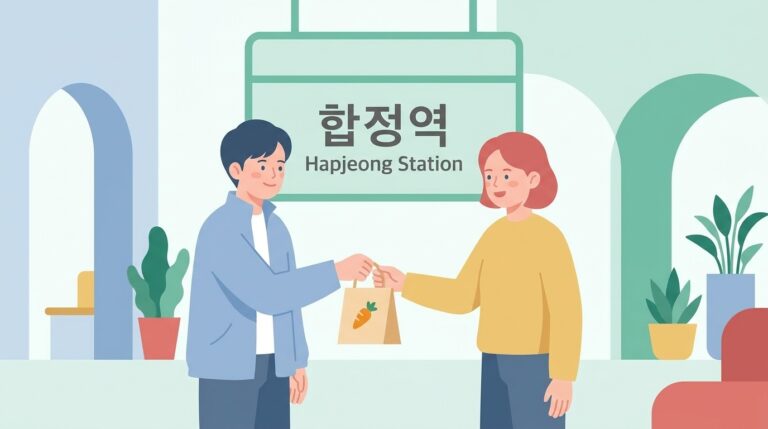
Meet Me at Exit 7: Your Ultimate Guide to Korean Subway Secondhand Trading
Phase 1: Empathy (스토리 몰입형 오프닝)
안녕하세요! Hello there! I’m your Daily Hangul editor, your 10-year local culture navigator.
Imagine this: You’re scrolling through Korea’s legendary local secondhand trading app, Karrot Market (당근마켓), and you find that limited-edition K-Pop vinyl or a perfect vintage camera you’ve been hunting for months. You excitedly message the seller, and they reply:
“합정역 7번 출구 앞에서 직거래 가능해요!”
(We can do a face-to-face trade in front of Hapjeong Station Exit 7!)
Suddenly, your heart beats a little faster. Meeting a complete stranger at a bustling Seoul subway exit sounds like a covert operation from a spy movie! What if you can’t find them? What if you don’t know what to say?
Don’t worry! In Korea, doing a 직거래 (jik-geo-rae / direct trade) at subway exits is a cozy, extremely common, and safe daily routine. This guide is based on real experiences from our global learners who went from being terrified of their first trade to becoming absolute “Karrot Masters.” By the end of this post, you’ll feel like a local navigating the Seoul underground with confidence!
Phase 2: Key Expressions & Deep Analysis (핵심 표현 3선 심층 분석)
1. ~번 출구 앞에서 만나요 (~beon chul-gu ap-eseo man-na-yo)
- Pronunciation: beon chool-goo ahp-eh-suh mahn-nah-yo (Sounds like “burn chool-goo up-eh-suh mahn-nah-yo”)
- Meaning: “Let’s meet in front of exit [number].”
- K-Culture Moment: You will hear this phrase in almost every slice-of-life K-Drama. Because Seoul’s subway system is incredibly clean and efficient, exits are the universal landmark for meeting friends, blind dates, and yes, secondhand sellers.
- Editor’s Insight: The word 앞 (ap / front) is the golden key here. Some exits have massive crowds, so specifying “앞” means you should stand right outside the glass doors or stairs of that specific exit number.
- Situation Spectrum: Casual (⚠️) | Semi-formal (✅) | Formal (🚫)
- 🤔 Think About It: Why does Korea’s high level of public safety make crowded subway stations the perfect, stress-free spot for trading goods with strangers?
2. 혹시 당근이세요? (hok-si dang-geun-i-se-yo?)
- Pronunciation: hok-shee dahng-geun-ee-seh-yo (Sounds like “hawk-shee dahng-guhn-ee-say-yo”)
- Meaning: “By any chance, are you from Karrot Market?” (Literally: “Are you a carrot?”)
- K-Culture Moment: This is the ultimate Korean cultural meme! It’s the magic password used across the nation. On Korean YouTube variety shows, you’ll see celebrities awkwardly wandering around subway stations whispering this exact line to suspicious-looking passersby.
- Editor’s Insight: 당근 (dang-geun) literally means “carrot,” but it is short for “당근마켓” (Karrot Market). Asking this with a polite tilt of your head instantly breaks the ice!
- Situation Spectrum: Casual (✅) | Semi-formal (✅) | Formal (⚠️)
- 🤔 Think About It: How amazing is it that a simple vegetable name has transformed into a national verb meaning “to trade secondhand items locally”?
3. 물건 확인해 보세요 (mul-geon hwa-gin-hae bo-se-yo)
- Pronunciation: mool-guhn hwah-gheen-hae boh-seh-yo (Sounds like “mool-guhn hwah-ghin-hay boh-say-yo”)
- Meaning: “Please check/inspect the item.”
- K-Culture Moment: In K-Dramas depicting honest everyday citizens, you’ll see the seller proudly presenting the item, encouraging the buyer to take their time inspecting it to show mutual respect.
- Editor’s Insight: Even if you trust the seller 100%, it is polite for them to offer this, and it’s completely expected for you to inspect the item. Don’t rush! A quick 10-second check is standard etiquette.
- Situation Spectrum: Casual (⚠️) | Semi-formal (✅) | Formal (✅)
- 🤔 Think About It: How does this face-to-face inspection build a stronger sense of community trust compared to anonymous online deliveries?
Phase 3: Textbook Korean vs. Real Korean (교과서 한국어 vs 진짜 한국어)
Situation 1: Letting the seller know you are arriving
- 📖 Textbook Style: “어디에 있습니까?” (eodi-e its-seumni-ka? / Where are you?)
- Why it feels awkward: This sounds like a police interrogation! It’s too stiff and demanding for a friendly trade.
- 🗣️ Real Korean Style: “저 거의 다 왔어요! 혹시 어디쯤이세요?” (jeo geo-ui da wass-eo-yo! hok-si eo-di-jjeum-i-se-yo? / I’m almost there! Whereabouts are you?)
- Why it works: Saying 거의 다 왔어요 (almost there) reassures the seller, and 어디쯤 (whereabouts) sounds much softer and gentler than a direct “Where are you?”
Situation 2: Saying goodbye after a successful trade
- 📖 Textbook Style: “감사합니다. 안녕히 가십시오.” (gamsa-hamnida. annyeonghi gasipsio. / Thank you. Goodbye.)
- Why it feels awkward: It sounds like you’re checking out of a luxury hotel. It’s too formal for a neighborly exchange.
- 🗣️ Real Korean Style: “감사합니다! 예쁘게 잘 쓸게요~” (gamsa-hamnida! yeo-ppeu-ge jal sseul-ge-yo~ / Thank you! I will use it well/beautifully~)
- Why it works: In Korea, expressing that you will “use the item well” (잘 쓸게요) makes the seller feel happy that their pre-loved possession is going to a good home.
Phase 4: K-Culture Deep-Dive & Non-Verbal Manners (K-Culture 딥다이브)
4-1. Subway Station “Nunchi” & Gestures
How do you spot your seller in a crowd of fifty people?
1. The ‘Karrot Bag’ Signal: Look for someone holding a small paper shopping bag, looking down at their phone, and then looking up to scan the crowd.
2. The Eye Contact & Nod: When your eyes lock with someone matching the description, do not stare blankly. Give a slight head bow (목례 – mok-rye) and raise your hand slightly.
3. The Phone Match: Gently hold up your phone to show you are on the app. It’s the universal silent signal of “Yes, I am your Karrot buyer!”
4-2. The Culture of Trust
Karrot Market works because Korea has an incredibly high-trust culture. It is not uncommon to see sellers leave items in a locker or outside their door for “non-face-to-face” trades. But when doing subway trades, being punctual is the ultimate form of respect. If you are even 2 minutes late, texting the seller in advance is considered mandatory manners.
Phase 5: Interactive Roleplay Scenario (실전 롤플레이 시나리오)
Background: You are meeting 민우 (Minwoo), a friendly local college student, at Hapjeong Station Exit 7 to buy a gorgeous vintage film camera.
Characters:
- 민우 (Minwoo): The seller. Friendly, wearing a casual hoodie, holding a paper bag.
- You (Buyer): Eager to get your new camera!
- 민우: (Scanning the crowd, spots you and waves) 🎭 혹시… 당근이세요?
- You: 아, 네! 맞아요. 카메라 거래하러 왔어요!
- 민우: 🎭 (Smiles warmly and opens the paper bag) 아, 반가워요! 여기 카메라예요. 물건 확인해 보세요.
- You: 🎭 (Gently holding the camera) 우와, 진짜 깨끗하네요! 작동도 잘 돼요?
- 민우: 네! 배터리 새로 넣어서 켜질 거예요. 여기 셔터도 한번 눌러보세요.
- You: 🎭 (Clicks the shutter button) 와, 소리 좋네요! 마음에 들어요. 바로 송금해 드릴게요.
- 민우: 감사합니다. 여기 제 계좌번호예요.
- You: 송금 완료했어요! 확인해 보세요. 예쁘게 잘 쓸게요!
🔀 Interactive Choice Point!
What should you do if you notice a small scratch that wasn’t mentioned in the chat, but you still want the item?
- A) “조금 더 자세히 봐도 될까요?” (Can I look at it a bit more closely?)
- Feedback (Best): Perfect! It politely gives you time to inspect the scratch without making the seller feel defensive.
- B) “이거 기스 있는데, 왜 말 안 하셨어요? 환불해 주세요!” (There’s a scratch, why didn’t you tell me? Refund me!)
- Feedback (Bad): Too aggressive! Subway trades are friendly. Polite communication works much better.
- C) (Say nothing, pay the full price, and complain in the app review later)
- Feedback (Risk): You will regret the purchase. It is always best to clarify any concerns on the spot kindly.
Phase 6: 10-Second Emotion Shadowing Drill (10초 감정 섀도잉)
Let’s practice speaking with real Korean emotion! Use the slashes / as your natural pausing points.
- “저 거의 다 왔어요! / 혹시 / 어디쯤이세요?”
- Emotion Tag: [😊 Friendly, apologetic, and slightly breathless as if you just walked up the stairs]
- “우와, / 상태가 진짜 좋네요! / 감사합니다!”
- Emotion Tag: [🤩 Excited, genuinely impressed with the quality of the item]
Phase 7: K-Culture Mini Dictionary (K-Culture 미니 사전)
- 직거래 (Jik-geo-rae) | Direct trade | Face-to-face transactions in public places, usually to avoid scams and shipping fees.
- 네고 (Nego) | Negotiation | Short for “negotiation.” Asking for a small discount. (e.g., “네고 되나요?” – Is negotiation possible?)
- 당근하다 (Dang-geun-hada) | To do Karrot | A newly coined slang verb meaning to buy, sell, or trade used goods.
- 쿨거래 (Kul-geo-rae) | Cool trade | A transaction that is quick, polite, and done without unnecessary haggling or delays.
Phase 8: Survival Kit for Travelers (여행자를 위한 생존 키트)
Survival Expressions TOP 3
- “계좌번호 알려주세요.” (gyejwa-beonho al-ryeo-ju-se-yo)
- Pro Tip: “Please give me your bank account number.” Most Koreans prefer instant mobile banking over physical cash.
- “봉투 필요 없어요. 그냥 가져갈게요!” (bong-tu pil-yo eops-eo-yo. geu-nyang ga-jeo-gal-ge-yo!)
- Pro Tip: “I don’t need a bag. I’ll just carry it!” Great if you already have a backpack.
- “늦어서 정말 죄송합니다!” (neu-jeo-seo jeong-mal joe-song-ham-nida!)
- Pro Tip: “I am so sorry for being late!” Use this if you get lost inside the giant maze of a Seoul subway station.
🧭 Editor’s Travel Note:
To navigate Seoul’s complex underground, don’t rely solely on global map apps which can be outdated. Make sure to download the Naver Map App to find the exact exit number and real-time train arrivals. Note: Transit details and app interfaces may change over time.
Phase 9: “One Step Deeper” (한 발 더 깊이 – 생각 질문)
In many Western countries, secondhand trading often involves shipping or meeting in heavily monitored police parking lots. In contrast, Koreans use subway exits, local playgrounds, or apartment lobbies. This highlights Korea’s unique “우리” (uri – we/our) culture, which fosters a strong baseline of safety, shared space, and community trust.
💬 Your Turn!
Have you ever done a face-to-face secondhand trade in your home country? How does it compare to Korea’s subway station culture? Share your stories in the comments below!
Phase 10: FAQ & Avoiding Misunderstandings (FAQ & 오해 방지)
Q: Can foreigners use Karrot Market (당근마켓) in Korea?
A: Yes! However, you must verify your location within Korea, and the app requires a active Korean phone number for SMS verification.
Q: Is cash preferred, or should I use bank transfer?
A: Bank transfers via Korean banking apps (Toss, KakaoPay) are the default standard. If you are a traveler without a local bank account, ask the seller in advance: “현금으로 드려도 될까요?” (Can I pay in cash?) and bring exact change.
Q: Can I ask for a discount (“네고”) when we meet in person?
A: No, absolutely not! This is considered extremely rude (비매너 – bi-mae-neo). All price negotiations must be fully agreed upon in the chat before you meet up.
🚨 Common Mistakes Alert!
- Showing up late without notice: This heavily drops your “Manner Temperature” (매너온도) rating on the app.
- Not inspecting the item: If you find a defect after leaving the subway exit, it is extremely difficult to ask for a refund.
- Waiting at the wrong gate: Some stations (like Express Bus Terminal) have different subway lines with separate exits. Double-check the line and exit number!
Phase 11: Action Mission & Engagement (액션 미션)
- Bronze Medal 🥉: Say “혹시 당근이세요?” out loud 5 times in front of your mirror with a friendly smile!
- Silver Medal 🥈: Share this post on social media and tag your favorite K-Drama buddy with the caption: “Let’s do a jik-geo-rae at Exit 7!”
- Gold Medal 🥇: The next time you visit Korea, browse Karrot Market or local forums and try setting up a safe public trade yourself!
- 🎮 K-Culture Mission: Go to YouTube and search the phrase “당근마켓 레전드” (Karrot Market Legends) to see hilarious, heartwarming, and real stories of Koreans trading everything from heavy sofas to catching lost pets!
Phase 12: Interactive Quiz Challenge (인터랙티브 퀴즈 챌린지)
1. Where is the most common and polite place to meet for a direct secondhand trade in Korea?
- A) Inside a dark alleyway
- B) At a subway station exit front
- C) Inside the seller’s house
2. Fill in the blank: “혹시 _________이세요?”
- A) 사과 (Apple)
- B) 당근 (Carrot)
- C) 수박 (Watermelon)
3. True or False: It is completely fine to ask for a discount during the face-to-face meeting.
- A) True
- B) False
🎉 Click here to reveal the answers and explanations!
- Answer: B | Subway exits are bright, public, monitored by CCTV, and highly accessible, making them the safest and most convenient spot!
- Answer: B | 당근 (Karrot) is the magic keyword representing Karrot Market.
- Answer: B (False) | Asking for a discount on the spot is bad manners. Always negotiate via chat before meeting!







