

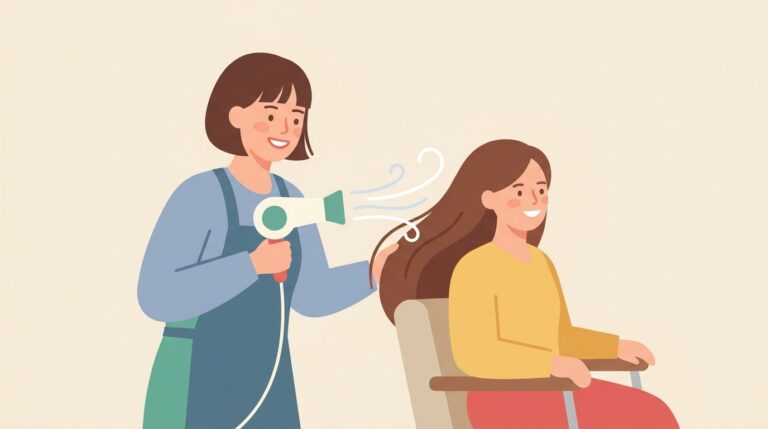
Dry Your Hair Like a K-Beauty Pro: Survival Korean at the Hair Salon
안녕하세요! (An-nyeong-ha-se-yo!) Hello! It’s your favorite Korean bestie and lead editor at Daily Hangul.
Imagine this: You are sitting in a gorgeous, aesthetic hair salon in Hongdae or Cheongdam-dong. You just got the most relaxing shampoo of your life (seriously, Korean salon head massages are heavenly!). But as the stylist turns on the hairdryer, the air feels burning hot on your scalp, or they start styling your bangs in a way that makes you panic. You want to ask for cool air, or tell them to dry your bangs first, but you freeze up!
Don’t worry! Today, we are mastering the art of 머리 말리기 (meo-ri mal-li-gi – drying hair). By the end of this guide, you will navigate the blow-dry stage of your K-Beauty transformation with absolute confidence and ease. Let’s dive in!
Phase 2: 3 Core Expressions for Your Perfect Blow-Dry
Here are the top three expressions you absolutely need to know. Practice these, and you will sound like a local!
1. 찬바람으로 말려주세요 (Chan-baram-euro mallyeo-juseyo)
- Pronunciation: Chan-bah-rahm-oo-roh mahl-lyuh-joo-seh-yo (Think of “chan” as in “channel” + “baram” like the wind)
- Meaning: Please dry it with cool air.
- K-Culture Moment: You often see K-Pop idols in behind-the-scenes vlogs getting their hair prepped with cool air to preserve their vibrant hair colors (like pastel pink or ash blue!).
- Editor’s Insight: Korean salons are highly focused on “두피 케어” (du-pi ke-eo – scalp care). Cool air prevents scalp irritation, so asking for this actually makes you look like a hair care expert!
- Situation Spectrum: Casual ⚠️ (Too blunt) | Semi-formal ✅ (Perfect for stylists) | Formal ✅
- 🤔 Think About It: In English, we say “cool air,” but in Korean, we say “찬바람” (cold wind). How does your native language describe the air from a hair dryer?
2. 바짝 말려주세요 (Bab-jjak mallyeo-juseyo)
- Pronunciation: Bah-jjak mahl-lyuh-joo-seh-yo (Pronounce “jjak” with a sharp, crisp ‘j’ sound)
- Meaning: Please dry it completely / bone-dry.
- K-Culture Moment: Essential before using a “고데기” (go-de-gi – hair straightener/curling iron) to get those perfect, bouncy C-curls you see in K-Dramas.
- Editor’s Insight: “바짝” (bah-jjak) is an adverb meaning “tightly” or “completely dry.” It’s a very natural, native-level word that textbook-only learners rarely know!
- Situation Spectrum: Casual ⚠️ | Semi-formal ✅ | Formal ✅
- 🤔 Think About It: Notice how Korean uses expressive sound-symbolic words like “바짝” to show the degree of dryness.
3. 앞머리 먼저 말려야 해요 (Ap-meori meon-jeo mallyeo-ya haeyo)
- Pronunciation: Ahp-muh-ree muhn-juh mahl-lyuh-yah hae-yo
- Meaning: My bangs need to be dried first.
- K-Culture Moment: If you have Korean-style “시스루뱅” (see-through bangs), you know that if they dry naturally even for a minute, they get frizzy and lose their shape!
- Editor’s Insight: Stylists appreciate this tip because they want your bangs to look absolutely perfect just as much as you do.
- Situation Spectrum: Casual ⚠️ | Semi-formal ✅ | Formal ✅
- 🤔 Think About It: Bangs (앞머리 – literally “front hair”) are considered a crucial frame for the face in K-Beauty.
Phase 3: Textbook Korean vs. Real Korean
Let’s compare the stiff textbook phrases with what Koreans actually say in the salon chair.
Scenario 1: Asking the stylist to dry your hair
- 📖 Textbook: “머리를 건조해 주세요.” (Meo-ri-reul geon-jo-hae ju-se-yo.)
- 🗣️ Real Korean: “머리 말려주세요.” (Meo-ri mallyeo-juseyo.)
- 💡 Why is it different? “건조” (geon-jo) means dehydration or technical drying (like clothes in a dryer). Using it for hair sounds like a science experiment! “말리다” (mal-li-da) is the warm, natural verb for drying hair.
Scenario 2: Expressing that the dryer is too hot
- 📖 Textbook: “뜨거운 바람이 싫습니다.” (Tteu-geo-un ba-ram-i sil-seup-ni-da.)
- 🗣️ Real Korean: “조금 뜨거워요!” (Jo-geum tteu-geo-wo-yo!)
- 💡 Why is it different? Saying “I dislike hot wind” (싫습니다) sounds incredibly confrontational and dramatic. Simply saying “It’s a bit hot” is polite, soft, and gets the message across instantly.
Phase 4: K-Culture Deep Dive & Non-verbal Manners
4-1. Nunchi (눈치) & Salon Gestures
If the hair dryer is too hot, don’t jump or gasp! Instead, use your Nunchi (tact/situational awareness):
1. Slightly tilt your head away from the dryer nozzle.
2. Gently raise your hand a few inches and smile.
3. Say softly: “앗, 조금 뜨거워요!” (Ah, it’s a bit hot!)
This non-verbal cue combined with polite speech ensures you don’t startle the stylist while holding a hot tool.
4-2. The “Palli-Palli” (빨리빨리) Drying Culture
When you visit a Korean salon, you might experience a cultural shock: two stylists drying your hair at the same time! This is the ultimate expression of Korea’s fast-paced “Palli-Palli” culture combined with high-efficiency service. It is designed to save your precious time while ensuring you get styled to perfection.
Phase 5: Interactive Roleplay Scenario
Meet Jia (지아), your friendly, trendy hair stylist at a chic salon in Mapo-gu. Let’s practice a real conversation!
🎭 Hair Drying Session
- Jia: “샴푸 시원하셨어요? 이제 머리 말려드릴게요.”
(Shampoo si-won-ha-shyeot-eo-yo? I-je meo-ri mallyeo-deu-ril-ge-yo.)
(Was the shampoo refreshing? Now I’ll dry your hair.)
🎭Smiling warmly while guiding you to the styling chair. -
You: “네, 아주 시원했어요! 감사합니다.”
(Ne, a-ju si-won-haess-eo-yo! Gam-sa-ham-ni-da.)
(Yes, it was very refreshing! Thank you.)
🎭Nodding happily with a dry towel around your shoulders. -
Jia: “평소에 머리 어떻게 말리세요?”
(Pyeong-so-e meo-ri eo-tteo-ke malli-se-yo?)
(How do you usually dry your hair?)
🎭Combing through your wet hair gently. -
You: “저는 두피가 약해서 찬바람으로 말려주세요.”
(Jeo-neun du-pi-ga yak-hae-seo chan-baram-euro mallyeo-juseyo.)
(My scalp is sensitive, so please dry it with cool air.)
🎭Pointing gently to your scalp in the mirror. -
Jia: “아, 네! 찬바람이랑 미지근한 바람 섞어서 말려드릴게요.”
(Ah, ne! Chan-baram-i-rang mi-ji-geun-han ba-ram seokk-eo-seo mallyeo-deu-ril-ge-yo.)
(Ah, yes! I’ll dry it using a mix of cool and lukewarm air.)
🎭Setting the hairdryer temperature nozzle. -
You: “그리고 앞머리는 먼저 말려주실 수 있나요?”
(Geu-ri-go ap-meo-ri-neun meon-jeo mallyeo-ju-sil su in-na-yo?)
(And could you dry my bangs first?)
🎭Touching your wet bangs slightly with your fingertips. -
Jia: “그럼요! 앞머리는 바로 안 말리면 모양이 안 예쁘죠.”
(Geu-rom-yo! Ap-meo-ri-neun ba-ro an malli-myeon mo-yang-i an ye-ppeu-jyo.)
(Of course! If we don’t dry bangs right away, the shape doesn’t look pretty.)
🎭Directing the warm, gentle air nozzle to your bangs first. -
You: “맞아요, 고맙습니다! 잘 부탁드려요.”
(Ma-ja-yo, go-map-seup-ni-da! Jal bu-tak-deu-ryeo-yo.)
(That’s right, thank you! I’m in your hands.)
🎭Smiling relaxedly as the drying process begins.
🔀 What if the dryer gets too hot during the styling? Choose your path!
- Option A: “앗! 너무 뜨거워요!” (Ah! It’s too hot!)
- 🔴 Feedback (Bad): While honest, shouting this abruptly can startle the stylist holding professional equipment.
- Option B: “조금 뜨거운데, 바람 온도 좀 낮춰주실 수 있으세요?” (It’s a bit hot, could you lower the temperature a bit?)
- 🟢 Feedback (Best!): Extremely polite, natural, and perfectly guides the stylist without any awkwardness.
- Option C: (Say nothing and endure the heat with a red face)
- ⚠️ Feedback (Risk): You risk getting a minor scalp burn! Korean stylists genuinely want you to be comfortable, so please speak up!
Phase 6: 10-Second Emotion Shadowing Drill
Let’s practice the rhythm and emotion of these key sentences. Breathe, mimic the tone, and read aloud!
- “앗 / 조금 / 뜨거워요!”
[🥺 Startled but extremely polite]- Ah / jo-geum / tteu-geo-wo-yo!
- “찬바람으로 / 말려주세요!”
[😊 Friendly and confident request]- Chan-ba-ram-eu-ro / mahl-lyuh-joo-seh-yo!
Phase 7: K-Culture Mini Dictionary
- 고데기 (Go-de-gi): Hair straightener or curling iron. Essential for creating modern K-styles.
- 두피 (Du-pi): Scalp. Healthy hair starts with scalp care, a major beauty trend in Korea.
- 앞머리 (Ap-meori): Bangs or fringe. Whether it’s see-through bangs or side bangs, it’s a styling staple.
- 드라이 (Deu-ra-i): Blow-dry or professional hair styling using blow dryers and brushes.
Phase 8: Survival Kit for Travelers
Survival Expressions TOP 3
- “따뜻한 바람으로 해주세요.” (Please use warm wind.) | Tta-tteut-han ba-ram-eu-ro hae-ju-se-yo.
- “바람이 너무 세요.” (The wind is too strong.) | Ba-ram-i neo-mu se-yo.
- “에센스 발라주세요.” (Please apply hair essence.) | E-sen-seu bal-la-ju-se-yo.
Editor’s Travel Note 🗺️
Before booking, use the Naver Map App Download to find top-rated salons in Seoul. Many places offer exclusive booking discounts through Naver Map! When paying, most salons accept global credit cards easily, but having KakaoPay ready is always a great backup.
Phase 9: One Step Deeper (Korean Culture Essay)
In Korea, going to the salon is not just a chore—it’s a holistic form of self-care and relaxation. The detailed questions about hair dryness and temperature show the high standard of service and hospitality. Koreans highly value comfort and detailed customization, which is why stylists will constantly check in on you. It’s a beautiful dance of respectful communication and modern styling technique.
💬 Your Turn: Have you ever had your hair done in South Korea? What was your favorite part of the experience? Let us know in the comments below!
Phase 10: FAQ & Common Mistakes
Q: Can I request cool air even if my hair is very thick?
A: Yes! While it might take slightly longer, Korean hair dryers are highly professional and powerful. Stylists often mix cool and warm air to dry thick hair safely without heat damage.
Q: Should I wash my hair before going to a Korean salon?
A: There is no need! Shampooing (샴푸) is almost always included in your haircut or styling service, and it’s one of the best parts of the experience.
Q: How do I tell them I want a natural blow-dry look?
A: You can say: “자연스럽게 드라이 해주세요” (Ja-yeon-seu-reob-ge deu-ra-i hae-ju-se-yo), which means “Please blow-dry it naturally.”
🚨 Common Mistakes Board
- Mistake 1: Calling the cool wind “추운 바람” (choun baram – freezing/winter wind).
- Correct Action: Use 찬바람 (chan-baram – cool air/wind).
- Mistake 2: Screaming “뜨거워!” (tteu-geo-wo – informal/rude way to say hot).
- Correct Action: Use the polite form: 뜨거워요 (tteu-geo-wo-yo).
- Mistake 3: Using “건조” (geon-jo – industrial drying) for your hair.
- Correct Action: Use 말리다 (mal-li-da – natural hair drying).
Phase 11: Action Mission
- 🥉 Bronze: Look in the mirror today and practice saying “찬바람으로 말려주세요” three times out loud.
- 🥈 Silver: Take a picture of your current hairstyle, upload it to your socials, and share one Korean hair term you learned today!
- 🥇 Gold: Next time you visit a Korean hair salon (or a Korean-owned salon in your city), use these phrases directly with your stylist!
- 🎮 K-Culture Mission: Watch a salon scene in a K-Drama (like Record of Youth) and listen closely for the word “드라이” (blow-dry)!
Phase 12: Interactive Quiz Challenge
Test your K-Beauty salon vocabulary!
1. Which word means “scalp” in Korean?
- A) 앞머리 (Ap-meori)
- B) 두피 (Du-pi)
- C) 고데기 (Go-de-gi)
Reveal Answer
Correct Answer: B) 두피 (Du-pi)
Explanation: 앞머리 means bangs, and 고데기 means hair straightener. 두피 is your scalp!
2. Fill in the blank: “앞머리
____ 말려주세요” (Please dry my bangs first.)
* A) 먼저 (Meon-jeo)
* B) 바짝 (Bab-jjak)
* C) 아주 (A-ju)
Reveal Answer
Correct Answer: A) 먼저 (Meon-jeo)
Explanation: “먼저” means “first” or “in advance.” “바짝” means completely dry, and “아주” means very.
3. True or False: “건조해 주세요” is the most natural way to ask to dry your hair.
Reveal Answer
Correct Answer: False!
Explanation: “건조해 주세요” sounds robotic and chemical. The natural, everyday expression is 말려주세요 (mallyeo-juseyo).
“, 200: 200,







