

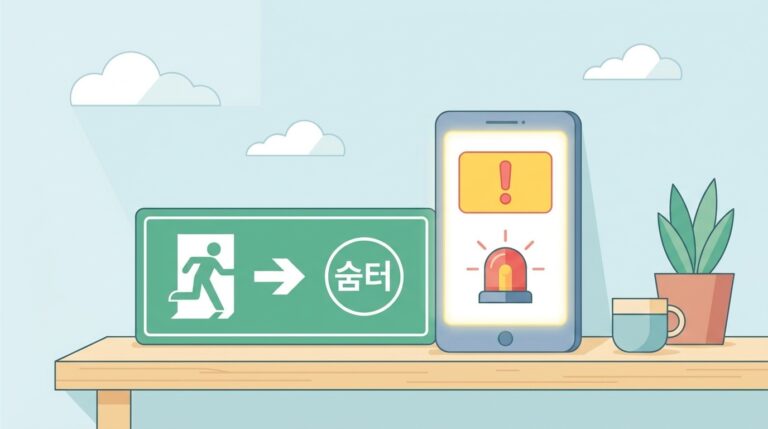
Phase 1: Empathy (Welcome to Daily Hangul!)
안녕하세요! 매일한글 (Daily Hangul) family! It is your trusted local culture navigator and chief editor here.
Imagine this: You are relaxing in your cozy Seoul officetel, sipping sweet banana milk, when suddenly—BEEP! BEEP! BEEP!—a loud, siren-like alarm pierces through your phone with a bright red pop-up message entirely in Korean. Your heart drops. Is it a typhoon? An earthquake? Or just a heavy rain warning?
If you have watched K-Dramas like the realistic disaster series D-Day (디데이) or the action-comedy film Exit (엑시트), you know how crucial split-second decisions and clear communication are during an emergency. In Korea, natural disasters like summer typhoons (태풍) and occasional earthquakes (지진) do happen, and the local emergency system is incredibly fast. However, if your Korean is limited to standard textbook scripts, you might miss the vital, split-second cues used by locals during an evacuation.
Don’t panic! Today, we are upgrading your safety toolkit to B2 (Intermediate) level. Based on real feedback from expats and travelers living in Korea, this guide will teach you not just what to say, but how to read the room, understand local safety alerts, and react calmly and quickly like a native.
Phase 2: Deep Dive into 3 Essential Emergency Expressions
During a crisis, you don’t have time to conjugate complex grammar. You need direct, active, and culturally natural expressions. Let’s master the top three safety phrases.
1. 대피소로 대피해야 해요 (dae-pi-so-ro dae-pi-hae-ya hae-yo)
- Pronunciation: Dae-pee-so-ro dae-pee-hae-ya hae-yo (Sounds like: “Day-pee-so” + “ro” + “day-pee-hay-ya” + “hay-yo”)
- Meaning: “We must evacuate to a shelter.”
- K-Culture Moment: You will hear this phrase shouted by brave main characters in disaster movies like Tsunami (해운대) as they guide terrified citizens away from rising coastal waters.
- Editor’s Insight: The word 대피소 (dae-pi-so) combines 대피 (evacuation/shelter) and 소 (place). In Korea, public subway stations, underground parking lots, and designated community centers double as emergency shelters. Adding -해야 해요 (must do) shows a strong, necessary obligation during critical moments.
- Situation Spectrum:
- Casual (To close friends): 대피소로 대피해야 돼! (dae-pi-so-ro dae-pi-hae-ya dwae!) | ✅
- Semi-formal (To neighbors/strangers): 대피소로 대피해야 해요. | ✅
- Formal (Official announcements/police): 대피소로 대피하시기 바랍니다. (dae-pi-so-ro dae-pi-ha-si-gi ba-ram-ni-da) | ✅
- 🤔 Think About It: How does your home country mark emergency shelters? In Korea, you will see yellow and black signs pointing to “지하 대피소” (Underground Shelter) near almost every subway entrance.
2. 재난문자 왔어요? (jae-nan-mun-ja wat-seo-yo?)
- Pronunciation: Jaen-an-moon-ja wat-suh-yo? (Sounds like: “Jan-an-moon-jah” + “wat-suh-yo?”)
- Meaning: “Did you get the emergency disaster alert?”
- K-Culture Moment: In daily life, when everyone’s phone buzzes simultaneously in a crowded subway car, Koreans immediately look at each other and ask this exact question to check what just happened.
- Editor’s Insight: 재난문자 (jae-nan-mun-ja) literally translates to “disaster text message.” The Korean government sends these localized cell-broadcast alerts for everything from heavy snow to missing persons and severe natural disasters. Asking if someone received it is the fastest way to verify safety updates.
- Situation Spectrum:
- Casual: 재난문자 왔어? (jae-nan-mun-ja wat-seo?) | ✅
- Semi-formal: 재난문자 왔어요? | ✅
- Formal: 재난문자를 수신하셨습니까? (jae-nan-mun-ja-reul su-sin-ha-seot-seum-ni-ka?) | ⚠️ (Too stiff for real-life conversations; stick to semi-formal!)
- 🤔 Think About It: Korea’s digital safety infrastructure is incredibly proactive. How does receiving real-time government alerts change how safe you feel in a foreign country?
3. 낙하물을 조심하세요 (nak-ha-mul-eul jo-sim-ha-se-yo)
- Pronunciation: Nak-ha-mool-eul jo-seem-ha-seh-yo (Sounds like: “Knock-ha-mool-ool” + “jo-seem-ha-say-yo”)
- Meaning: “Watch out for falling objects / debris.”
- K-Culture Moment: During a severe typhoon in Seoul, news anchors standing in heavy wind coats will repeatedly warn viewers about flyaway signs and rooftop tiles using this exact vocabulary.
- Editor’s Insight: 낙하물 (nak-ha-mul) is a Hanja-based (Sino-Korean) word: 낙 (fall) + 하 (down) + 물 (object). During earthquakes or typhoons in dense urban areas like Gangnam or Hongdae, falling air conditioners, building tiles, and commercial signs pose the biggest threat.
- Situation Spectrum:
- Casual: 떨어지는 거 조심해! (tteol-eo-ji-neun geo jo-sim-hae! – “Watch out for dropping things!”) | ✅
- Semi-formal: 낙하물 조심하세요. | ✅
- Formal: 낙하물에 유의하시기 바랍니다. (nak-ha-mul-e yeu-ui-ha-si-gi ba-ram-ni-da) | ✅
- 🤔 Think About It: In highly urbanized areas, danger during natural disasters often comes from artificial structures rather than nature itself. Are you aware of your surroundings when walking through tall cityscapes during a storm?
Phase 3: Textbook Korean vs. Real-Life Korean
When disaster strikes, textbooks often teach formal, slow-paced warnings. Real Koreans, however, use shorter, high-urgency colloquialisms. Let’s compare!
Situation 1: During an Earthquake (지진)
- 📖 Textbook Style:
“지진이 발생했습니다. 안전한 곳으로 대피하십시오.”
(An earthquake has occurred. Please evacuate to a safe place.)- Why you might hesitate: This is the cold, robotic voice of an automated broadcast system. If you say this to a friend, you will sound like an emergency manual.
- 🗣️ Real-Life Korean:
“지진 났어요! 얼른 테이블 밑으로 들어가세요!”
(It’s an earthquake! Hurry, get under the table!)- 💡 Why it’s different: Locals use 지진 나다 (an earthquake happens/breaks out) instead of the formal “발생하다.” The adverb 얼른 (hurry/quickly) is preferred over “신속히” in spoken conversation to show immediate urgency.
Situation 2: During a Heavy Typhoon (태풍)
- 📖 Textbook Style:
“기상 악화로 인해 외출을 자제해 주시기 바랍니다.”
(Due to deteriorating weather conditions, please refrain from going outside.)- Why you might hesitate: This is too formal and passive for everyday warning between colleagues, classmates, or roommates.
- 🗣️ Real-Life Korean:
“태풍 오니까 오늘은 웬만하면 집콕해요.”
(The typhoon is coming, so let’s just stay home today if possible.)- 💡 Why it’s different: 웬만하면 (if possible/unless absolutely necessary) is an incredibly common intermediate-level phrase. 집콕 (jib-kok) is a popular modern slang word meaning “nesting at home” or “staying indoors like a hermit.” It sounds warm, friendly, and naturally protective.
Phase 4: K-Culture Deep Dive & Non-Verbal Survival Etiquette
4-1. “Nunchi” (눈치) & Non-Verbal Actions during Disasters
If you find yourself in an emergency in Korea, your non-verbal cues and observation skills—눈치 (Nunchi, emotional quickness)—are your best friends.
1. Protect Your Head with Anything: During an earthquake, if there are no sturdy tables, watch what the locals do. They will instantly grab heavy bags, cushions, or even thick books to shield their heads while moving toward exits.
2. Follow the Green exit signs (피난구유등): In public buildings and subway stations, look for the bright green running-man signs. Koreans are trained from school to look for these green indicators rather than trying to use elevators (엘리베이터 사용 금지).
4-2. The “Emergency Alert” Culture of South Korea
South Korea has one of the fastest disaster-broadcasting networks in the world.
* 재난문자 (Disaster Text Alerts): These alerts are categorized into three levels: 재난경보 (Emergency Disaster), 긴급재난 (Urgent Disaster), and 안전안내 (Safety Information).
* The KakaoTalk Safety Check: Whenever a major earthquake or typhoon hits, KakaoTalk (Korea’s primary messaging app) often experiences a massive traffic spike because everyone is simultaneously sending “괜찮아?” (Are you okay?) messages to family and friends. Checking in on your Korean acquaintances immediately during a localized disaster is seen as a highly polite, caring gesture that builds deep social bonds (Jeong / 정).
Phase 5: Real-Life Roleplay Scenario
Setting: You are at home in Seoul with your Korean roommate, Ji-hoon (지훈), on a summer afternoon. Suddenly, the windows begin to rattle violently, and both of your phones blast an emergency alert sound.
👥 Characters:
- Ji-hoon (지훈): Your calm but active Korean roommate.
- You (Alex): An intermediate expat trying to stay safe and communicate effectively.
🚨 [Sound effect: Heavy rain pounding against the window, followed by a loud smartphone siren]

지훈: (놀란 표정으로 휴대폰을 보며) 어? 알렉스, 방금 재난문자 확인했어요?
Ji-hoon: (With a surprised look, checking his phone) Huh? Alex, did you just check the emergency alert?

알렉스: (불안해하며) 아니요, 아직요. 무슨 일이에요? 지진인가요?
Alex: (Anxiously) No, not yet. What's going on? Is it an earthquake?

지훈: (진지하게) 아니요, 태풍 경보예요! 지금 바람이 너무 세서 창문이 깨질 수도 있겠어요.
Ji-hoon: (Seriously) No, it's a typhoon warning! The wind is so strong right now, the windows might break.

알렉스: (창문을 보며) 아, 진짜네 창문이 엄청 흔들려요! 우리 어떻게 해야 돼요?
Alex: (Looking at the window) Ah, you're right, the windows are shaking so much! What should we do?

지훈: (거실로 걸어가며) 일단 베란다 창문을 꼭 닫고 잠가야 해요. 그래야 안 깨져요.
Ji-hoon: (Walking to the living room) First, we must tightly close and lock the balcony windows. That's how they don't break.

알렉스: (서두르며) 제가 거실 창문 잠글게요! 밖에 낙하물 조심하라는 문자도 있네요.
Alex: (Hurrying) I'll lock the living room windows! The text also says to watch out for falling objects outside.

지훈: (고개를 끄덕이며) 맞아요. 오늘은 웬만하면 나가지 말고 집콕해요. 배달도 안 될 거예요.
Ji-hoon: (Nodding) Exactly. Let's not go out today if possible and just stay home. Deliveries won't work either.

알렉스: (안심하며) 네, 냉장고에 라면 있으니까 집에서 조용히 태풍이 지나가길 기다려요.
Alex: (Relieved) Right, we have ramyeon in the fridge, so let's quietly wait at home for the typhoon to pass.
🔀 Choose Your Next Move! (Interactive Branch)
What would you say next if the power suddenly went out (정전)?
- Option A: “아이고 무서워요! 나 지금 당장 편의점 갔다 올게요!”
(Oh my god I’m scared! I’m going to the convenience store right now!) - Option B: “지훈 씨, 정전됐네요. 만약을 대비해서 손전등이랑 비상식량 어디 있는지 확인해 볼까요?”
(Ji-hoon, the power went out. Just in case, shall we check where the flashlight and emergency rations are?) - Option C: “정전이니까 귀찮네요. 우리 그냥 심심한데 게임이나 해요.”
(Since the power is out, this is annoying. Let’s just play a game because I’m bored.)
💡 Feedback & Evaluation:
- Choice A (Bad/Dangerous): 🚫 Risk! Going outside during a typhoon power outage is extremely dangerous due to flying signboards and risk of electrocution from streetlights.
- Choice B (Best): 🏆 Perfect! You showed proactive safety awareness, used respectful yet natural cooperative language (-해 볼까요?), and addressed the situation systematically. Ji-hoon will be highly impressed by your composure!
- Choice C (Mediocre): ⚠️ Too casual. While staying calm is good, ignoring a blackout during a severe storm without checking safety gear might leave you vulnerable if the situation deteriorates.
Phase 6: 10-Second Emotional Shadowing Drill
When you are scared, your voice changes. Practice these natural breathing breaks (/) and emotional cues to sound natural when delivering these vital phrases under pressure.
- [🚨 Urgently and Loudly]
“태풍 때문에 / 밖에 / 낙하물이 많아요! / 절대 나가면 안 돼요!”
(Tae-pung ttae-mun-e / bakk-e / nak-ha-mul-i man-a-yo! / jeol-dae na-ga-myeon an dwae-yo!)- Translation: Because of the typhoon, there are many falling objects outside! You must absolutely not go out!
- [😰 Anxiously but Calmly]
“정전이 됐는데… / 우리 / 비상용 랜턴 / 어디 있는지 알아요?”
(Jeong-jeon-i dwaet-neun-de… / u-ri / bi-sang-yong raen-teon / eo-di in-neun-ji a-ra-yo?)- Translation: The power went out… do you know where our emergency lantern is?
Phase 7: K-Culture Mini Dictionary (disaster Edition)
- 재난문자 (jae-nan-mun-ja) | Emergency Disaster Alert
- Usage: Real-time regional safety alerts sent directly to smartphones by local city halls based on cell-tower locations.
- 국민재난안전포털 (gung-min jae-nan an-jeon po-teol) | National Disaster Safety Portal
- Usage: The official portal run by the Ministry of the Interior and Safety where you can find safety guidelines in English and lists of local shelter addresses.
- 안전디딤돌 (an-jeon di-dim-dol) | Safety Stepping Stone App
- Usage: The government’s official multilingual disaster safety app. Highly recommended for travelers and expats in South Korea.
- 민방위 (min-bang-wi) | Civil Defense
- Usage: National emergency drills held periodically in Korea. If you hear sirens on a weekday afternoon and traffic stops for 15 minutes, it is likely a civil defense drill!
Phase 8: Emergency Survival Kit for Travelers
Survival Phrases TOP 3
- 도와주세요! (do-wa-ju-se-yo!) – “Help me!”
- 대피소가 어디예요? (dae-pi-so-ga eo-di-ye-yo?) – “Where is the shelter?”
- 다친 사람이 있어요. (da-chin sa-ram-i is-seo-yo.) – “There is an injured person.”
📝 Editor’s Travel Note
Before traveling or moving to Korea, download the “안전디딤돌 (Emergency Ready App)” on your smartphone. It provides real-time English translations of disaster alerts and uses interactive maps to show emergency shelters near you even if you don’t have active mobile data. Also, keep Naver Maps (네이버 지도) bookmarked, as it quickly updates flooded roads, blocked streets, and train delays during severe storms.
(Note: Always check the latest operating system compatibility for government safety apps.)
Phase 9: One Step Deeper (Reflecting on Korean Safety Culture)
In Korea, disaster response is deeply connected to the “Palli-Palli” (빨리빨리 – fast-fast) culture. Because Korea is highly urbanized and digitally connected, emergency responses from both police and citizens are incredibly rapid. When a typhoon hits, you will see local community apps, neighborhood KakaoTalk groups, and store owners instantly sharing real-time localized warnings.
This rapid response represents a collective community responsibility. In times of crisis, Koreans are quick to coordinate and help clear roads or share emergency supplies with neighbors.
💬 Your Turn: How does your hometown react to natural disasters? Do you have digital alerts like Korea’s “재난문자”? Let’s discuss in the comments below!
Phase 10: FAQ & Common Mistakes
Q: I received an alert in Korean but don’t understand it. What should I do immediately?
A: Do not swipe it away! Immediately take a screenshot. You can upload the screenshot to translation apps like Papago or Google Translate to instantly decode the warning. Alternatively, open the 안전디딤돌 app to check current alerts in English.
Q: Can I run to a subway station during an earthquake?
A: Yes, Korean subway stations are built to withstand high seismic activity and often act as official civil shelters. However, during active shaking, shield your head and stay under a sturdy table first. Once the heavy shaking stops, use stairs (never elevators) to evacuate to an open safety zone or designated shelter.
Q: Are emergency services free in Korea?
A: Absolutely. Calling 119 for fire, rescue, and medical emergencies, or 112 for police, is completely free, and they provide translation services for non-Korean speakers.
🚨 Common Mistakes Warning Board
- Mistake: Ignoring the siren sound on your phone thinking it’s just spam.
- Correct Action: Even if it’s frequent during summer, always glance at the text to spot critical keywords like 태풍 (Typhoon), 호우 (Heavy Rain), or 지진 (Earthquake).
- Mistake: Trying to use the elevator during a blackout or earthquake evacuation.
- Correct Action: Elevators can trap you. Always use the emergency exit stairs (비상구 계단).
- Mistake: Walking near active street drains or riverfront parks (like Han River Parks) during heavy rain.
- Correct Action: Water levels in Korean urban rivers rise rapidly within minutes. Stay far away from underpasses and low-lying pathways.
Phase 11: Action Missions for Today!
- Bronze Mission: Open your phone’s translation app and learn to recognize these three written words instantly: 대피 (Evacuation), 경보 (Warning), and 주의보 (Advisory).
- Silver Mission: Share this post on your social media or with a friend living in Korea to make sure they know how to find local emergency shelters.
- Gold Mission: Open [Naver Map] or [Kakao Map] and locate the nearest 대피소 (Shelter) from your current residence or accommodation.
🎮 K-Culture Mission
The next time you watch a modern K-Drama, listen closely when a character’s phone goes off. Can you spot whether they say “재난문자” or react to a weather warning? Let us know which drama you spotted it in!
Phase 12: Interactive Quiz Challenge
Let’s test your survival Korean skills! Can you get a perfect score?
1. Situational Judgment Quiz
You are walking through Hongdae and suddenly feel the ground shaking. The alarms sound. Which of the following is the best phrase to yell to warn nearby friends?
* A) “기상청 특보를 확인하십시오!”
* B) “지진 났어요! 머리 보호하고 낙하물 조심해요!”
* C) “태풍이 오니까 집콕해요.”
👉 Click to reveal the Correct Answer & Explanation
Correct Answer: B
Explanation: B is highly natural, urgent, and addresses both the immediate crisis (“지진 났어요!” – Earthquake!) and safety instructions (“머리 보호하고 낙하물 조심해요!” – Protect your head and watch out for falling debris!). Option A is too formal/robotic, and Option C is for typhoons, not earthquakes.
2. Fill in the Blanks
Complete this natural intermediate sentence:
“오늘 태풍이 엄청 심하니까 밖에 나가지 말고 집에서 ________ 해요.”
(Today the typhoon is really severe, so don’t go outside and let’s just stay home.)
👉 Click to reveal the Correct Answer
Correct Answer: 집콕 (jib-kok)
Explanation: “집콕하다” is the perfect, trendy intermediate slang to describe cozying up at home to stay safe from the storm outside!
3. True or False? (Korean Culture Quiz)
Q: In South Korea, subway stations serve as designated civil defense shelters.
* True or False?
👉 Click to reveal the Correct Answer
Correct Answer: True
Explanation: Yes! Due to their deep underground structure and high seismic durability, most major Korean subway stations are officially certified shelters (대피소) equipped with basic emergency supplies.







