

Beyond ‘I’ and ‘E’: How to Talk About Your MBTI and Personality in Korean Like a True Local
Phase 1: The Ultimate Icebreaker in Modern Korea
“안녕하세요! (An-nyeong-ha-se-yo!) Hello! I’m your Daily Hangul Editor-in-Chief.”
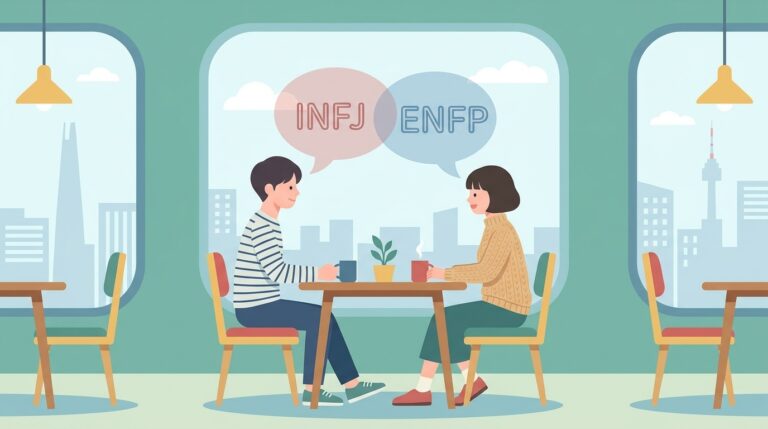
Imagine walking into a trendy café in Hongdae, Seoul. You sit down with a group of new Korean friends, and within five minutes of casual chatter, someone looks at you with sparkling eyes and asks:
“혹시… MBTI가 어떻게 되세요?” (Hok-si… MBTI-ga eo-tteo-ke doe-se-yo? / By the way… what is your MBTI?)
In modern South Korea, MBTI (the Myers-Briggs Type Indicator) is no longer just a psychological test; it is the ultimate social currency and icebreaker. It has almost entirely replaced the traditional “What is your blood type?” or “What is your zodiac sign?” questions.
But here is the real pain point for intermediate (B1) learners: when someone asks you about your MBTI, saying “I am an INFP” or “I am an ESTJ” in English is too simple. And relying on basic textbook terms like “착해요” (I’m nice) or “조용해요” (I’m quiet) doesn’t capture the true, colorful depth of your unique personality.
To help you truly connect and laugh with your Korean friends, we have prepared a deep-dive cultural and linguistic guide. This is based on real-life case studies of our learners who went from feeling awkward during social gatherings to being the life of the party by mastering local personality descriptions. Let’s dive in!
Phase 2: Deep Dive into 3 Core Expressions
Here are three essential, high-impact personality expressions that native speakers use daily when discussing MBTI.
1. 낯을 가리다 (nach-eul garida)
- Pronunciation: [nach-eul ga-ri-da] (Sounds like “Notch-ool gah-ree-dah”)
- Meaning: To be shy around strangers (Literally: “To screen/filter faces”)
- K-Culture Moment: You often see introverted K-Pop idols on variety shows sitting quietly in the corner during the first episode. The editors will put a caption over them: “아직 낯가리는 중…” (Still screening faces… / Still shy…).
- Editor’s Insight: This is the gold standard phrase for anyone with an “I” (Introverted) in their MBTI. It doesn’t mean you are anti-social; it just means you take a little time to warm up to new people.
- Situation Spectrum: Casual (✅), Semi-formal (✅), Formal (⚠️ – use “낯을 좀 가리는 편입니다”)
- 🤔 Think About It: In Korea, admitting you “낯을 가리다” is often viewed as polite and modest, showing that you respect social boundaries, whereas in some Western cultures, immediate extroversion is highly expected. How does your culture view initial shyness?
2. 귀를 기울이다 (gwi-reul gi-ul-i-da)
- Pronunciation: [gwi-reul gee-ool-ee-da] (Sounds like “Gwee-rul gee-ool-ee-dah”)
- Meaning: To listen attentively (Literally: “To tilt one’s ears”)
- K-Culture Moment: Think of your favorite K-Drama “second lead”—the warm-hearted friend who sits with the main character, listening to their worries without interrupting. They are practicing “귀를 기울이기.”
- Editor’s Insight: This is the perfect expression for “F” (Feeling) types who excel at empathy. It conveys active, deeply respectful listening.
- Situation Spectrum: Casual (✅), Semi-formal (✅), Formal (✅)
- 🤔 Think About It: Why do you think Korean uses physical metaphors like “tilting ears” to express deep empathy? It shows how physical presence and body language are deeply integrated into Korean communication.
3. 계획적이다 (gye-hoek-jeok-i-da)
- Pronunciation: [gye-hoek-jeok-ee-da] (Sounds like “Gyeh-hwek-jeok-ee-dah”)
- Meaning: To be organized, structured, or planned
- K-Culture Moment: On travel reality shows, you will see the “J” (Judging) type member bringing an hourly color-coded Excel spreadsheet of the trip itinerary, while the “P” (Perceiving) type member just wants to follow their nose.
- Editor’s Insight: If you are a “J” in the MBTI system, this word is your identity. Its opposite is “즉흥적이다” (jeuk-heung-jeok-i-da / spontaneous, improvised).
- Situation Spectrum: Casual (✅), Semi-formal (✅), Formal (✅)
- 🤔 Think About It: Korea’s rapid economic and social development heavily prioritized efficiency and planning. Do you think being “계획적” is valued more than being “즉흥적” in your country?
Phase 3: Textbook Korean vs. Real Korean
Let’s upgrade your classroom Korean to natural, street-smart conversational phrases!
Situation 1: Describing a highly social personality
- 📖 Textbook Korean: “저는 사교적이에요.” (jeo-neun sa-gyo-jeok-i-e-yo. / I am sociable.)
- 🗣️ Real Korean: “저 완전 인싸예요!” (jeo wan-jeon in-ssa-yeo-yo! / I am a total insider/extrovert!)
- 💡 Why the difference? While “사교적” is correct, it sounds like it came straight out of a written resume. Native speakers under 40 almost always use “인싸” (from “insider”) to describe a highly social, fun-loving person.
Situation 2: Describing a meticulous planner
- 📖 Textbook Korean: “저는 항상 계획을 세웁니다.” (jeo-neun hang-sang gye-hoe-geul se-up-ni-da. / I always make plans.)
- 🗣️ Real Korean: “제가 은근히 계획적이에요.” (je-ga eun-geun-hi gye-hoek-jeok-i-e-yo. / I’m secretly/surprisingly a planner.)
- 💡 Why the difference? Using “은근히” (subtly/secretly/surprisingly) adds a touch of natural humility and nuance to your personality description, making you sound extremely fluent.
Phase 4: K-Culture Deep Dive & Non-verbal Manners
4-1. Physical Gestures and Shyness
When describing yourself as someone who “낯을 가리다” (shy), it is common to physically shrink your shoulders slightly, make gentle eye contact, and wave a hand dismissively while smiling. This non-verbal display of modesty (“아니에요~” / “No, it’s not like that~”) is crucial. Overly direct eye contact while claiming to be shy can feel contradictory to Koreans!
4-2. The MBTI Blind Date (MBTI 소개팅)
In Korea, young people even look at MBTI compatibility when going on blind dates. There are viral YouTube videos of “MBTI blind dates” where an INFP meets an ESTJ to see if opposites attract. Knowing how to playfully discuss these letters will immediately make you feel like part of the group.
Phase 5: Real-Life Roleplay Scenario
Setting: A cozy, warm-lit café in Yeonnam-dong.
Characters:
* Minjun (민준): An energetic, open-minded Korean friend (ENFP).
* Sofia (소피아): A warm but slightly reserved exchange student (INFJ).
민준: 소피아 씨, 혹시 MBTI가 어떻게 되세요?
      [Sofia-ssi, hok-si MBTI-ga eo-tteo-ke doe-se-yo?]
      (Sofia, by the way, what is your MBTI?)

소피아: 저요? 저는 INFJ예요. 민준 씨는요?
        [Jeo-yo? Jeo-neun INFJ-yeo-yo. Min-jun-ssi-neun-yo?]
        (Me? I'm an INFJ. What about you, Minjun?)

민준: 🎭 (손뼉을 치며) 대박! 저는 ENFP예요! 우리 완전 찰떡궁합이네요!
      [Daebak! Jeo-neun ENFP-yeo-yo! Uri wan-jeon chal-tteok-gung-hap-i-ne-yo!]
      (Wow, awesome! I'm an ENFP! We are a perfect match!)

소피아: 🎭 (부끄러워하며) 아, 진짜요? 근데 저 처음에는 낯을 엄청 가려요.
        [Ah, jin-jja-yo? Geun-de jeo cheo-eum-e-neun nach-eul eom-cheong ga-ryeo-yo.]
        (Oh, really? But I am super shy around strangers at first.)

민준: 에이, 전혀 그렇게 안 보여요! 말을 너무 잘하시는데요?
      [Ei, jeon-hyeo geu-reoh-ge an bo-yeo-yo! Mal-eul neo-mu jal-ha-si-neun-de-yo?]
      (Eh, you don't seem like that at all! You speak so well!)

소피아: 🎭 (미소를 지으며) 친해지면 말을 많이 하는데, 처음엔 주로 귀를 기울이는 편이에요.
        [Chin-hae-ji-myeon mal-eul ma-ni han-un-de, cheo-eum-en ju-ro gwi-reul gi-ul-i-neun pyeon-i-e-yo.]
        (I talk a lot once we get close, but at first, I tend to listen attentively.)

민준: 역시 INFJ네요! 다른 사람 말을 진짜 잘 들어주는 따뜻한 성격!
      [Yeok-si INFJ-ne-yo! Da-reun sa-ram mal-eul jin-jja jal deol-eo-ju-neun tta-tteut-han seong-gyeok!]
      (As expected of an INFJ! A warm personality that listens to others so well!)

소피아: 좋게 봐주셔서 감사해요. 민준 씨는 엄청 즉흥적인 편인가요?
        [Jo-ke bwa-ju-syeo-seo gam-sa-hae-yo. Min-jun-ssi-neun eom-cheong jeuk-heung-jeok-in pyeon-in-ga-yo?]
        (Thank you for seeing me in a positive light. Are you a very spontaneous person, Minjun?)
🔀 Choose Your Branch!
How should Sofia respond to Minjun’s enthusiastic energy?
- A) “맞아요! 저 완전 집순이/집돌이예요!” (That’s right! I’m a total homebody!)
- Feedback: BEST! This uses the trendy slang “집순이” (female homebody) or “집돌이” (male homebody). It perfectly explains why an “I” type loves staying home, prompting a big laugh of agreement.
- B) “저는 MBTI 안 믿어요. 비과학적이에요.” (I don’t believe in MBTI. It’s unscientific.)
- Feedback: BAD. While true, this completely kills the fun social vibe of the conversation. Keep it playful!
- C) “제가 생각이 너무 많아서 그래요.” (It’s because I have too many thoughts.)
- Feedback: RISK. It is accurate for an INFJ, but it might sound a bit too serious or heavy for a casual café icebreaker. Add a smile or “은근히” to soften it.
Phase 6: 10-Second Emotional Shadowing Drill
Practice these sentences out loud to master the natural emotional rhythm of Korean speech!
- “저 / 완전 / 낯가림 심한데, / 친해지면 / 엄청 시끄러워요!”
- Pronunciation: [Jeo / wan-jeon / nach-ga-rim sim-han-de, / chin-hae-ji-myeon / eom-cheong si-kkeu-reo-wo-yo!]
- Emotion: [😊 Playfully confessing with a bright grin]
- Meaning: I am super shy around strangers, but once we get close, I am incredibly loud!
- “제 친구는 / 엄청 계획적인데, / 저는 / 진짜 즉흥적이에요.”
- Pronunciation: [Je chin-gu-neun / eom-cheong gye-hoek-jeok-in-de, / jeo-neun / jin-jja jeuk-heung-jeok-i-e-yo.]
- Emotion: [🤷 Confessing with a light, cute shrug]
- Meaning: My friend is super organized, but I am really spontaneous.
Phase 7: K-Culture Mini Dictionary
- 인싸 (In-ssa) | Insider / Social butterfly. Used to describe someone who gets along with everyone.
- 아싸 (Ah-ssa) | Outsider / Loner. Often used self-deprecatingly by introverts who prefer staying home.
- 공감능력 (Gong-gam-neung-ryeok) | Empathy / Ability to empathize. Highly discussed when comparing “F” (Feeling) and “T” (Thinking) types.
- 과몰입 (Gwa-mor-ip) | Over-immersion / Hyper-fixation. Used when someone is extremely obsessed with MBTI (“MBTI 과몰입러”).
Phase 8: Survival Kit for Travelers
Survival Expressions TOP 3
- “MBTI가 어떻게 되세요?” [MBTI-ga eo-tteo-ke doe-se-yo?] | What is your MBTI? (Your go-to icebreaker!)
- “저랑 MBTI 똑같으시네요!” [Jeo-rang MBTI ttok-gat-eu-si-ne-yo!] | Our MBTIs are exactly the same!
- “저는 뼛속까지 ‘I’예요.” [Jeo-neun ppyeot-sok-kka-ji ‘I’-yeo-yo.] | I am an ‘I’ to my absolute bones (a true introvert).
Editor’s Travel Note
When traveling around trendy Seoul neighborhoods like Seongsu-dong or Hongdae, you will see photobooths and pop-up stores themed around MBTI. To navigate these spots easily, make sure to download the Naver Map App to find local hot spots where youth culture thrives!
Phase 9: Go Deeper (Cultural Reflection)
Why did MBTI take over Korea so deeply? Historically, Korea has been a collective society that highly values social harmony and group dynamics. However, modern Koreans also crave individual expression.
MBTI bridges this gap perfectly. It allows individuals to proudly express their unique quirks while providing a structured, safe framework to understand and respect other people’s boundaries without causing conflict. It is a modern, digitized evolution of “Nunchi” (눈치)—the art of reading the room.
💬 Your Turn: What is your MBTI, and do you think your Korean personality traits match your type? Let us know in the comments below!
Phase 10: FAQ & Avoiding Misunderstandings
Q: Is it considered rude to ask someone’s MBTI during a first meeting in Korea?
A: Not at all! In fact, it is considered one of the safest, most polite, and most engaging icebreakers you can use with people in their teens, 20s, and 30s. It immediately opens up lighthearted conversation.
Q: What does “T발 C야?” mean? I keep seeing it on Korean social media.
A: This is a humorous, slangy pun used to playfully tease a “T” (Thinking) type for being too blunt or cold. It sounds very similar to a strong Korean curse word, but disguised as MBTI letters. Only use this with extremely close friends!
Q: How do I say “I don’t really believe in MBTI” politely?
A: You can say: “저는 MBTI를 그냥 재미로만 봐요.” (jeo-neun MBTI-reul geu-nyang jae-mi-ro-man bwa-yo / I just look at MBTI for fun).
🚨 Common Mistakes Board
- Wrong: “저는 내향적을 좋아해요.” (I like introverted.)
- Correct Action: Use the adjective form: “저는 내향적인 편이에요.” (I tend to be introverted.)
- Wrong: “너는 진짜 차가운 성격이야.” (You have a cold personality.)
- Correct Action: Saying this directly can sound very offensive. Instead, say: “너는 완전 이성적이다!” (You are so rational/logical!).
- Wrong: Pronouncing MBTI as “M-B-T-Eye” with heavy English stress.
- Correct Action: Pronounce it flatly in Korean phonetics: [엠비티아이 / Em-bi-ti-a-i].
Phase 11: Action Mission
- Bronze Mission: Write your MBTI and one sentence describing your personality (e.g., “저는 낯을 좀 가려요”) in your journal.
- Silver Mission: Share an MBTI meme on Instagram and tag your Korean friend with the caption: “우리 완전 찰떡궁합!” (We are a perfect match!).
- Gold Mission: Next time you meet a Korean speaker, ask them: “혹시 MBTI가 어떻게 되세요?” and use our shadowing drill expressions in real life!
Phase 12: Interactive Quiz Challenge
1. Situation Quiz
Your new Korean colleague listens to your problems attentively at work and offers comforting words. Which expression best describes them?
* A) 낯을 가려요
* B) 귀를 기울여요
* C) 즉흥적이에요
Click to reveal the answer!
Answer: B) 귀를 기울여요 (Listen attentively)
Explanation: A colleague who listens deeply to your concerns is “귀를 기울여 주는 사람” (someone who tilts their ears to listen).
2. Fill-in-the-Blank
“저는 항상 여행을 갈 때 엑셀로 일정을 짜요. 저는 아주 ________ 성격이에요.”
(Hint: I always plan my trips using Excel. I have a very planned personality.)
Click to reveal the answer!
Answer: 계획적인 (gye-hoek-jeok-in / planned)
Explanation: Excel planning is the ultimate trait of a “계획적인 성격” (planned/organized personality).







