

Talk About Korean Family Gatherings Like a Native! (Without the Awkwardness!)
Phase 1: Empathy (Welcome to the Family Table!)
안녕하세요! (An-nyeong-ha-se-yo!) Hello! I am your lead editor at Daily Hangul, your cozy Korean culture navigator.
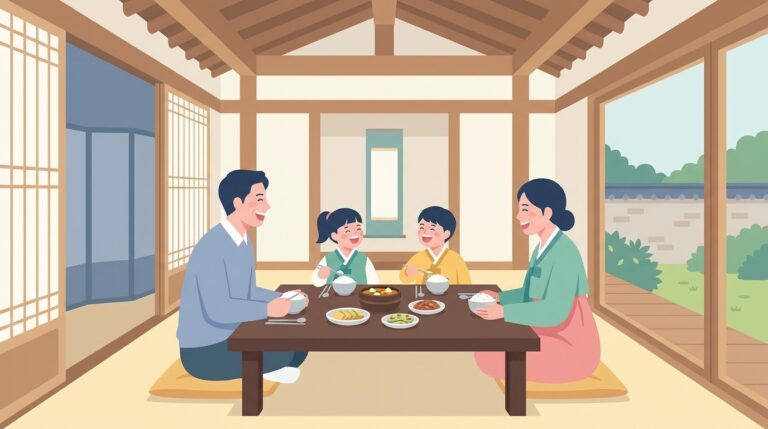
Have you ever watched a K-Drama where the entire family gathers around a massive low table, talking, laughing, passing around side dishes, and… occasionally nagging each other? Whether it is the classic heartwarming feast in Reply 1988 or a festive holiday dinner in a modern drama, Korean family gatherings—known for their warmth and chaotic energy—are a huge part of the culture.
But when a Korean friend asks you, “What did you do over the weekend?” or “Do you gather with your family often?”, do you find yourself freezing? Maybe you only know how to translate word-for-word from your native language, resulting in robotic phrases like “I ate food with my mother.”
Don’t worry! Today, we are going to learn how to talk about family gatherings in a natural, warm, and culturally authentic way. This guide is designed specifically for A2 (Elementary) learners and is packed with practical tips tested and loved by our global students. By the end of this post, you will sound like a loving family member, not a textbook!
Phase 2: Core Expressions Deep Dive
Let’s master the three most essential expressions you need to describe a family gathering.
1. 가족들이랑 밥 먹었어요. (I had a meal with my family.)
- Pronunciation: Gajok-deur-irang bap meogeoss-eoyo (gah-jok-deul-ee-rang bahp muh-guss-uh-yo)
- Meaning: Literally “I ate rice with family,” but it means “I had a meal/dinner with my family.”
- K-Culture Moment: In almost every family K-Drama, the matriarch yells, “밥 먹어!” (Come eat!). Eating together is the ultimate sign of love and connection in Korea.
- Editor’s Insight: In Korean, “밥” (bap/rice) represents any meal. Using the particle “랑” (rang/with) makes you sound friendly and conversational.
- Situation Spectrum: Casual ✅ | Semi-formal ✅ | Formal ⚠️
- 🤔 Think About It: In your culture, do you use a specific food item (like “bread” or “rice”) to mean a whole meal?
2. 오랜만에 모였어요. (We got together after a long time.)
- Pronunciation: Oraenmane moyeosseoyo (oh-raen-mahn-eh mo-yuss-uh-yo)
- Meaning: “We gathered after a long time.”
- K-Culture Moment: During traditional holidays like Chuseok (Korean Thanksgiving) or Seollal (Lunar New Year), millions of Koreans travel across the country to see their relatives. This massive migration is called “귀경길” (gwi-gyeong-gil), all just to gather oraenmane.
- Editor’s Insight: “오랜만에” (oraenmane) is a magical adverb that adds deep emotion. It hints that this gathering was special and highly anticipated.
- Situation Spectrum: Casual ✅ | Semi-formal ✅ | Formal ✅
- 🤔 Think About It: How often does your family gather? Once a month? Once a year?
3. 시끌벅적했어요. (It was noisy and lively!)
- Pronunciation: Sikkeul-beokjeok-haesseoyo (see-kkeul-buk-juk-hae-suh-yo)
- Meaning: “It was bustling / lively / loud (in a fun way).”
- K-Culture Moment: Imagine aunts gossiping in the kitchen, uncles laughing over a glass of Makgeolli, and kids running around the living room. That warm, noisy atmosphere is perfectly described as sikkeul-beokjeok.
- Editor’s Insight: While “시끄러웠어요” (sikkeureowosseoyo) just means “it was loud/annoying,” “시끌벅적하다” has a positive, cozy, and energetic nuance.
- Situation Spectrum: Casual ✅ | Semi-formal ✅ | Formal ⚠️
- 🤔 Think About It: Is your family gathering usually quiet and calm, or is it “시끌벅적”?
Phase 3: Textbook Korean vs. Real Korean
Let’s upgrade your Korean from “classroom robot” to “local resident”! Here are two common contrasts:
Scenario 1: Describing a family get-together
- 📖 Textbook: “가족 모임을 가졌습니다.” (Gajok moimeul gajeot-seumnida – We held a family meeting.)
- 🗣️ Real Korean: “가족끼리 뭉쳤어요!” (Gajok-kkiri mung-chyeosseoyo! – We got together as a family! / We hung out!)
- 💡 Why is it different? “가족 모임” sounds very formal, almost like a corporate business meeting. Using “우리끼리” (among ourselves) and the verb “뭉치다” (literally to clump/unite) sounds incredibly close, affectionate, and modern.
Scenario 2: Eating a lot of food
- 📖 Textbook: “음식을 아주 많이 먹었습니다.” (Eumsigeul aju mani meogeot-seumnida – I ate a lot of food.)
- 🗣️ Real Korean: “배 터지게 먹었어요!” (Bae teo-jige meogeosseoyo! – I ate until my stomach burst!)
- 💡 Why is it different? When you visit a Korean grandmother (할머니), she will not stop putting food on your plate. Saying “배 터지게 먹었어요” is a playful, high-compliment expression to show you thoroughly enjoyed the feast.
Phase 4: K-Culture Deep Dive & Non-verbal Manners
4-1. The Art of “Nunchi” (눈치) at the Dining Table
At a Korean family gathering, body language speaks louder than words. If you ever attend one, keep these non-verbal manners in mind:
* The Spoon Rule: Never pick up your spoon or chopsticks before the oldest person at the table (usually grandparents or parents) lifts theirs first.
* Two-Handed Respect: When passing a glass or a dish to an elder, always use both hands (or place your left hand under your right forearm/chest as a sign of respect).
4-2. The “Sweet and Sour” Holiday Culture
In K-Dramas, you might see relatives asking probing questions like, “When are you getting married?” or “Did you get a job yet?” This is called 잔소리 (Jansori – nagging). While it can be stressful, historically in Korea, asking these personal questions was a way of showing deep interest and concern (정 – Jeong). Today, young Koreans tease about this, but it remains a staple dynamic of any family reunion!
Phase 5: Real-Life Roleplay Scenario
Setting: It is Monday morning. Minjun (your Korean coworker) and Chloe (an expat living in Seoul) are chatting over coffee about their weekend.
Characters:
* 민준 (Minjun): A friendly Korean colleague who loves food.
* 클로이 (Chloe): An enthusiastic A2 Korean learner.
민준: 클로이 씨, 주말에 뭐 했어요?
      (Chloe, what did you do over the weekend?)

클로이: 🎭 (Smiling warmly) 오랜만에 가족들이랑 뭉쳤어요!
       (I hung out with my family after a long time!)

민준: 오, 진짜요? 재미있었겠네요. 어디서 만났어요?
      (Oh, really? That must have been fun. Where did you meet?)

클로이: 🎭 (Gesturing towards her stomach) 할머니 집에서 모였어요. 진짜 배 터지게 먹었어요!
       (We gathered at my grandmother's house. I seriously ate until my stomach burst!)

민준: 하하, 할머니 집밥이 최고죠! 분위기는 어땠어요?
      (Haha, grandma's home-cooked meals are the best! How was the atmosphere?)

클로이: 🎭 (Laughing) 사촌들이 많아서 아주 시끌벅적했어요.
       (I have a lot of cousins, so it was very lively and noisy.)

민준: 와, 부럽네요! 저희 집도 다음 주에 명절이라 모여요.
      (Wow, I'm jealous! My family is gathering next week for the holiday too.)

클로이: 🎭 (Clasping hands together) 우와, 좋은 시간 보내세요!
       (Oooh, have a wonderful time!)
🔀 Interactive Choice Point!
How should Chloe respond if Minjun asks: “가족들이랑 만나면 보통 뭐 해요?” (What do you usually do when you meet your family?)
- Option A: “그냥 밥만 먹고 집에 가요.” (We just eat food and go home.)
- Editor’s Feedback: [Risk] A bit too blunt and cold. It might end the conversation abruptly!
- Option B: “집밥 먹고 같이 재미있는 이야기해요.” (We eat home-cooked food and talk about fun things together.)
- Editor’s Feedback: [Best] Perfect! It is simple, warm, and natural for an A2 learner. It keeps the friendly vibe alive.
- Option C: “저는 가족을 사랑하기 때문에 항상 포옹을 합니다.” (Because I love my family, I always hug them.)
- Editor’s Feedback: [Bad] A bit overly dramatic and grammatically stiff for a casual Monday coffee chat.
Phase 6: 10-Second Emotional Shadowing Drill
Speak like a native by practicing these sentences with natural rhythm (/ represents short pauses) and the correct emotion!
- [😊 Bright & Happy]
- “오랜만에 / 가족들이랑 / 맛있는 거 / 먹었어요!”
- Pronunciation: Oraenmane / gajok-deur-irang / masinneun geo / meogeosseoyo!
- Translation: I ate delicious food with my family after a long time!
- [🤪 Playful & Full]
- “할머니 집에서 / 진짜 / 배 터지게 / 먹었어요~”
- Pronunciation: Halmeoni jib-eseo / jinjja / bae teojige / meogeosseoyo~
- Translation: At grandma’s house, I seriously ate until my stomach burst!
Phase 7: K-Culture Mini Dictionary
| Word (Korean) | Romanization | English Translation | Real-Life Usage Note |
|---|---|---|---|
| 집밥 | Jip-bap | Home-cooked meal | Used to express nostalgia for comforting, non-restaurant food. |
| 잔소리 | Jan-sori | Nagging | Usually refers to loving but annoying advice from parents or relatives. |
| 명절 | Myeong-jeol | Traditional holiday | Refers specifically to big holidays like Seollal or Chuseok. |
| 친척 | Chin-cheok | Relatives | Broad term covering uncles, aunts, and cousins. |
Phase 8: Traveler’s Survival Kit
Survival Expressions for Family Visits
- “감사히 잘 먹겠습니다!” (Gam-sahi jal meok-get-seumnida!)
- Pro Tip: Say this loudly before eating a meal prepared by a Korean host or family member. It means “I will eat gratefully!”
- “배불러요, 하지만 너무 맛있어요!” (Bae-bul-leo-yo, hajiman neomu masisseoyo!)
- Pro Tip: Use this when a relative tries to give you a 4th serving of food. It politely says, “I’m full, but it’s so delicious!”
- “새해 복 많이 받으세요!” (Sae-hae bok mani badeuseoyo!)
- Pro Tip: The ultimate greeting for Lunar New Year (Seollal). It means “Please receive a lot of good fortune in the New Year!”
🧳 Editor’s Travel Note
If you are traveling in Korea during a major holiday (명절), train tickets sell out months in advance. Make sure to download the Korail Talk App early to secure your KTX seats, or use Naver Map to find alternative express buses if trains are fully booked!
Note: Travel reservation policies and schedules may vary, so always check the official apps for the most up-to-date holiday schedules.
Phase 9: “Go One Step Deeper” (Cultural Reflection)
In Western cultures, people often say “my family,” “my mother,” or “my house.” However, in Korea, you will almost always hear “우리 가족” (our family), “우리 엄마” (our mom), or “우리 집” (our house).
This stems from Korea’s deep-rooted collectivist culture, where community and sharing take priority over individual ownership. Even if you are an only child, saying “내 엄마” (my mom) sounds very unnatural and strangely possessive to Korean ears. By using “우리,” you instantly sound warmer and more integrated into the community.
💬 Your Turn: Does your native language prefer “my” or “our” when talking about family? Share your thoughts in the comments below!
Phase 10: FAQ & Avoiding Common Mistakes
Q: Why do Koreans ask me if I have eaten (밥 먹었어?) as a greeting?
A: Historically, when food was scarce in Korea, asking if someone had eaten was a way of checking on their well-being. Today, it is simply a warm way of saying “How are you?” or “I care about you.” You don’t always have to give a detailed menu of what you ate!
Q: What is the difference between ‘삼촌’ (Samchon) and ‘이모’ (Imo)?
A: 삼촌 refers to your father’s brother (uncle), while 이모 refers to your mother’s sister (aunt). Interestingly, you can also call friendly older female restaurant staff 이모 to sound sweet and friendly!
Q: Can I use “너” (you) to my older cousin at a family gathering?
A: No! Never use “너” to anyone older than you in a Korean family. Instead, use terms like 형 (Hyeong – older brother for males), 누나 (Nuna – older sister for males), 오빠 (Oppa – older brother for females), or 언니 (Eonni – older sister for females).
🚨 Common Mistakes Alert!
- Mistake 1: Saying “내 가족” (nae gajok).
- Correct Action: Always say “우리 가족” (uri gajok – our family) to sound natural.
- Mistake 2: Sticking your chopsticks vertically into your rice bowl.
- Correct Action: Rest them on the side of your bowl or on a holder. Vertical chopsticks resemble incense burned at funerals and are considered bad luck.
- Mistake 3: Using “먹어” (eat!) to elders.
- Correct Action: Use the polite form “드세요” (deuseyo) or the highly respectful “잡수세요” (japsuseyo).
Phase 11: Action Missions
Complete these three fun steps to lock in your new Korean skills!
- 🥉 Bronze Mission: Pronounce “우리 가족이랑 밥 먹었어요” out loud 3 times in front of a mirror with a big smile.
- 🥈 Silver Mission: Take a photo of your dinner today and post it on your social media with the caption: “오늘 저녁은 집밥! 배 터지게 먹었어요! 🍚” (Tag us at #DailyHangul so we can cheer you on!)
- 🥇 Gold Mission: Next time you chat with a Korean language exchange partner or friend, start the conversation by asking: “주말에 가족들이랑 맛있는 거 먹었어요?”
🎬 K-Culture Bonus Mission: Watch Episode 1 of the drama Reply 1988 on Netflix. Count how many times the neighbors share plates of food with each other before dinner!
Phase 12: Interactive Quiz Challenge
Test your knowledge and see if you are ready for a real Korean family dinner!
1. Which expression means “We got together after a long time”?
- A) 오랜만에 모였어요.
- B) 지금 배고파요.
- C) 가족이 많아요.
2. Fill in the blank: Koreans say “________ 가족” (our family) instead of “내 가족” (my family).
- (Hint: Two letters in Hangul!)
3. True or False: It is perfectly polite to start eating before your grandparents lift their spoon.
- True / False
🎉 Click here to reveal the answers and explanations!
Answers:
- A) 오랜만에 모였어요. (Oraenmane moyeosseoyo).
- Explanation: “오랜만에” means “after a long time,” and “모였어요” means “gathered.”
- 우리 (Uri)
- Explanation: “우리” means “we/our” and is the culturally correct way to refer to family.
- False
- Explanation: Always wait for the elders to lift their spoons first as a sign of respect!
How did you do? If you got 3/3, you are officially ready to join a Korean family feast! 🥳






