

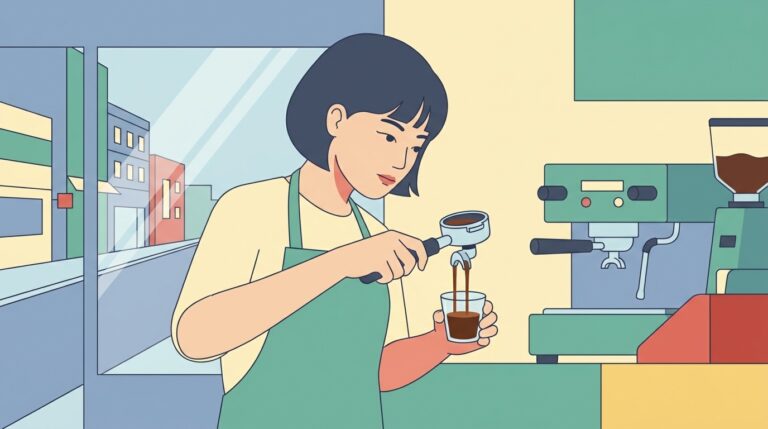
Decode Korean Espresso Secrets: Mastering Espresso Extraction for Your Dream Seoul Cafe
Phase 1: Empathy (스토리 몰입형 오프닝)
안녕하세요! Welcome back to another premium edition of Daily Hangul, your go-to space for mastering real-world Korean. I’m your senior editor and cultural navigator.
Imagine this: You are standing in a trendy, minimalist specialty cafe in Seongsu-dong (성수동)—the Brooklyn of Seoul. The air is thick with the rich, nutty aroma of freshly roasted beans. You’ve dreamed of opening your own café in Korea, or perhaps collaborating with top-tier Korean baristas. You step up to the sleek, multi-group Synesso espresso machine, ready to dial in the perfect shot. But as the espresso begins to extract, it spirts wildly, creating a messy channel. The head barista glances over and asks, “원두 분쇄도 조절 다시 해야 할 것 같은데, 채널링 나나요?” (I think we need to adjust the grind size, is it channeling?)
Suddenly, the C1 Korean you studied from general textbooks feels miles away from the technical, fast-paced language of a professional Korean bar. Understanding the physics of espresso extraction is hard enough, but discussing variables like pressure, flow rate, and channeling in natural Korean is a whole different beast.
Don’t worry! Today, we are diving deep into the exact terminology, professional nuances, and cultural dynamics of the Korean specialty coffee scene. Based on feedback from real foreign entrepreneurs who successfully launched cafes in Seoul, this guide will elevate your Korean from “just ordering a coffee” to “mastering the bar.”
Phase 2: Deep Dive into 3 Key Expressions
To talk like a pro on the Korean cafe floor, you need to master these three advanced expressions.
1. 과소 추출 (Gwaso Chuchul) vs. 과다 추출 (Gwada Chuchul)
- Pronunciation: Gwa-so Chu-chul / Gwa-da Chu-chul (Sounds like “Gwah-so Choo-chool” / “Gwah-dah Choo-chool”)
- Meaning: Under-extraction vs. Over-extraction
- K-Culture Moment: In coffee competition documentaries or professional vlogs on YouTube (like Bean Brothers or Fritz Coffee Company), you will constantly hear roasters diagnosing a shot’s flavor profile using these terms.
- Editor’s Insight: 과(Gwa) means “excess” or “surpassing,” 소(So) means “small/under,” and 다(Da) means “many/over.” 추출(Chuchul) is extraction. If your espresso tastes overly sour, salty, and thin, it’s 과소 추출. If it is intensely bitter, hollow, and dry, it’s 과다 추출.
- Situation Spectrum: Casual 🚫 | Semi-formal ⚠️ | Formal ✅ (These are highly technical, professional terms used in the bar or business meetings.)
- 🤔 Think About It: In English, we often use the verbs “under-extracted” or “over-extracted” casually. In Korean, the nouns 과소 추출 and 과다 추출 are combined with action verbs like 되다 (to become) or 나타나다 (to appear). How does nominalizing these concepts change the way you analyze the science of coffee?
2. 채널링 현상 (Chaeneolring Hyeonsang)
- Pronunciation: Chae-neol-ring Hyeon-sang (Sounds like “Chae-nuhl-ring Hyuhn-sahng”)
- Meaning: Channeling (The phenomenon where water finds the path of least resistance in the coffee puck)
- K-Culture Moment: Watch any Korean barista’s “ASMR Bottomless Portafilter” Instagram Reel. When a shot sprays, the comments will immediately light up with: “앗, 채널링 났네요! 템핑 다시 하셔야 할 듯” (Ah, channeling occurred! Looks like you need to tamp again).
- Editor’s Insight: Koreans love adding the word 현상 (hyeonsang – phenomenon) to English loanwords to make them sound more academically or technically precise in a professional setting.
- Situation Spectrum: Casual ⚠️ | Semi-formal ✅ | Formal ✅
- 🤔 Think About It: Why do you think the Korean specialty coffee scene relies so heavily on English terms like “channeling” rather than creating pure Korean words? How does this reflect Korea’s rapid adoption of global coffee standards?
3. 분쇄도 조절 (Bunsaedo Jojeol)
- Pronunciation: Bun-sae-do Jo-jeol (Sounds like “Boon-sae-doh Joh-juhl”)
- Meaning: Grind size adjustment / dialing in
- K-Culture Moment: During the morning rush, a head barista will check the humidity and tell the staff: “오늘 날씨 흐려서 원두가 습기 먹었으니까 분쇄도 조절 좀 해줘요.” (Since it’s cloudy today and the beans absorbed moisture, adjust the grind size.)
- Editor’s Insight: 분쇄(Bunsae) means grinding/pulverizing, 도(Do) means degree/level, and 조절(Jojeol) means adjustment. Mastering 분쇄도 조절 is considered the absolute core skill of a professional barista in Korea.
- Situation Spectrum: Casual ⚠️ | Semi-formal ✅ | Formal ✅
- 🤔 Think About It: In Korea, precision is respect. Adjusting the grind size to the micrometer shows your dedication to the customer. How does your culture view the relationship between technical precision and hospitality?
Phase 3: Textbook Korean vs. Real Korean
Let’s look at how textbooks teach coffee extraction versus how professional Korean baristas actually talk on the bar.
Situation 1: Describing a perfectly extracted espresso shot
- 📖 Textbook Korean: “에스프레소가 적절하게 추출되었습니다.”
- Espresso has been extracted appropriately.
- 🗣️ 진짜 한국어: “샷이 아주 예쁘게 잘 빠졌네요.”
- The shot came out really beautifully.
- 💡 Why the difference? While “적절하게” is technically correct, real baristas treat the extraction flow like an art piece. They use the word “빠지다” (to pull/come out) instead of “추출되다”, and describe a perfect tiger-striped extraction flow as “예쁘다” (pretty/beautiful).
Situation 2: Explaining that the grind is too fine, choking the machine
- 📖 Textbook Korean: “원두가 너무 가늘게 분쇄되어 추출 속도가 느립니다.”
- The coffee beans are ground too finely, so the extraction speed is slow.
- 🗣️ 진짜 한국어: “원두가 너무 곱게 갈려서 샷이 꽉 막혔어요.”
- The grind is too fine, so the shot is completely choked (clogged).
- 💡 Why the difference? Baristas use sensory, tactile words. Instead of “가늘게” (thinly), they use “곱게” (fine/softly). “막히다” (to be clogged/choked) vividly describes the espresso machine struggling to push water through the dense puck.
Phase 4: K-Culture Deep Dive & Non-verbal Manners
4-1. The Body Language of a Korean Barista
When you are dialing in espresso in Korea, your posture speaks louder than your words.
* The Eye-Level Crema Check: When the espresso starts flowing, squat slightly so your eyes are level with the bottomless portafilter. This shows intense focus (집중).
* The Stirring Gesture: When tasting the espresso to evaluate the extraction, always use a small spoon to stir the espresso 5 to 6 times from top to bottom before taking a sip. Slurping loudly (커핑하듯이) to aerate the coffee is highly respected in professional circles—it shows you are analyzing the sensory variables seriously, not just drinking for caffeine.
4-2. The Cultural Shift: “Ppalli-Ppalli” vs. “Jeongseong” (정성)
Korea is famous for its “Ppalli-Ppalli” (빨리빨리 – fast, fast) culture, and nowhere is this more visible than the morning iced americano rush. However, the specialty coffee revolution has introduced a counter-culture: 정성 (Jeongseong – sincere devotion/care).
In high-end cafes in districts like Hannam-dong (한남동) or Yeonhui-dong (연희동), customers are willing to wait 10 minutes for a single origin pour-over or a meticulously dialed-in espresso. Showing the customer that you discarded a shot because it “channeled” (채널링 났다) actually increases their loyalty because it proves your commitment to 정성.
Phase 5: Real-Life Roleplay Scenario
Characters:
- 민준 (Min-jun): The experienced, meticulous Head Barista of a famous roastery in Seoul. Highly critical but a great mentor.
- 소피아 (Sophia): An ambitious foreign entrepreneur preparing to open her own specialty cafe in Seoul. Currently interning under Min-jun.
[Scene: The bar of 'Slate Coffee' in Seongsu-dong, 8:00 AM. The espresso machine is heating up.]

민준: 🎭 (에스프레소 머신의 압력 게이지를 확인하며) 소피아 씨, 오늘 첫 샷 한번 뽑아볼까요? 날씨가 어제보다 많이 습해요.
      (Looking at the pressure gauge) Sophia, shall we pull today's first shot? The weather is much more humid than yesterday.

소피아: 🎭 (긴장한 표정으로 포타필터에 원두를 담으며) 네, 점장님. 어제 세팅 그대로 18g 도징해서 추출해 볼게요.
        (Nervously dosing beans into the portafilter) Yes, manager. I will dose 18g with yesterday's settings and extract.

[The extraction begins. The espresso streams from the bottomless portafilter unevenly, spraying water droplets onto the cup.]

민준: 🎭 (눈살을 찌푸리며 컵을 바라본다) 아... 물줄기가 사방으로 튀네요. 추출 시간도 너무 빨라요.
      (Frowning, looking at the cup) Ah... the stream is spraying everywhere. The extraction time is also too fast.

소피아: 🎭 (당황하며) 어? 어제랑 똑같이 템핑했는데... 이거 완전 채널링 현상이죠?
        (Flustered) Oh? I tamped the exact same way as yesterday... Is this definitely a channeling phenomenon?

민준: 🎭 (고개를 끄덕이며) 맞아요. 물길이 한쪽으로 쏠렸어요. 이 정도면 분명 과소 추출되어서 엄청 시고 떫을 거예요.
      (Nodding) Correct. The water path tilted to one side. At this rate, it's definitely under-extracted and will be extremely sour and astringent.

소피아: 🎭 (에스프레소를 살짝 맛보며 인상을 쓴다) 윽, 정말이네요. 바디감도 전혀 없고 그냥 레몬즙 같아요. 어떻게 해결해야 할까요?
        (Tasting the espresso and grimacing) Ugh, you're right. No body at all, just tastes like lemon juice. How should we solve this?

민준: 🎭 (포타필터를 분해하며) 원두가 습기를 먹어서 뭉쳤을 확률이 커요. 칠침봉(WDT툴)으로 원두 침칠을 먼저 잘 해보세요.
      (Disassembling the portafilter) There's a high chance the grinds clumped because of the moisture. Try distributing with a WDT tool first.

소피아: 🎭 (도구를 챙기며) 아, 원두 분배를 더 골고루 해야겠군요. 그리고 분쇄도 조절도 한 단계 더 가늘게 해볼게요!
        (Grabbing the tool) Ah, I need to distribute the coffee grounds more evenly. And I'll try adjusting the grind size one step finer too!
🔀 Interactive Choice Point
What should Sophia do next to impress Min-jun with her C1-level technical Korean?
- Option A: “점장님, 분쇄도를 한 칸 줄여서 추출 압력을 더 높여보겠습니다.”
- Option B: “원두가 문제인 것 같으니 그냥 새 원두 봉투를 뜯을게요.”
- Option C: “머신 고장 난 거 아니에요? 서비스 센터 부를까요?”
💡 Feedback & Consequences:
- Best Choice – Option A: “점장님, 분쇄도를 한 칸 줄여서 추출 압력을 더 높여보겠습니다.” (Manager, I will decrease the grind size by one notch to increase the extraction pressure.)
- Feedback: Excellent! You used the professional term “분쇄도” (grind size) and “추출 압력” (extraction pressure) accurately. Min-jun will be highly impressed by your systematic, scientific approach to troubleshooting.
- Risk Choice – Option B: “원두가 문제인 것 같으니 그냥 새 원두 봉투를 뜯을게요.” (It seems to be a bean problem, so I’ll just open a new bag.)
- Feedback: Not ideal. While opening a new bag is a last resort, it wastes expensive specialty beans. In Korea, wasting ingredients before thoroughly adjusting machine variables violates the spirit of Jeongseong.
- Bad Choice – Option C: “머신 고장 난 거 아니에요? 서비스 센터 부를까요?” (Isn’t the machine broken? Should we call the service center?)
- Feedback: A big mistake. Blaming the high-end espresso machine immediately without checking your own distribution and tamping is a major faux pas. It shows a lack of professional accountability.
Phase 6: 10-Second Emotional Shadowing Drill
Practice saying these high-level sentences with the exact rhythm and emotional nuance of a professional Korean barista. Use the slashes / for natural pauses!
Sentence 1: Diagnosing Channeling
- Context: Pointing out a bad extraction with a professional, analytical tone.
- Expression:
[🧐 차분하고 분석적인 톤으로]“물줄기가 튀는 걸 보니 / 채널링 현상이 발생한 것 같아요.” - Romanization: Mul-jul-gi-ga twi-neun geol bo-ni / chae-neol-ring hyeon-sang-i bal-saeng-han geot ga-ta-yo.
- English: Seeing the stream spray, it seems like a channeling phenomenon has occurred.
Sentence 2: Proposing a Solution
- Context: Offering a precise technical fix to the head barista.
- Expression:
[💪 자신감 있고 적극적으로]“원두 분배를 골고루 하고 / 분쇄도 조절을 / 다시 해보겠습니다!” - Romanization: Won-du bun-bae-reul gol-go-ru ha-go / bun-sae-do jo-jeol-eul / da-si hae-bo-get-seum-ni-da!
- English: I will distribute the grounds evenly and adjust the grind size again!
Phase 7: K-Culture Mini-Dictionary
Here are 4 essential barista terms used daily in Korean specialty coffee shops:
- 템핑 (Taem-ping / Tamping):
- Meaning: Compacting the coffee grounds in the portafilter.
- Usage: “템핑을 수평으로 맞추지 않으면 채널링이 납니다.” (If you don’t keep the tamping level, channeling will occur.)
- 디개싱 (Di-gae-sing / Degassing/Aging):
- Meaning: The process of letting freshly roasted beans release carbon dioxide.
- Usage: “이 원두는 로스팅한 지 하루밖에 안 돼서 디개싱이 더 필요해요.” (These beans were roasted only yesterday, so they need more degassing.)
- 산미 (San-mi / Acidity):
- Meaning: Bright, acidic notes in coffee. Highly prized in Korean specialty culture, though some older demographics still prefer classic bitter/nutty flavors.
- Usage: “요즘 젊은 손님들은 화사한 산미가 있는 원두를 선호해요.” (These days, young customers prefer beans with bright acidity.)
- 바디감 (Ba-di-gam / Body/Mouthfeel):
- Meaning: The texture and weight of the coffee in the mouth.
- Usage: “이 에스프레소는 바디감이 아주 묵직하네요.” (This espresso has a very heavy/rich body.)
Phase 8: Traveler’s & Business Survival Kit
Top 3 Survival Phrases for Coffee Pros in Korea
- “에스프레소 세팅 잡는데 원두 몇 그램 사용하시나요?”
- Romanization: Espresso setting jap-neun-de won-du myeot geuraem sa-yong-ha-si-na-yo?
- Pro Tip: Use this when visiting a famous Korean roastery. It means: “How many grams of beans do you use when dialing in your espresso?” It will instantly mark you as an insider.
- “추출 수율이 정말 좋네요.”
- Romanization: Chuchul su-yul-i jeong-mal jot-nae-yo.
- Pro Tip: “The extraction yield is really great.” Complimenting a barista’s 수율 (yield) is the ultimate praise in the specialty world.
- “싱글 오리진 에스프레소는 어떤 원두가 제일 잘 나가나요?”
- Romanization: Single origin espresso-neun eo-tteon won-du-ga je-il jal na-ga-na-yo?
- Pro Tip: “For single origin espresso, which bean is selling the best?” “잘 나가다” (to go well/sell well) is the most natural way to ask for bestsellers.
🗺️ Editor’s Travel Note
When scouting cafe locations or visiting top-tier roasteries in Seoul, do not rely solely on global search engines. To find the real hidden gems that local coffee geeks love, download the Naver Map App (네이버 지도). Search for the keyword “스페셜티 커피” (Specialty Coffee) or check out the curated cafe lists on the Blue Ribbon Survey (블루리본 서베이), Korea’s premier culinary guide.
Disclaimer: Public transport schedules and cafe operating hours in Seoul can change frequently; always check Naver Map for real-time updates.
Phase 9: “한 발 더 깊이” (Go Deeper – Thought-Provoking Essay)
In many Western cultures, coffee dialing-in is seen purely as a science of variables: mass in, mass out, time, temperature. However, in Korea, the perfect extraction is viewed as a holistic alignment of the environment, the machine, and the barista’s state of mind.
This is deeply rooted in the concept of 조화 (Johwa – Harmony). If a barista is rushed, frustrated, or careless, it is believed that their 템핑 (tamping) will be uneven, leading to 채널링 (channeling). The physical espresso shot becomes a mirror of the maker’s inner state. This is why top Korean bars maintain an almost zen-like focus during the morning calibration.
💬 Your Turn: How is coffee culture in your home country different? Do you view coffee-making as a strict chemical science, a daily routine, or an art form tied to mindfulness? Let us know in the comments below!
Phase 10: FAQ & Common Mistakes (FAQ Schema)
Q: What is the difference between ‘분쇄도’ and ‘입자’?
A: 분쇄도 (Bunsaedo) refers to the “degree of grinding” (the setting on the grinder), whereas 입자 (Ipja) refers to the physical “particles” of the ground coffee. For example, you adjust the 분쇄도 to make the 입자 finer or coarser.
Q: Can I use the word ‘싱겁다’ to describe under-extracted coffee to a barista?
A: 싱겁다 (Singgeopda) means “bland” or “watery” (usually due to lack of salt in food). While baristas will understand you, it sounds a bit amateurish. In a professional context, it is much better to say “농도가 낮다” (concentration is low) or “바디감이 약하다” (body is weak).
Q: How do I ask a Korean roaster about the roasting profile?
A: You can ask: “로스팅 프로파일이 어떻게 되나요? 약배전인가요, 강배전인가요?” (What is the roasting profile? Is it light roast or dark roast?)
🚨 흔한 실수 (Common Mistakes) Warning Board
- Using “에스프레소 짜다” (Squeezing espresso):
- Incorrect: “에스프레소 짜 주세요.” (Thinking it means “extract” because 짜다 means to squeeze/wring out).
- Correct Action: Use “에스프레소 추출해 주세요” (Please extract the espresso) or “샷 내려 주세요” (Please pull a shot).
- Confusing “신맛” (Sourness) with “산미” (Acidity):
- Incorrect: “이 커피는 신맛이 좋네요.” (Calling professional acidity “sourness” can sound like the coffee went bad).
- Correct Action: Use “산미가 화사하다” (The acidity is bright/flowery) to praise high-quality specialty coffee.
- Pronouncing “크레마” as “크림”:
- Incorrect: “크림이 두껍네요.” (Calling crema “cream”).
- Correct Action: Always use the proper loanword “크레마” (Crema).
Phase 11: Action Mission & Engagement
Ready to take action? Challenge yourself with this 3-step mission!
- 🥉 Bronze Mission: Say “분쇄도 조절” and “채널링 현상” aloud three times with correct pronunciation using the audio guide in Phase 6.
- 🥈 Silver Mission: Go to your local cafe, take a photo of an espresso shot, and post it on Instagram. Tag us
@DailyHangulwith the caption: “오늘의 에스프레소, 크레마가 참 예쁘게 잘 빠졌네요!” (Today’s espresso, the crema came out so beautifully!) - 🥇 Gold Mission: Walk into a Korean specialty coffee shop (or any specialty cafe run by Korean baristas) and ask them: “오늘 에스프레소 세팅 원두 도징량은 몇 g인가요?”
🎮 K-Culture Mission
Watch a K-Drama set in a cafe (such as the classic Coffee Prince or the modern web drama Café Minamdang). Listen closely to how they talk about coffee. Can you spot any of the technical terms we learned today? Write the timestamp and the word in the comments!
Phase 12: Interactive Quiz Challenge
Test your knowledge with these three advanced questions!
1. Situation Quiz
If the extraction time is too fast (e.g., 15 seconds for a 1:2 ratio) and the taste is extremely sour, what adjustment should you make to the 분쇄도 (grind size)?
* A) 분쇄도를 더 굵게 한다 (Make grind coarser)
* B) 분쇄도를 더 가늘게 한다 (Make grind finer)
* C) 템핑을 더 살살 한다 (Tamp more gently)
2. Fill-in-the-Blank
“에스프레소 물길이 한쪽으로 쏠려서 원두가 고르게 추출되지 않는 현상을 [ ] 현상이라고 합니다.”
3. True/False
In Korean specialty cafes, the word “예쁘다” (pretty) can be used to describe a technically perfect, beautiful extraction flow.
* True / False
🔍 Click here to reveal the Answers & Explanations!
- Answer: B) 분쇄도를 더 가늘게 한다.
- Explanation: If the extraction is too fast, the water is rushing through the puck without picking up enough solubles (과소 추출). Making the grind finer (가늘게) creates more resistance, slowing down the extraction and balancing the flavor.
- Answer: 채널링 (Channeling)
- Explanation: When water channels through one path of least resistance, it causes uneven extraction.
- Answer: True!
- Explanation: Real Korean baristas frequently say “샷이 예쁘게 빠졌다” (the shot came out beautifully) to express professional satisfaction with a flawless extraction.







