

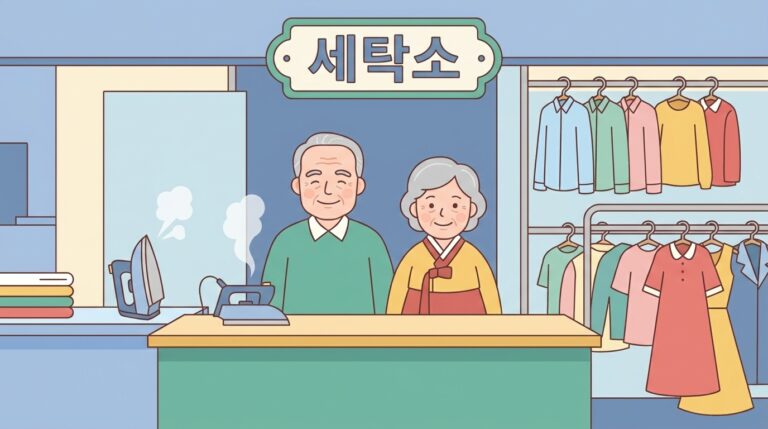
Speak Like a Local: How to Drop Off Your Dry Cleaning in Korea (A1 Level Guide)
안녕하세요! (An-nyeong-ha-se-yo!) Hello, wonderful learners! It’s your favorite Korean bestie and Lead Editor at Daily Hangul.
We’ve all been there: you’re enjoying a sizzling bowl of delicious Tteokbokki (spicy rice cakes) or slurping down a warm bowl of Kalguksu (knife-cut noodles), and—bam!—a bright red drop of sauce lands right on your favorite white sweater. Oh, the horror!
If you are living in or visiting Korea, finding a local dry cleaner (세탁소 – Seatakso) can feel incredibly intimidating. What if they ask complex questions? What if they don’t understand your English?
Don’t worry! Today, we are going to learn exactly how to walk into a Korean dry cleaner, drop off your clothes with confidence, and pick them up looking brand new. Let’s dive in!
Phase 2: Core Expressions Deep Dive
Here are the three magical phrases that will get you through any dry cleaning situation in Korea.
1. 이거 드라이클리닝 해주세요 (I-geo deu-ra-i-keul-li-ning hae-ju-se-yo)
- Pronunciation: “Ee-geo dry-cleaning hae-joo-seh-yo” (Sound analogy: “Dry-cleaning” is exactly like the English word, but said with a soft Korean accent! “Ee-geo” means “this,” and “hae-ju-se-yo” is your polite way of saying “please do it for me.”)
- Meaning: Please dry clean this.
- K-Culture Moment: You will hear this phrase constantly in Korean lifestyle vlogs or slice-of-life K-Dramas whenever a character is preparing their heavy winter coats for the upcoming season.
- Editor’s Insight: You can also shorten “드라이클리닝” to just “드라이” (Deu-ra-i). Saying “이거 드라이 해주세요” sounds super natural and trendy!
- Situation Spectrum: Casual ⚠️ | Semi-formal ✅ | Formal ✅
- 🤔 Think About It: How does your culture view clothing care? In Korea, taking care of your clothes is seen as a sign of respect and neatness in society.
2. 이 얼룩 좀 지워주세요 (I eol-luk jom ji-wo-ju-se-yo)
- Pronunciation: “Ee awl-look jom jee-wo-joo-seh-yo” (Sound analogy: “eol-luk” sounds like “awl-look” with a quick, soft start. “Jom” is a magical softener that sounds like “chom.”)
- Meaning: Please remove this stain.
- K-Culture Moment: Picture a romantic K-Drama scene where the clumsy lead spills coffee on their boss’s shirt and rushes to the neighborhood dry cleaners to save the day.
- Editor’s Insight: The word “좀” (jom) literally means “a little,” but when used in requests, it acts as a polite cushion. It makes your request sound much softer and friendlier!
- Situation Spectrum: Casual ⚠️ | Semi-formal ✅ | Formal ✅
- 🤔 Think About It: In your language, do you use filler words like “please” or “just” to make requests sound softer?
3. 언제 찾을 수 있어요? (Eon-je cha-jeul su is-seo-yo?)
- Pronunciation: “Eon-jeh chah-jeul soo ees-saw-yo?”
- Meaning: When can I pick it up? (Literal: When can I find it?)
- K-Culture Moment: In suspense dramas, characters ask this with intense eyes when they need their “lucky suit” back before a big court hearing or business presentation.
- Editor’s Insight: In Korean, you don’t say “pick up” (픽업). Instead, you use the verb “찾다” (chat-da), which means “to find” or “to retrieve.”
- Situation Spectrum: Casual 🚫 | Semi-formal ✅ | Formal ✅
- 🤔 Think About It: Why do you think Korean uses the word “to find” (찾다) instead of “to pick up”?
Phase 3: Textbook Korean vs. Real Korean
Let’s compare what dusty grammar textbooks teach you versus how real Koreans actually talk!
Situation 1: Dropping off laundry at the counter
- 📖 Textbook Korean: “세탁을 의뢰하고 싶습니다.” (Se-tak-eul ui-roe-ha-go sip-seum-ni-da. – I would like to request laundry services.)
- 🗣️ Real Korean: “이거 드라이 맡기려고요.” (I-geo deu-ra-i mat-gi-ryeo-go-yo. – I’m here to drop this off for dry cleaning.)
- 💡 Why the difference? “의뢰하다” (to request/commission) sounds way too clinical—like you’re hiring a private investigator! Real Koreans use “맡기다” (to entrust/leave something) for everyday errands.
Situation 2: Asking to remove a dirty stain
- 📖 Textbook Korean: “오염 물질을 제거해 주십시오.” (O-yeom mul-jil-eul je-geo-hae ju-sip-si-o. – Please eliminate the contaminating substances.)
- 🗣️ Real Korean: “여기 얼룩 좀 지워주세요.” (Yeo-gi eol-luk jom ji-wo-ju-se-yo. – Please get this stain out here.)
- 💡 Why the difference? “오염 물질” sounds like toxic waste! Simply pointing to the spot and saying “여기 얼룩” (this stain here) is much more natural and polite.
Phase 4: K-Culture Deep Dive & Non-verbal Manners
4-1. Nunchi (눈치) & Hand Gestures
- The Two-Handed Hand-off: When you hand your clothes to the dry cleaning owner (whom you should call 사장님 – Sajangnim, meaning “boss”), always hold the garment with both hands. This simple gesture shows respect.
- The Gentle Point: When pointing to a stain, use a flat, open hand instead of aggressively pointing with a single finger. This looks much softer and more polite.
4-2. The Cozy “Neighborhood Seatakso” (동네 세탁소)
In Korea, local dry cleaners are neighborhood hubs. Unlike giant industrial chains, local Seatakso are usually small shops packed to the ceiling with hangers, smelling of warm steam and fresh detergent. The owners are often friendly Ajeossis (uncles) and Imos (aunties) who have run the shop for decades. Getting to know your local dry cleaner is a wonderful way to feel connected to your neighborhood!
Phase 5: Real-Life Roleplay Scenario
Let’s practice! You are walking into “Sunny Dry Cleaners” (햇살 세탁소). The owner is Mr. Kim (김 사장님), a warm uncle in his late 50s who is busy steaming a shirt.
Character Profile:
- Mr. Kim: Friendly, speaks with a warm neighborhood accent, always helpful.
- You: A traveler/resident in Korea who needs to clean a coffee stain on a white coat.
The 8-Turn Dialogue
- You: 안녕하세요!
(An-nyeong-ha-se-yo!)
🎭[Smiling warmly and holding your coat with both hands]
“Hello!” -
Mr. Kim: 어서 오세요! 뭐 도와드릴까요?
(Eo-seo o-se-yo! Mwo do-wa-deu-ril-kka-yo?)
🎭[Wiping steam off his glasses and smiling]
“Welcome! How can I help you?” -
You: 이거 드라이 맡기려고요.
(I-geo deu-ra-i mat-gi-ryeo-go-yo.)
🎭[Gently presenting the white coat]
“I want to drop this off for dry cleaning.” -
Mr. Kim: 아, 하얀 코트네요. 어디 보자… 어라, 여기 뭐가 묻었네?
(A, ha-yan ko-teu-ne-yo. Eo-di bo-ja… Eo-ra, yeo-gi mwo-ga mu-deot-ne?)
🎭[Examining the sleeve carefully under the light]
“Ah, a white coat. Let me see… Oh, there’s something on the sleeve?” -
You: 네, 맞아요. 여기 얼룩 좀 지워주세요.
(Ne, ma-ja-yo. Yeo-gi eol-luk jom ji-wo-ju-se-yo.)
🎭[Pointing politely with an open palm to the coffee spot]
“Yes, that’s right. Please get this stain out here.” -
Mr. Kim: 알겠어요. 커피 자국이네. 깨끗하게 해 줄게요!
(Al-get-seo-yo. Keo-pi ja-guk-i-ne. Kkae-kkeut-ha-ge hae jul-ge-yo!)
🎭[Nodding confidently and writing it down on his pad]
“I see. It’s a coffee stain. I’ll make it sparkling clean for you!” -
You: 감사합니다! 언제 찾을 수 있어요?
(Gam-sa-ham-ni-da! Eon-je cha-jeul su is-seo-yo?)
🎭[Looking hopeful and tilting your head slightly]
“Thank you! When can I pick it up?” -
Mr. Kim: 목요일 오후에 오세요. 영수증 여기 있어요!
(Mok-yo-il o-hu-e o-se-yo. Yeong-su-jeung yeo-gi is-seo-yo!)
🎭[Handing you a small pink paper receipt]
“Come on Thursday afternoon. Here is your receipt!”
—
🔀 Choose Your Response!
A) “목요일에 올게요! 감사합니다!” (Mok-yo-il-e ol-ge-yo! Gam-sa-ham-ni-da!)
Best! You acknowledged the day (Thursday) and thanked him politely. He will love your manners!
B) “더 빨리 안 돼요?” (Deo ppal-li an dwae-yo?)
Risk! This means “Can’t you do it faster?” While not rude, it might stress Mr. Kim out unless you have an absolute emergency!
C) “싫어요. 지금 당장 해줘요.” (Sil-eo-yo. Ji-geum dang-jang hae-jwo-yo.)
Bad! This means “I don’t want to. Do it right now.” This is incredibly rude and will ruin your relationship with the local owner!
Phase 6: 10-Second Shadowing Drill
Let’s practice speaking with real-life emotions! Pause briefly at each / and try matching the emotional milestone in brackets.
이거 / 드라이 / 맡기려고요.
(I-geo / deu-ra-i / mat-gi-ryeo-go-yo.)[😊 Friendly and confident]-> “I’m here to drop this off for dry cleaning.”
여기 얼룩 좀 / 지워주세요.
(Yeo-gi eol-luk jom / ji-wo-ju-se-yo.)[🥺 Slightly worried but polite]-> “Please get this stain out here.”
언제 / 찾을 수 있어요?
(Eon-je / cha-jeul su is-seo-yo?)[🧐 Bright and curious]-> “When can I pick it up?”
Phase 7: K-Culture Mini Dictionary
- 세탁소 (Seatakso) | Dry Cleaners / Laundry Shop
The magical place where clothes are ironed, cleaned, and repaired. - 얼룩 (Eolluk) | Stain
Whether it’s coffee, kimchi soup, or ink, this is the word for any stain. - 영수증 (Yeongsujeung) | Receipt
The crucial slip of paper you need to bring back to claim your clothes! - 수선 (Suseon) | Alteration / Repair
Need your pants hemmed or a button sewn back on? Look for this word!
Phase 8: Traveler’s Survival Kit
Survival Expressions TOP 3
- “카드 돼요?” (Ka-deu dwae-yo?) -> “Do you accept cards?” (Pro Tip: Most shops accept credit cards, but carrying a bit of cash is great for tiny neighborhood shops.)
- “수선도 돼요?” (Su-seon-do dwae-yo?) -> “Do you also do clothing alterations?”
- “영수증 잃어버렸어요.” (Yeong-su-jeung il-eo-beo-ryeot-seo-yo.) -> “I lost my receipt.” (Use this if you can’t find your slip!)
Editor’s Travel Note
Need to find a dry cleaner near your Airbnb? Don’t use Google Maps (it isn’t very detailed in Korea!). Instead, open the Naver Map App on your phone and search for “세탁소” (Seatakso). It will show you all the nearest local spots with reviews and opening hours! Disclaimer: Operating hours may vary, so it’s always best to check before visiting.
Phase 9: “한 발 더 깊이” (One Step Deeper)
In Korea, there is a beautiful cultural concept called 정 (Jeong)—a deep feeling of warm affection, attachment, and community spirit.
You will experience Jeong at your neighborhood dry cleaners. Don’t be surprised if Mr. Kim sews a loose button back onto your coat, or irons out a random wrinkle in your shirt for free, without saying a single word. It is their way of looking out for you as a neighbor. When you return to pick up your clothes, a warm smile and a sincere “감사합니다!” (Thank you!) is the best way to return that beautiful Jeong.
💬 Your Turn: Have you ever experienced a small act of kindness like Jeong in your hometown? Let us know in the comments below!
Phase 10: FAQ & Common Mistakes
Q: What should I do if I lose my paper receipt?
A: Don’t panic! Just tell the owner your phone number or your name. Most neighborhood dry cleaners enter your details in their digital or paper ledger when you drop off your clothes.
Q: Can I drop off shoes or heavy blankets too?
A: Yes! Many Korean dry cleaners also wash sneakers (운동화 세탁 – Un-dong-hwa se-tak) and bulky winter blankets (이불 세탁 – I-bul se-tak). They are true life-savers!
Q: How much does dry cleaning usually cost in Korea?
A: For a standard dress shirt, it’s usually around 2,000 to 3,000 KRW. For a heavy winter coat, it ranges from 10,000 to 15,000 KRW. It’s incredibly affordable!
🚨 Common Mistakes Alert!
- Mistake 1: Saying “드라이클리닝 원해요” (I want dry cleaning). Correction: It sounds very robotic. Use “드라이 맡기려고요” (I want to drop off dry cleaning) instead!
- Mistake 2: Leaving your receipt behind. Correction: Always take the receipt! Some traditional shops keep clothes in massive racks and absolutely need the receipt number to find your garment quickly.
Phase 11: Action Mission & Engagement
- Bronze Level: Practice saying “이거 드라이 해주세요” out loud 5 times in front of your mirror!
- Silver Level: Look at your clothes and find 3 items that need dry cleaning. Write down their names in Korean (e.g., 코트 – coat, 셔츠 – shirt).
- Gold Level: Walk into a real Korean dry cleaner (or practice with a Korean-speaking friend) and drop off an item using today’s dialogue!
🎮 K-Culture Mission: The next time you watch a modern K-Drama, look closely at the clothes hanging in the background of a character’s room. Can you spot the thin wire hangers wrapped in white paper covers? Those are straight from the neighborhood Seatakso!
Phase 12: Interactive Quiz Challenge
Test your skills with this quick quiz!
1. What is the most natural way to say “Please get this stain out here”?
- A) 이거 드라이 해주세요.
- B) 여기 얼룩 좀 지워주세요.
- C) 영수증 주세요.
See Answer & Explanation
- Correct Answer: B) 여기 얼룩 좀 지워주세요.
- Explanation: “여기” means here, “얼룩” means stain, and “지워주세요” means please erase/remove. Perfect!
2. True or False: You should hand your clothes to the shop owner with only one hand to show confidence.
- A) True
- B) False
See Answer & Explanation
- Correct Answer: B) False
- Explanation: Always hand your clothes over with two hands to show polite manners (Nunchi) in Korea!







