

Ending on a Golden Note: Mastering the Art of Korean ‘Bokkeumbap’ After Seafood Stew (해물찜)
안녕하세요! It’s your trusty local culture navigator and Korean best friend from 매일한글 (Daily Hangul)!
Imagine this: You’re sitting in a bustling restaurant in Seoul, the air thick with the aroma of steamed crab, squid, and crunchy bean sprouts. You’ve just finished devouring a gorgeous, spicy plate of 해물찜 (Haemuljjim – Braised Spicy Seafood). Your tongue is tingling, your belly is warm, and you think you’re done.
But wait! Your Korean friend stops you from putting down your chopsticks and looks at you with a serious, almost sacred expression. “We can’t leave yet. We haven’t had the dessert.”
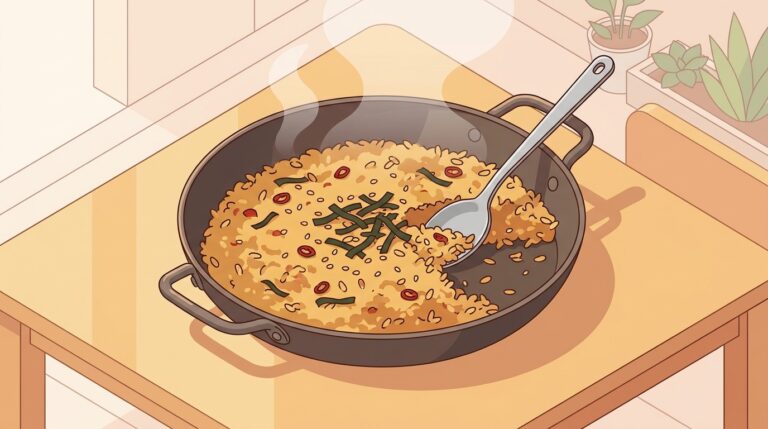
Suddenly, the server takes your steel pan, whisks it away to the kitchen, and returns with a sizzling, fragrant masterpiece of seaweed, sesame oil, and rice spread thinly across the hot grill. This is the legendary ‘K-Dessert’: 볶음밥 (Bokkeumbap – Fried Rice).
Many intermediate learners struggle with the timing and etiquette of ordering fried rice at the end of a communal meal. Today, we’ll dive into the real-world linguistic and cultural tricks to help you finalize your Haemuljjim like a true local. Let’s get cooking!
Phase 2: 3 Key Expressions for the Ultimate Finale
To navigate this culinary climax, here are three essential expressions you must tuck into your linguistic pocket.
1. 밥 볶아 주세요 (Bap bokka juseyo)
- Pronunciation: bahp bok-ah joo-seh-yo (Think of “bap” like a soft pop, “bokka” like “poke-ah” with a double ‘k’, and “juseyo” like “joo-say-yo”)
- Meaning: “Please fry the rice [for us].”
- K-Culture Moment: This is the magic phrase uttered at the end of meals like Tteokbokki, Gamjatang, or Haemuljjim. You’ll see K-drama characters raise their hands, lock eyes with the server, and confidently declare this to seal the meal.
- Editor’s Insight: In Korean dining, we don’t usually say “fried rice” as a separate menu item from the start; it’s a finale. Say this when you have about 10-15% of the sauce and veggies left on your plate.
- Situation Spectrum: Casual ✅ / Semi-formal ✅ / Formal ⚠️
- 🤔 Think About It: Why do you think Korean food culture prioritizes finishing a spicy, savory dish with rice rather than sweet items like cake or ice cream?
2. 누룽지 만들어 먹을게요 (Nurungji mandeureo meogeulgeyo)
- Pronunciation: noo-roong-jee mahn-deul-eo meog-eul-geh-yo
- Meaning: “We’ll let it crust (make scorched rice) to eat.”
- K-Culture Moment: Nurungji is the caramelized, crispy layer of rice that sticks to the bottom of the hot pan. Watching friends fight over who gets to scrape this crunchy treasure with their spoons is a classic Korean dining scene.
- Editor’s Insight: Do not stir the rice immediately when the server brings it out! Let it sit on the heat for 1–2 minutes until you hear a crackling sound (타닥타닥). That is the secret to perfect nurungji.
- Situation Spectrum: Casual ✅ / Semi-formal ✅ / Formal ⚠️
- 🤔 Think About It: How does the appreciation of textural contrast (soft vs. crispy) influence food vocabulary in your native language compared to Korean?
3. 양념 좀 남겨둘까요? (Yangnyeom jom namgyeodulkkayo?)
- Pronunciation: yahng-nyeom jom nahm-gyeo-dool-kkah-yo?
- Meaning: “Should we leave some sauce?”
- K-Culture Moment: When eating with locals, you’ll hear this question pop up right as the food is winding down. It shows high social awareness (눈치 – Nunchi) toward the flow of the meal.
- Editor’s Insight: If you eat all the spicy sauce (양념), the server won’t have enough flavor base to fry your rice. Asking this ensures everyone stops eating just in time.
- Situation Spectrum: Casual ✅ / Semi-formal ✅ / Formal ✅
- 🤔 Think About It: How does communal dining in Korea foster a collective mindset during a conversation?
Phase 3: Textbook Korean vs. Real-Life Korean
Let’s compare the stiff expressions found in classic grammar books with the vibrant, natural language spoken on the streets of Seoul.
Scenario 1: Ordering the Fried Rice
- 📖 Textbook Korean: “볶음밥 두 공기를 주문하고 싶습니다.” (I would like to order two bowls of fried rice.)
- 🗣️ 진짜 Korean: “여기 밥 두 개만 볶아 주세요!” (Here, please fry just two [portions of] rice!)
- 💡 Why the Difference? In real life, Koreans treat the rice as a continuation of the current pan, measuring portions simply as “개” (units/things) rather than the formal “공기” (bowls) in this context.
Scenario 2: Expressing Excitement Over the Crispy Bottom
- 📖 Textbook Korean: “냄비 바닥에 붙은 밥을 긁어 먹읍시다.” (Let us scrape and eat the rice stuck to the bottom of the pot.)
- 🗣️ 진짜 Korean: “밑에 누룽지 긁어 먹어야 제맛이에요.” (Scraping the scorched rice at the bottom is the best part!)
- 💡 Why the Difference? 제맛이다 is a gorgeous idiomatic phrase meaning “to be at its absolute best” or “to show its true flavor.” Using this will instantly make you sound like a seasoned Korean foodie!
Phase 4: K-Culture Deep Dive & Non-verbal Manners
4-1. The “Spoon Press” Gesture (숟가락 꾹꾹이)
When the server finishes mixing the rice with seaweed, sesame oil, and your leftover Haemuljjim sauce, they will flatten it across the pan. Once they walk away, the designated “table captain” will use the back of their spoon to gently press the rice down (꾹꾹 누르기). This maximizes heat contact to create a crunchy crust. Doing this for your friends is a sign of ultimate care and dedication!
4-2. The “K-Dessert” Philosophy
In Korea, carbs are love. While Western cultures often wrap up a heavy meal with sugar, Koreans crave a savory, smoky carb finish. The phrase “밥 배는 따로 있다” (There is a separate stomach for rice) perfectly mirrors the Western saying “There is always room for dessert!”
Phase 5: Real-Life Roleplay Scenario
Setting: Mapo Seafood Kingdom (마포 해물나라), a legendary local spot famous for its fiery Haemuljjim.
Characters:
* 민준 (Minjun): Your food-obsessed Korean friend.
* 이모님 (Imonim): The veteran server who runs the dining floor with charismatic authority.
민준: 와, 해물찜 진짜 맵고 맛있다! 슬슬 배부른데?
      (Wow, this Haemuljjim is seriously spicy and delicious! I'm getting full.)

나: (Smiling) 배불러도 볶음밥은 꼭 먹어야 해! 밥 볶아달라고 할까?
    (Even if we are full, we must have fried rice! Shall we ask to fry some rice?)

민준: 당연하지! 볶음밥 안 먹으면 해물찜 먹었다고 할 수 없지.
      (Of course! If you don't eat fried rice, you can't say you ate Haemuljjim.)

나: (Raising hand to call the server) 저기요, 저희 밥 두 개만 볶아 주세요!
    (Excuse me, please fry just two portions of rice for us!)

이모님: 네~ 양념 조금만 남겨두고 앞접시에 남은 해물 덜어드릴게요.
        (Sure~ I will scoop the remaining seafood onto your side plates, leaving just a bit of sauce.)

민준: 이모님! 누룽지 좀 눌려 먹을 수 있게 불 세게 해주세요!
      (Imonim! Please keep the heat high so we can make some scorched rice!)

이모님: (Winking) 걱정 마요! 조금 타닥타닥 소리 나면 불 끄고 긁어 드세요.
        (Don't worry! Once you hear a little crackling sound, turn off the heat and scrape it up.)

나: 감사합니다! 와, 고소한 참기름 냄새 대박이다.
    (Thank you! Wow, the aroma of savory sesame oil is incredible.)
🔀 Interactive Choice Points
What would you do when the server comes to take the pan away for frying?
- Option A: Rapidly scoop your favorite pieces of octopus and conch into your 앞접시 (personal plate) before she whisk the pan away.
- Feedback (Best): Perfect! The server only needs the sauce and veggies. Saving your expensive seafood to eat with the fried rice later is a pro-move.
- Option B: Keep eating the remaining spicy sauce with your spoon until the pan is completely dry.
- Feedback (Bad): Oh no! Without any remaining sauce, your fried rice will taste bland and dry. Keep some sauce behind!
- Option C: Turn the portable gas stove to maximum heat and walk away to the restroom.
- Feedback (Risk): Danger! The thin metal pans can burn the rice to ash within a minute, ruining the food and filling the restaurant with smoke.
Phase 6: 10-Second Emotion Shadowing Drill
Let’s practice speaking with the exact rhythmic pauses (/) and emotions of a native Korean speaker!
- “여기 / 밥 두 개만 / 볶아 주세요!”
- Emotion Guide: [😊 Excitedly, with high-pitched anticipation]
- “밑에 / 누룽지 긁어 먹어야 / 제맛이에요!”
- Emotion Guide: [😋 Proudly sharing a culinary secret, eyes wide with hunger]
Phase 7: K-Culture Mini Dictionary
- 볶음밥 (Bokkeumbap) | Fried Rice: The ultimate savory ending of multi-stage hot pot or steamed meals.
- 누룽지 (Nurungji) | Scorched Rice: The crunchy, golden crust formed at the bottom of a hot cooking pot.
- 이모님 (Imonim) | Auntie: Literally “mother’s sister,” but widely used to affectionately call middle-aged female restaurant staff.
- 앞접시 (Ap-jeopsi) | Side Plate: A small, personal dish used to portion out food from a large, shared communal pot.
Phase 8: Traveler’s Survival Kit
Survival Phrases TOP 3
- “양념 따로 덜어주세요.” (yang-nyeom tta-ro deol-eo-joo-seh-yo)
- Pro Tip: Use this if you want the server to put the extra spicy sauce on a separate plate so you can dip your fried rice in it later.
- “치즈 사리 추가해 주세요!” (chee-zeu sah-ree choo-gah-heh-joo-seh-yo)
- Pro Tip: “사리” means an added ingredient. Adding cheese to spicy seafood fried rice is heavenly.
- “이거 좀 덜 매워요?” (ee-geo jom deol mae-wo-yo?)
- Pro Tip: If the seafood was too spicy, ask this to see if they can make the fried rice milder.
📌 Editor’s Travel Note:
To find the best local Haemuljjim spots that serve high-quality fried rice, avoid global tourist maps. Instead, use the Naver Map app to search for “해물찜 맛집” (Haemuljjim local favorites) and read authentic reviews left by Korean foodies. (Note: Map features and translations may vary based on app updates.)
Phase 9: “Going One Step Deeper” (Cultural Reflection)
In many Western cultures, double-dipping or sharing a single plate with multiple utensils can feel uncomfortable. In Korea, however, scraping the exact same pot of Bokkeumbap with shared spoons is a physical manifestation of 정 (Jeong)—the warm, unspoken feeling of bonding, attachment, and collective identity. Sharing the crunchy crust isn’t just about satisfying hunger; it’s about erasing personal boundaries to build closer relationships.
💬 Your Turn: How does your culture view sharing a single dish at the table? Let us know in the comments below!
Phase 10: FAQ & Avoiding Common Mistakes
Q: Can I order fried rice at any restaurant that serves hot dishes?
A: Generally, yes! If the main dish is cooked in a wide metal pan or pot on a portable stove right at your table (like Galbi-jjim, Dak-galbi, or Haemuljjim), fried rice is almost always an option. If it is served in a ceramic bowl, it might not be possible.
Q: Is it rude to scrape the pan loudly?
A: Not at all! In fact, the soft metallic scraping sound (슥슥) is music to a Korean host’s ears. It means the food was absolutely delicious.
Q: What if the rice is burning?
A: Quickly turn off the dial on the gas stove. Do not wait for the server to do it. Your table is your responsibility once the frying is complete!
🚨 Common Mistakes Alert
- Mistake 1: Eating all the spicy bean sprouts.
- Correct Action: Leave at least a handful! The crunchy sprouts give the fried rice a fantastic texture.
- Mistake 2: Scraping the pan with chopsticks.
- Correct Action: Always use the flat edge of your metal spoon. Chopsticks will slip and scratch the pan uselessly.
- Mistake 3: Eating the rice immediately while it’s watery.
- Correct Action: Wait! Let the heat dry the moisture out for at least 60 seconds to build that crunchy base.
Phase 11: Action Mission & Engagement
- 🥉 Bronze Mission: Practice saying “밥 두 개만 볶아 주세요!” smoothly in front of your mirror.
- 🥈 Silver Mission: Share this post on your social media and tag your favorite dining buddy with whom you want to share a hot plate of Haemuljjim.
- 🥇 Gold Mission: Go to a Korean restaurant this week, order a sharing dish, and confidently guide your group to order and press down the Bokkeumbap yourself!
Phase 12: Interactive Quiz Challenge
Test your intermediate Korean dining skills!
1. Situational Judgment
You are down to your last few bites of Haemuljjim. You want to get the fried rice. What is the most natural way to signal the server?
* A) “볶음밥을 배달해 주세요.”
* B) “여기 밥 두 개만 볶아 주세요!”
* C) “냄비를 가져가세요.”
2. Fill-in-the-Blank
“The crispy, caramelized rice layer stuck to the bottom of the hot pan is called ________.”
* Hint: ㄴㄹㅈ
3. True or False
“You should eat every drop of the red seafood sauce before asking the server to make the fried rice.”
* (True / False)
🔍 Click here to reveal the Answers & Explanations!
- Answer: B
- Explanation: “여기 밥 두 개만 볶아 주세요!” is the natural, friendly way to order two portions of fried rice. (A means “Please deliver fried rice,” and C means “Take the pot away.”)
- Answer: 누룽지 (Nurungji)
- Explanation: This refers to the beloved scorched rice crust.
- Answer: False
- Explanation: You must leave some sauce behind to flavor the rice! If the pan is empty, the rice won’t have that rich, spicy seafood flavor.
- Explanation: You must leave some sauce behind to flavor the rice! If the pan is empty, the rice won’t have that rich, spicy seafood flavor.







