

Phase 1: Empathy (Your Noraebang Adventure Begins!)
안녕하세요! (An-nyeong-ha-se-yo!) Hello there! Your favorite Korean bestie and Daily Hangul Editor is here to guide you through one of the most exciting, yet nerve-wracking experiences in Korea: entering a Korean Noraebang (노래방 – Karaoke room)!
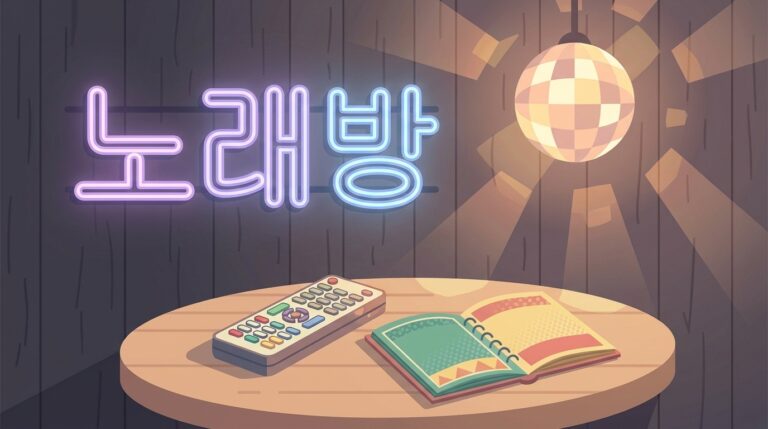
Picture this: You are standing in a neon-lit private room. The disco ball is spinning, the tambourines are glittering, and your Korean friends are handing you a massive, brick-sized remote control (리모컨) filled with Korean characters. Your heart races. You want to sing your favorite K-pop song or that iconic Western pop hit, but you have no idea how to search for it!
Don’t panic. Based on years of teaching and countless karaoke nights with international friends, I’ve put together this ultra-simple, bulletproof guide to searching for songs. By the end of this quick read, you’ll navigate the remote control like a true Seoulite. Let’s dive in!
Phase 2: Core Expressions (3 Essential Keys)
1. 노래 찾아줘 (Norae chaj-a-jwo)
- Pronunciation: noh-rae chah-jah-jwoh (Sounds like “no-ray” + “cha-ja-jwo”)
- Meaning: “Find/Search for a song for me.” (Casual)
- K-Culture Moment: You see this in K-dramas whenever a group of friends enters a room and one person becomes the designated “remote hog” (리모컨 대장). You hand them the remote and shout, “Hey! 노래 찾아줘!”
- Editor’s Insight: The verb 찾다 (chaj-da) means to look for or find. Adding -아줘 (-a-jwo) turns it into a friendly request. It’s warm, intimate, and highly casual.
- Situation Spectrum:
- Casual (Close friends): 노래 찾아줘! (✅)
- Semi-formal (Coworkers/Acquaintances): 노래 찾아주세요. (⚠️)
- Formal (Boss/Elders): 노래를 찾아주시면 감사하겠습니다. (🚫 – Too stiff for a fun karaoke room!)
- 🤔 Think About It: In English, we say “Search for a song.” In Korean, we say “Find a song for me.” Why do you think Korean uses the concept of “finding” rather than just “searching”?
2. 이 노래 있어요? (I norae isseoyo?)
- Pronunciation: ee noh-rae ee-ssuh-yoh (Sounds like “E” + “no-ray” + “it-suh-yo”)
- Meaning: “Do you have this song?” (Polite)
- K-Culture Moment: Use this when you are looking through the massive songbook (노래책) and can’t find your favorite jam. You can ask your Korean friend or the staff.
- Editor’s Insight: 이 (I) means “this,” 노래 (norae) means “song,” and 있어요? (isseoyo?) means “is there? / do you have?” This is a magical, versatile phrase you can use anywhere, even in shops (e.g., “이거 있어요?” – Do you have this?).
- Situation Spectrum:
- Casual: 이 노래 있어? (✅)
- Semi-formal: 이 노래 있어요? (✅)
- Formal: 이 노래가 있습니까? (🚫 – Sounds like a business interview!)
- 🤔 Think About It: How does asking “Do you have this song?” feel different from asking “Can I sing this song?” in your culture?
3. 번호가 몇 번이에요? (Beonhoga myeot beon-ieyo?)
- Pronunciation: buhn-ho-gah myuht buhn-ee-eh-yoh (Sounds like “bun-ho-gah” + “myut” + “bun-E-eh-yo”)
- Meaning: “What is the song number?” (Polite)
- K-Culture Moment: Every song in a Korean karaoke system has a unique 4-to-5-digit number. Typing this number into the remote is the fastest way to play your song. Ask this to the friend who has the songbook!
- Editor’s Insight: 번호 (beonho) means “number,” 몇 번 (myeot beon) means “which number.” Even if your Korean pronunciation of a song title is slightly off, knowing the number makes you look like an absolute pro.
- Situation Spectrum:
- Casual: 번호가 몇 번이야? (✅)
- Semi-formal: 번호가 몇 번이에요? (✅)
- Formal: 번호가 어떻게 되십니까? (⚠️ – Super polite, only if you are trying to be funny with friends!)
- 🤔 Think About It: Korean uses different counting units for different objects. Here, “번” (beon) is specifically used for sequential numbers. Does your language have separate words for counting sequential numbers vs. physical items?
Phase 3: Textbook Korean vs. Real Korean
Let’s compare the stiff textbook phrases with what real Koreans actually say in a lively karaoke room!
Situation A: Asking someone to search for a song
- 📖 Textbook Korean: 노래를 검색하고 싶습니다. (Noraereul geomsaekhago sipseumnida. / “I would like to search for a song.”)
- 🗣️ Real Korean: 노래 좀 찾아줘. (Norae jom chaj-a-jwo. / “Hey, search this song for me.”)
- 💡 Why the difference? Nobody uses formal grammar like “-고 싶습니다” in a dark room filled with pulsing lights and tambourines! Adding the little word “좀” (jom – please/softener) makes your request sound natural and friendly.
Situation B: Asking for the song number
- 📖 Textbook Korean: 해당 곡의 번호를 입력하십시오. (Haedang gogui beonhoreul imnyeokhasippsio. / “Please input the number of the corresponding song.”)
- 🗣️ Real Korean: 몇 번이야? (Myeot beon-iya? / “What number is it?”)
- 💡 Why the difference? Short and sweet wins the race. When the music is loud, you want the shortest possible phrase to communicate.
Phase 4: K-Culture Deepdive & Non-verbal Manners
4-1. The Art of “Nunchi” (눈치) with the Remote Control
In Korea, Nunchi (눈치)—the art of reading the room—is crucial in a Noraebang.
* The Remote Hog Sin: The giant remote control is a powerful tool. Do not keep it in front of you all night. Once you search for your song, hand the remote to the next person.
* The Song-Reservation Etiquette: Do not reserve (예약) five of your own songs in a row. The unwritten rule is: One song per person at a time. If you want to search for another, wait until everyone else has reserved at least one!
4-2. The Golden Noraebang Culture
When your friend is searching for a song, it’s polite to browse the songbook with them or cheer them on. In K-Dramas, you often see characters dancing wildly with tambourines even during other people’s songs. This energetic backup dancing is called 흥 (Heung – collective high tension/joy). Join in, shake those tambourines, and help them find their rhythm!
Phase 5: Real-life Roleplay Scenario
Background: You are at a cozy luxury Noraebang in Hongdae with your high-energy Korean friend, Minjun (민준). The room is glowing, and Minjun is holding the remote like a microphone.
- Minjun: 🎭 (Shaking a tambourine energetically) 야, 오늘 완전 신난다! 너 무슨 노래 부를 거야?
(Ya, oneul wanjeon sinnanda! Neo museun norae bureul geoya? / Hey, today is so exciting! What song are you going to sing?) - You: 나 K-pop 부르고 싶어! 근데… 노래 좀 찾아줘.
(Na K-pop bureugo sipeo! Geunde… norae jom chaj-a-jwo. / I want to sing K-pop! But… search for the song for me.) - Minjun: 🎭 (Grinning and handing you the giant remote) 당연하지! 네가 직접 검색해 봐. 재미있어!
(Dangyeonhaji! Nega jikjeop geomsaekhae bwa. Jaemiisseo! / Of course! Try searching for it yourself. It’s fun!) - You: 🎭 (Looking at the Korean buttons nervously) 어… 너무 어려워. 이 노래 있어요?
(Eo… neomu eoryeowo. I norae isseoyo? / Uh… it’s too hard. Do you have this song?) - Minjun: 🎭 (Peeking at your phone screen) 아, 이 노래? 당연히 있지! 내가 번호 찾아줄게.
(Ah, i norae? Dangyeonhi itji! Naega beonho chaj-ajulge. / Oh, this song? Of course we have it! I will find the number for you.) - You: 고마워! 번호가 몇 번이에요?
(Gomawo! Beonhoga myeot beon-ieyo? / Thank you! What is the song number?) - Minjun: 🎭 (Flipping through the big songbook) 여기 있다! 4-8-9-2-1! 얼른 눌러!
(Yeogi itda! Sa-pal-gu-i-il! Eolleun nulleo! / Here it is! 4-8-9-2-1! Press it quickly!) - You: 🎭 (Pressing the numbers and hitting the green ‘Start’ button) 우와, 나온다! 고마워, 민준아!
(Uwa, naonda! Gomawo, Minjuna! / Wow, it’s starting! Thanks, Minjun!)
🔀 Your Turn! Interactive Choice
What do you do next as the music starts?
- Option A: You immediately start singing at the top of your lungs.
- Option B: You hand the remote back to Minjun and grab a tambourine to share the spotlight.
- Option C: You press the “Cancel” (취소) button by mistake because the button is red.
Check your Option Feedback!
- Option A (Good): Great energy! But remember to share the mic if it’s a duet!
- Option B (Best – absolute local pro!): Excellent Nunchi! Giving the remote back shows you respect the turn-taking culture, and the tambourine adds amazing ‘Heung’ (흥)!
- Option C (Risk – Oh no!): Red buttons in Korean Noraebangs usually mean ‘Cancel’ (취소) or ‘Stop’. Avoid pressing red unless you want to kill the vibe!
Phase 6: 10-Second Emotion Shadowing Drill
Let’s practice saying these like a real native! Pay attention to the pauses (/) and the emotional cues.
- [😊 Excited & Hopeful]
노래 / 좀 / 찾아줘!
(Norae / jom / chaj-a-jwo!)
Mouth Tip: Keep the ‘jom’ short and cute to make your friend smile! -
[🥺 Shy & Asking for help]
이 노래 / 있어요? / 제발요~
(I norae / isseoyo? / Jeball-yo~)
Mouth Tip: Extend the ‘yo~’ slightly at the end for a friendly, polite tone. -
[⚡ Energetic & Hurrying]
번호가 / 몇 번 / 이에요? / 빨리!
(Beonhoga / myeot beon / ieyo? / Ppalli!)
Mouth Tip: Emphasize ‘myeot’ (myuht) clearly so they know you are asking for the specific number.
Phase 7: K-Culture Mini Dictionary
| Korean Word | Pronunciation | English Meaning | Real-life Usage |
|---|---|---|---|
| 리모컨 | rimokeon | Remote Control | The physical key to your Noraebang night. Don’t drop it! |
| 노래책 | noraechaek | Songbook | A massive directory book. Great for browsing old-school hits. |
| 신곡 | singok | New Releases | Clicking this button on the remote shows the newest K-pop hits. |
| 인기차트 | ingichateu | Popular Charts | The top 100 songs currently sung in Korea. Great when you have no idea what to sing! |
Phase 8: Traveler’s Survival Kit
Survival Expressions TOP 3
- 시작 (Si-jak) – “Start”
- If the song doesn’t start automatically after typing the numbers, press the big green button that says 시작.
- 취소 (Chwi-so) – “Cancel”
- Oh no, typed the wrong number? Press the red button that says 취소 to start over.
- 서비스 주세요! (Seobiseu juseyo!) – “Give us free minutes!”
- Pro Tip: In Korea, owners of Noraebangs often give 10 to 30 minutes of free extra time (called ‘service’). Smile nicely at the counter and ask for ‘service’!
Editor’s Travel Note
To find the hottest karaoke spots in Korea, don’t rely on global maps. Download the Naver Map App and search for “코인노래방” (Coin Noraebang). Coin Noraebangs are budget-friendly options where you pay per song (usually 4 songs for 1,000 KRW) rather than by the hour. Disclaimer: Prices may vary depending on location and time of day.
Phase 9: “One Step Deeper” (Culture Insight)
In many Western cultures, karaoke is seen as a performance where you stand on a stage in front of strangers. In Korea, however, Noraebang (노래방 – Song Room) is an intimate, private space designed to relieve stress with your inner circle. It is a therapy session where no one cares if you miss a note. It’s all about expressing your 흥 (Heung)—that uniquely Korean explosive energy of joy and shared emotion. Next time you go, don’t worry about being perfect. Just let go and sing!
💬 Your Turn: What is your go-to song when you sing karaoke in your country? Let me know in the comments below!
Phase 10: FAQ & Common Mistakes
Q: Can I search for English songs in a Korean Noraebang?
A: Absolutely! All modern Korean karaoke machines (TJ and Geumyoung) have a massive database of Western pop, Japanese, and Chinese songs. Just press the “영문/국가” (English/Country) button on the remote to change the keyboard to English.
Q: What is the difference between a standard Noraebang and a Coin Noraebang?
A: A standard Noraebang is rented by the hour (usually 15,000 – 30,000 KRW) and is great for large groups. A Coin Noraebang (코노 – Ko-No) charges you per song (usually coins or cards inserted directly into the machine) and is perfect for solo travelers or duets!
Q: How do I reserve a song so it plays next?
A: After typing the song number, press the 예약 (Ye-yak / Reserve) button. If you press 시작 (Si-jak / Start), it will immediately cut off the song currently playing—which is a major social crime!
🚨 Common Mistakes Board
- Mistake 1: Pressing the red 취소 (Cancel) button thinking it means “Enter.”
- Correct Action: Press the green 시작 (Start) or blue 예약 (Reserve) button instead.
- Mistake 2: Singing over someone else’s song without asking.
- Correct Action: Always ask, “같이 불러도 돼?” (Can I sing with you?) first.
- Mistake 3: Keeping the microphone too close to the speakers.
- Correct Action: Keep it pointed away to avoid that awful, high-pitched screeching sound!
Phase 11: Action Mission & Challenge
Ready to take action? Try these three levels of challenges!
- 🥉 Bronze Mission: Practice saying “노래 좀 찾아줘” out loud 5 times in front of your mirror with high energy!
- 🥈 Silver Mission: Write down your favorite song title in Korean characters and find its standard 5-digit code online.
- 🥇 Gold Mission: Walk into a local Coin Noraebang on your next trip to Korea, search for a song, and sing it successfully using only Korean remote commands!
🎮 K-Culture Mission: Watch a clip of your favorite Korean drama (like Reply 1988 or Business Proposal). Spot the scene where they go to a Noraebang and try to find the giant remote control!
Phase 12: Interactive Quiz Challenge
Test your new skills!
1. What does “이 노래 있어요?” mean?
- A) I don’t like this song.
- B) Do you have this song?
- C) Please skip this song.
2. Fill in the blank: If you want to ask for the song number, you say: “____ 몇 번이에요?”
- A) 리모컨 (Rimokeon)
- B) 번호가 (Beonhoga)
- C) 노래방 (Noraebang)
3. True or False: Pressing ‘시작’ (Si-jak) will reserve your song to play next after the current song finishes.
- True / False
Click here to reveal the Answers & Explanations!
- Answer: B. “이 노래 있어요?” translates directly to “Do you have this song?” It’s perfect when asking your friends or looking through a songbook.
- Answer: B. “번호가 몇 번이에요?” means “What is the song number?” (번호 = number).
- Answer: False. Pressing ‘시작’ will start the song immediately, cutting off whatever is currently playing! To reserve, always press 예약 (Ye-yak).
“,







