

Master Yutnori Like a Local: Navigating Board Strategies and Cultural Slang
Phase 1: Empathy (Immersive Opening)
안녕하세요! Hello, beautiful minds! It’s your favorite cultural navigator and senior editor from Daily Hangul.
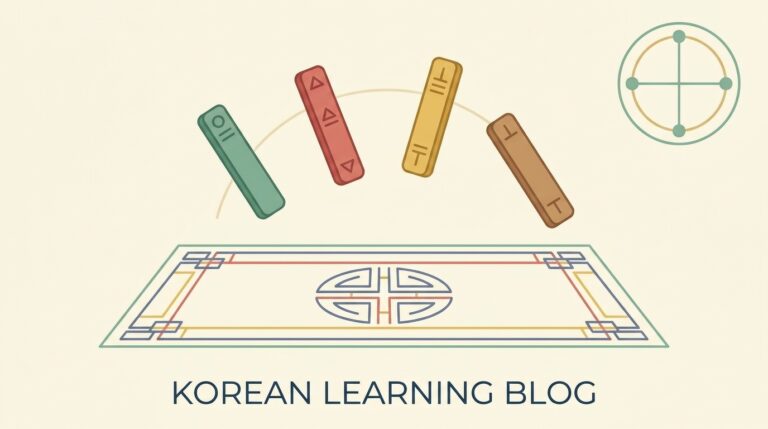
Imagine this: It is Lunar New Year (Seollal, 설날), and you are invited to your Korean friend’s family home. The living room is buzzing with energy. A large blanket is laid out on the floor, and in the center is a game board with circular nodes and four polished wooden sticks. Yes, you are about to play Yutnori (윷놀이), Korea’s ultimate traditional board game!
You throw the sticks. You get a Girl (걸 – three steps forward). Awesome! But then, your friend’s uncle strokes his chin and starts throwing around complex strategic terms: “Are we going to stack them?” “Should we make a run for the shortcut?” “Watch out, they might eat us!”
Suddenly, you realize this isn’t just a simple game of rolling dice. It is a high-stakes psychological war zone requiring tactical maneuvering of game pieces, known as Malpan Ssu-gi (말판 쓰기 – board token strategy). Many advanced learners grasp the basic rules of throwing the sticks (Do, Gae, Geol, Yut, Mo), but they hit a massive roadblock when trying to follow the lightning-fast strategy talks and playful banter of native speakers.
Today, we are going to crack the code. Based on real feedback from our advanced learners, we’ve built this masterclass to help you navigate the Yutnori board with C1-level fluency, complete with native strategic slang that will make your Korean hosts’ jaws drop!
Phase 2: Deep Dive into 3 Core Expressions
To master Yutnori strategy, you must first master the verbs that dictate the movement of the pieces (말 – Mal, literally meaning “horses”). Here are the three most crucial expressions used around the board.
1. 말을 놓다 (mal-eul not-da)
- Pronunciation: [mal-eul not-da] (sounds like “mahl-eul note-dah”)
- Meaning: Literally “to place a horse (token)” / Figuratively: To deploy a new piece onto the board.
- K-Culture Moment: You will hear this in Korean variety shows like Run BTS! or Running Man when players debate whether to bring a new piece onto the starting point or continue moving an active piece that is already on the board.
- Editor’s Insight: The word 말 (mal) has three major meanings in Korean: “horse,” “speech/language,” and “game piece.” Interestingly, 말을 놓다 also means “to drop honorifics/speak casually” in social conversations. When playing Yutnori, the double meaning adds a layer of fun: you are placing your pieces, but you are also playfully “dropping” formalities to banter with your opponents!
- Situation Spectrum: Casual (✅) / Semi-formal (✅) / Formal (⚠️ – Accepted in game commentary, but keep it professional)
- 🤔 Think About It: In your native language, does the term for a board game token carry other significant cultural or linguistic meanings?
2. 업고 가다 (eop-go ga-da)
- Pronunciation: [eop-go ga-da] (sounds like “up-go gah-dah”)
- Meaning: Literally “to carry on one’s back” / Figuratively: To stack your own tokens together so they can move as a single unit.
- K-Culture Moment: This is the ultimate “high risk, high return” (하이 리스크 하이 리턴) move. If you land on a space already occupied by your own token, you can up (업다) them and move both together. But beware! If the opponent lands on your stacked pieces, they capture both, sending them all back to the start!
- Editor’s Insight: “업다” is a deeply emotional verb in Korean culture, often associated with carrying a sleepy child or a beloved elder on one’s back. In Yutnori, this mechanism reflects the collectivist nature of Korean culture—moving together as a unit (우리 – Uri, meaning “we/us”), sharing both the triumphant glory and the devastating defeat.
- Situation Spectrum: Casual (✅) / Semi-formal (✅) / Formal (🚫)
- 🤔 Think About It: Stacking pieces together represents shared destiny. How does this compare to Western board games where pieces usually block each other rather than merge?
3. 잡아먹다 (jap-ah-meok-da)
- Pronunciation: [ja-ba-meok-da] (sounds like “jah-bah-muck-dah”)
- Meaning: Literally “to catch and eat” / Figuratively: To capture/eliminate an opponent’s piece.
- K-Culture Moment: When your piece lands exactly on the spot occupied by an opponent’s piece, you “eat” it. The opponent’s piece is kicked off the board, and as a reward, you get to throw the Yut sticks one more time!
- Editor’s Insight: While “eat” might sound aggressively predatory, in Korean play culture, it is used with vibrant, playful energy. Saying “내가 네 말 잡아먹었다!” (I ate your piece!) is accompanied by laughter, dramatic groans, and high-fives.
- Situation Spectrum: Casual (✅) / Semi-formal (⚠️ – use playfully) / Formal (🚫)
- 🤔 Think About It: Why do you think Korean play culture uses visceral sensory verbs like “eating” (먹다) to describe taking over an opponent’s space?
Phase 3: Textbook Korean vs. Real-Life Korean
When analyzing the state of the board, textbooks will teach you dry, literal translations. But to sound like a natural player, you need the colloquial punch of a native.
Situation 1: Plotting a dramatic comeback victory
- 📖 Textbook Korean: “우리가 역전하여 승리할 것입니다.” (We will reverse the game and win.)
- 🗣️ Real-Life Korean: “이거 한 판이면 뒤집을 수 있어요! 역전극 갑시다!” (With just this one throw, we can flip the table! Let’s go for a historic comeback!)
- 💡 Why the difference? Koreans love a good underdog story. The verb 뒤집다 (dwi-jib-da – to flip/turn over) vividly describes completely reversing a losing situation, carrying far more emotional weight than the sterile “역전하다.”
Situation 2: Deciding to take a risky shortcut
- 📖 Textbook Korean: “위험하지만 지름길로 가겠습니다.” (It is risky, but I will go by the shortcut.)
- 🗣️ Real-Life Korean: “모 아니면 도니까 그냥 질러 갈게요!” (It’s all or nothing, so I’m just gonna gun it/shortcut it!)
- 💡 Why the difference? 모 아니면 도 (Mo ani-myeon Do) is Korea’s most famous idiom for “all or nothing” (literally meaning throwing a five-step Mo or a one-step Do). Combined with 지르다 (ji-reu-da), which means to recklessly plunge forward or take a shortcut, it shows true local confidence.
Phase 4: K-Culture Deep-Dive & Non-Verbal Manners
4-1. Nunchi & Physical Etiquette of the Throw
When playing Yutnori, your physical gestures speak louder than words. Pay attention to these unwritten rules:
1. The Mat Boundary (낙 – Nak): Always throw the sticks so they land inside the designated mat (멍석 – Meongseok). If even one stick rolls off the mat, it is called a 낙 (Nak – Fall/Out of bounds), and your turn is instantly forfeited. Throw with controlled enthusiasm!
2. Hand Movements: When shaking the four sticks in your hands, it is customary to rattle them close to your ear to create a pleasant wooden clicking sound. This builds suspense and shows you are channeling your inner game spirit.
3. Reading the Board (눈치 – Nunchi): Before deciding whether to stack (업다) your pieces, look at your opponents’ faces. Are they holding a Back-Do (빽도 – backward move) stick? Stacking three pieces requires superb Nunchi to calculate if they can snooker you on their next turn.
4-2. The Cultural Tapestry of Seollal
Yutnori is one of the rare social spaces in Confucian-oriented Korea where strict age hierarchies temporarily melt away. During a match, a young grandchild can gleefully “eat” the token of their grandfather and yell teasing remarks without being considered rude. It acts as a vital social lubricant, fostering family bonding through shared laughter and strategic banter.
Phase 5: Real-Life Roleplay Scenario
Setting: Lunar New Year’s Day. You are at your friend Minjun’s house. You are paired with Minjun against his cousin, Seoyeon, who is a legendary Yutnori master. The score is tight.
Characters:
- You (C1 Korean Speaker)
- Minjun (민jun – Your teammate, excited but nervous)
- Seoyeon (서연 – The rival cousin, highly competitive)
1. 민준: (초조하게 손톱을 깨물며) 아, 어떡하지? 서연이 말이 바로 우리 뒤까지 쫓아왔어. 이번에 못 도망가면 잡힌다.
   Minjun: (Nervously biting nails) Ah, what do we do? Seoyeon's piece is chasing us right from behind. If we don't escape this time, we're caught.

2. 나: (말판을 날카롭게 분석하며) 걱정 마. 지금 우리한테 선택지가 두 개 있잖아. 말을 새로 놓거나, 아니면 지금 있는 말을 업고 뛰거나.
   You: (Analyzing the board sharply) Don't worry. We have two options right now. We either deploy a new piece, or we stack our current piece and run.

3. 서연: (여유롭게 미소를 지으며) 과연~? 근데 너네 지금 업고 가다가는 내 손에 다 잡아먹힐 텐데? 괜찮겠어?
   Seoyeon: (Smiling relaxed) Let's see~ But if you stack and go now, you might get eaten up by my hand. Will you be okay?

4. 민준: (나를 바라보며) 어떻게 할래? 안전하게 말을 새로 놓을까? 아니면 한 판 뒤집기 가볼까?
   Minjun: (Looking at you) What do you want to do? Deploy a new piece safely? Or try to flip the game in one go?

5. 나: (결연한 표정으로 윷가락을 쥐며) 모 아니면 도지! 우리 이거 업고 가자. 윷이나 모 나오면 대역전극이야!
   You: (Gripping the Yut sticks resolutely) It's all or nothing! Let's stack this and go. If we get a Yut or a Mo, it's a massive comeback drama!

6. 서연: (오~ 하고 감탄하며) 올~ 자신감 장난 아닌데? 자, 그럼 시원하게 던져봐!
   Seoyeon: (Admiringly) Oh~ Your confidence is no joke! Alright, then throw it coolly!

7. 나: (기합을 넣으며) 윷 나온다, 흡! (윷가락을 멍석 위로 부드럽게 던진다)
   You: (Gathering energy) Here comes Yut, hup! (Gently throws the Yut sticks onto the mat)

8. 민준: (와! 소리 지르며) 대박! 진짜 윷이다! 야, 빨리 말 업어! 어서 지름길로 지르자!
   Minjun: (Screaming "Wow!") Amazing! It's actually a Yut! Hey, quickly stack the piece! Let's shortcut it right now!
🔀 Interactive Choice Point
Now it’s your turn to make the strategic call on the Malpan! Your pieces are stacked (2 horses), and you just rolled a 윷 (Yut – 4 steps forward). This lands you exactly on the corner shortcut node. But Seoyeon’s piece is lurking just 3 spaces behind your starting point. What do you do?
- [Option A] “안전하게 새로운 말을 놓자.” (Let’s play it safe and deploy a new piece to distract her.)
- [Option B] “지름길로 바로 질러가자! 모 아니면 도야!” (Take the corner shortcut directly! It’s all or nothing!)
- [Option C] “상대방 심리를 흔들기 위해 일부러 천천히 가자.” (Slow down on purpose to mess with her psychology.)
💡 Feedback Box:
- Best Choice: Option B! Choosing Option B shows you understand the speed of Yutnori. In advanced play, securing the corner shortcut (지름길) while stacked is the fastest way to bring your pieces home. Taking the risk makes the game thrilling and showcases your high-level Korean competitive spirit!
- Bad Choice: Option A. While safe, deploying a new piece when you have a golden opportunity to take the shortcut slows down your momentum and lets Seoyeon dominate the board layout.
- Risk Warning: Option C. Trying to play slow mind games in Yutnori often backfires because of the Back-Do (빽도) variable. If you linger, you are highly likely to get caught from behind!
Phase 6: 10-Second Emotion Shadowing Drill
To sound truly Korean, you must master the rhythmic pauses (/) and emotional pitch of board game banter. Try reading these aloud!
- [😊 Filled with high hopes and excitement]
- “이번 판은 / 무조건 / 업고 가야 돼! / 뒤집을 수 있어!”
- i-beon pan-eun / mu-jo-geon / eop-go ga-ya dwae! / dwi-ji-beul su is-seo!
- (This round / absolutely / we must stack and go! / We can flip this!)
- [🥺 Disappointed but playfully whining to friends]
- “아, 진짜… / 왜 하필 여기서 / 빽도가 나오냐고~!”
- *ah, jin-jja… / wae ha-pil yeo-gi-seo / bpaek-do-ga na-o-nya-go~! *
- (Ah, seriously… / Why of all places / does a Back-Do have to drop~!)
Phase 7: K-Culture Mini Dictionary
Let’s enrich your vocabulary with four indispensable Yutnori culture terms:
- 빽도 (Back-Do | [bpaek-do])
- Definition: One of the four sticks marked with a special character (usually an ‘X’ or a design). If you roll a ‘Do’ (one flat side up) with this specific stick, your piece must move backward one space.
- Usage: Used metaphorically in daily life when someone makes progress only to experience a sudden setback.
- 낙 (Nak | [nak])
- Definition: When a thrown stick falls off the playing mat.
- Usage: In general conversations, “낙이 없다” means “having no joy or zest in life,” but in games, it means a completely invalid turn.
- 모 아니면 도 (Mo-ani-myeon-do | [mo a-ni-myeon do])
- Definition: Literally “either a Mo (5 steps forward) or a Do (1 step forward).”
- Usage: A ubiquitous Korean idiom meaning “all or nothing” or “make or break.”
- 밭 (Bat | [bat])
- Definition: Literally “field.” In Yutnori, it refers to the individual circular nodes (spaces) on the board.
- Usage: “네 번째 밭에 말이 있어” (The piece is on the fourth space).
Phase 8: Traveler’s Survival Kit
Planning to experience traditional festivals in Korea? Here is your survival kit!
Survival Expressions:
- “말판 설명 좀 해주실 수 있어요?”
- Romanization: mal-pan seol-myeong jom hae-ju-sil su is-seo-yo?
- Pro Tip: Use this when playing with locals to ask them to explain their unique house rules on the board.
- “낙인가요, 아닌가요?”
- Romanization: nak-in-ga-yo, a-nin-ga-yo?
- Pro Tip: Ask this playfully when a stick lands right on the edge of the mat to spark a fun debate.
- “우리가 이겼어요!”
- Romanization: u-ri-ga i-gyeot-seo-yo!
- Pro Tip: Say this with high-fives when your stacked horses cross the finish line.
Editor’s Travel Note:
To see live, giant Yutnori matches during national holidays like Seollal or Chuseok, head over to the Namsangol Hanok Village or the National Folk Museum of Korea in Seoul. You can find detailed directions and schedule updates by searching “Namsangol Hanok Village” directly on the Naver Map App. Always check holiday operating hours beforehand as public transport schedules may vary.
Phase 9: “One Step Deeper” (Reflective Question)
In Western board games like Chess or Monopoly, pieces are individualistic; one piece’s movement rarely merges physically with another to share its fate. In contrast, Yutnori’s 업기 (stacking) mechanism forces players to decide: Do we merge our destinies and risk losing everything together, or do we walk solitary, slower paths? This beautifully mirrors the Korean cultural concept of 정 (Jeong – deep social affinity) and 우리 (Uri – collectivism).
💬 Your Turn: How does game strategy in your culture reflect your society’s core values? Share your thoughts in the comments below! We’d love to read your cultural insights.
Phase 10: FAQ & Common Mistakes
Q: Can I “eat” (잡아먹다) my partner’s pieces in a team game?
A: No! You can only “eat” your opponent’s pieces. Landing on your teammate’s piece allows you to stack (업다) them together to move as a unified team.
Q: What happens if I roll a Yut (윷) or Mo (모)? Do I throw again immediately or move my pieces first?
A: You keep throwing first! You accumulate all your throws (e.g., if you throw a Yut, then throw again and get a Gae, you have a ‘Yut’ and a ‘Gae’ to use). You can then choose which pieces to apply these moves to.
Q: Is there a limit to how many pieces you can stack (업다)?
A: Theoretically, no! You can stack all four of your horses together. If you manage to bring all four home in one go, you win instantly. But remember, the risk of getting captured altogether is incredibly high!
🚨 Common Mistakes Board (외국인 학습자가 흔히 하는 실수)
- Saying “말을 놓아주세요” when asking someone to speak casually: While “말을 놓다” means both placing a piece and speaking casually, saying “놓아주세요” to a senior can sound overly demanding. Instead, use “편하게 말씀하세요” (Please speak comfortably).
- Throwing the Yut sticks over shoulder height: Throwing too high often causes the wooden sticks to fly off the mat, resulting in a 낙 (out of bounds). Keep your throw gentle and under-hand.
- Confusing ‘Do’ (도) and ‘Back-Do’ (빽도): Remember, a regular ‘Do’ moves you forward one space. Only the stick with the special mark facing up allows you to move backward.
Phase 11: Action Mission & Participation
Ready to put your knowledge into action? Take on our Daily Hangul Challenge!
- 🥉 Bronze Mission: Write a comment below using the phrase “모 아니면 도” in a sentence about a decision you have to make this week.
- 🥈 Silver Mission: Share this post on your social media and tag a friend you want to challenge to a game of Yutnori using the hashtag #DailyHangulYutnori.
- 🥇 Gold Mission: Watch a Korean variety show episode featuring Yutnori (e.g., Run BTS! Ep. 22 or New Journey to the West) and try to spot at least two of the strategic terms we learned today!
Phase 12: Interactive Quiz Challenge
Test your C1-level Yutnori instincts!
1. Situational Judgment
Your opponent’s piece is sitting right on the space you want to land on. You throw the sticks and get a Gae (개 – 2 steps), which lands you exactly on their spot. What is the most natural native slang to yell out?
* A) 내가 네 말 역전했다!
* B) 내가 네 말 잡아먹었지롱!
* C) 내가 네 말 업었어!
🔍 Reveal Answer & Explanation
Correct Answer: B!
Since you landed on the opponent’s piece, you “ate” (captured) it. Adding “-지롱” at the end makes it playful and friendly. Option A is unnatural, and Option C is only used for your own/allied pieces.
2. Fill in the Blank
When a player wants to take a risky but fast shortcut on the board, they often say:
“위험해도 _____________________이니까 그냥 질러 가자!”
🔍 Reveal Answer & Explanation
Correct Answer: 모 아니면 도 (Mo ani-myeon Do)
This fits perfectly to mean “It’s all or nothing anyway, so let’s take the shortcut!”
3. True or False
True or False: If your thrown Yut stick lands outside the boundary mat, you can throw it again as long as you say “Sorry” in Korean.
🔍 Reveal Answer & Explanation
Correct Answer: False!
Landing outside the mat is an immediate 낙 (Nak), and your turn ends immediately without a re-throw. No excuses allowed on the battlefield of Yutnori! 😉







